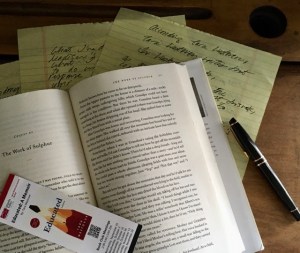
 Reading your textual analyses demonstrated that an exercise in integrating quotations would be a valuable follow-up assignment. In academic writing, sentences never begin with quotations. Instead, they’re introduced with signal phrases, such as these:
- According to Tara Westover,
- Tara Westover writes that
- In Westover’s words,
As an example for the comment you will post this week, I have turned back to the comment that Madison wrote last week. First, here is her comment as it appears word for word:
Deep down, past her internal struggle of accepting vulnerability, Westover realizes that she, too, has her own voice. This is revealed in her conflicting journal entries where she writes about a violent event involving Shawn assaulting her and her uncertainty about what to think about it. She bounces back and forth between reasoning that the attack was her fault and Shawn being in the wrong. Her doubt is disclosed as a turning point in the perceiving of her thoughts compared to her family’s.
Here’s my revised version, which introduces three lines from the end of the chapter:
Deep down, past her internal struggle of accepting vulnerability, Westover realizes that she, too, has her own voice. This is revealed in her conflicting journal entries where she writes about a violent event involving Shawn assaulting her and her uncertainty about what to think about it. She bounces back and forth between reasoning that the attack was her fault and Shawn being in the wrong. Readers witness her predicament as she reflects on her journal entries. In Westover’s words, “[t]he second entry would not obscure the words of the first. Both would remain, my memories set down alongside his. There was a boldness in not editing for consistency” (197). The bold act of writing her own memory to counter Shawn’s serves as a turning point, a place where her perceptions diverge from her family’s.
What I’ve done with Madison’s comment is what I’m asking you to do with your own response to a passage in our reading for this week.
Directions
- Write a short response to a passage in Chapter 25, 26, 27, or 28 of Educated.
- Include in your response a short quotation with a signal phrase and a parenthetical citation.
- If you name Westover in the signal phrase, include only the page number (216).
- If you do not name Westover in the signal phrase, include her last name (Westover 216). Note that there’s no comma or page abbreviation.
- Post your comment/reply no later than 5 p.m. on Wednesday, April 8.
For more information on signal phrases, see The Norton Field Guide to Writing and (551-57) and OWL‘s Signal and Lead-in Phrases page.
Remember to check your CVCC email and Blackboard regularly for updates and assignments.
Works Cited
Seagle, Madison. Comment on “ENG 011/111: Educated, Chapter 22.” Jane Lucas, 31 Mar. 2020, 11:36 a.m., https://janelucas.com/2020/03/30/eng-011-101-educated-chapter-22/#comments. Accessed 6 Apr. 2020.
Westover, Tara. Educated. Random House, 2018.
 Welcome to our first drama workshop and our first WordPress gathering. Although I wouldn’t have chosen for us to work exclusively online as a community of writers, I value the opportunity that it will afford us, in May, to look back and weigh the merits of the two versions of our class: the before and the after–or, more accurately, the before and during (COVID-19 time).
 The points I have included below are not ones that you’re required to address in your comments. I offer them as suggestions only. I will probably address some of them in the follow-up remarks that I’ll post at the beginning of our second session.
 Dear Readers,
 And the early-bird bonus points go to these CVCC Red Hawks: Grey Sacona, Caeley Arney, Madison St. Clair, Gabe Carswell, Chandler Danner, Lauren Setzer, Jenna Ramsey, Joshua West, Ruben Castillo, and Joe Van Story! Well Done!
 Chapter 22, “What We Whispered and What We Screamed,” marks a change in
 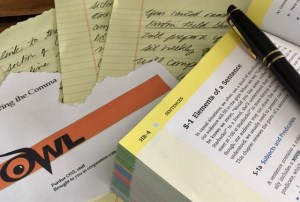 Your revised readings in The Norton Field Guide to Writing will prepare you for the six quizzes that you will complete during the remaining weeks of the semester. I selected the six subjects for the quizzes (words often confused, punctuation, precise words, active and passive voice, main points and support, and MLA documentation) based on patterns that I have identified in your essays. Most of the readings that will prepare you for the quizzes are in the yellow-edged Handbook section of Norton.
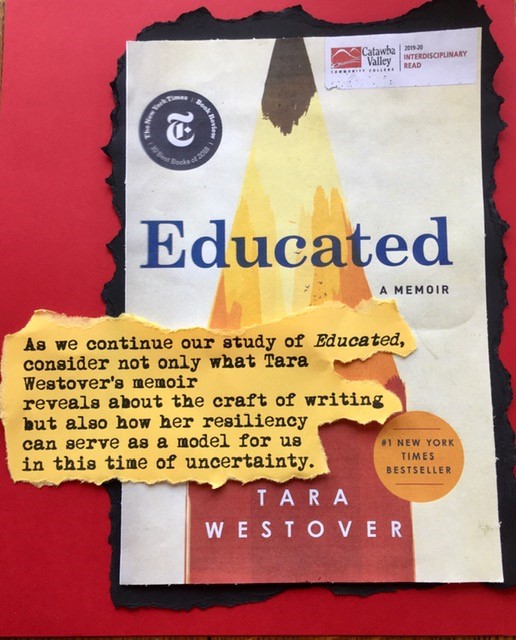 Wherever you are in your reading of Educated, I encourage you to look back at the pages where Tara Westover recounts her first days on campus at Brigham Young University (155-58). Stepping into the unfamiliar–as she was then and we are now–is always difficult.
 This post serves as both a welcome back note and a blog entry on the writer’s craft, the second one I’ve written with you. (I posted the first one on
  Another dovetail discovery occurred when my composition students were studying Chapter 11 of Tara Westover’s memoir, Educated. The latter half of that chapter, “Instinct,” depicts Westover’s brother Shawn reining in the frightened gelding, Bud, preventing him from throwing Tara.
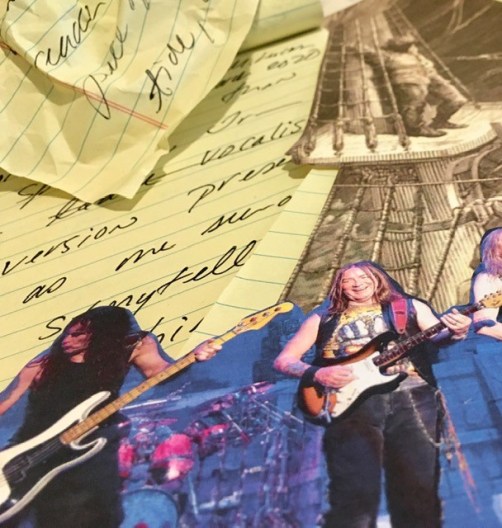 A sailor kills a bird of good omen, his destructive act dooms his shipmates and curses him with retelling the tale over and over: So the story of the Ancient Mariner goes. Yet those plot details convey neither the epic nature of Samuel Taylor Coleridge’s poem nor its influence on later writers. Only the poem itself places readers fully in the imaginative realm of the tale, but its late eighteenth-century diction creates a gulf between the poem and contemporary readers. Consequently, one of the challenges of introducing “The Rime of the Ancient Mariner” to millennial students is bridging that gulf. Iron Maiden’s adaptation offers one solution. By eliminating the shifts in the narrative voice and updating the story with contemporary language, their heavy-metal version draws listeners into the story with emphatic rhythms that capture the spirit of the original lines.
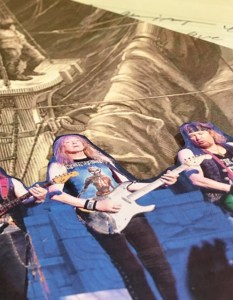 Iron Maiden’s adaptation eliminates those issues with updated diction and a consistent narrative voice. Rather than shifting speakers, Iron Maiden’s version presents the tale sung by a single storyteller, not the sailor himself, but a narrator who tells listeners to “[h]ear the rime of the ancient mariner” (1). Those first words of the song, penned by lead singer Bruce Dickinson, form an imperative sentence: a command with the understood subject “you”—“[You] hear the rime . . . ” (1). I am master and commander of this story, Dickinson seems to say, and you will hear it now. Such is the power of the imperative. Rather than leaving the reader questioning, as Coleridge’s first stanzas may, Iron Maiden’s song speaks directly to listeners, taking hold of them with the pull of a powerful tide, drawing them out to sea to witness the Mariner as he kills the albatross and seals his fate.
 Jane Lucas