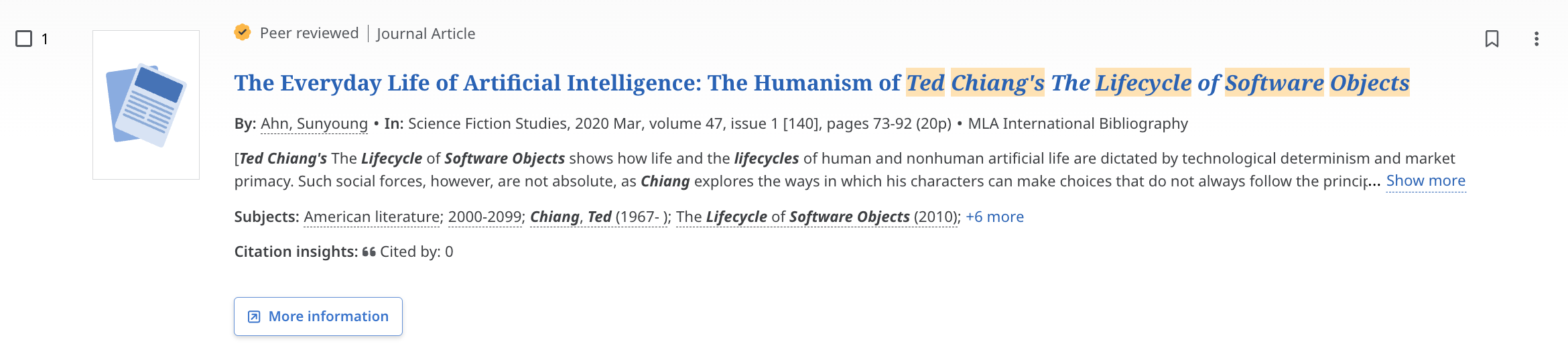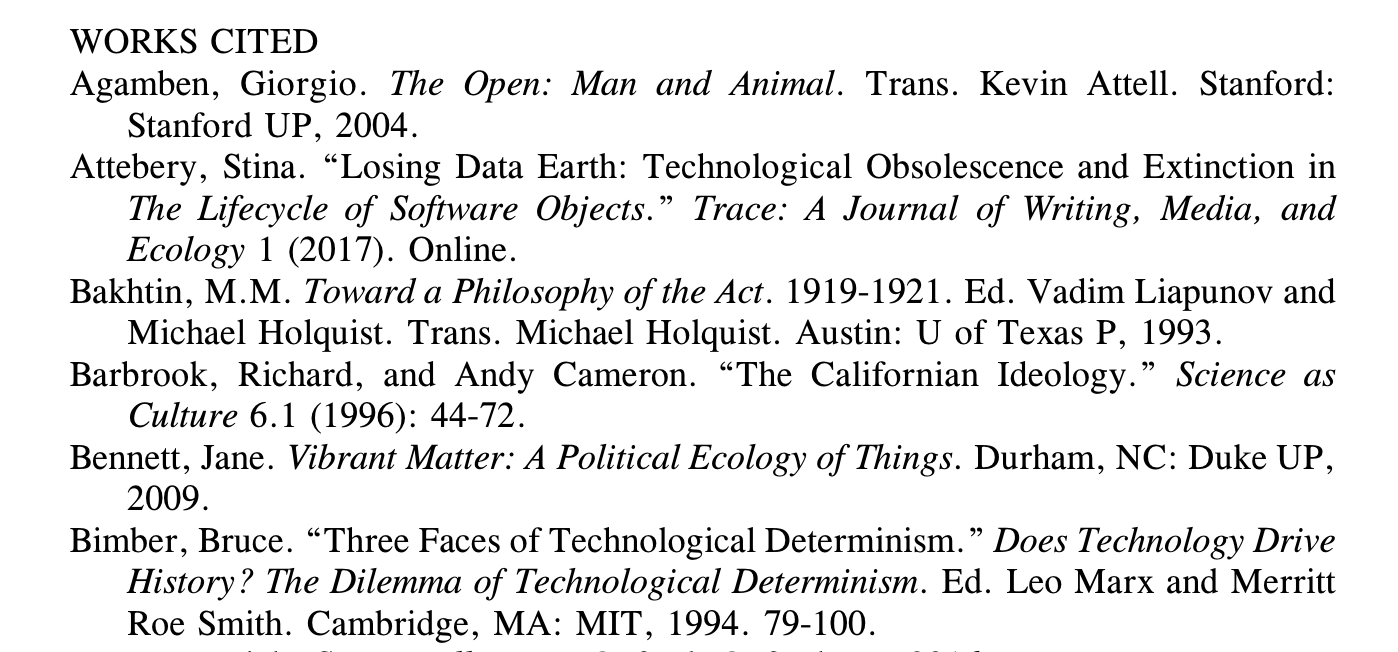
Last Thursday’s class notes detailed how perusing the works cited list for the peer-reviewed article “The Everyday Life of Artificial Intelligence: The Humanism of Ted Chiang’s The Lifecycle of Software Objects,” by Sunyoung Ahn, led me to three potential sources, one of which I have decided to include in my bibliography as a second peer-reviewed source. You are required to include only one peer-reviewed article or chapter from a university press book, but you are welcome to include more than one.
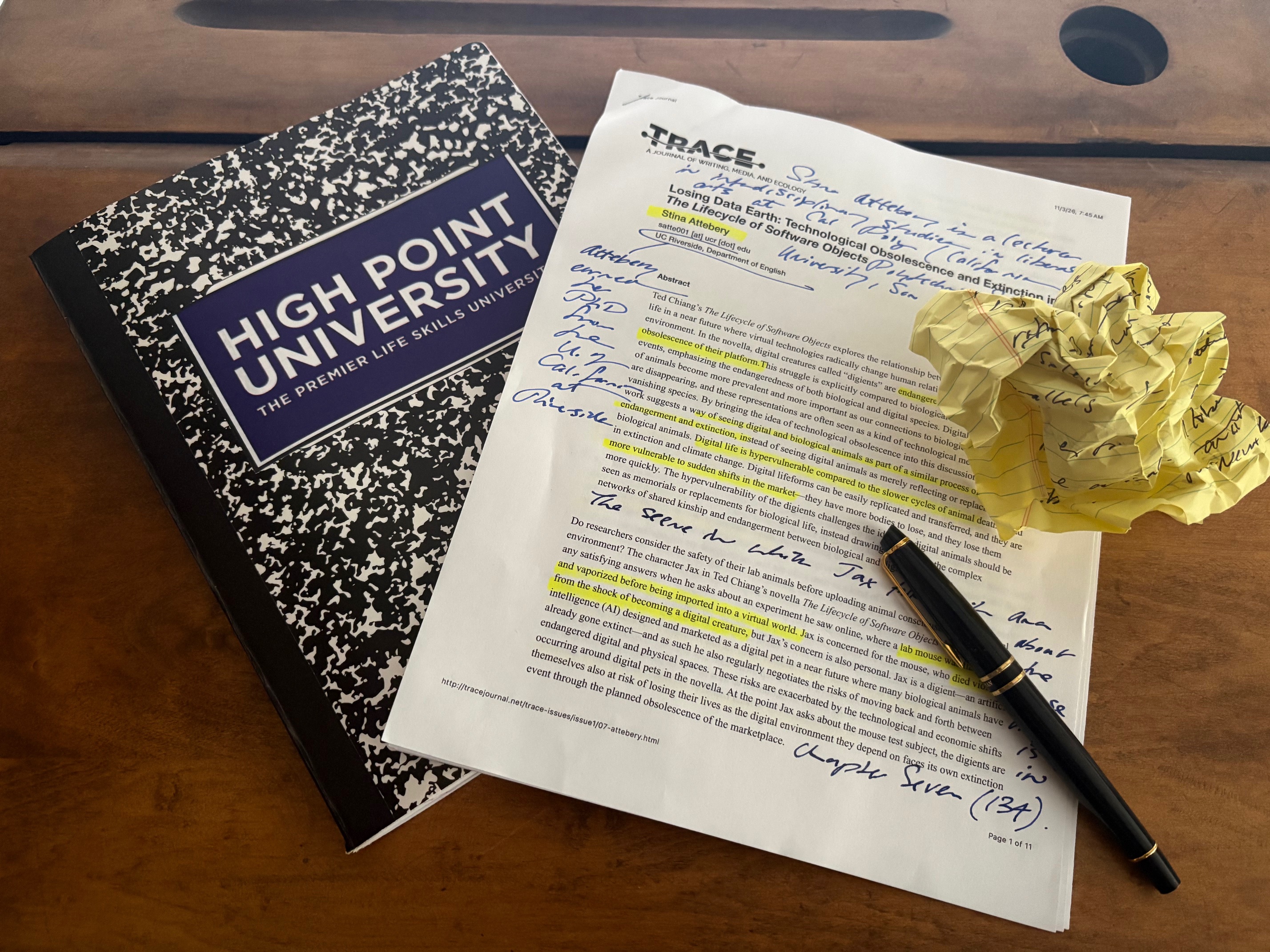
Today’s class notes include drafts of my annotated bibliography entries for my two peer-reviewed sources: “Losing Data Earth: Technological Obsolescence and Extinction in The Lifecycle of Software Objects,” by Stina Attebery, and Sunyoung Ahn’s article, which led me to Atteberry’s.
Sample Annotated Bibliography Entry–Peer-Reviewed Article
Ahn, Sunyoung. “The Everyday Life of Artificial Intelligence: The Humanism of Ted Chiang’s The Lifecycle of Software Objects.” Science Fiction Studies, vol. 47, no. 1, Mar. 2020, pp. 73–92. JSTOR, https://doi.org/10.5621/sciefictstud.47.1.0073.
Sunyoung Ahn cites French philosopher Henri Lefebvre’s The Critique of Everyday Life (1977), in which Lefebvre speculates “that in the not-too-distant future human cells will be created artificially (which is perfectly conceivable) and given consciousness” (qtd. in Ahn 73). From that premise, Lefebvre supposes that such artificial intelligence will experience the same struggles in everyday life that humans face. For Ahn, that philosophy of Lefebvre’s aligns with Ted Chiang’s depiction of his digients’ development and their relationships to the trainer Ana Alvarado and animator Derek Brooks, the humans who work with the digients at Blue Gamma and later become their caregivers. Ahn notes that such scenarios in science fiction are rare: Rather than turning to the trope of the cautionary dystopian tale, Chiang presents characters who “take responsibility for their own creation[s]” (88) and who, along with the digients, “stay useful and relevant by constantly modifying themselves” (87).
Ahn’s study delineates Chiang’s focus on the formative stage of artificial intelligence as a point of contrast to AI as it is widely imagined as “developed, perfected, and therefore culminant” (78). Ahn demonstrates the singular vision of The Lifecycle of Software Objects as a narrative in which “humans anthropomorphize the digients” (87) and the digients lead the humans to “think digitally” (87).
Sunyoung Ahn, an associate professor of English at Korea University in Seoul, is the author of “New Sincerity, New Worldliness: Post 9/11 Fiction of Don Delillo and David Foster Wallace.”
Source Details–What to Include
Note that the entry below for Stina Attebery’s article includes the web address, or URL, but the name of a database does not precede it. That’s because the journal Trace is available as an open source on the web, which is the exception rather than the rule for scholarly sources. In my entry for Sunyoung Ahn’s article, included above, JSTOR precedes the web address, or URL, because, Ahn’s article is included in the MLA International Bibliography, which is available through JSTOR on the HPU Libraries site.
Additional Sample Annotated Bibliography Entry–Peer-Reviewed Article
Attebery, Stina. “Losing Data Earth: Technological Obsolescence and Extinction in The Lifecycle of Software Objects.” Trace: A Journal of Media, Writing, and Ecology, 17 April 2017, http://tracejournal.net/trace-issues/issue1/07-attebery.html.
Stina Attebery examines Ted Chiang’s The Lifecycle of Software Objects as a narrative in which digital entities do not substitute for their dwindling counterparts in the wild but instead experience obsolescence that parallels the endangerment and extinction of biological animals. Attebery suggests that the Neuroblast digient Jax’s anxiety regarding his vanishing platform, Data Earth, indicates that digital life may be “hypervulnerable compared to the slow cycles of animal death found in extinction and climate change” (par. 4).
Attebery’s study elucidates how life forms whose genomes are written in code—both the digients in Chiang’s novella and real-world digital entities—are surprisingly similar to biological animals in terms of their risk for endangerment. In Attebery’s words, “[d]igital life forms can be easily replicated and transformed and are more vulnerable to shifts in the market” (par. 4). As Attebery explains, since Chiang’s Neuroblast digients’ Data Earth virtual environment is a casualty of corporate takeover, and they cannot run on the newer platform Real Space, they are deemed irrelevant, but those technological changes alone do not lead to their change in fortunes. Because they lack the task-oriented focus of the newer Sophonce digients, they are perceived as unmarketable and valueless.
Stina Attebery is a lecturer in interdisciplinary studies in liberal arts at Cal Poly (California Polytechnic State University, San Luis Obispo). She is the author of “Coshaping Digital and Biological Animals: Companion Species Encounters and Biopower in the Videogames Pikmin and Pokémon.” She also serves as managing editor for the Eaton Journal of Archival Research in Science Fiction.
Page Numbers Versus Paragraph Numbers
The entry for Ahn’s article includes page numbers in parenthetical citations because JSTOR files are photographic images of physical pages of journals. Attebery’s entry includes paragraph numbers because Trace is an unpaginated online journal. Whether your parenthetical citations contain page numbers or paragraph numbers will depend on whether the article is paginated. Note that the page numbers that you see on a print-out of an online article, such as Page 1 of 11 in the lower right, is not the journal pagination but the printer’s numbering. In parenthetical citations, do not list those numbers as page numbers. List the paragraph numbers instead.
Next Up
On Wednesday, we will examine Chapter Eight of Ted Chiang’s The Lifecycle of Software Objects, and you will have additional time to devote to your research and writing.