In the previous weeks, I published blog posts featuring the playable two-letter words that begin with a, b, c, d, e, f, g, h, i, j, k, and l. Today’s post features the playable two-letter words beginning with m, n, o, and p. Learning these two-letter words, as well as the other two-letter words in the alphabet, will enable you to see more options for play and increase the number of points you earn in a single turn.
M, by the way, is the most versatile consonant. In the first position, m pairs with every vowel: ma, me, mi, mo, mu, and also my. In the second position, m pairs with every vowel except i: am, em, om, um.
ma: a mother
me: a singular objective pronoun
mi: a tone of the diatonic scale
mm: an expression of assent
mo: a moment
mu: a Greek letter
my: a first-person possessive adjective
na: no, not
ne: born with the name of
no: a negative answer
nu: a Greek letter
od: a hypothetical force
oe: a whirlwind off the Faero Islands
of: originating from
oh: an exclamation of surprise
oi: an expression of dismay (also oy)
om: a sound used as a mantra
on: the batsman’s side in cricket
op: a style of abstract art dealing with optics
or: the heraldic color gold
os: a bone
ow: used to express pain
ox: a clumsy person
oy: an expression of dismay (also oi)
pa: a father
pe: a Hebrew letter
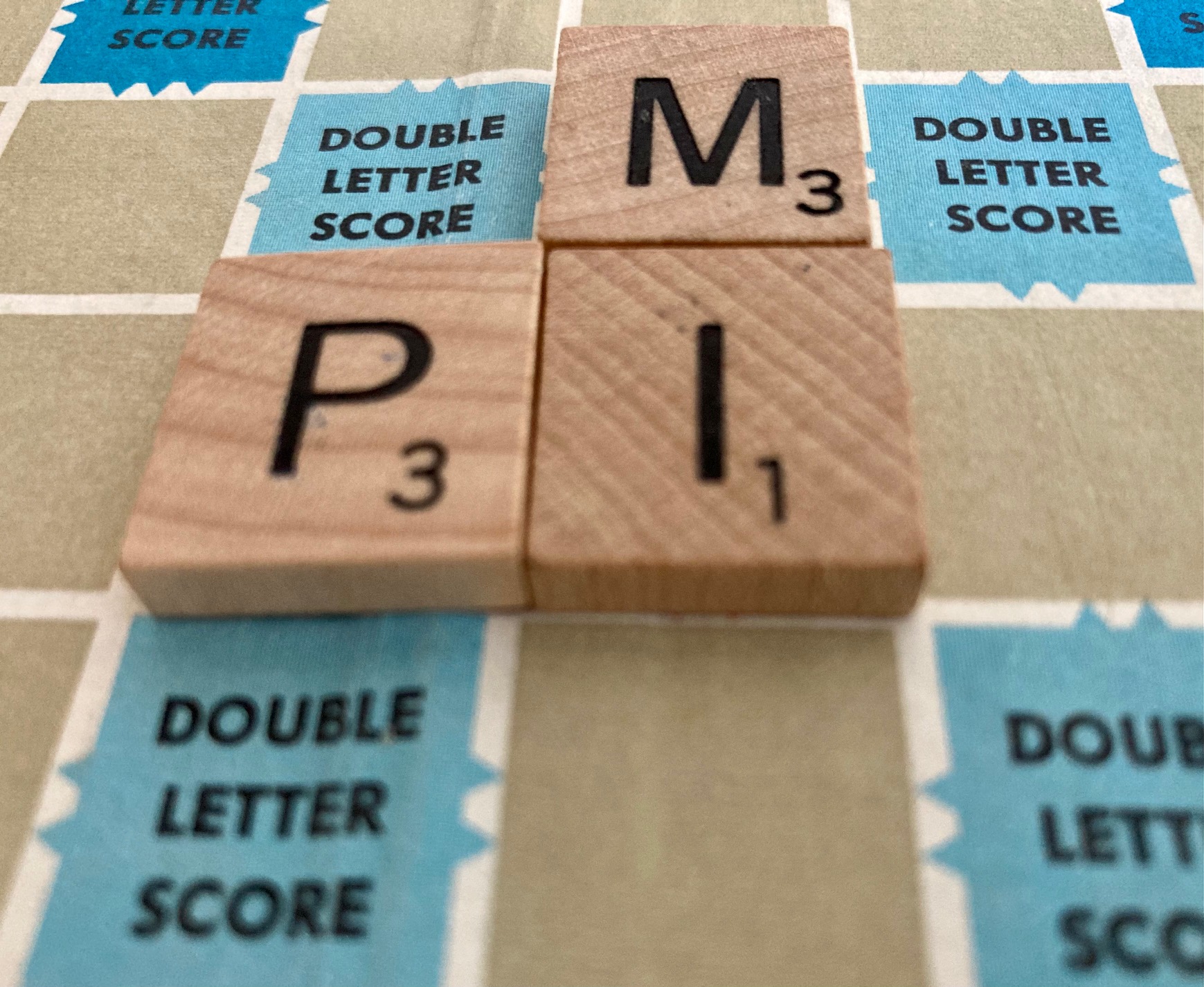
pi: a Greek letter
Next Up
Wordplay Day! To prepare for class, revisit the Dictionary and World Builder pages on the Scrabble website. Also review the posts on my blog devoted to Scrabble tips, including this one.
This morning, after I collect yourfinal Check, Please! worksheets, I will return your drafts, and you will have the remainder of the class period to begin revising your analyses on your laptops. You will have an additional week to continue your revision work before you submit the assignment to Blackboard and publish it as a WordPress blog entry. The due date is next Wednesday, October 4 (before class). The hard deadline is 10:30 a.m. on Friday, October 6. Directions for submitting your analyses are included on your assignment sheet and on the Blackboard submission site.
Parenthetical Citations
In your analysis, you will include parenthetical citations for quotations and paraphrases. Since you are writing a textual analysis, I recommend quoting rather than paraphrasing because the writer’s particular word choices are vital to the text’s overall effect. If your subject is one of the unpaginated texts (“Me Talk Pretty One Day,” “The Day Language Came into My Life,” or “The Falling Man”), your parenthetical citations will include the abbreviation par. for paragraph, followed by the paragraph number. If your subject is one of the paginated texts (“Back Story” or “The School”), your parenthetical citations will include the page number by itself. Including the author’s last name as well would be redundant because you have established in your introduction that your essay focuses solely on a work by him or her.
Here are some examples of how to use parenthetical citations in your analysis:
The nonsense words “meimslsxp” and “lgpdmurct” underscore his utter lack of comprehension in French class (par. 2).
The line “‘like Aaron’s rod, with flowers'” is a biblical allusion to Numbers 17.8 (par. 9).
He notes that in contrast to the Falling Man, the others who jumped appeared “confused, as though trying to swim down the side of a mountain” (par. 1).
He employs the “One Mississippi . . . Two Mississippi . . .” count to mark the seconds leading up to Joe Theismann’s career-ending injury (15).
With the words, “is death that which gives meaning to life?,” the story shifts from realism to surrealism (10).
Work Cited Entry
At the end of your analysis, you will include an MLA-style work cited entry. Refer to the models below.
Barthelme, Donald. “The School.” The Best American Short Stories 1975, edited by Martha Foley, Houghton Mifflin, 1975. pp. 8-11.
Lewis, Michael. Chapter One: “Back Story.” The Blind Side. 2006. Norton, 2009, pp. 15-23.
Sedaris, David. “Me Talk Pretty One Day.” Me Talk Pretty One Day. Little Brown, 2000. pp. 166-73.
As you continue to revise your analysis, consider visiting the Writing Center. If you do so, you will earn five bonus points for the assignment.
To schedule an appointment, visit https://highpoint.mywconline.com, email the Writing Center’s director, Professor Justin Cook, at jcook3@highpoint.edu, or scan the QR code below. To earn bonus points for your analysis, consult with a Writing Center tutor no later than Thursday, October 5.
I recommend taking a copy of the text that serves as the subject of your analysis (“Me Talk Pretty One Day,” “The Day Language Came into My Life,” “The Falling Man,” “Back Story,” or “The School”) to your Writing Center appointment.
Next Up
Wordplay Day! To prepare for class, revisit the Dictionary and World Builder pages on the Scrabble website, and review the posts on my blog devoted to Scrabble tips.
“The School,” originally published in The New Yorker magazine, was one of twenty-one stories chosen for the annual Best American Short Stories anthology in 1975.
This morning in class we will examine Donald Barthelme’s short story “The School,” and in groups of three or four you will address in writing some of the elements of the story that you might explore in an analysis. As I mentioned last week, if you find the prospect of analyzing “The School” more appealing than analyzing one of the texts we studied previously (“Me Talk Pretty One Day,” “The Day Language Came into My Life,” the opening of “The Falling Man,” “Back Story”), you are welcome to change the subject of your analysis to “The School.”
The elements of Barthelme’s story that you will consider this morning are these:
the narrator and the narrative voice
conflict
narrative shift (Where does “The School” make an unexpected turn?)
Whether you analyze Bartheleme’s story or one of our earlier readings, you will begin your first paragraph with a summary of the text. Remember that a summary is an objective synopsis of a text’s key points. It should be written in third person and present tense. For example, if you choose to analyze “The School,” you might summarize it this way:
Donald Barthelme’s short story “The School” recounts a series of classroom lessons that end with the deaths of plants and animals–deaths that serve as a prelude to the unexplained death of a Korean orphan, followed by the senseless deaths of classmates and family members.
Notice that the summary above does not comment on the story in any way. What follows the summary will be the beginning of your commentary, or analysis, the thesis statement that offers your particular close reading, or interpretation, of the story. The passage below is the same as the one above, but at the end of it I have added a thesis statement in bold.
Donald Barthelme’s short story “The School” recounts a series of classroom lessons that end with the death of plants and animals–deaths that serve as a prelude to the death of a Korean orphan, followed by the deaths of classmates and family members. With conversational narration, accumulation of detail, and a shift in fictional mode, Barthelme deftly depicts the reality of the fleeting nature of life, even as the story itself veers from reality.
If were to continue to write the analysis that I began in the previous paragraph, I would follow that opening paragraph with body paragraphs that address each of the three story elements that I include in my thesis: (1) “conversational narration,” (2) “accumulation of detail,” and (3) shift in fictional mode.
Next Up
In class on Wednesday, after I collect your fifth Check, Please! assignments, I will return your handwritten analysis plans and drafts (with my notes), and you will have the remainder of the class period to devote to revising on your laptops and tablets. You will have an additional week to continue revising. Your revision is due on Blackboard and on your WordPress blog the morning of Wednesday, October 4. The hard deadline in Friday, October 6.
In the previous weeks, I published one blog post featuring playable two-letter words that begin with a and a second blog post featuring playable two-letter words that start with b, c, d, and e. Today’ s blog post features playable two-letter words beginning with f, g, h, i, j, k, and l. Learning these two-letter words, as well as the other two-letter words in the alphabet, will enable you to see more options for play and increase the number of points you earn in a single turn.
fa: a tone on the diatonic scale
fe: a Hebrew letter
gi: a white garment worn in martial arts
go: a Japanese board game
ha: used to express surprise
he: a pronoun signifying a male
hi: an expression of greeting
hm: used to express consideration
ho: used to express surprise
id: the least censored part of the three-part psyche
if: a possibility
in: to harvest (a verb, takes -s, -ed, -ing)
is: the third-person singular present form of “to be”
it: a neuter pronoun
jo: a sweetheart
ka: the spiritual self in ancient Egyptian spirituality
ki: the vital life force in Chinese spirituality (also qi)
la: a tone of the diatonic scale
li: a Chinese unit of distance
lo: an expression of surprise
Competitive Scrabble
Last week some students asked whether Scrabble is played competitively. It is, and the culture of competitive Scrabble is documented in detail in journalist Stephan Fatsis’ Word Freak (2001). In his author’s note, Fatis outlines what distinguishes casual play from competitive Scrabble:
“A twenty-three-page game book governs everything from how to select tiles properly (the bag containing them must be held at eye level or higher) to what to do if a player needs to to go to the bathroom during a game (a situation that just happens to fall under Rule II P).”
Competitive Scrabble is a also the subject of a documentary film, Word Wars (2004).
Next Up
Wordplay Day! To prepare for class, revisit the Dictionary and World Builder pages on the Scrabble website. Also review the posts on my blog devoted to Scrabble tips, including this one.
This morning, after I collect your fourth Check, Please! assignment, you will begin your analysis of one of the texts we have studied in class, which include these:
The first paragraphs of “Back Story” by Michael Lewis
“The Day Language Came into My Life” by Helen Keller
The first paragraphs of “The Falling Man” by Tom Junod
“Me Talk Pretty One Day” by David Sedaris
On Monday we will read a short story, “The School” by Donald Barthelme, which will serve as an additional option for your analysis. If you begin an analysis of one of the texts listed above and decide you would rather write about “The School,” you are welcome to change your focus.
As a starting point for your analysis planning, this morning you will read the pages in Writing Analytically devoted to analysis. Among the key points to keep in mind as you write are these:
“One common denominator in all effective analytical writing is that it pays close attention to detail” (5).
“In order to understand a subject, we need to discover what it is ‘made of,’ the particulars that contribute most strongly to the character of the whole” (5).
“[A]sk not just ‘What is it made of?’ but also ‘How do these parts help me to understand the meaning of the subject as a whole?”’ (5).
“Analytical writing is more concerned with arriving at an understanding of a subject than it is with either self-expression or changing readers’ views” (5).
Next Wednesday, September 27, I will return your handwritten drafts with notes, and you will have the class period to begin revising on your laptops and tablets. You will have an additional week to continue to revise. Your revisions are due on Blackboard and on your blogs on Wednesday, October 4. The hard deadline is Friday, October 6.
Next Up
Wordplay Day! To prepare for class, revisit the Dictionary and World Builder pages on the Scrabble website, and review the posts on my blog devoted to Scrabble tips.
Now that you have revised your literacy narrative, consider submitting it for publication. Although posting a public blog entry is referred to as publishing, it does not have the prestige associated with publishing your work in a peer-reviewed journal.
High Point University no longer publishes its own student journal, but there are many national undergraduate magazines you can submit to, including the one listed on the CUR (Council on Undergraduate Research) website.
If you are interested in looking beyond publications specifically for undergrads, Poets and Writers magazine’s site features a page where you can search for publications by the genre’s they publish (creative nonfiction, fiction, poetry), subgenre (speculative fiction, young adult, etc.) and reading period (the time when the journal accepts submissions).
Next Up
In class on Wednesday you will begin planning and drafting your analysis, which will focus on one of the texts that we have studied in class, including David Sedaris‘s “Me Talk Pretty One,” Helen Keller‘s “The Day Language Came into My Life,” Tom Junod‘s “The Falling Man,” and Michael Lewis‘s “Back Story.” If you have misplaced your copy of any of those or were absent the day that I distributed copies, you can download a copy from Blackboard and print it. Next Monday we will examine an additional text that may serve as the subject of your analysis. If it appeals to your more than the text you write about on Wednesday, you are welcome to change your subject to that latest addition to the readings.
Today’s class will be devoted primarily to reading and responding to the blog post of one of your classmates’ literacy narratives. Elements to consider in your response include these:
the title
vivid details
dialogue, the use of scene and/or summary
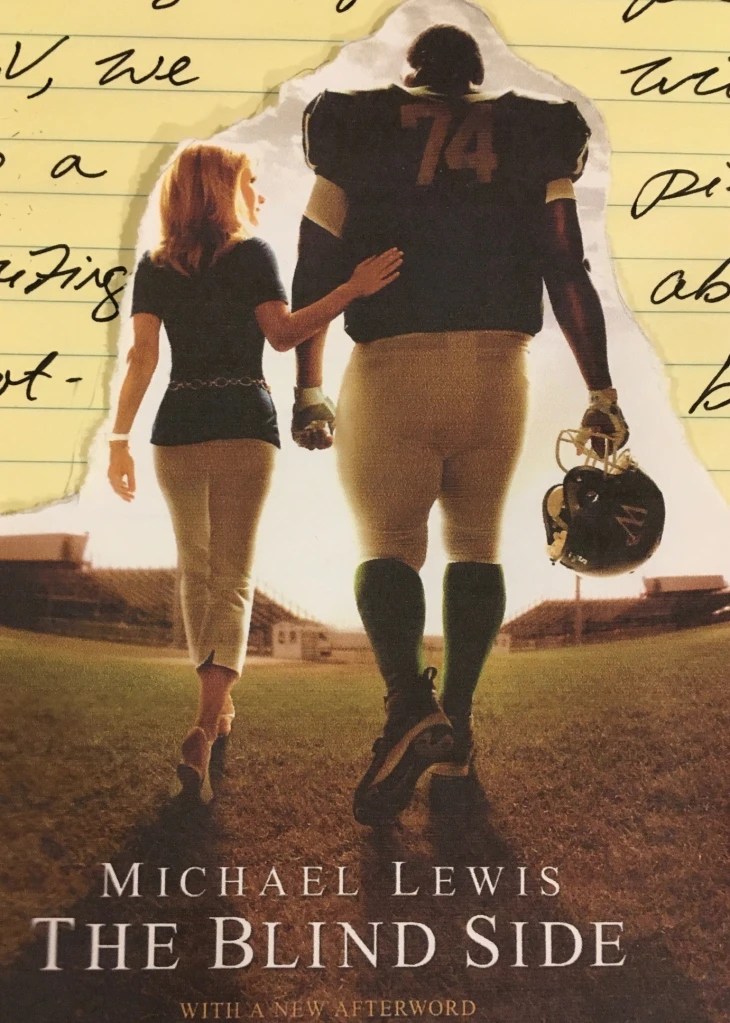
After you complete that assignment, you will begin reading the opening pages of “Back Story,” the first chapter of Michael Lewis’s The Blind Side, which dramatizes the moments in the November 1985 Redskins-Giants football game leading up to the injury that ended quarterback Joe Theismann’s career:
“From the snap of the ball to the snap of the first bone is closer to four seconds than to five. One Mississippi: The quarterback of the Washington Redskins, Joe Theismann, turns and hands the ball to running back John Riggins. He watches Riggins run two steps forward, turn, and flip the ball back to him. It’s what most people know as a “flea-flicker,” but the Redskins call it a “throw-back special.” Two Mississippi: Theismann searches for a receiver but instead sees Harry Carson coming straight at him. It’s a running down—the start of the second quarter, first and 10 at midfield, with the score tied 7–7—and the New York Giants’ linebacker has been so completely suckered by the fake that he’s deep in the Redskins’ backfield. Carson thinks he’s come to tackle Riggins but Riggins is long gone, so Carson just keeps running, toward Theismann. Three Mississippi: Carson now sees that Theismann has the ball. Theismann notices Carson coming straight at him, and so he has time to avoid him. He steps up and to the side and Carson flies right on by and out of the play. The play is now 3.5 seconds old. Until this moment it has been defined by what the quarterback can see. Now it–and he–is at the mercy of what he can’t see” (15).
What Theismann cannot see is Lawrence Taylor. A second later, as Taylor sacks Theismann, Taylor’s knee drives straight into Theismann’s lower right leg, leading to the “snap of the first bone” that Lewis mentions in the first sentence. He hooks the reader by linking the beginning of the play, “the snap of the ball” to the gruesome “snap of the first bone” that will follow. Lewis develops the paragraph using the common one-Mississippi, two-Mississippi method of marking seconds to present the events leading up to the compound fracture that ends Theisman’s career.
Lewis doesn’t dramatize the injury itself because his interest lies instead in the blind side that led to it and subsequently elevated the status and salary of the left tackle, the player who protects the quarterback’s blind side.
When you’re struggling to develop a piece of writing, reread the opening paragraph of The Blind Side. Study how Lewis dramatizes 3.5 seconds–yes, only 3.5 seconds–with 224 words.
Next Up
In class on Wednesday you will begin planning and drafting your analysis, which will focus on one of the texts that we have studied in class, including David Sedaris‘s “Me Talk Pretty One,” Helen Keller‘s “The Day Language Came into My Life,” Tom Junod‘s “The Falling Man,” and Michael Lewis‘s “Back Story.” If you have misplaced your copy of any of those or were absent the day that I distributed copies, you can download a copy from Blackboard and print it. Next Monday we will examine an additional text that may serve as the subject of your analysis. If it appeals to your more than the text you write about on Wednesday, you are welcome to change your subject to that latest addition to the readings.
This week’s Scrabble post addresses some recent questions of yours regarding abbreviations and acronoyms and whether they are playable.
When a shortened version of a word comes into common use, it will likely find its way into the Scrabble Dictionary. Keep in mind, however, that an abbreviation you use may not have found its way into the Scrabble dictionary yet, and acronyms, unlike abbreviations, are not playable. Unlike shortened words, acronyms are formed with the initial letters of separate words, for example: NASA for (for National Aeronautics and Space Administration) and IQ (for intelligence quotient.
Here’s a list–by no means a comprensive one–of playable abbreviations:
ab: an abdominal muscle
bi: a bisexual
cig: a cigarette
flu: influenza
hic: used to represent a hiccup
hippo: a hippopotamus
mono: mononucleosis
narc: an undercover drug agent
rec: recreation
ref: a referee
rhino: a rhinoceros
ump: an umpire
za: pizza
Next Up
Wordplay Day! To prepare for class, revisit the Dictionary and World Builder pages on the Scrabble website, and review the posts on my blog devoted to Scrabble tips, including this one.
This morning in class, after I collect your third Check, Please! assignments, you will compose a short essay in which you reflect on the processes of planning, drafting, and revising your literacy narrative. Questions to consider include the ones below. You don’t need to address all of the questions, focus on the ones whose answers reveal the most about your work.
What aspect of the writing seemed the most challenging? Determining the focus of your narrative? Developing the story? Crafting the conclusion? Why did that aspect of the writing seem the most challenging?
Did you change the subject of your narrative? If so, what was the original subject? What did you change it to? Why?
Did you change the organization of the narrative? For example: Did you initially present the story chronologically, then change it?
Did any of the sample essays we examined (“Me Talk Pretty One Day,” “The Day Language Came into My Life,” “A Bridge to Words”) prove helpful to you as a model? If so, how? (Offer one or more concrete details to support your claim.)
What do you consider the strongest element of your literacy narrative?
At what point in the process did you decide on a title? Did you change the title during the writing process? If so, what was the original title?
What image did you include that documents part of your writing process away from the screen? Why did you choose that particular image?
What relevant website did you link to your blog post. Why is that particular site relevant to your narrative?
In addition to metacognition, did any of the other habits of mind of successful college students play a significant role in your writing process? If so, which one? The other seven are curiosity, openness, engagement, creativity, persistence, responsibility, and flexibility.
Students who have their physical copies of Writing analytically have the option of integrating a quotaion from the textbook into their reflection. See the directions and the example below.
Directions
Read the section of Writing Analytically titled “Writing on Computers vs. Writing on Paper.”
Choose a short passage from the section that is relevant to your writing process and include it in your reflection.
Introduce the quotation with a signal phrase and end the sentence with a parenthetical citation. At the end of your reflection, include an MLA-style work cited entry. See the example below.
Example
The authors of Writing Analytically note that beginning a piece of writing on a computer can “lock you into a draft or a particular idea too soon” (Rosenwasser and Stephen 124). Early in the process of writing my literacy narrative, I found myself locked into an idea that I was able to discard only after I resumed writing longhand.
Work Cited
Rosenwasser, David and Jill Stephen. “Writing on Computers vs. Writing on Paper.” Writing Analytically, 8th edition. Wadsworth/Cengage, 2019. pp. 124-25.
Postscript
Here is my version of the Check, Please! lesson three assignment that you submitted at the beginning of class this morning:
Check, Please! Sample Assignment Lesson Three
In the third lesson of the Check, Please! Starter Course, Mike Caulfield, author of the course and research scientist at the University of Washington’s Center for an Informed Public, continues his instruction on the second step in four-step SIFT approach to determining the reliability of a source. Lesson three, “Further Investigation,” covers these topics: (1) Just add Wikipedia for names and organizations, (2) Google Scholar searches for verifying expertise, (3) Google News searches for information about organizations and individuals, (4) the nature of state media and how to identify it, and (5) the difference between bias and agenda.
One of the most instructive parts of lesson three focuses on two news stories about MH17, Malyasia Airlines Flight 17, a passenger flight scheduled to land in Kuala Lumpur that was shot down over eastern Ukraine on July 17, 2014. While the second story, a television news segment, appears to present detailed investigative reporting challenging the conclusion of the Dutch Safety Board and Dutch-led joint investigation team–the conclusion that Russia was to blame–a quick just-add-Wikipedia check reveals that RT (formerly Russia Today) is a Russian state-controlled international TV network, a government propaganda tool rather than a source of fair and balanced news. The first video, the one produced by Business Insider, a financial and business news site, delivers accurate coverage of MH17.
Another notable segment of “Further Investigation” addresses the important distinction between bias and agenda. There, Caulfield observes that “[p]ersonal bias has real impacts. But bias isn’t agenda, and it’s agenda that should be your primary concern for quick checks,” adding that “[b]ias is about how people see things; agenda is about what a news or research organization is set up to do.”
Wordplay Day! To prepare for class, revisit the Dictionary and World Builder pages on the Scrabble website, and review the posts on my blog devoted to Scrabble tips.
Yesterday in class, in addition to studying my sample literacy narrative “A Bridge to Words,” we examined the opening paragraphs of Tom Junod‘s essay “The Falling Man, published in Esquire magazine two years after 9-11. When you wrote in your journal about the first two paragraphs of Junod’s essay, I asked you to consider these questions:
The long first paragraph of Junod’s essay could be two or more paragraphs. If you were Junod, where might you have divided the paragraph? Why do think he chose not to divide it?
Where does Junod employ similes?
Though “The Falling Man” is not a literacy narrative, it is an excellent example of creative nonfiction. As you continue to revise your literacy narrative, what in Junod’s essay might prove useful to you as a model?
Junod might have started a second paragraph with the words “[i]n all the other pictures,” because there he shifts the focus from the Falling Man to the photographs of other people who jumped from the Twin Towers. An opportunity for a third paragraph comes with the words “[t]he man in the picture, by contrast” where Junod turns his attention back to the Falling Man. And he might have begun a fourth paragraph with “[s]ome people who look at the picture,” because there he shifts to viewers’ perceptions of the Falling Man.
The first paragraph is over four-hundred words long, longer than some of your literacy narratives will be. I advise you to avoid writing paragraphs of that length. Generally, one-hundred to one-hundred-and-fifty words is a suitable length. As a rule, you should begin a new paragraph whenyou present a new idea or point. If you have an extended idea that spans multiple paragraphs, each new point within that idea should have its own paragraph. But the first paragraph of “The Falling Man” is an exception. For Junod, choosing not to divide the first paragraph creates an unbroken movement that parallels the unbroken downward flight of his subject, the Falling Man. Outside of the photograph, “he drops and keeps dropping until he disappears.” With “disappears,” the last word of the paragraph,” the Falling Man disappears from the page, and Tom Junod turns to the photographer, whom we learn later in the essay is Richard Drew.
Junod’s use of figurative include these lines:
“he departs from this earth like an arrow”
“the towers . . .loom like colosssi”
“they look confused, as though trying to swim down the side of a mountain”
“as though he were a missile, a spear”
Unless you subscribe to Esquire, the magazine’s paywall will deny you access to the full text of “The Falling Man”; but if you’re interested in reading it in full, you can access it through the HPU Library site by following these steps:
Under the heading “Search HPU Libraries . . . ,” click on the “Articles” tab.
Under the “Articles” tab, type Tom Junod “Falling Man” Esquire in the search box and click “search.”
On the next screen, you will see a brief summary of the article. Click “Access Online” to view the full article.
Next Up
Wednesday in class you will compose a short essay that reflects on the process of planning, drafting, and revising your literacy narrative. In addition to revisiting your own final narrative and the writing that led up to it, you will address one or more of the essays that you examined as models.




 Jane Lucas