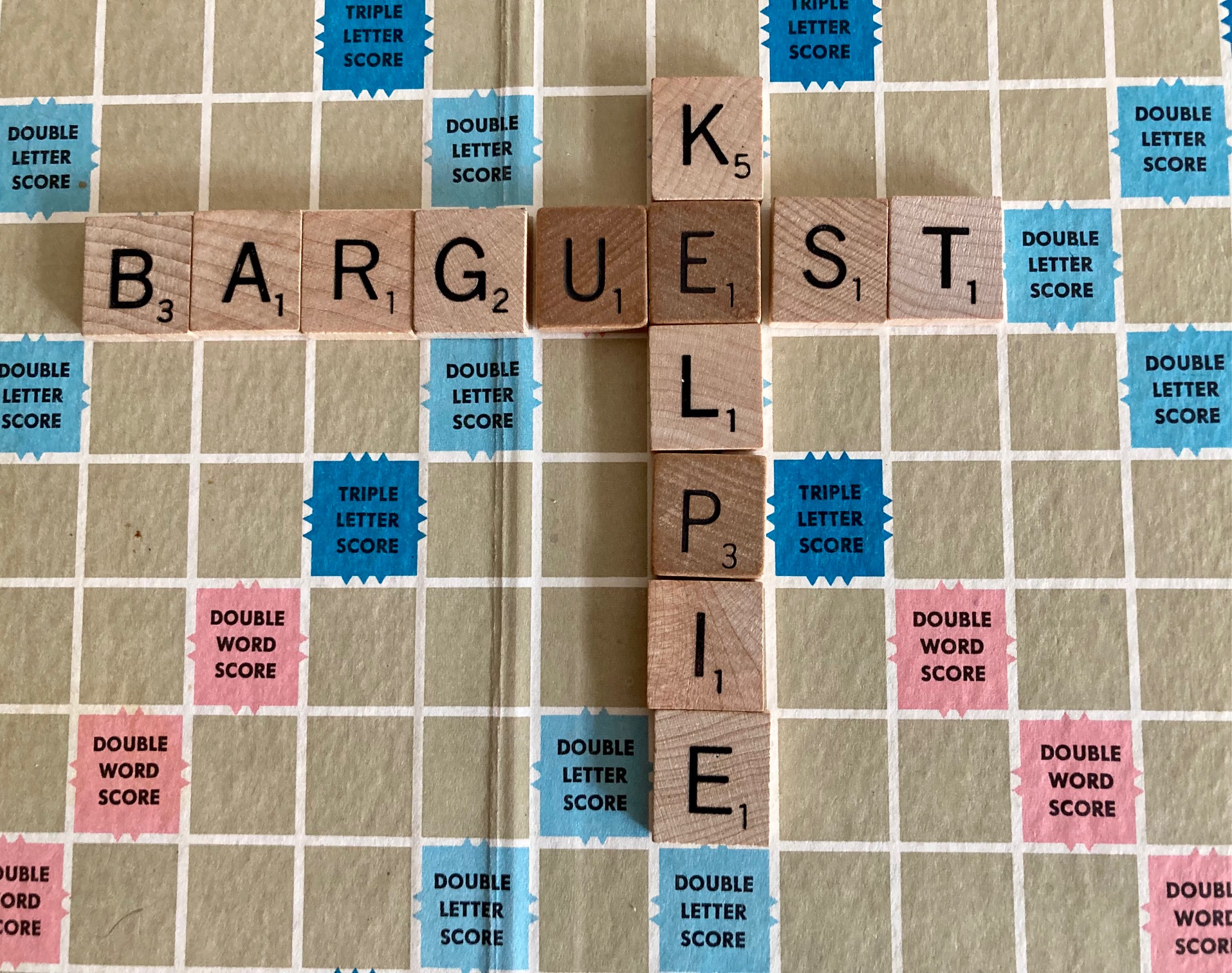
For Halloween, today’s Scrabble blog post is devoted to words for ghosts. Two of the words (banshee and eidolon) are seven letters long, enabling a player or team to Scrabble, or bingo, earning an additional fifty points for the play. Another two are eight letters long (barguest and fairyism) and can be formed by adding letters to a word played previously.
banshee: a female spirit in Gaelic folklore that wails to warn of a family member’s imminent death. Note that this word is featured in Stephen King’s short story “Strawberry Spring,” which we examined in class yesterday.
barguest: a goblin (also barghest)
bogy: a goblin
daimon: a spirit (also daemon and demon)
eidolon: a phantom or specter
fairyism: the quality of being like a fairy (not really a ghost but a great word)
haint: a ghost
kelpie: a water sprite in Scottish folklore known for drowning sailors
wraith: a ghost of a person, often appearing just before that person’s death
zombi: a zombie
Next Up
At the beginning of class on Wednesday we will briefly review “Strawberry Spring,” and you will have the remainder of the period to continue your work on your final essay and annotated bibliography.
Today in class we will read Stephen King‘s short story “Strawberry Spring,” which was published in Ubris magazine in 1968 and included in King’s first short story collection, Night Shift (1978).
For the collaborative exercise that you will complete after we read the story, I will ask you to determine whether you can identify any details that indicate why the narrator may have murdered any of his victims. Although there is no indication that the narrator knew Gale Cerman, Adelle Parkins, or Marsha Curran, but he did know Ann Bray.
I will also ask you to identify words and phrases that illustrate how the story is not only a horror story but also a commentary on war, the Vietnam War in particular, and the Vietnam era.
Lastly, I will ask you to try to identify the two literary allusions in King’s story. We will address these questions at the beginning of class on Wednesday, and I will post the answers on my blog.
Next Up
We will review “Strawberry Spring” at the beginning of Wednesday’s class, and you will have the remainder of the period to devote to research and writing for your final essay and annotated bibliography.
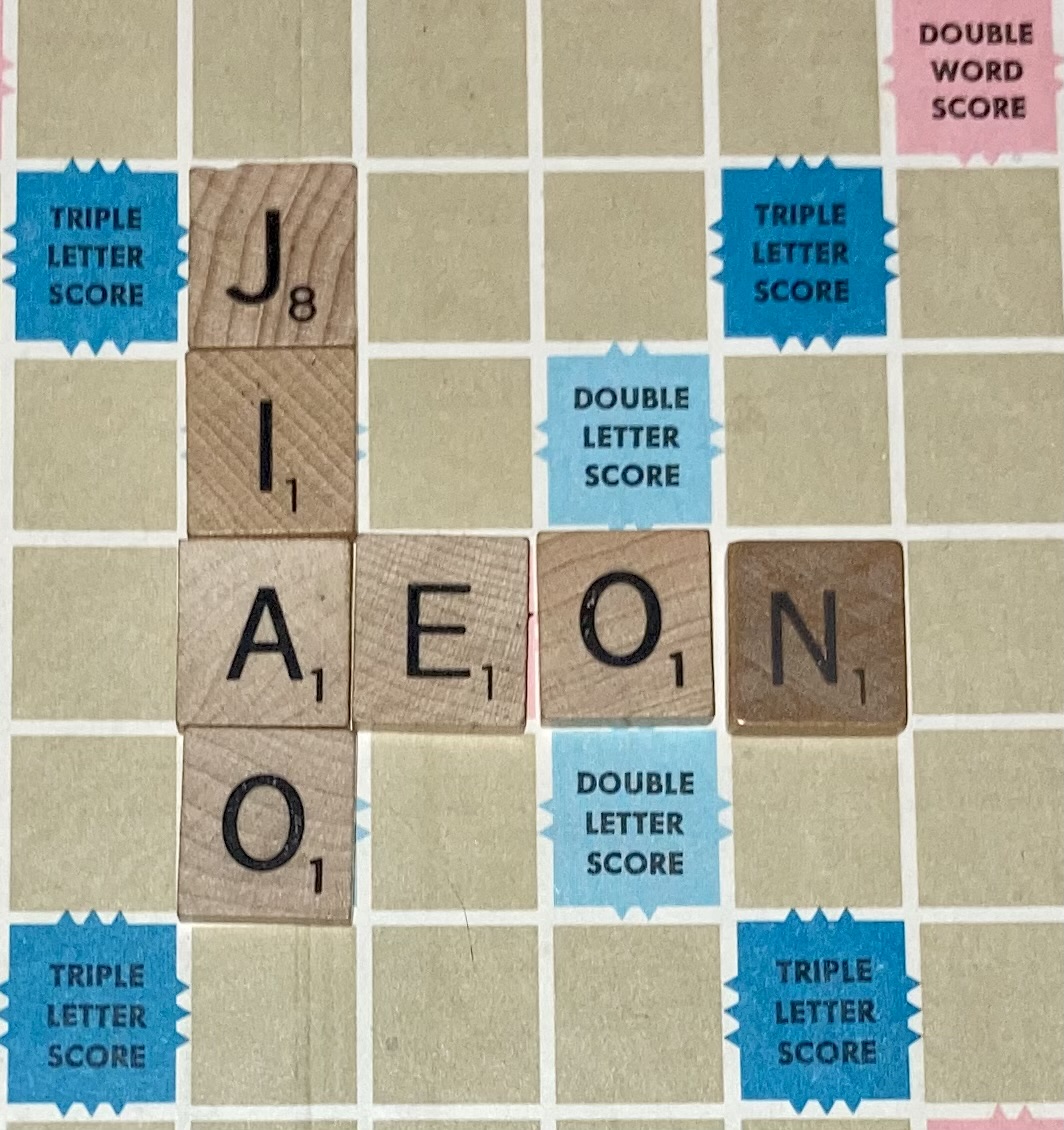
Knowing words with multiple vowels proves useful when you’re faced with a rack of mostly, or all, vowels. Here’s a list of the first twenty-two playable four-letter words with three vowels:
aeon: a long period of time (also eon)
agee: to one side (also ajee)
agio: a surcharge applied when exchanging currency
ague: a sickness associated with malaria
ajee: to one side (also agee)
akee: a tropical tree
alae: wings (pl. of ala)
alee: on the side shielded from wind
amia: a freshwater fish
amoa: a kind of small buffalo
awee: a little while
eaux: waters (pl. of eau)
eide: distinctive appearances of things (pl. of eidos)
emeu: an emu
etui: an ornamental case
euro: an Australian marsupial, also known as wallaroo, for being like the kangaroo and the wallaby; also a unified currency of much of Europe
ilea: the terminal portions of small intestines (pl. of ileum)
ilia: pelvic bones (pl. of ilium)
jiao: a Chinese currency (also chiao)
luau: a large Hawaiian feast
meou: to meow
moue: a pouting expression
Next Up
Wordplay Day! To prepare for class, revisit the Dictionary and World Builder pages on the Scrabble website. Also review the posts on my blog devoted to Scrabble tips, including this one.
As one of the preliminary steps in your research and writing process, you will conduct a short personal interview that will serve as one of the sources for your project. If you decide that you do not want to use the interview that you conduct today, you are welcome to include another one in your project. Keep in mind, however, that the interview you include in your project must be conducted with a student currently enrolled in section 20 or 21, and the subject of the interview must be the subject of your project.
Questions to Ask Your Interviewee Include the Following:
What experience, if any, did you have with the subject (the reading or the aspect of the course) before you encountered it in English 1103?
Has it changed your perspective on reading and/or writing? If so, how?
Will you continue to pursue the subject (read more work by the author, continue the classroom practice or activity) after the conclusion of the semester?
Introducing an Interview Quotation
After you conduct your interview, compose on the worksheet provided a sentence in which you introduce a quotation with a signal phrase, such as “According to First Name Last Name,” or “First Name Last Name notes or observes or points out that . . . .” Your quotation will not be followed by a parenthetical citation because it is a form of oral communication (without page or paragraph numbers).
Composing a Work Cited Entry for Your Interview
Follow your quotation with a work cited entry that follows this format:
Work Cited
Last Name, First Name. Interview. Conducted by First Name Last Name. Day Month Year.
Note that your work cited entry should include a hanging indent.
The complete final essay and annotated bibliography assignment is included below.
Final Essay and Annotated Bibliography Assignment
OVERVIEW
An annotated bibliography is a list of sources on a subject that includes a summary of each source. Some bibliographies include additional information, such as the authors’ credentials. That is the type of bibliography that you will compose along with your final essay for the course.
KEY FEATURES
An introductory essay of three or more paragraphs that (1) presents the subject of your bibliography, and (2) addresses your purpose for compiling it. In other words: What drives your research? What interests you about the subject, and what question/s do you seek to answer about your subject?
A complete MLA-style bibliographic entry for each source.
A one-paragraph summary of each source followed by a shorter second paragraph that presents the writer’s credentials and addresses the purpose that the source might serve in a larger project. Would it serve as a point of comparison or contrast to another source? Would it support or challenge an idea presented in another source? Is it a secondary source that sheds light on the meaning of a primary source? The last question pertains primarily to bibliographies that focus on one of the writers studied in the course.
PRELIMINARY WORK—What to Complete in Class Today
Personal Interview
Your final essay and annotated bibliography will focus on one of the authors we have studied or one of elements of the course, including (1) blogging in the classroom, (2) limiting screen time, (3) writing longhand, and (4) playing Scrabble. As a starting point, you will conduct a short personal interview that will serve as one of the sources for your project. If you decide that you do not want to use the interview that you conduct today, you are welcome to include another one in your project. Keep in mind, however, that the interview you include in your project must be conducted with a student currently enrolled in section 20 or 21, and the subject of the interview must be the subject of your project.
Questions to ask your interviewee include the following:
What experience, if any, did you have with the subject (the reading or the aspect of the course) before you encountered it in English 1103?
Has it changed your perspective on reading and/or writing? If so, how?
Will you continue to pursue the subject (read more work by the author, continue the classroom practice or activity) after the conclusion of the semester?
After you conduct your interview, compose on the worksheet provided a sentence in which you introduce a quotation with a signal phrase, such as “According to First Name Last Name,” or “First Name Last Name notes or observes or points out that . . . .” Your quotation will not be followed by a parenthetical citation because it is a form of oral communication (without page or paragraph numbers).
Follow your quotation with a work cited entry in this format:
Work Cited*
Last Name, First Name. Interview. Conducted by First Name Last Name. Day Month Year.
*Note that you will use the header annotated bibliography, not works cited, in your final essay and annotated bibliography.
Annotated Bibliographic Entry
After you complete your personal interview, compose an annotated bibliographic entry for the text that serves as the starting point for your project. (See the list below.) Your annotated bibliographic entry consists of three parts: (1) the MLA-style work cited entry, as shown below, (2) a one-paragraph summary, and (3) a paragraph of commentary—see the third bullet point under the heading KEY FEATURES.
Rosenwasser, David and Jill Stephen. “Writing on Computers vs. Writing on Paper.” Writing Analytically, 8th edition. Wadsworth/Cengage, 2019. pp. 124-25.
Sedaris, David. “Me Talk Pretty One Day.” Me Talk Pretty One Day. Little, Brown, 2000. 166-73.
Begin by conducting a short personal interview and an annotated bibliographic entry for the appropriate source listed above, or on page two (the one that focuses on your subject), and complete the worksheet provided. For more information. See the paragraphs under the header PRELIMINARY WORK—What to Complete in Class Today.
Use the HPU Libraries site, https://www.highpoint.edu/library/, and Google Scholar to locate a minimum of three additional reliable and relevant print sources (articles, essays, and/or books) devoted to the same subject. Compose your summaries and commentaries in complete sentences, introduce any quotations with signal phrases, and include parenthetical citations where needed. Your bibliography must include five sources, four of which must be print. (Your personal interview is a nonprint source.) If you wish to include an additional non-print source, such as a video, you may include that as a sixth source.
After you have composed your annotated bibliographic entries, write an introductory essay that (1) presents the subject of your bibliography, and (2) addresses your purpose for compiling it. In other words: What drives your research? What question do you seek to answer about your subject? Also, (3) What larger project might develop from your bibliography? Would it be a project for a course in psychology, science, education, or another discipline? Address all five of your sources in your essay, and quote at least two of them.
Note: Though your introductory essay will precede your annotated bibliography, you will compose it last because you will need to re-read and summarize your sources before you will know how to address them in your essay.
DIRECTIONS FOR RESEARCHING, DRAFTING, REVISING, AND SUBMITTING
Devote today’s class primarily to conducting a personal interview and composing an annotated bibliographic entry for the text that serves as a starting point for your research. You will have two additional Wednesdays to work in class on your final essay and annotated bibliography before you post your revision to Blackboard and to your WordPress blog.
Before class on the due date: Post a copy of your revision to Blackboard and to your blog. In your blog post, omit the first-page information included in your file submitted to Blackboard (your name, professor’s name, course and section, and date). Add to your blog post an image that documents some part of your writing process away from the screen, such as the summary of your source in your journal, today’s worksheet, or a page of your draft. Also add an embedded link to a relevant web site. Even though your work for this assignment will take place primarily in front of the screen, your writing process still involves putting pen to paper, and photographic documentation of that on your blog is a requirement of the assignment.
Next Up
Wordplay Day! To prepare for class, revisit the Dictionary and World Builder pages on the Scrabble website. Also review the posts on my blog devoted to Scrabble tips
After your group presentations this morning, if time permits, you will compose a short reflection. Elements to address in your reflection include the following:
the introduction of your group members and opening remarks
the brief discussion of one or more points in the Check, Please! lesson
the close examination of one segment
the conclusion
optional element: observations about the relevance of the lesson to your other work in English 1103 and/or your other courses
poise, eye contact, and avoidance of filler words
Once you have completed your paragraph, or paragraphs, devoted to your own group’s presentation, you will compose an additional paragraph that addresses a presentation by one of the other groups. Choose the one that stands out the most to you. What element or elements of that presentation made it particularly effective (or not) and why?
If time does not permit the completion of your reflection in class today, you will submit the assignment at the beginning of class on Wednesday, October 25.
Next Up
Wednesday’s class will be devoted to preliminary work for your final essay and annotated bibliography. You will receive a handout with the assignment instructions at the beginning of class.
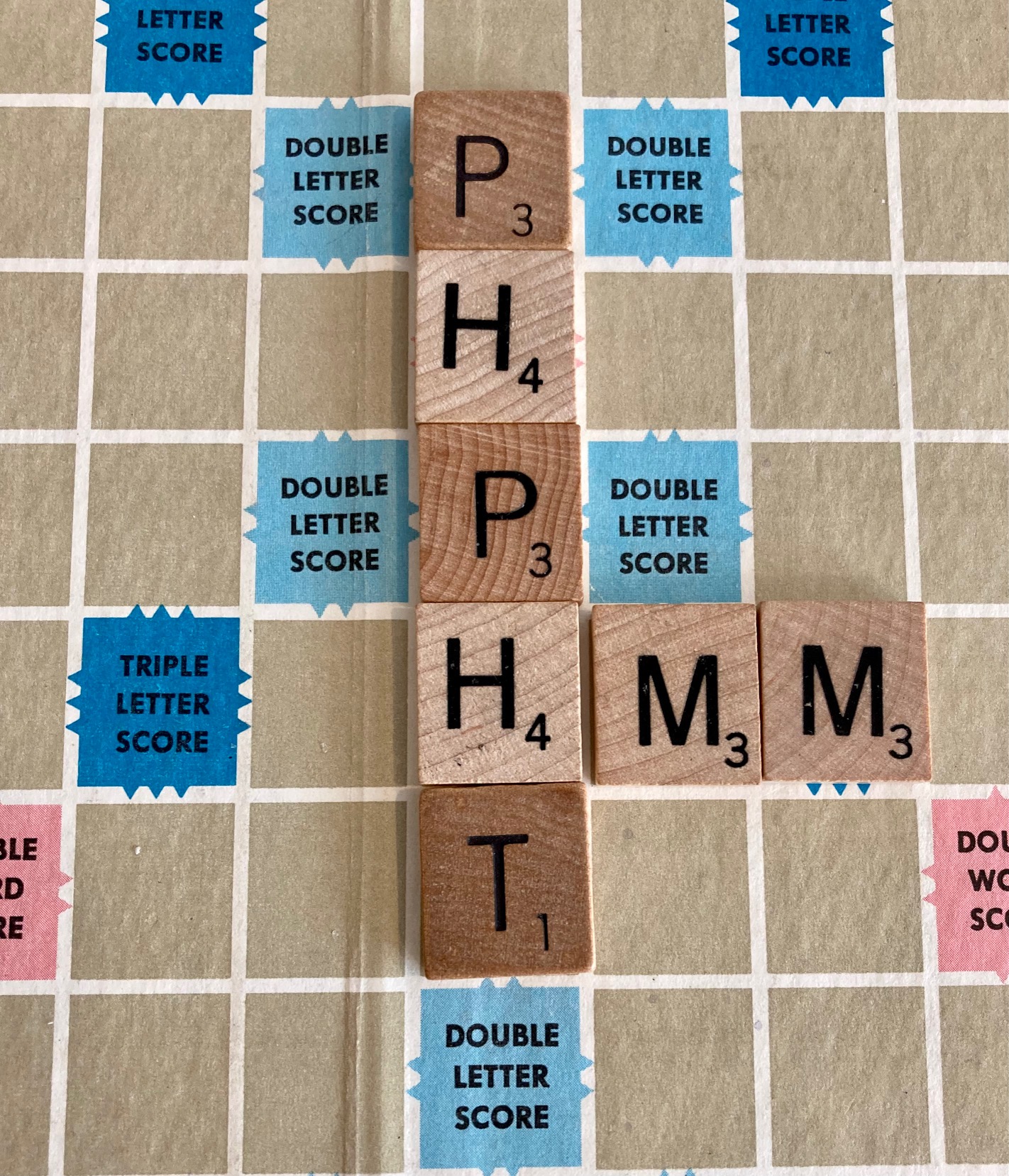
On a recent WordPlay day, a student remarked that he was unfamiliar with the word nth, which is used to describe an unspecified number. Learning nth and other all-consonant words that follow will enable you to continue the game when you’re faced with a rack without vowels.
brr: used to indicate that one is cold
crwth: an ancient stringed instrument (pl. -s)
cwm: a cirque (a deep, steepwalled basin on a mountain, pl. -s, prounounced to rhyme with “boom”)
hm: used to express thoughtful consideration (also “hmm“)
mm: used to express assent or satisfaction
nth: describing an unspecified number in a series
phpht: used as an expression of mild anger or annoyance (also “pht“)
psst: used to attract someone’s attention
sh: used to urge silence (also “shh” and “sha“)
tsk: to utter an exclamation of annoyance (-ed, -ing, -s)
tsktsk: to “tsk” (-ed, -ing, -s)
Next Up
Wordplay Day! To prepare for class, revisit the Dictionary and World Builder pages on the Scrabble website. Also review the posts on my blog devoted to Scrabble tips, including this one.
Today’s class will be devoted to planning and preparing for your group presentation:
As an exercise in reviewing one of the lessons in the Check, Please! course and as an exercise in collaboration and oral communication, you and two or three of your classmates will deliver a concise and engaging presentation that addresses the most significant points covered in one of the five lessons in the Check, Please! Course. (You will receive your specific group assignments this morning in class.)
DIRECTIONS FOR PLANNING
Plan a presentation of five to ten minutes that addresses the most significant points covered in your group’s designated lesson in the Check, Please! course. (See pages 2-3 for the lists of groups and lesson assignments)
Include in your presentation (a) an opening in which you state each member’s first and last name, (b) a close examination of one segment of the lesson, and (c) a conclusion that provides closure and invites questions.
You are encouraged but not required to address how the lesson has been relevant to your other work in English 1103 an/or your other courses.
DIRECTIONS FOR REHEARSING
In preparation for rehearsing, write your notes on an index card. If your initial notes are written in complete sentences, rewrite them to include only words and short phrases for your key points. If your notes are too detailed, you will risk relying too heavily on them and making minimal eye contact with the audience. Plan to make as much eye contact as possible and be sure to make eye contact with people throughout the room rather than fixing your eyes on one or two people.
Familiarize yourself with the presentation station. If you have not used the presentation station, I encourage you to devote part of today’s class period to familiarizing yourself with its setup.
Practice good posture. As you deliver your presentation, your ears should be directly above your shoulders. If you tend to shift your weight from one foot to the other—a distracting habit that’s sometimes called rocking the boat—stand with your feet perpendicular to each other. If you do so, you will not be able to shift your weight from one foot to the other.
Avoid filler words, such as uh, um, like, and you know. If you tend to use filler words, practice pausing at the points where you are likely to use fillers.
Take turns delivering your portions of the presentation, and offer feedback to your group members. Offer both suggestions for improvement and words of encouragement.
Next Up
Wordplay Day! To prepare for class, revisit the Dictionary and World Builder pages on the Scrabble website. Also review the posts on my blog devoted to Scrabble tips.
The assignments that I wrote as models for lessons one through five appear below. As you and your group members prepare for your presentation, you may find it helpful to review the sample assignment for your designated lesson.
Check, Please! Sample Assignment, Lesson One
In the first lesson of the Check, Please!, Starter Course, Mike Caulfield, author of the course and research scientist at the University of Washington’s Center for an Informed Public, introduces the four-step SIFT approach to determining the reliability of a source: (1) “Stop,” (2) “Investigate,” (3) “Find better coverage,” and (4) “Trace claims, quotes, and media to the original context.”
One of the most useful practices presented in lesson one is what the author terms the Wikipedia Trick. Deleting everything that follows a website’s URL (including the slash), adding a space, typing “Wikipedia,” and hitting “enter” will yield the site’s Wikipedia page. The Wikipedia entry that appears at the top of the screen may indicate the source’s reliability or lack thereof.
The most memorable segment of lesson one is the short, riveting video “The Miseducation of Dylann Roof,” which begins with the narrator asking the question, “How does a child become a killer?” Produced by the Southern Poverty Law Center, it documents how algorithms can lead unskilled web searchers down paths of disinformation. In the worst cases, such as Roof’s, algorithms can lead searchers to the extremist propaganda of radical conspiracy theorists.
In the second lesson of the Check, Please!, Starter Course, Mike Caulfield, author of the course and a research scientist at the University of Washington’s Center for an Informed Public, focuses on investigating a source, the second step in the SIFT approach that he introduces in lesson one.
One of the most useful practices presented in lesson two is Caulfield’s follow-up to the Wikipedia strategy that he outlines in the previous lesson. After he reviews that strategy, Caulfield explains how to use the control-f keyboard shortcut (command-f on a Mac). Typing control-f (or command-f) will open a small textbox in the upper right of the screen. Typing a word you are searching for will highlight the first appearance of the word in the text. Hitting return will highlight each subsequent appearance of the word.
Lesson two introduced me to fauxtire, a term for websites such as World News Daily Report, based in Tel Aviv, that present themselves as satirical but in fact serve primarily to perpetuate disinformation.
Perhaps the most memorable portion of lesson two was the side-by-side comparison of the websites for the American Academy of Pediatrics and the American College of Pediatricians. Though at first glance the two appear comparable, using the Wikipedia strategy reveals their profound differences. While AAP is the premiere authority on children’s health and well-being, ACP was founded to protest the adoption of children by single-sex couples and is widely viewed as a single-issue hate organization.
In the third lesson of the Check, Please!, Starter Course, Mike Caulfield, author of the course and a research scientist at the University of Washington’s Center for an Informed Public, continues his instruction on the second step in four-step SIFT approach to determining the reliability of a source. Lesson three, “Further Investigation” covers these topics: (1) Just add Wikipedia for names and organizations, (2) Google Scholar searches for verifying expertise, (3) Google News searches for information about organizations and individuals, (4) the nature of state media and how to identify it, and (5) the difference between bias and agenda.
One of the most instructive parts of lesson three focuses on two news stories about MH17, Malyasia Airlines Flight 17, a passenger flight scheduled to land in Kuala Lumpur that was shot down over eastern Ukraine on July 17, 2014. While the second story, a television news segment, appears to present detailed investigative reporting challenging the conclusion of the Dutch Safety Board and Dutch-led joint investigation team–the conclusion that Russia was to blame–a quick just-add-Wikipedia check reveals that RT (formerly Russia Today) is a Russian state-controlled international TV network, a government propaganda tool rather than a source of fair and balanced news. The first video, the one produced by Business Insider, a financial and business news site, delivers accurate coverage of MH17.
Another notable segment of “Further Investigation” addresses the important distinction between “bias” and “agenda.” There, Caulfield observes that “[p]ersonal bias has real impacts. But bias isn’t agenda, and it’s agenda that should be your primary concern for quick checks,” adding that “[b]ias is about how people see things; agenda is about what a news or research organization is set up to do.”
In the fourth lesson of the Check, Please!, Starter Course, Mike Caulfield, author of the course and a research scientist at the University of Washington’s Center for an Informed Public, focuses his instruction on the third step in the four-step SIFT approach to determining the reliability of a source. Lesson four, “Find Trusted Coverage,” addresses these topics: (1) scanning Google News for relevant stories, (2) using known fact-checking sites, and (3) conducting a reverse-image search to find a relevant source for an image.
One of the concepts Caulfield introduces in lesson four is click restraint, which was given its name by Sam Wineberg, Professor of History and Education at Stanford, and Sarah McGrew, Assistant Professor of Education at the University of Maryland. Click Restraint is an activity that fact checkers practice regularly, but average people do not. Fact checkers resist the impulse to click on the first result, opting instead to scan multiple results to find one that combines trustworthiness and relevance.
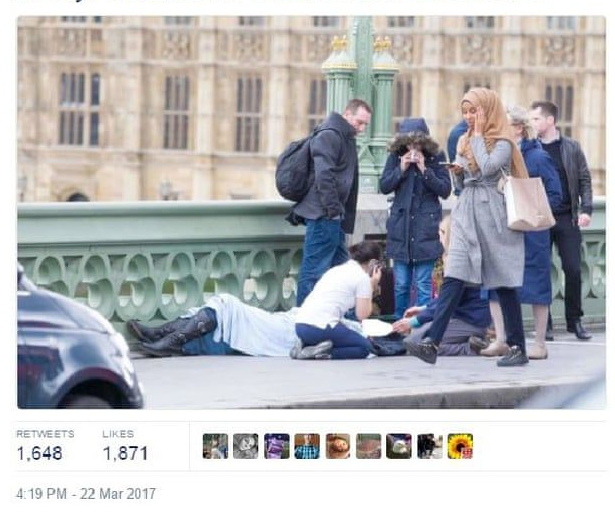
Caulfield also considers the issue of false frames and offers as an example the miscaptioned photo of a young woman that circulated widely after the 2017 London Bridge attack. In the photo, the woman, who is wearing a hijab, is looking down at her phone as she walks past one of the victims lying by the side of the road, surrounded by members of the rescue team. Because the woman’s face is blurred, viewers of the miscaptioned picture cannot see the look of shock that is visible in her face in another image taken by the same photographer. Subsequently, her apparent lack of concern for the victim seems to confirm the caption in the infamous tweet.
Choosing a general search term over a specific one is a useful and unexpected tip Caulfield includes in his discussion of image searches. He explains that the benefit of such a bland term as “letter” or “photo” will prevent the confirmation bias that can lead to the proliferation of disinformation through false frames.
In the fifth lesson of the Check, Please!, Starter Course, Mike Caulfield, author of the course and a research scientist at the University of Washington’s Center for an Informed Public, covers the final step in the five-step SIFT approach: “Trace Claims, Quotes, and Media to Their Original Context.” Caulfield outlines the process of locating the original context as an antidote to the issues of accuracy that occur when information passes through intermediaries.
One of the most instructive portions of lesson five features a passage in which Caulfield cites a study of how stories evolve as gossip through the processes of leveling (stripping details), sharpening (adding or emphasizing details), and assimilating, which combines the two. In the process of assimilation “the details that were omitted and the details that were added or emphasized are chosen because they either fit what the speaker thinks is the main theme of the story, or what the speaker thinks the listener will be most interested in.” Similarly, leveling, sharpening, and assimilating all figure in the altered photographs and memes in lesson four. The abbreviated speech of the NRA’s CEO, Wayne LaPierre, which omits commentary, inaccurately indicates a contradiction in his stance on the presence of guns in schools.
The image of photographer Kawika Singson with flames at his feet serves as an example of leveling. Although the flames are real, they were not caused by the heat of the lava flow where Singson stands with his tripod. Instead, to create the image, a friend of his poured accelerant on the lava before Singson stepped into the frame. The deception wasn’t intentional; Singson simply wanted the image for his Facebook cover photo.
Unlike Singson’s photograph, the altered photograph of the Notorious B.I.G. with Kurt Cobain was created with the intent to deceive. Cropping and merging the two photographs illustrates the assimilation process adopted by Photoshop users to appeal to music fans eager to think that such fictional meetings of icons took place. Krist Novoselic, who founded Nirvana with Cobain, replied to the is-it-real question with his own fake photo, making the claim that the hand holding the cigarettes was Shakur’s, that he had been cropped from the right.
This morning in class you will plan and draft a short midterm reflection essay that documents your work in the first half of the semester, focusing on what you consider your most significant achievements and the feature or features of the course that have benefited your development as a writer and a student. Features to consider include the following:
Planning, drafting, and revising your literacy narrative or your analysis
Keeping a journal
Completing Check, Please! assignments
Studying one of the readings examined class, including “Me Talk Pretty One Day,” “The Day that Language Came into My Life,” “Back Story” (from The Blind Side), “The Falling Man,” “The School,” the sample literacy narrative (“A Bridge to Words”), or one of the sample analyses
Writing for an online audience beyond the classroom/creating and maintaining a WordPress blog
Collaborating with your classmates on in-class writing assignments
Playing Scrabble/Collaborating with your teammates on Wordplay Day
Writing longhand
Limiting screen time
Focus on two, three, or four features of the course (but no more than four), and include in your reflective essay the following elements:
A title that offers a window into your reflection
An opening paragraph that introduces your focus and presents your thesis
Body paragraphs that offer concrete details from your work to support your thesis.
A relevant quotation from Writing Analytically or a relevant quotation from one of the texts that we have studied in class. Introduce your quotation with a signal phrase and follow it with a parenthetical citation.
A conclusion that revisits the thesis without restating it verbatim
An MLA-style works cited entry for your source
Sample Works Cited Entries
Bartheleme, Donald. “The School.” The Best American Short Stories 1975, edited by Martha Foley, Houghton Mifflin, 1975. pp.8-11.
Rosenwasser, David and Jill Stephen. “Analysis Does More than Break a Subject into Its Parts.” Writing Analytically, 8th edition. Wadsworth/Cengage, 2019. pp. 4-5.
—. “Distinguishing Analysis from Summary, Expressive Writing, and Argument.” Writing Analytically, 8th edition. Wadsworth/Cengage, 2019. pp. 5-8.
—. “Writing on Computers vs. Writing on Paper.” Writing Analytically, 8th edition. Wadsworth/Cengage, 2019. pp. 124-25.
Sedaris, David. “Me Talk Pretty One Day.” Me Talk Pretty One Day. Little, Brown, 2000. 166-73.
Next Up
Wednesday’s class will be devoted to planning and preparing for your group presentations on the Check, Please! course. At the beginning of the class period, you will receive your group assignments, including which of the five lessons will be the focus of your presentation.
If your midterm grade isn’t as high as you hoped it would be, keep in mind that many additional assignments–including the analysis that you just submitted–will factor in your final grade for the course.
The lists that follow present the midterm grade distribution, the combined distribution for sections nineteen and twenty, followed by the distribution for each section individually.
ENG 1103.19 and 20 Midterm Grade Distribution
A 3
A- 13
B+ 5
B 7
B- 3
C+ 3
C 1
C- 1
D- 1
F 2
ENG 1103.19
A 1
A- 6
B+ 4
B 4
C+ 2
C 1
C- 1
F 1
ENG 1103.20
A 2
A- 7
B+ 1
B 3
B- 3
C+ 1
D- 1
F 1
Next Up
Fall break! I look forward to seeing you back in class on Monday, October 16.





 Jane Lucas