Monday in class, after your Scrabble debriefing, you read a sample final essay and annotated bibliography written by a student last semester. After you read and took notes on that sample assignment, you and two or three of your classmates collaboratively composed a one-paragraph assessment of it. Among the points that some of you addressed in your assessments include these:
The writer does mention her interest in whether writing longhand is more beneficial that typing, but she does not move beyond the simple either/or notion of the subject. A more substantive introduction would find her posing such questions as, in what contexts might writing longhand prove more beneficial than typing, and in what other contexts might the opposite be the case? The choice of sources might shed light on that, but her bibliography lacks a variety of perspectives. All of the sources except her interview with a classmate focus on published authors’ pereferences for beginning the writing process by composing longhand.
The final essay does not include the minimum requirement of two quotations (one quotation from one source, a second from a second source), and the quotation is not followed by a parenthetical citation.
The bibliography does meet the five-source minimum, but the sources are not presented in the correct order. They should be alphabetized by the authors’ last names.
One of the bibliographic entries does not include the author’s name.
The publication/interview information for each source is followed by a paragraph of summary and a second paragraph of commentary, but the commentaries are insufficient. Rather than offering some assessment of the source (explaining its usefulness, comparing it to another source), the commentaries primarily reiterate the ideas presented in the summaries that precede them.
The final essay and annotated bibliography is marred by errors of diction, grammar, punctuation, mechanics, and style. The mistake of writing the word cancer, instead of the intended word, chance, is an egregious error of diction (par. 4).
Additional Research and Writing
This morning we will review the points outlined above, and you will have the remainder of the class period to conduct additional research and compose additional portions of your final essay and annotated bibliography. Tasks to undertake include these:
Using the HPU Libraries databases to locate additional sources.
If the subject of your final essay/annotated bibliography has a Wikipedia page, locating that page, scrolling down to the list of references, and identifying one that might serve as one of your sources.
Using Google Scholar to locate a potential source.
Composing an annotation for one of your sources.
Reviewing the sources you have gathered and noting what similarities and differences you can identify among them. Those similarities and differences may serve as material for your essay or your commentaries.
Next Up
When class resumes next Wednesday, you will have additional time for locating sources and composing annotations for your final essay and annotated bibliography.
The student’s sample final essay and annotated bibliography that you reviewed yesterday in class included quotations from print sources without the required parenthetical citations. Remember that all of your sources except your interview (your nonprint source) should include parenthetical citations. If the source is paginated, include the page number in parentheses. If the source isn’t paginated included the abbreviation par. followed by the paragraph number in parentheses. Include the author’s name in parenetheses as well if he or she is not named in the signal phrase.
Examples
According to the author of “Scrabble is a Lousy Game,” it “treats language the way computers do—as arbitrarily ordered codes stored in a memory chip” (Kay, par. 7).
In Kay’s words, “Scrabble treats language the way computers do—as arbitrarily ordered codes stored in a memory chip” (par. 7).
The author of “Tabletop Games and 21st Century Skills Practice in the Undergraduate Classroom” observes that “two of the four Cs, communication and collaboration, figured prominently” (Hayse 298).
In “Tabletop Games and 21st Century Skills Practice in the Undergraduate Classroom,” Mark Hayse observes that “two of the four Cs, communication and collaboration, figured prominently” (298).
Note that the parenthetical citation with the author’s name and the page number does not include a comma but the parenthetical citation with the author’s name and the paragraph number does include one.
Quoting an Indirect Source
In the sample final essay and annotated bibliography, the student writer quotes the article “The Case for Writing Longhand,” but the words the student quotes aren’t those of the article’s writer, Sarah Bahr; they’re the words of Sam Anderson, one of the writers interviewed by Bahr. The quotation and its parenthetical citation should have appeared in one of these two ways:
In Bahr’s supports interview with Sam Anderson, a New York Times writer, Anderson says, “[H]e likes that the process slows him down and puts him in touch with his thoughts” (qtd. in par. 5).
Sam Anderson, a New York Times writer, says, “[H]e likes that the process slows him down and puts him in touch with his thoughts” (qtd. in Bahr, par. 5).
Hayse, Mark. “Tabletop Games and 21st Century Skill Practice in the Undergraduate Classroom.” Teaching Theology & Religion, vol. 21, no. 4, 2018, pp. 288– 302., https://onlinelibrary-wiley-com.libproxy.highpoint.edu /doi/epdf/10.1111/teth.12456.
Kay, Jonathan. Review. “Scrabble is a Lousy Game.” The Wall Street Journal, 4 Oct. 2018. ProQuest, https://libproxy.highpoint.edu/login?url=https://www.proquest.com /newspapers/scrabble-is-lousy-game-why-would-anyone- play/docview/2116081665/se- 2?accountid=11411.
Next Up
In class tomorrow, you will have additional time for locating sources and composing annotations for your own final essay and annotated bibliography.
Today in class, after your Scrabble debriefing, you will read a sample final essay and annotated bibliography written by a student last semester. After you read and make notes on the sample assignment, you and two or three of your classmates will collaboratively compose a one-paragraph assessment of it. Questions to consider in your assessment include these:
Does the essay answer the questions included in the first bullet point in the key features section of the assignment?
Does the essay include quotations from at least two of the sources in the bibliography? Are the quotations introduced with signal phrases? Are parenthetical citations included where needed?
Does the bibliography include a minimum of five sources, an interview with a classmate and at least four print sources?
Are the sources in the bibliography listed in the correct order?
Does the bibliographic entry for each source include complete MLA-style publication or interview information?
Is the publication or interview information for each source followed by a paragraph of summary?
Is each summary followed by a paragraph of commentary?
Does each commentary answer some of the questions included in the third bullet point in the key features section of the assignment?
Is the final essay and annotated bibliography marred by errors of diction, grammar, punctuation, mechanics, and/or style? If so, note at least one specific example in your assessment.
After you complete your assessment, review the grade criteria on your final essay and annotated bibliography assignment handout, and assign a grade.
Next Up
In class on Wednesday, you will have additional time for locating sources and composing annotations for your own final essay and annotated bibliography.
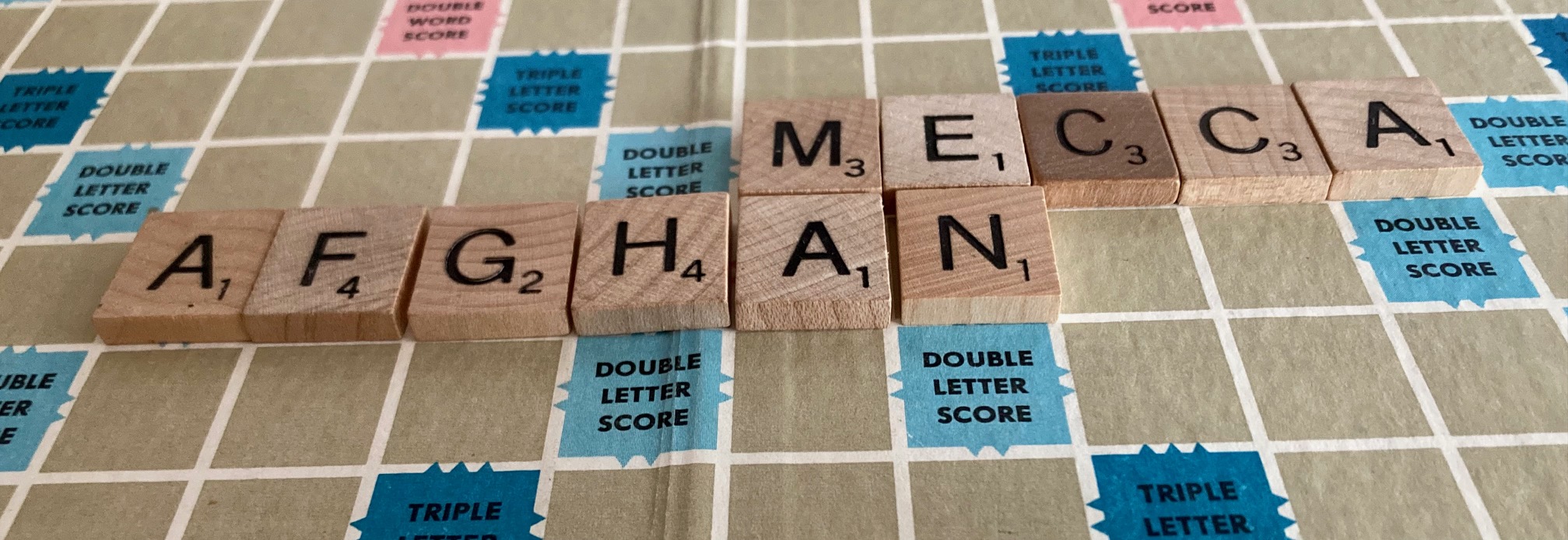
The first Scrabble post of the semester featured first names that are also common nouns, making them playable in Scrabble. Today’s post includes place names, or toponyms, that are playable in Scrabble. Learning these words will broaden your vocabulary and up your game.
afghan: a wool blanket
alamo: a cottonwood poplar tree
alaska: a heavy fabric
berlin: a type of heavy fabric
bermudas: a variety of knee-length, wide-legged shorts
bohemia: a community of unconventional, usually artistic, people
bolivia: a soft fabric
bordeaux: a wine from the Bordeaux region
boston: a card game similar to whist
brazil: a type of tree found in Brazil used to make instrument bows (also brasil)
brit: a non-adult herring
cayman: a type of crocodile, also known as a spectacled crocodile (also caiman)
celt: a type of axe used during the New Stone Age
chile: a spicy pepper (also chili)
colorado: used to describe cigars of medium strength and color
congo: an eellike amphibian
cyprus: a thin fabric
dutch: referring to each person paying for him or herself
egyptian: a sans serif typeface
english: to cause a ball to spin
french: to slice food thinly
gambia: a flowering plant known as cat’s claw (also gambier, which is a small town in Ohio)
geneva: gin, or a liquor like gin
genoa: a type of jib (a triangular sail), also known as a jenny, first used by a Swedish sailor in Genoa
german: also known as the german cotillon, an elaborate nineteenth-century dance
greek: something not understood
guinea: a type of British coin minted from 1663 to 1813
holland: a linen fabric
japan: to gloss with black lacquer
java: coffee
jordan: a chamber pot
kashmir: cashmere
mecca: a destination for many people
Next Up
Wordplay Day! To prepare for class, revisit the Dictionary and World Builder pages on the Scrabble website, and review the posts on my blog devoted to Scrabble tips, including this one.
Your final essay and annotated bibliography will focus on one of the authors we have studied or one of elements of the course, including (1) blogging in the classroom, (2) limiting screen time, (3) writing longhand, and (4) playing Scrabble. As a starting point, you will conduct a short personal interview that will serve as one of the sources for your project. If you decide that you do not want to use the interview that you conduct today, you are welcome to include another one in your project. Keep in mind, however, that the interview you include in your project must be conducted with a student currently enrolled in section 20 or 21, and the subject of the interview must be the subject of your project.
Questions to ask your interviewee include the following:
What experience, if any, did you have with the subject (the reading or the aspect of the course) before you encountered it in English 1103?
Has it changed your perspective on reading and/or writing? If so, how?
Will you continue to pursue the subject (read more work by the author, continue the classroom practice or activity) after the conclusion of the semester?
After you conduct your interview, compose on the worksheet provided a sentence in which you introduce a quotation from the interview with a signal phrase or clause, such as, According to . . . , or [insert first and last name] notes or observes or points out that . . . .” Your quotation will not be followed by a parenthetical citation because it is a form of oral communication (without page or paragraph numbers). See the sample on your worksheet.
Follow your quotation with annotated bibliography entry in this format:
Annotated Bibliography*
Last Name, First Name. Interview. Conducted by Your First Name Your Last Name. Day Month Year.
*Note that you will use the header annotated bibliography, not works cited, in your final essay and annotated bibliography.
Below the work cited/bibliography entry, compose a one-paragraph summary of the interview followed by a second shorter paragraph that identifies the student by class and major (or undeclared) and addresses what role the interview might serve in a larger project. Would it serve as a point of comparison or contrast to another source? Would it support or challenge an idea presented in another source? See the model below.
Sample Quotation with Signal Clause
English 1103 student Jesse Brewer observes that Scrabble has expanded his vocabulary, saying it has “introduced me to new words, which allows me to read and write more capably in everyday life.”
Sample Annotated Bibliographic Entry
Brewer, Jesse. Interview. Conducted by Jane Lucas. 20 Oct. 2023.
English 1103 student Jesse Brewer recounts how he has played Scrabble for most of his life. Ever since he was a young child, he has played the game with his grandparents whenever he visited their home in Pennsylvania. Brewer will continue to play Scrabble after the end of the semester because the game remains a tradition in his family. In his words, “[M]y grandmother is still going to want to play it every summer.” Brewer also notes that the game has expanded his vocabulary, saying it has “introduced me to new words, which allows me to read and write more capably in everyday life.”
Brewer is a freshman computer science major at High Point University, where he is currently enrolled in English 1103, section 20. His remarks on vocabulary building highlight the game’s verbal benefits, and his observations on Scrabble as a family tradition serve as a point of contrast to that of some other students’—such as Ava Salvant’s—who had not played Scrabble before playing it as a weekly exercise in English 1103.
Note that the first paragraph of the bibliography entry, the summary, is written in present tense and third person. Also note that after the first mention of the interviewee’s name, he is referred to by last name.
The annotated bibliographic entry for your interview will be shorter than your other entries because (1) you are annotating a brief interview, and (2) your classmate does not have the credentials that you will list in the annotations for your other sources.
The complete final essay/annotated bibliography assignment appears below.
Overview
An annotated bibliography is a list of sources on a subject that includes a summary of each source. Some bibliographies include additional information, such as the authors’ credentials. That is the type of bibliography that you will compose along with your final essay for the course.
Key Features
Your final essay, which is an introductory essay of three or more paragraphs that (1) presents the subject of your bibliography, and (2) addresses your purpose for compiling it. In other words: What drives your research? What interests you about the subject, and what question/s do you seek to answer about your subject?
A complete MLA-style bibliography entry for each source.
A one-paragraph summary of each source followed by a shorter second paragraph that presents the writer’s credentials and addresses the purpose that the source might serve in a larger project. Would it serve as a point of comparison or contrast to another source? Would it support or challenge an idea presented in another source? Is it a secondary source that sheds light on the meaning of a primary source? The last question pertains primarily to bibliographies that focus on one of the writers studied in the course.
Preliminary Work—What to Complete in Class Today
Personal Interview
Your final essay and annotated bibliography will focus on one of the authors we have studied or one of elements of the course, including (1) blogging in the classroom, (2) limiting screen time, (3) writing longhand, and (4) playing Scrabble. As a starting point, you will conduct a short personal interview that will serve as one of the sources for your project. If you decide that you do not want to use the interview that you conduct today, you are welcome to include another one in your project. Keep in mind, however, that the interview you include in your project must be conducted with a student currently enrolled in section 20 or 21, and the subject of the interview must be the subject of your project.
Begin by conducting a short personal interview and composing an annotated bibliographic entry for the interview. For more information, see the paragraphs under the header PRELIMINARY WORK—What to Complete in Class Today.
Compose an annotated bibliographic entry for the source that serves as the starting point for your research. See the list of texts that follows.
Use the HPU Libraries site, https://www.highpoint.edu/library/, and Google Scholar to locate a minimum of three additional reliable and relevant print sources (articles, essays, and/or books) devoted to the same subject. Compose your summaries and commentaries in complete sentences, introduce any quotations with signal phrases, and include parenthetical citations where needed. Your bibliography must include five sources, four of which must be print. (Your personal interview is a nonprint source.) If you wish to include an additional non-print source, such as a video, you may include that as a sixth source.
After you have composed your annotated bibliography entries, write an introductory essay that (1) presents the subject of your bibliography, and (2) addresses your purpose for compiling it. In other words: What drives your research? What question do you seek to answer about your subject? Also, (3) What larger project might develop from your bibliography? Would it be a project for a course in psychology, science, education, or another discipline? Address all five of your sources in your essay, and quote at least two of them.
Note: Though your introductory essay will precede your annotated bibliography, you will compose it last because you will need to re-read and summarize your sources before you will know how to address them in your essay.
Directions for Researching, Drafting, Revising, and Submitting
Devote today’s class primarily to conducting a personal interview and composing an annotated bibliography entry for the interview. You will have two additional Wednesdays to work in class on your final essay and annotated bibliography before you post your revision to Blackboard and to your WordPress blog.
Before class on the due date: Post a copy of your revision to Blackboard and to your blog. In your blog post, omit the first-page information included in your file submitted to Blackboard (your name, professor’s name, course and section, and date). Add to your blog post an image that documents some part of your writing process away from the screen, such as the summary of your source in your journal, today’s worksheet, or a page of your draft. Also add an embedded link to a relevant web site. Even though your work for this assignment will take place primarily in front of the screen, your writing process still involves putting pen to paper, and photographic documentation of that on your blog is a requirement of the assignment.
Rosenwasser, David and Jill Stephen. “Arriving at an Interpretive Conclusion: Making Choices.” Writing Analytically, 9th edition. Wadsworth/Cengage, 2024. pp. 111-12.
Sedaris, David. “Me Talk Pretty One Day.” Me Talk Pretty One Day. Little, Brown, 2000. pp. 166-73.
An A final essay and annotated bibliography includes these components:
An introductory essay of three or more paragraphs that (1) presents the subject of your bibliography, and (2) addresses your purpose for compiling it. In other words: What drives your research? What question do you seek to answer about one of the subjects that you’ve studied in the course or about one aspect of the course? Also, (3) what larger project might develop from your bibliography? Would it be a project for a course in science, psychology, education, or another discipline?
A complete works cited/bibliographic entry for a minimum of five reliable and relevant sources, four of which are print. Alphabetize the list by the writers’ last names.
A one-paragraph summary of each source followed by a shorter paragraph of commentary that presents the writer’s credentials.
An A final essay and annotated bibliography complies with the requirements above and is also cohesive and relatively free of surface errors.
A B final essay and annotated bibliography effectively meets all of the requirements above but may be flawed by minor issues of organization and/or surface errors.
A C final essay and annotated bibliography meets most but not all of the requirements above and may also be flawed by issues of organization and/or surface errors.
A D final essay and annotated bibliography meets only a few of the requirements above and may also be flawed by issues of organization and/or surface errors.
An F final essay and annotated bibliography fails to meet the requirements above and may also be flawed by substantial issues of organization and/or surface errors.
Next Up
Wordplay Day! To prepare for class, revisit the Dictionary and World Builder pages on the Scrabble website. Also review the blog posts devoted to Scrabble tips.
As you make your final preparations for your group presentations, be sure to complete the steps below, which are also included on your assignment sheet.
If your notes are written in complete sentences, rewrite them to include only words and short phrases for your key points. If your notes are too detailed, you will risk relying too heavily on them and making minimal eye contact with the audience. Plan to make as much eye contact as possible and be sure to make eye contact with people throughout the room rather than fixing your eyes on one or two people.
Familiarize yourself with the presentation station. If you have not used the presentation station, I encourage you to devote a couple of minutes before the class period to familiarizing yourself with its setup.
Practice good posture. As you deliver your presentation, your ears should be directly above your shoulders. If you tend to shift your weight from one foot to the other—a distracting habit that’s sometimes called rocking the boat—stand with your feet perpendicular to each other. If you do so, you will not be able to shift your weight from one foot to the other.
Avoid filler words, such as uh, um, like, and you know. If you tend to use filler words, practice pausing at the points where you are likely to use fillers.
Time permitting, after the presentations, you will compose a reflection that addresses your group’s presentation as well as the presentation delivered by one of the other groups.
Next Up
Wednesday you will receive your asignment for your final essay and annotated bibliography, and you will begin planning and drafting. Bring your laptops to class.
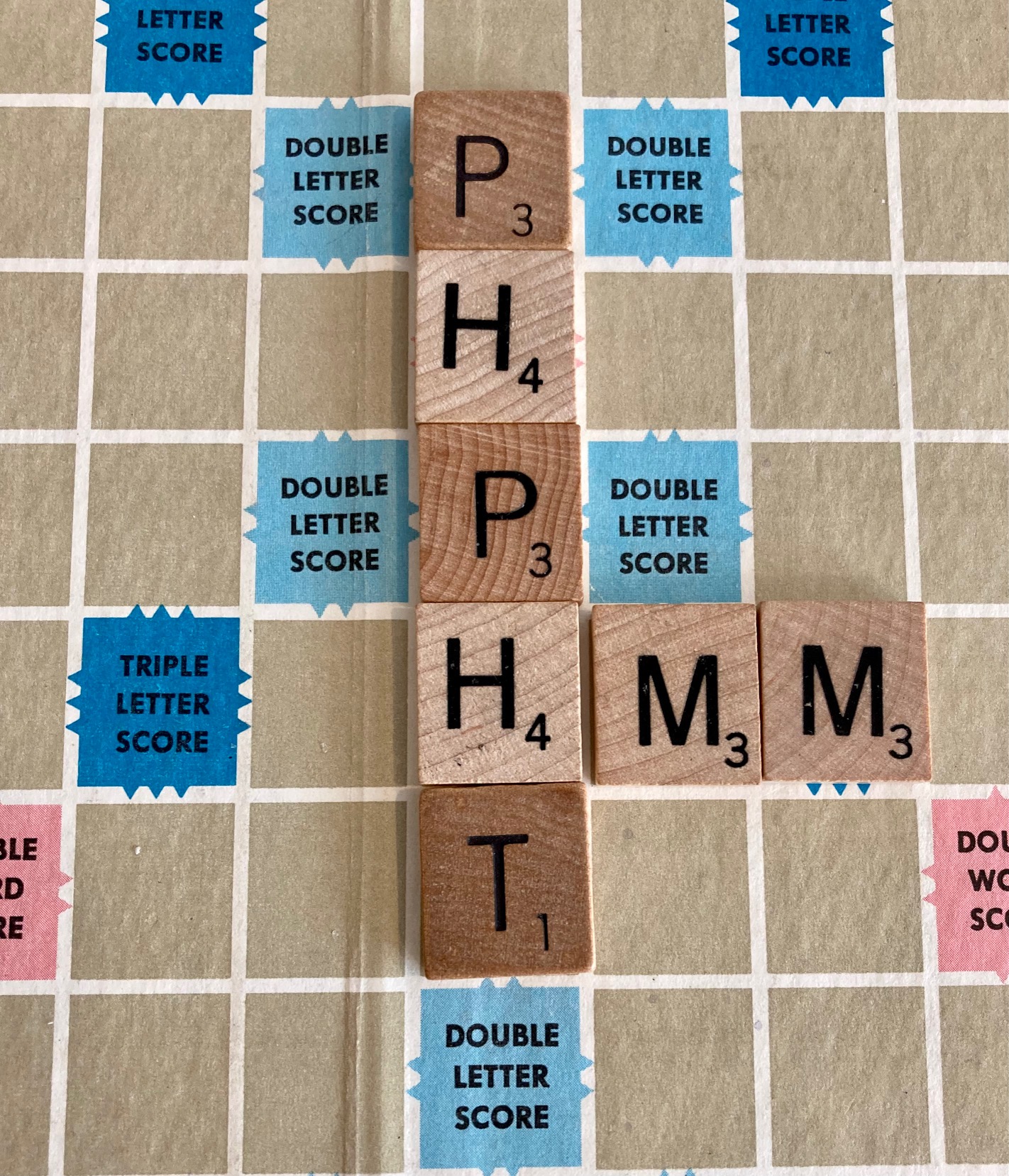
Learning nth (an unspecified number) and other all-consonant words can enable you to continue the game when you’re faced with a rack without vowels.
brr: used to indicate that one is cold
crwth: an ancient stringed instrument (pl. -s)
cwm: a cirque (a deep, steepwalled basin on a mountain, pl. -s, prounounced to rhyme with “boom”)
hm: used to express thoughtful consideration (also “hmm“)
mm: used to express assent or satisfaction
nth: describing an unspecified number in a series
phpht: used as an expression of mild anger or annoyance (also “pht“)
psst: used to attract someone’s attention
sh: used to urge silence (also “shh” and “sha“)
tsk: to utter an exclamation of annoyance (-ed, -ing, -s)
tsktsk: to “tsk” (-ed, -ing, -s)
Next Up
Wordplay Day! To prepare for class, revisit the Dictionary and World Builder pages on the Scrabble website. Also review the blog posts devoted to Scrabble tips, including this one.
Today in class, before you continue planning your group presentations, you will complete an exercise that offers you practice in some of the key moves of academic writing: (1) introducing a quotion with a signal phrase, (2) following it with a parenthetical citation, and (3) developing a paragraph by offering your own ideas on the subject of the quotation.
As model for you, I offer the sample paragraph below, which focuses on the Diego Velaszquez painting above and the Pablo Picasso painting below.
Sample Paragraph
The authors of Writing Analytically note, “There are provocative differences between Velásquez’s original and Picasso’s copy in size, spatial configuration, and palette” (Rosewasser and Stephen 268). Yet despite those differences, The Maids of Honor (Las Meninas, after Velásquez) features all of the figures in the same spirit Velásquez depicts them. Along with the painter’s canvas out of view, the artists’ foregrounding of elements ordinarily relegated to the perimeter—children, pets, servants, the artist, himself—invite a new way of seeing. Both Velásquez’s seventeenth-century baroque rendering of King Phillip IV’s court and Picasso’s cubist reassembling of it challenge viewers’ expectations of the subjects of art.
Picasso, Pablo. The Maids of Honor (Las Meninas, after Velazquez). 1957.
The paragraph that follows is the same as the one above, but the parenthetical citation includes only the page number because the authors are named in the signal phrase. In academic writing, whenever you quote more than one source, the authors’ names should appear either in a signal phrase or in the parenthetical citation, not both. Your analysis was an exception to this rule because your cited only one source, the text that served as your subject.
Sample Paragraph
David Rosenwasser and Jill Stephens, the authors of Writing Analytically, note, “There are provocative differences between Velásquez’s original and Picasso’s copy in size, spatial configuration, and palette” (268). Yet despite those differences, The Maids of Honor (Las Meninas, after Velásquez) features all of the figures in the same spirit Velásquez depicts them. Along with the painter’s canvas out of view, the artists’ foregrounding of elements ordinarily relegated to the perimeter—children, pets, servants, the artist, himself—invite a new way of seeing. Both Velásquez’s seventeenth-century baroque rendering of King Phillip IV’s court and Picasso’s cubist reassembling of it challenge viewers’ expectations of the subjects of art.
Directions
As practice in three of the key moves of academic writing, use the paragraphs above as models for your own paragraph focusing on Ian Falconer’s The Competition. (See page 108.)
Include in your paragraph a signal phrase that introduces one of the following two quotations:
“At its most serious, The New Yorker cover may speak to American history, in which New York has been a major point of entry for generations of immigrants, embracing diversity and nonconformity, while viewing the rest of the nation as more homogenous.”
“[T]he magazine is [. . .] admitting, yes America, we New Yorkers do think that we’re cooler and more individual than the rest of you, but we also know that we shouldn’t be so smug about it.”
Follow the quotation with a parenthetical citation. If you name the authors in the signal phrase, include only the page number, 112, in the parenthetical citation. If you do not name the authors in the signal phrase, include their last names before the page number.
Develop the paragraph with two or more sentences that offer your own reading of the magazine cover.
Follow your paragraph with a work cited entry:
Work Cited
Rosenwasser, David and Jill Stephen. “Arriving at an Interpretive Conclusion: Making Choices.” Writing Analytically. 9th edition, Wadsorth/Cengage, 2024. pp. 111-12.
Next Up
Wordplay Day! To prepare for class, revisit the Dictionary and World Builder pages on the Scrabble website. Also review the blog posts devoted to Scrabble tips.
As an exercise in reviewing one of the lessons in the Check, Please! course and also as an exercise in collaboration and oral communication, you and two or three of your classmates will deliver a short presentation that addresses the most significant points covered in one of the five lessons in the Check, Please! Course.
This morning in class, after you complete your Scrabble debriefing, you will receive your group assignments and begin planning for your presentation. You will receive a handout in class with directions for your presentation, and I am including the directions below as well.
Directions for Planning
Plan a presentation of five to ten minutes that addresses the most significant points covered in your group’s designated lesson in the Check, Please! course. (See pages 2-3 for the lists of groups and lesson assignments)
Include in your presentation (a) an opening in which you state each member’s first and last name, (b) a close examination of one segment of the lesson, and (c) a conclusion that provides closure and invites questions.
You are encouraged but not required to address how the lesson has been relevant to your other work in English 1103 and/or your other courses.
Directions for Rehearsing
In preparation for rehearsing, write your notes on an index card. If your initial notes are written in complete sentences, rewrite them to include only words and short phrases for your key points. If your notes are too detailed, you will risk relying too heavily on them and making minimal eye contact with the audience. Plan to make as much eye contact as possible and be sure to make eye contact with people throughout the room rather than fixing your eyes on one or two people.
Familiarize yourself with the presentation station. If you have not used the presentation station, I encourage you to devote part of today’s class period to familiarizing yourself with its setup.
Practice good posture. As you deliver your presentation, your ears should be directly above your shoulders. If you tend to shift your weight from one foot to the other—a distracting habit that’s sometimes called rocking the boat—stand with your feet perpendicular to each other. If you do so, you will not be able to shift your weight from one foot to the other.
Avoid filler words, such as uh, um, like, and you know. If you tend to use filler words, practice pausing at the points where you are likely to use fillers.
Take turns delivering your portions of the presentation, and offer feedback to your group members. Offer both suggestions for improvement and words of encouragement.
Check, Please! Lesson Three: Ava Gaudioso, Mason Hooey, Izzy O’Connor, Chaning Smith
Check, Please! Lesson Four: Santino Hall, Ella MacGlashan, Autumn Spaulding, Renae West
Check, Please! Lesson Five: Madison Harding, Brayden Krieser, Kenzie Van Cleef, Liz Wilburn
Grade Criteria
An A presentation includes all elements outlined in the directions for planning and demonstrates the group members’ poise and ability to avoid filler words.
A B presentation includes all elements outlined in the directions for planning but may be marred by group members’ lack of poise and/or inability to avoid filler words.
A C presentation includes most but not all elements outlined in the directions for planning and may also be marred by group members’ lack of poise and/or inability to avoid filler words.
A D presentation includes only some elements outlined in the directions for planning and may also be marred by group members’ lack of poise and/or inability to avoid filler words.
An F presentation includes few if any elements outlined in the directions for planning and may also be marred by group members’ lack of poise and/or inability to avoid filler words.
Next Up
In class on Wednesday, you will have additional time to prepare for your group presentations.
Your fifth and final Check, Please! assignment is due at the beginning of class next Wednesday, March 13. If you were absent on the day that I distributed the worksheet for the assignment, or you misplaced your copy, you should download and print a copy from Blackboard.
Although the assignment isn’t due until Wednesday, I encourage you to complete it before Monday’s class. In class on Monday, you will begin planning your group presentations on the Check, Please! lessons. Since you may be in the group that will deliver a presentation on lesson five, you will be able to devote more of your class time to planning if you have already completed the lesson.
Be sure to bring your worksheets for lessons one through four, so you will have the corresponding worksheet to refer to as you and your group members plan your presentation. Also, you may find it helpful to review the blog post that features my model assignment for the lesson:
Lesson One, January 23
Lesson Two, February 2
Lesson Three, February 16
Lesson Four, February 23
Next Friday, March 15, I will publish a blog post devoted to lesson five.
Next Up
In class on Monday, you and two or three of your classmates will begin planning for a short presentation on one of the five Check, Please! lessons. After your Scrabble debriefing at the beginning of class, you will receive your group assignments.





 Jane Lucas