Please take a few minutes to complete the Spring 2024 Library Student Survey, which the HPU Library has distributed in partnership with the Office of Research and Planning. You should have received an email with a link that will direct you to the survey. The email’s subject line is “Your Opinion Matters: Take the Library Student Survey!” The survey will run April 4-13.
Next Up
Monday’s class will focus on a model final essay and annotated bibliography. You and two or three of your classmates will collaboratively compose answers to questions regarding (1) the different perspectives represented in the sources, and (2) examples of the writer either juxtaposing sources or noting their similarity.
The most recent Scrabble post, published on March 22, featured a list of toponyms (place names) in the first half of the alphabet. This post includes a list of toponyms in the second half. Learning these playable place names will broaden your vocabulary and up your game.
oxford: a type of shoe, also known as a bal or balmoral
panama: a type of wide-brimmed hat
paris: a type of plant found in Europe and Asia that produces a lone, poisonous berry
roman: a romance written in meter
scot: an assessed tax
scotch: to put an end to; or to etch or scratch (as in hopscotch)
sherpa: a soft fabric used for linings
siamese: a water pipe providing a connection for two hoses
swiss: a sheer, cotton fabric
texas: a tall structure on a steamboat containing the pilothouse
toledo: a type of sword known for its fine craftsmanship, originally from Toledo
wale: to injure, to create welts on the skin
warsaw: a type of grouper fish
waterloo: a definitive defeat
zaire: a currency of Zaire
Next Up
Wordplay Day! To prepare for class, revisit the Dictionary and World Builder pages on the Scrabble website, and review the posts on my blog devoted to Scrabble tips, including this one.
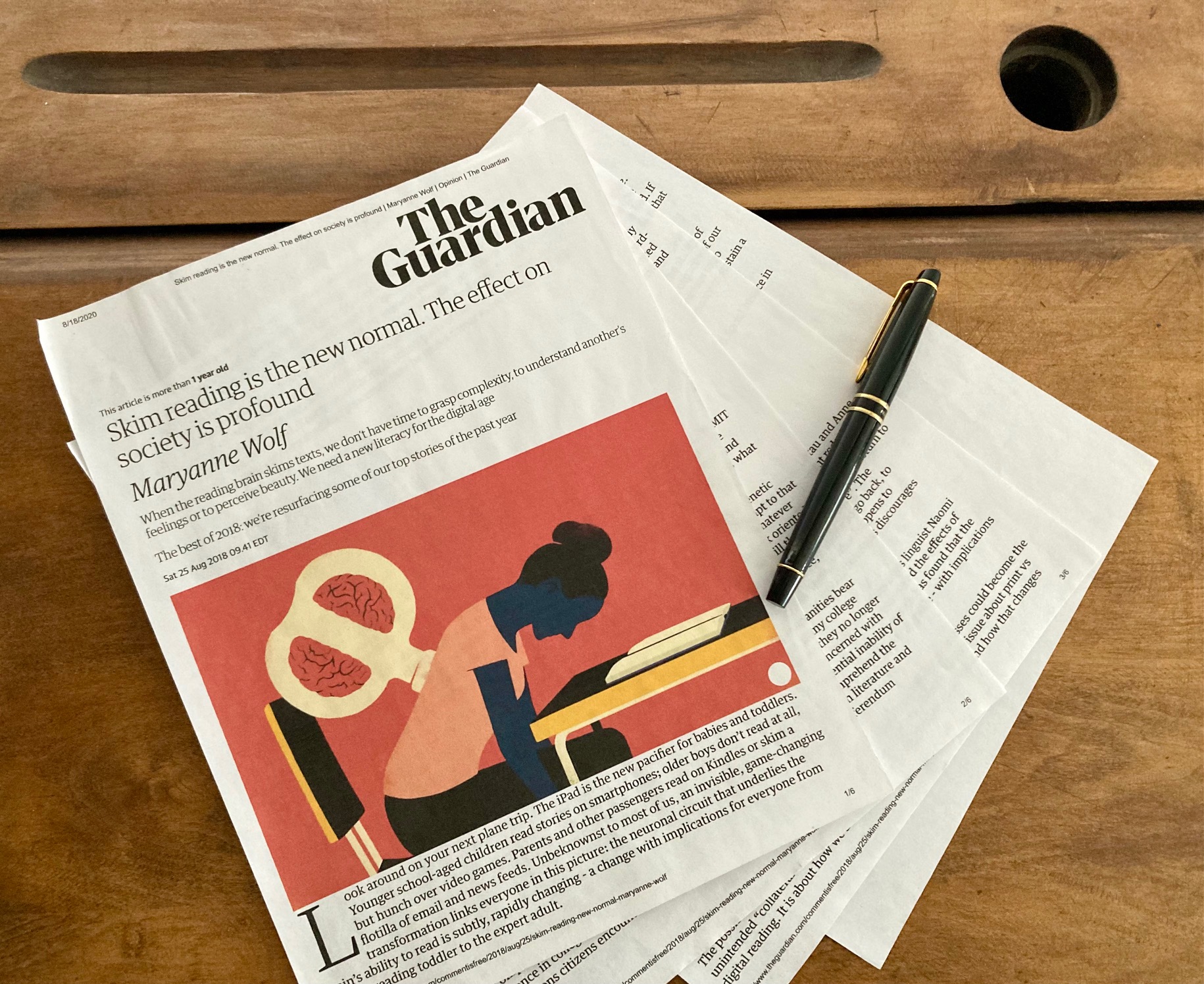
Today in class we will examine Maryanne Wolf’s Guardian essay “Skim Reading is the New Normal.” If your final essay and annotated bibliography focuses on limiting screen time, consider including Wolf’s essay as an additional source.
Note that Wolf mentions several studies of the effects of screen use. If you use Wolf’s essay as a source, look carefully at the ideas you cite and determine whether they are hers or those of a researcher she mentions. If they are the ideas of another researcher, be sure to include the appropriate parenthetical citation for an indirect source. See the samples in last Tuesday’s post.
After we examine Wolf’s essay, you will have the remainder of the class period to conduct additional research and compose additional portions of your final essay and annotated bibliography. Tasks to undertake include these:
Using the HPU Libraries databases to locate additional sources.
If the subject of your final essay/annotated bibliography has a Wikipedia page, locating that page, scrolling down to the list of references, and identifying one that might serve as one of your sources.
Using Google Scholar to locate a potential source.
Composing an annotation for one of your sources.
Reviewing the sources you have gathered and noting what similarities and differences you can identify among them. Those similarities and differences may serve as material for your essay or your commentaries.
Revising your final essay.
Next Up
Wordplay Day! To prepare for class, revisit the Dictionary and World Builder pages on the Scrabble website, and review the posts on my blog devoted to Scrabble tips,


 Jane Lucas