
Yesterday morning, you and your classmates in sections 19 and 20 hosted virtual visits with award-winning author and teacher Roy Peter Clark.
Clark, whose books include the popular Writing Tools, is a senior scholar at the Poynter Institute and is often referred to as America’s Writing Coach.
Among the topics Clark discussed were the importance of thinking of yourselves as writers, developing your writing with concrete details, and placing the most vital words at the beginning and the end of sentences.
Six students, three in each section, asked questions of Clark:
Section 19
- Bailey Dawkins
- Lexi Painter
- J.J. Pollender
Section 20
- Chase Eller
- Stella Galindo Haas
- Lydia Henderson
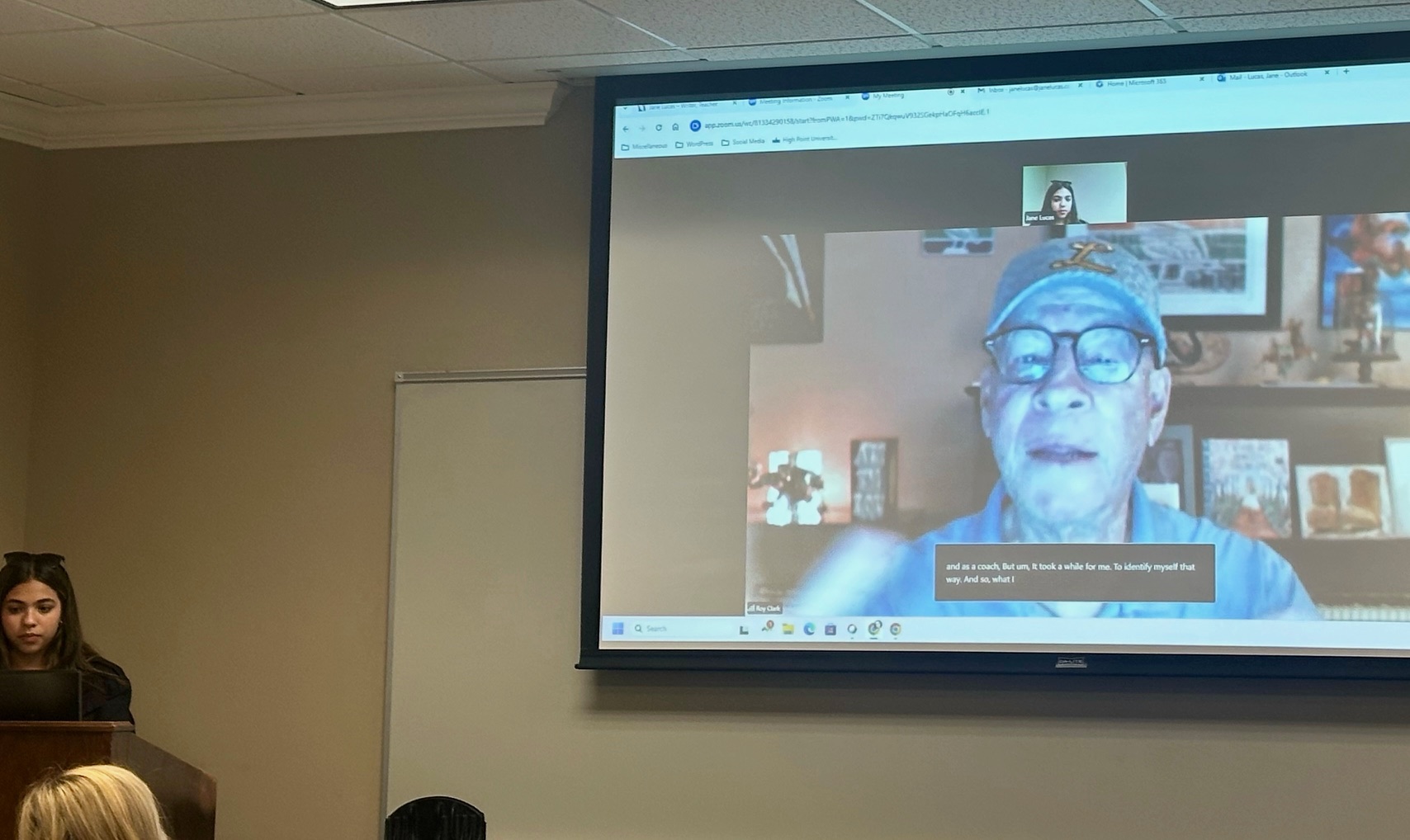
The students questions included (1) When did you know that you wanted to be a writer? (2) How do you incorporate humor into writing? (3) How do you address writer’s block? and (4) Which of your own books on writing is your favorite?
Clark noted that at a very young age he was fascinated by words and loved reading and writing. Of incorporating humor into writing, he said that if the writer himself isn’t funny on the page, he should try citing the words of someone who is. To address writer’s block, he recommended setting low standards. Writers have difficulty beginning drafts because they want them to be better than first drafts can be. In response to the favorite-book question, Clark said Writing Tools, adding that he did not choose that as his favorite among his books, his readers did; it’s his most popular and best-selling book.
To demonstrate the effectiveness of beginning and ending sentences with the most vital words, Clark offered an example from Shakespeare’s MacBeth. After the suicide of MacBeth’s wife, Seyton, an attendant to MacBeth, tells his master, “The queen, my lord, is dead” (2.2.19). Clark said that Shakespeare might have instead written, “The queen is dead, my lord.” But ending with “dead” rather than “lord” makes for a more powereful line; what’s vital to the sentence is the announcement of the death, not that Seyton is announcing it to his master, MacBeth
The Zoom meetings came about after Clark conducted an online search of his name that yielded one of my blog posts devoted to one of his essays. After Clark reviewed my blog last May he emailed me. Clark wrote, “I have concluded that you are a remarkable teacher of writing. Your students are lucky to have you. I enjoy making the occasional cameo appearance via Zoom in classes where my work has been under discussion. If I can ever be of help, just holler.”
Work Cited
Shakespeare, William. Folger Shakespeare Library: The Tragedy of MacBeth. Edited by Barbara A. Mowat and Paul Werstine, Simon and Schuster, 2013.
Thanks, to Bailey Dawkins, Lexi Painter, J.J. Pollender, Chase Eller, Stella Galindo, Haas, and Lydia Henderson for asking questions–and thanks to Madison Kline and Chase for photographing Roy Peter Clark’s virtual visit.
Next Up
At the beginning of class on Wednesday, you will submit your worksheet for the third lesson in the Check, Please! course. After that, you will compose a reflective essay on your literacy narrative.
Your reflective essay assignment requires you to include a minimum of one relevant quotation from our textbook, Writing Analytically. To prepare for that portion of the assignment, read the sections titled “Keeping a Writer’s Notebook” (157-58) and “Writing from the Life: The Personal Essay” (161-68). Make note in your journal of any phrases or sentences that speak to your experience of planning, drafting, and/or revising your literacy narrative. Remember to bring your textbook to class.

 Jane Lucas