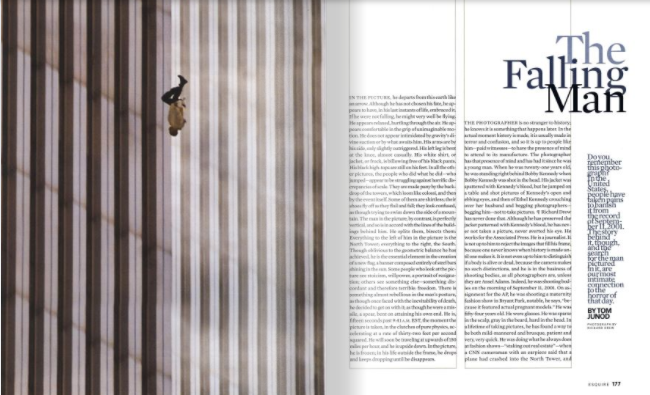
Yesterday in class, before you composed your reflective essays on your literacy narratives, we examined the beginning of Tom Junod‘s essay “The Falling Man,” published in Esquire magazine two years after 9-11. After we read the first paragraph, I asked you to consider these questions:
- The long first paragraph of Junod’s essay could be two or more paragraphs. If you were Junod, where might you have divided the paragraph?
- Why do think he chose not to divide it?
Junod might have started a second paragraph with the words “[i]n all the other pictures,” because there he shifts the focus from the Falling Man to the photographs of other people who jumped from the Twin Towers. An opportunity for a third paragraph comes with the words “[t]he man in the picture, by contrast,” where Junod turns his attention back to the Falling Man. And he might have begun a fourth paragraph with “[s]ome people who look at the picture,” because there he shifts to viewers’ perceptions of the Falling Man.
The first paragraph is over four-hundred words long, a length I advise you to avoid in your own paragraphs. Generally, one-hundred to one-hundred-and-fifty words is a suitable length. As a rule, you should begin a new paragraph when you present a new idea or point. If you have an extended idea that spans multiple paragraphs, each new point within that idea should have its own paragraph. But the first paragraph of “The Falling Man” is an exception. For Junod, choosing not to divide the first paragraph creates an unbroken movement that parallels the unbroken downward flight of his subject, the Falling Man. Outside of the photograph, “he drops and keeps dropping until he disappears.” With “disappears,” the last word of the paragraph,” the Falling Man disappears from the page, and Tom Junod turns to the photographer, whom we learn later in the essay is Richard Drew.
Unless you subscribe to Esquire, the magazine’s paywall will deny you access to the full text of “The Falling Man”; but if you’re interested in reading it in full, you can access it through the HPU Library site by following these steps:
- Go to the HPU Library site.
- Under the heading “Search HPU Libraries . . . ,” click on the “Articles” tab.
- Under the “Articles” tab, type Tom Junod “Falling Man” Esquire in the search box and click “search.”
- On the next screen, you will see a brief summary of the article. Click “Access Online” to view the full article.
Check, Please! Lesson Three
The second half of this blog post features my version of the third Check, Please! assignment, which you submitted at the beginning of class on Wednesday. In preparation for submitting your worksheet for lesson four, review this post as well as the assignment notes that I posted on September 3.
Sample Assignment
In the third lesson of the Check, Please!, Starter Course, Mike Caulfield, author of the course and a research scientist at the University of Washington’s Center for an Informed Public, continues his instruction on the second step in four-step SIFT approach to determining the reliability of a source. Lesson three, “Further Investigation” covers these topics: (1) Just add Wikipedia for names and organizations, (2) Google Scholar searches for verifying expertise, (3) Google News searches for information about organizations and individuals, (4) the nature of state media and how to identify it, and (5) the difference between bias and agenda.
One of the most instructive parts of lesson three focuses on two news stories about MH17, Malyasia Airlines Flight 17, a passenger flight scheduled to land in Kuala Lumpur that was shot down over eastern Ukraine on July 17, 2014. While the second story, a television news segment, appears to present detailed investigative reporting challenging the conclusion of the Dutch Safety Board and Dutch-led joint investigation team–the conclusion that Russia was to blame–a quick just-add-Wikipedia check reveals that RT (formerly Russia Today) is a Russian state-controlled international TV network, a government propaganda tool rather than a source of fair and balanced news. The first video, the one produced by Business Insider, a financial and business news site, delivers accurate coverage of MH17.
Another notable segment of “Further Investigation” addresses the important distinction between “bias” and “agenda.” There, Caulfield observes that “[p]ersonal bias has real impacts. But bias isn’t agenda, and it’s agenda that should be your primary concern for quick checks,” adding that “[b]ias is about how people see things; agenda is about what a news or research organization is set up to do.”
Work Cited
Caulfield, Mike. Check, Please! Starter Course, 2021, https://webliteracy.pressbooks.com/front-matter/updated-resources-for-2021/.
Next Up
Wordplay Day! To prepare for class, revisit the Dictionary and World Builder pages on the Scrabble website, and review the blog posts devoted to Scrabble tips.
 Jane Lucas