Today’s class will be devoted primarily to reading and responding to the blog post of one of your classmates’ literacy narratives. Elements you will consider in your response included these:
- the title
- vivid details
- dialogue, the use of scene and/or summary
You should also identify one or more of the “Nine Basic Writing Errors” (see Writing Analytically, 423-44), and address that error in your response. If you cannot identify one, include a sentence in your response that quotes a sentence of your peer’s and explains what makes it effective.
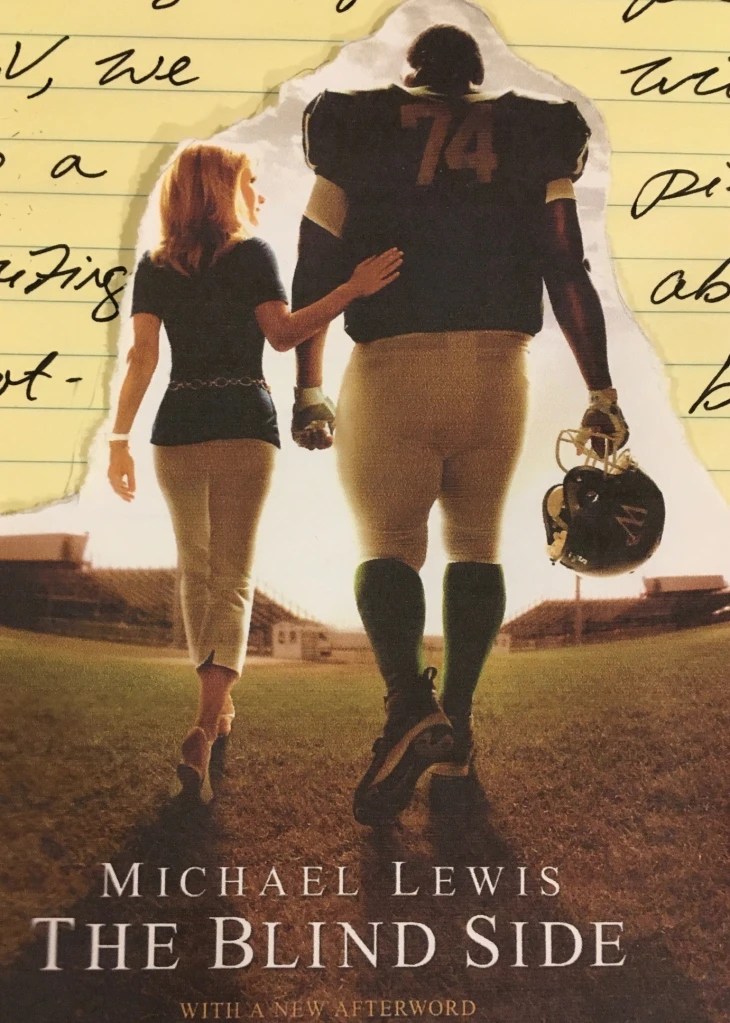
Before you begin that assignment, we will examine the opening pages of “Back Story,” the first chapter of Michael Lewis‘s The Blind Side, which dramatizes the moments in the November 1985 Redskins-Giants football game leading up to the injury that ended quarterback Joe Theismann’s career:
“From the snap of the ball to the snap of the first bone is closer to four seconds than to five. One Mississippi: The quarterback of the Washington Redskins, Joe Theismann, turns and hands the ball to running back John Riggins. He watches Riggins run two steps forward, turn, and flip the ball back to him. It’s what most people know as a ‘flea-flicker,’ but the Redskins call it a ‘throw-back special.’ Two Mississippi: Theismann searches for a receiver but instead sees Harry Carson coming straight at him. It’s a running down—the start of the second quarter, first and 10 at midfield, with the score tied 7–7—and the New York Giants’ linebacker has been so completely suckered by the fake that he’s deep in the Redskins’ backfield. Carson thinks he’s come to tackle Riggins but Riggins is long gone, so Carson just keeps running, toward Theismann. Three Mississippi: Carson now sees that Theismann has the ball. Theismann notices Carson coming straight at him, and so he has time to avoid him. He steps up and to the side and Carson flies right on by and out of the play. The play is now 3.5 seconds old. Until this moment it has been defined by what the quarterback can see. Now it–and he–is at the mercy of what he can’t see” (15).
What Theismann cannot see is Lawrence Taylor. A second later, as Taylor sacks Theismann, Taylor’s knee drives straight into Theismann’s lower right leg, leading to the “snap of the first bone” that Lewis mentions in the first line of the chapter. He hooks the reader by linking the beginning of the play, “the snap of the ball” to the gruesome “snap of the first bone” that will follow. Lewis develops the opening paragraph using the common one-Mississippi, two-Mississippi method of marking seconds to present the events leading up to the compound fracture that ends Theisman’s career.
Lewis doesn’t dramatize the injury itself because his interest lies instead in the blind side that led to it and subsequently elevated the status and salary of the left tackle, the player who protects the quarterback’s blind side.
When you’re struggling to develop a piece of writing, reread the opening paragraph of The Blind Side. Observe how Lewis dramatizes 3.5 seconds–yes, only 3.5 seconds–with about two-hundred words.
Next Up
In class on Wednesday, after you submit your worksheets for the fourth lesson of Check, Please!, we will examine Donald Barthelme’s short story “The School.” You do not need to print a copy of “The School”; you will receive a copy in class.
 Jane Lucas