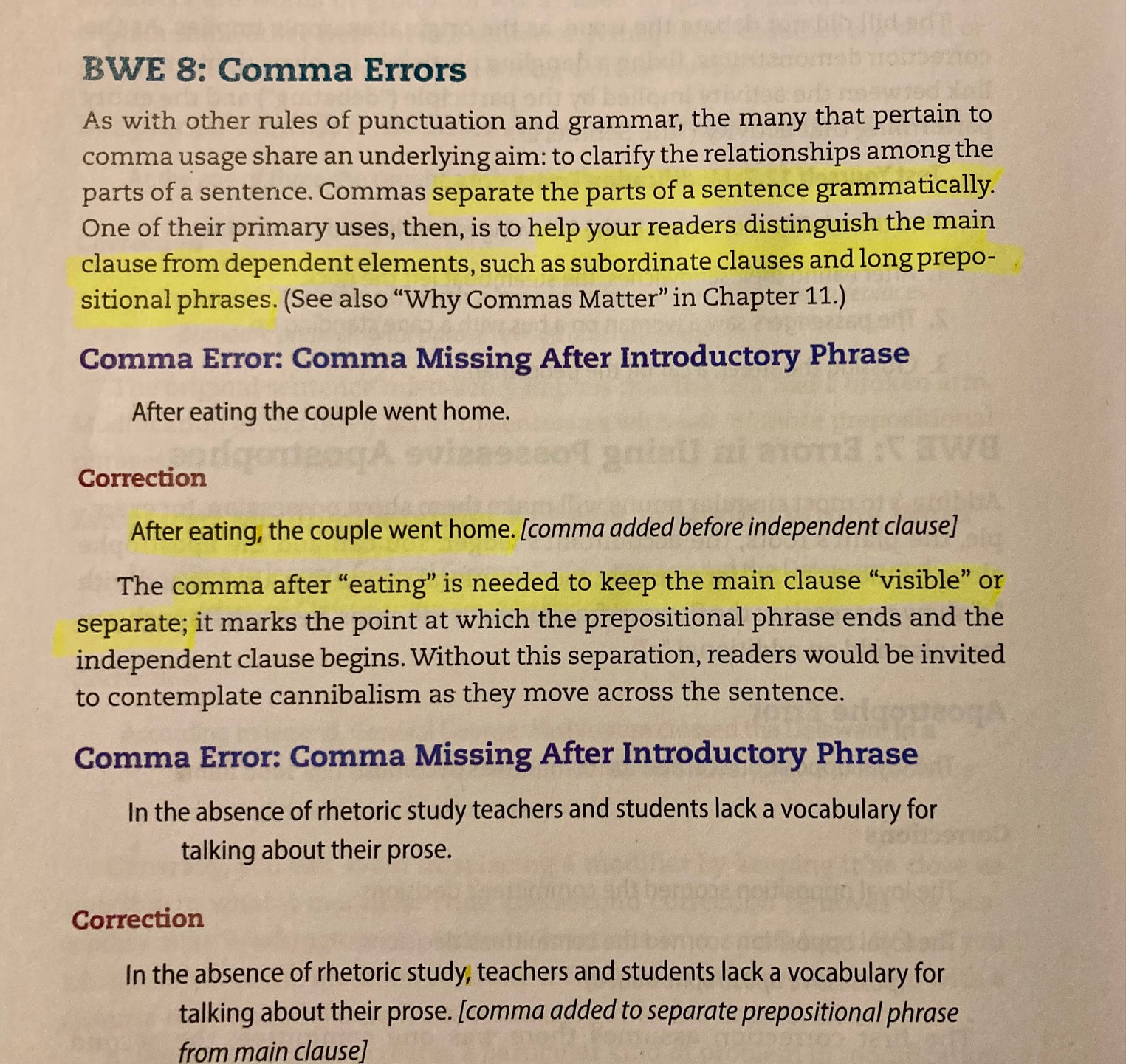
Yesterday in class you composed a blog comment in repsonse to one of your classmates’ literacy narratives. That assignment required you to either (1) identify and address one of the nine basic writing errors outlined in Writing Analytically, or (2) identify and address a particularly effective phrase, clause, or sentence.
In the sample comments that follow, I demonstrate my careful examination of the narratives through my use of concrete details.
Sample Comments
The final paragraph of your literacy narrative, includes an instance of BWE (Basic Writing Error) 8, Comma Errors, in the sentence, “For me to be a a good writer I really have to enjoy what I’m writing about” (par. 3). The omission of the required comma after “writer” is what the textbook authors label “Comma Missing After Introductory Phrase” (Rosenwasser and Stephen 440).
When you write, “my hands would break out in a sweat, my breathing would get shortened, and my knees would start to shake” (par. 18), you effectively convey your dread of public speaking, a dread you could express more succinctly with this revision: “my hands would sweat, my breathing would shortenen, and my knees would shake.”
Citations
Yesterday’s assignment required you to include a parenthetical citation for your quotation. It did not require you to include a work cited entry because the writing was a blog comment. If the assignment had been an essay, such as the reflection that you wrote last Wednesday, you would have been required to include a work cited entry, such as this:
Work Cited
Rosenwaser, David and Jill Stephen. Chapter 12: “Nine Basic Writing Errors and How to Fix Them.” Writing Analytically, 9th edition. Wadsworth/Cengage, 2024. pp. 421-55.
Reviewing Chapter 12
Returning to the pages of Chapter 12 throughout the semester will help you better understand the errors that you make and will enable you to better proofread your writing and the writing of your classmates.
Bonus-Point Opportunity
Taking advantage of the following bonus-point opportunity will not only earn you five points toward your final Check, Please! assignment, it will also provide one of your classmates with additional feedback on his or her literacy narrative.
Directions
- Read your classmates’ literacy narratives on their blogs, and make brief notes on them in your journal.
- Determine which literacy narrative you think is the strongest. Think in terms of both form and content.
- Compose a comment that includes the writer’s first and last name, the section number, the title of the literacy narrative, and a specific detail that demonstrates the strength of the essay.
- Post your response as a comment on this blog post no later than 9 a.m. on Wednesday, September 25. (To post your comment, click on the posts’s title, and scroll down to the bottom of the page. You will then see the image of an airmail envelope with a leave comment option.)
I will approve (make your comments visible) after the 9 a.m. deadline on September 25.
Next Up
In class on Wednesday, after you submit your worksheets for the fourth lesson of Check, Please!, we will examine Donald Barthelme’s short story “The School.” You do not need to print a copy of “The School”; you will receive a copy in class.

 Jane Lucas
Aiden Bazzell, who is a part of ENG 1103.20, had a really good literacy narrative. The title was “The Hidden Meaning” and it was about how writing a speech impacted him. I thought this line showed how much the assignment affected the class, “We sit in our regular seats, but something feels different, instead of nervousness, the classroom is filled with a sense of pride as students eagerly await their opportunity to disperse into their assigned classrooms and deliver their carefully crafted speeches.” This provided good detail and it was a “scene” moment.
Three-Hundred Sixty-Five Words, written by Annalise V. Lindsay, member of ENG 1103.19 portrays a beautiful and well told narrative recounting the story of when she received a vocab book from her brother on her sixteenth birthday. The strength of her literacy narrative comes from the way she utilizes her relationship with her brother to connect the entirety of her paper. From the introduction through the conclusion Ms. Lindsay gives us as readers the opportunity to watch the relationship between her and her brother grow and mature.
Living in Panera is the title of Jed Negley’s literacy narrative, based on an assignment from section 19 of English 1103. What makes this essay so strong is the detail that Jed implemented, an example being when he describes the food he smelled while writing in Panera.
Nicole Edelmon
Beyond the ballot
Section 19
This is a very strong essay providing many descriptive and key details in the writing. The formatting of the essay is on point. The picture is very clean, and the paragraphs are made appropriately. The strong point of this essay for me is how Edelmon concludes the essay. The essay is about a speech, and she is running for president. The essay concludes with how she didn’t win but the lesson she learned. She learned she has good qualities of a leader. She also learned how to deal with defeat and change direction and participate in student council. She took a defeat and turned it into a positive. This is why I think this essay is one of the stronger ones.