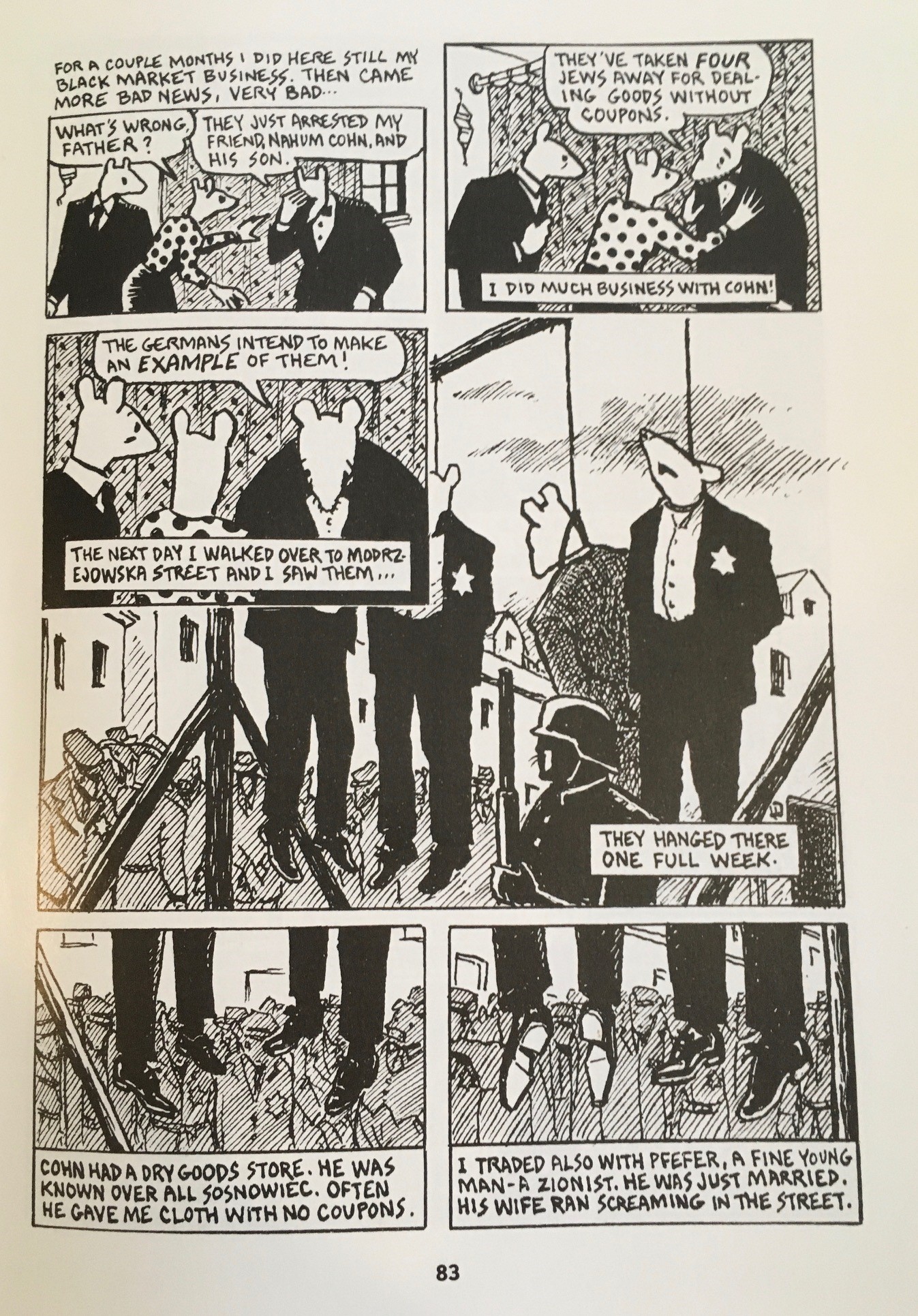
Today in class, after the Scrabble debriefing and the discussion of last Friday’s quiz, we will closley examine the page of Art Spiegelman’s Maus featured above.
Afterward, we will study an analysis of the page that I wrote as a model for my students in a previous semester, and you and two or three of your classmates will collaborate on an assignment that asks you to consider these questions:
- Where in the essay does the writer present an instance of the connection that she addresses in her thesis? Offer one example in your answer.
- Where in the essay does the writer present an instance of the separation that she addresses in her thesis?
- Effective strategies for concluding analyses include (1) offering an insight about the text or an additional quotation from it, (2) revisiting the thesis without stating it verbatim, and (3) pointing to the broader implications of the analysis. Reread the conclusion of “The Strange Fruit of Sosnowiec” and compose a paragraph that identifies the strategy or strategies listed above that the writer employs.
Friday’s Quiz
The first question asked you to list one punctuation rule that you learned or were reminded of in class. Some of you simply listed a term rather than a rule. Merely writing “comma splices” does not demonstrate that you know what a comma splice, or fused sentence, is or how to avoid or eliminate one. Here is one way to demonstrate your understanding of the term in your answer:
- A writer creates a comma splice, or a fused sentence, when he or she places a comma, rather than a period or semicolon, between two independent clauses (complete sentences).
The second question asked you to list one style rule that you learned or were reminded of in class. Again, some of you simply listed a term rather than a rule. Merely writing “MLA style” does not demonstrate that you know the rules of MLA style. Here are some ways to demonstrate your understanding of the term in your answer:
- In MLA style, numbers that can be expressed in one or two words are written as words, not figures.
- In MLA style, titles of short works, such as essays, are enclosed in quotation marks, and titles of long works, such a book-length texts and feature films, are italicized (or underlined in longhand).
- Thoughts are not enclosed in quotation marks; they are italicized.
The third question asked you to identify Michael Lewis, who is the author of The Blind Side, which you read an excerpt from on Monday.

Michael Lewis’s name appears on your copy of the excerpt from The Blind Side. It should also appear in the first sentence of the summary of the excerpt that you wrote in your journal, as well as in your journal notes on my September 16 blog post. We write to remember. Write notes in your journal on every reading and every blog post to retain what we have covered in class.
The fourth question asked you to identify the most versatile consonant. Some of you answered s, but the most common consonant is not the same as the most versatile. M is the most versatile In the first position in two-letter words, it pairs with every vowel: ma, me, mi, mo, mu, and also my. In the second position, it pairs with every vowel except i: am, em, om, um.
The fifth question asked you to explain why that letter is the most versatile consonant. M is the most versatile one because in the first position in two-letter words, it pairs with every vowel: ma, me, mi, mo, mu, and also my. In the second position, it pairs with every vowel except i: am, em, om, um.
The sixth question asked you to identify the topic of Friday’s blog post. Some of you answered “Scrabble.” Others answered “Wordplay Day.” Scrabble is the subject of the post; Wordplay Day is the occasion for it. The topic of a Scrabble post is always something more specific. Last Friday’s topic was two-letter words beginning with the letters q-z.
Lastly, you had the opportunity to earn bonus points by listing words that you had learned from last Friday’s Scrabble blog and any of the other previous Scrabble posts. Many of you earned points by listing playable names from the August 23 playable names blog post and/or the two-letter words blog posts published on August 22 and 30, and September 7, 13, and 30.
Next Up
On Wednesday, after I collect your fifth and final Check, Please! worksheets, you will begin planning and drafting your textual analyses. Review all of the texts that we have studied in class, reread your journal notes on them, and determine which one appeals to you most as a subject for analysis. As your writing progreses, you may decide to focus on a different text, but making a preliminary selection before Wednesday’s class will likely lead to a more productive planning and drafting period.

 Jane Lucas