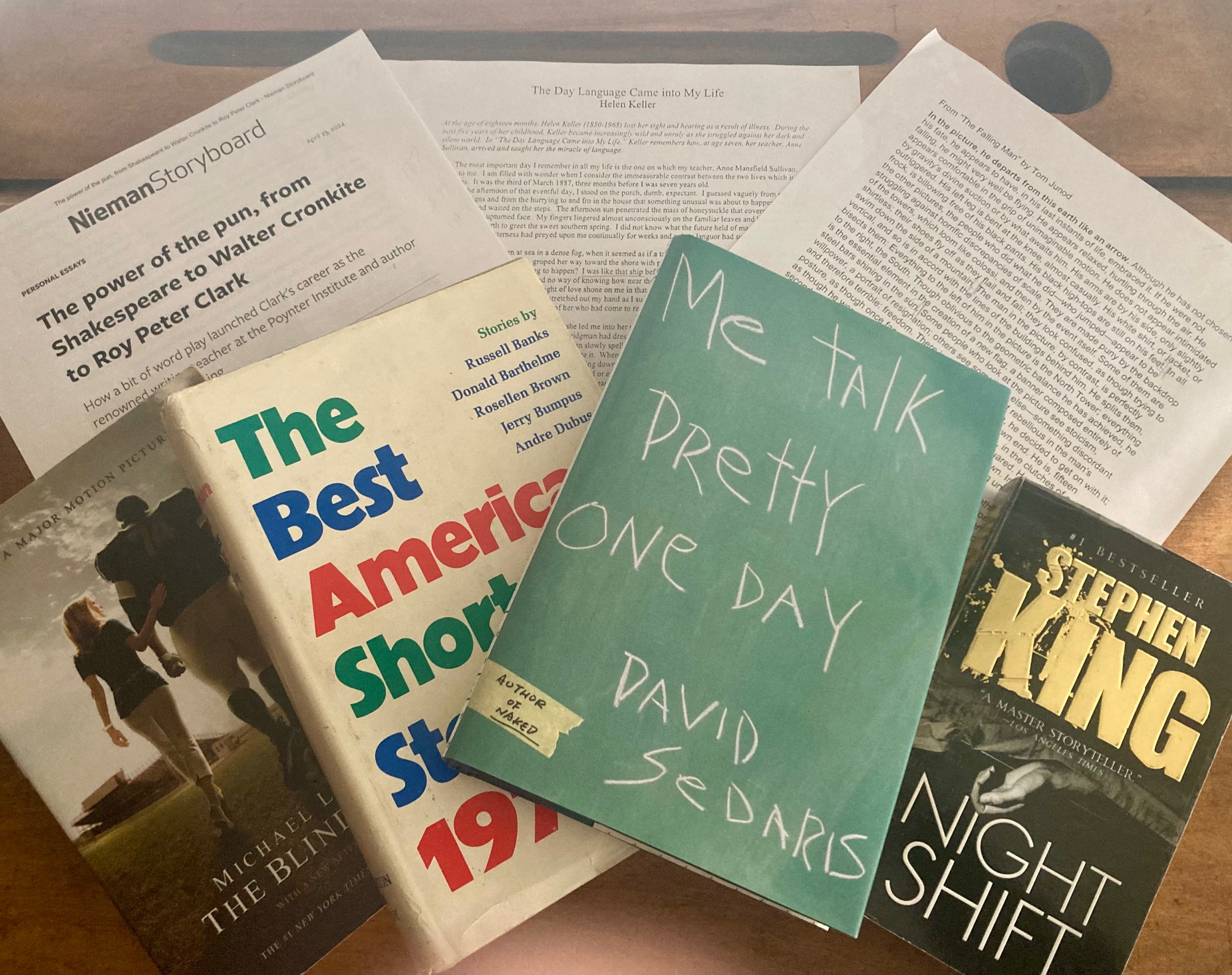
The best way to develop your skills as a writer is to write; the second best way is to study the prose of masterful writers. You will engage in those two practices simultaneously if you select one of the authors we’ve studied as the subject of your final essay and annotated bibliography. The majority of you have chosen instead to focus on one of the aspects of the course, namely playing Scrabble, writing longhand, or limiting screen time. To encourage you to take on a more intellectually rigorous exercise, I will award you 2.5 bonus points if you focus on the writing of one of our authors: Donald Barthleme, Roy Peter Clark, Tom Junod, Helen Keller, Stephen King, Michael Lewis, or David Sedaris. If you choose to write about one of those authors and consult with a Writing Center tutor, you will earn a total of 7.5 bonus points.
If, for example, you wrote about David Sedaris’s writing, your sources would consist of “Me Talk Pretty one Day,” a student interview about his writing, a secondary source–such as a study of his prose–and two additional essays by Sedaris. Only the first bibliographic entry for Sedaris would include his credentials. Including them in all three would be redundant. Below is a sample annotated bibliographic entry for a study of Sedaris’s writing, an anlaysis that’s available through the HPU Libraries’ databases.
Cardell, Kylie, and Victoria Kuttainen. “The Ethics of Laughter: David Sedaris and Humour Memoir.” Mosaic: A Journal for the Interdisciplinary Study of Literature, vol. 45, no. 3, 2012, pp. 99-114. ProQuest, https://libproxy.highpoint.edu/login?url=https://www.proquest.com/scholarly-journals/ethics-laughter-david-sedaris-humour-memoir/docview/1039705353/se-2.
In “The Ethics of Laughter: David Sedaris and the Humor Memoir,” Kylie Cardell and Victoria Kuttainen examine essays in three of Sedaris’s collections—Naked (1998), Dress Your Family in Corduroy and Denim (2008), and Squirrel Seeks Chipmunk: A Wicked Bestiary (2010)–as examples of real-life humor that veers from the truth, what Sedaris himself has described as “‘realish’” writing (qtd. in Cardell and Kuttainen, par. 1). Cardell and Kuttainen identify that gray area that Sedaris’s essays inhabit as “ethically hazardous territory” (par. 2).
Kylie Cardell is Senior Lecturer in English at Flinders University, South Australia, and author of Dear World: Contemporary Uses of the Diary, as well as editor (with Kate Douglas) of Telling Tales: Autobiographies of Childhood and Youth. Victoria Kuttainen is Senior Lecturer in English and Writing at James Cook University in North Queensland, Australia and the author of Unsettling Stories: Settler Postcolonialism and the Short Story Composite. Cardell’s and Kuttainen’s study of Sedaris’s writing offers insight into the role of artistic license in his essays, in particular how his humor blurs the line between fact and fiction and how that unclear division prompts questions regarding the ethics of embellishment—or otherwise altering the truth—in memoir.
Next Up
In class tomorrow, we will review a sample final essay and annotated bibliography, and you will have additional time to devote to researching and writing for your own final essay and annotated bibliography. Details and instructions TBA.
 Jane Lucas