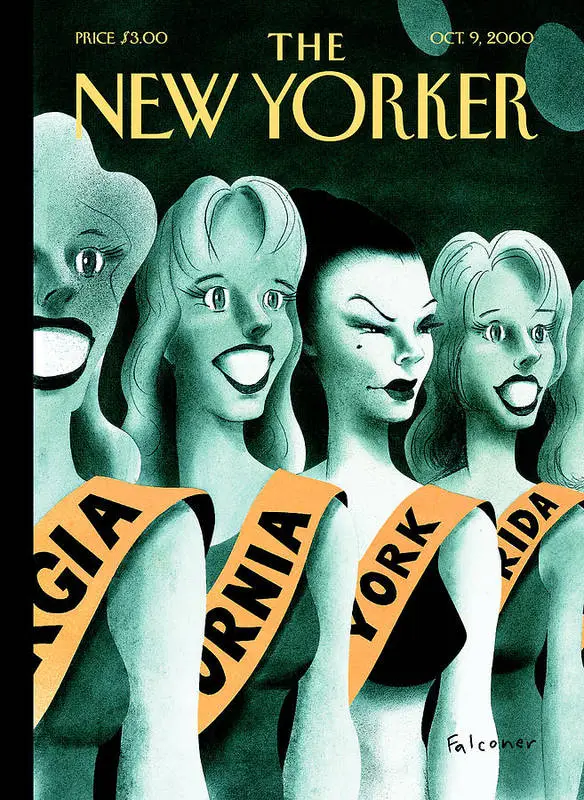
Today in class, we will examine Ian Falconer’s New Yorker magazine cover The Competition, and you will compose a one-paragraph summary of the cover. Rather than following your summary with a paragraph of commentary on The Competition, we will examine two commentaries in our textbook:
In Writing Analytically, David Rosenwasser and Jill Stephen note that “[a]t its most serious, The New Yorker cover may speak to American history, in which New York has been the point of entry for generations of immigrants, the ‘dark’ (literally and figuratively) in the face of America’s blonde northern European legacy” (112).
Also, in Writing Analytically, David Rosenwasser and Jill Stephen observe that “we might find ourselves wishing to leaven this dark reading with comic overtones–that the magazine is . . . admitting, yes America, we do think that we’re cooler and more individual and less plastic than the rest of you, but we also know that we shouldn’t be so smug about it” (112).
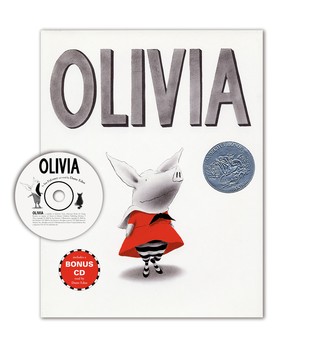
If the style of Ian Falconer’s New Yorker cover seems familiar to you, it may be because you encountered his work when you were a child. His book Olivia, published in 2000, received the 2001 Caldecott Medal, an award the Association for Library Service bestows upon the book they deem the best children’s picture book of the year. Falconer followed Olivia with several sequels, including Olivia Saves the Circus and Olivia Helps with Christmas.
After our dicsussion of The Competition, you will collaboratively compose a summary of another visual text, Tetsuya Ishida‘s Seedlings. Then, using the commentaries above as models, you will write a paragraph of commentary on the painting.

Work Cited
Rosenwasser, David and Jill Stephen. Chapter 3: “Interpretation: Asking So What?” Writing Analytically, 9th edition. Wadsworth/Cengage, 2019. pp. 81-118.
Next Up
At the beginning of class on Wednesday we will revisit Seedlings, and you will have the remainder of the period to devote to writing your reflection on your final essay and annotated bibliography.
 Jane Lucas