Yesterday in class, we examined the model literacy narrative “A Bridge to Words,” and you and two of your classmates collaboratively composed a piece of writing that addressed these elements of the essay:
- scene
- figurative language
- gaps in memory/what the narrator doesn’t know
- the story’s significance–how the writer conveys it subtly
The paragraphs that follow address the elements listed above, as well an additional one to consider as you revise your literacy narrative.
With the words, “[f]inally, one Sunday,” I shift from summary to scene for the first time (par. 3). The previous paragraphs describe the reading ritual that occurred every Sunday.
Instances of figurative language in the narrative include “as if covered by a shroud” (par. 1), “like links in a chain” (par. 7), and an extended metaphor in the conclusion:
“Perhaps rereading Art Spiegelman’s graphic memoir Maus with my students has aroused the wordless Henry and the word-filled Golden Book of Fun and Nonsense from the corner of my brain where they’ve slumbered. The former wakes and stretches out in my mind as a bridge to the latter: a spot in the world of words I’ve inhabited ever since” (par. 8).
Twice in the essay, I use a strategy employed by Helen Keller in “The Day Language Came into My Life,” specificaly, I note what I cannot recollect. I first use that strategy when I write, “Whether it was one of my parents or my sister, I don’t know” (par. 3). I draw on it again when I write, “Why these particular early memories visit me now, I don’t know” (par. 8).
As I noted in class, there are a number of ways that I convey the significance of my experience without stating explicitly that the events were noteworthy. The vivid details of the narrative demonstrate their importance. Those details that are vivid in my mind are subsequently lifelike on the page because their significance permeates them. Both of your groups offered as examples details about my sister, Jo, reading to me from The Golden Book of Fun and Nonsense. One group noted “the word ‘abhors’ . . . which appealed to me” (par. 7). The other group mentioned my “uncontrollable giggles” (par. 7).
Appositives
An appositive is a group of words that renames or defines a noun or noun phrase. Using appostives not only helps you develop your writing but also enables readers to better relate to your writing through the specifics that the appostives offer. Examine each of the four passages below, and note how each appositive expands on the ideas presented in the noun, the noun phrase, or the noun clause that precedes it.
- “My sister, who was three years older, had her very own news source, The Mini Page, a four-page miniature paper that arrived at our house as an insert in the Sunday edition (par. 2).
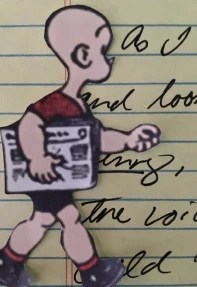
- I remember only the gesture and the words: someone handing me the Sunday comics and saying, “You can read part of the funny page, too. You can read Henry” (par. 3).
- “As the last word in the first line, ‘abhors’ serves as the lead-in to an enjambment: the continuation of a sentence or clause in a line break” (par. 7).
- The former wakes and stretches out in my mind as a bridge to the latter: a spot in the world of words I’ve inhabited ever since” (par. 8).
As you revise, review these notes and incorporate some of these elements into your own literacy narrative.
Work Cited
Lucas, Jane. “ENG 103: Model Literacy Narrative, ‘A Bridge to Words.'” Jane Lucas, 27 January 2025, https://janelucas.com/2025/01/27/eng-1103-model-literacy-narrative-a-bridge-to-words-3/.
Next Up
At the beginning of class on Wednesday, you will submit your worksheet for the second lesson in the Check, Please! course. After that, I will return your literacy narrative drafts with my notes, and you will have the remainder of the class period to begin your revisions. You will have an additional week to continue to revise. The due date for posting your revison to Blackboard and to your WordPress blog is Wednesday, February 5 (before class); the hard deadline is Friday, February 7 (before class).

 Jane Lucas