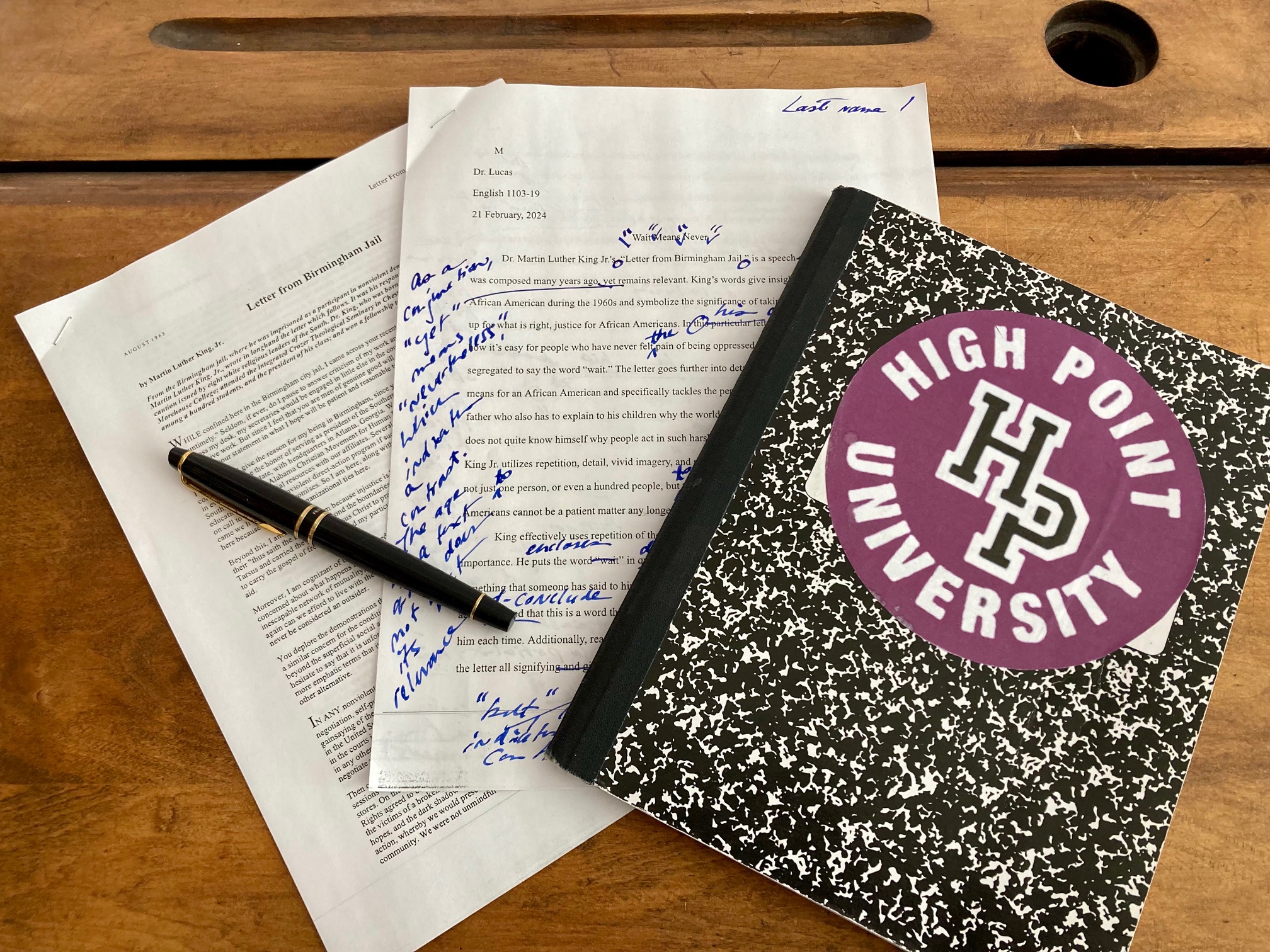
In the picture above–and in the one in yesterday’s post–you can see some of my notes on the sample King analysis, “Wait Means Never.” Today’s blog post presents more detailed notes on the essay’s content and form.
Content
- Rather than beginning with a summary of Martin Luther King, Jr.’s “Letter from Birmingham Jail,” the writer comments on it by observing its relevance. Instead the writer should state what the letter is, an epistolary essay King wrote in 1962 while he was jailed in Alabama for leading nonviolent protests.
- The writer ends the first paragraph with a thesis, but the statement is primarily description. Essentially, the writer states that King uses stylistic devices to deliver his message to a wider audience, but a thesis or main claim in a textual analysis should offer an assertion about how the writer’s use of those devices achieve a particular effect. In class next Monday, we will examine a sample revised thesis for “Wait Means Never.”
- The writer observes that King repeats “the word ‘wait’ throughout the letter” (par. 2), but King does not introduce that word until his eleventh paragraph. The writer could revise his thesis to focus specifically on King’s eleventh paragraph because that portion of the letter is the source of his claims and textual support.
- In the body paragraphs, the writer effectively details King’s diction and sentence structure, but a couple of inaccuaracies undercut the prose. Neither “from bad to worse” (par. 3) nor “at the end of the letter” (par. 5) is accurate.
- After ending the final body paragraph with ”’wait'” (par. 5), the writer turns to a conclusion that reads more like the ending of a history report than a textual analysis. Simply revising the opening of the last paragraph to begin, “[t]he words of Dr. Martin Luther King . . .” would maintain the focus of the analysis, the words themselves. The writer could still address the letter’s role in history by noting how the words have endured as a rallying cry for peaceful nonviolent protest. Consider how else the writer might give the analysis closure.
Form
- The document lacks a running header.
- Because the writer is referring to “wait” and “never” as words in his title, both should be enclosed in quotation marks.
- In the first line, the writer defines King’s letter as a “speech of literature” (par. 1). Although King was an orator, his “Letter from Birmingham Jail,” is not one of his speeches. As the title indicates, it’s a letter. Labeling the letter “literature” is unnecessary because the analysis that unfolds will reveal the literary quality of the prose. If the writer wants to address the letter’s status as a work of literature, in the conclusion, he might note that many students first encounter King’s letter in the pages of their high school and college anthologies.
- In the first sentence of the introductory paragraph and the second sentence of the second paragraph, the writer uses coordinating conjunctions that indicate contrast, but the clauses those words connect are not in contrast. See “yet remains” (par. 1) and “but irked” (par. 2). In both cases, “and” would be the accurate conjunction. That said, “yet remains” introduces an assessment of the letter–in particular, its relevance–which shouldn’t be part of the summary at the beginning of the analysis.
- The writer refers to King’s voice as “the narrator’s” (par. 2), but a narrator is a person who tells a story, usually a work of fiction or a narrative poem. King should be referred to as the writer or the author.
- The clauses “it can easily be acknowledged” (par. 2) and “it can be identified” (par. 5) are passive constructions that de-emphasize the subject. The sentences that contain those clauses should be revised to show the action that King performs as a writer. The second-paragraph sentence might be rewritten as this: King’s repetition of “wait” emphasizes how frequently he has heard the word and how its “piercing familiarity” (par. 11) has increased his frustration. The two sentences convey the same idea, but the revision is eleven words shorter.

 Jane Lucas