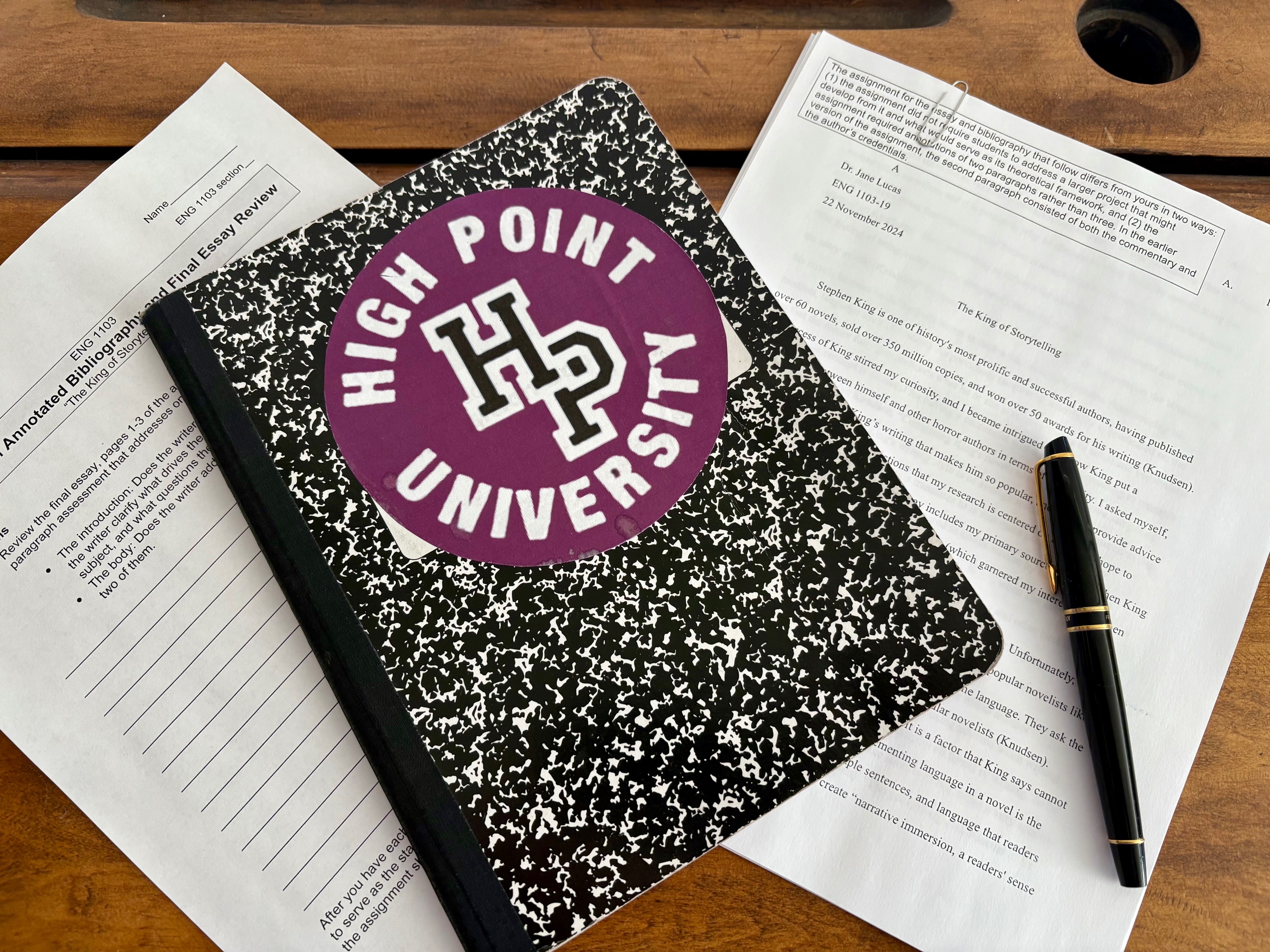
This morning’s class will focus on a review of the sample student essay and annotated bibliography “The King of Storytelling,” an exercise that will serve as a guide for you as you develop and revise your own essay and bibliography.
After your Scrabble debriefing at the beginning of class, I will give each of you a writing prompt that asks you to focus on one section of the sample assignment.
If your prompt directs you to examine the final essay, you will begin your writing by addressing one or more of these elements:
The introduction: Does the writer address the purpose for compiling it? Does the writer clarify what drives the research, what interests the writer in the subject, and what questions the writer seeks to answer?
The body: Does the writer address all five of the sources and quote at least two of them.
If your prompt directs you to examine the first three annotations or the last two, you will begin your writing by addressing one or more of these elements:
One of the summaries: Does it provide a clear objective overview of the article, book, or interview?
One of the commentaries: Does the writer identify the purpose that source might serve in a larger project? (Does the writer demonstrate how the source serves as a point of comparison or contrast to another source? Does the writer indicate how it supports or challenges an idea presented in another source? Does the writer identify it as secondary source that sheds light on the meaning of a primary source?)
After you have each completed your individual review, choose a passage from one of them to serve as the starting point for our class discussion. Then use the evaluation criteria on the assignment sheet to determine a letter grade for “The King of Storytelling.”
Time permitting, after our discussion of “The King of Storytelling,” we will preview an exercise for Wednesday’s class.
Next Up
Wordplay Day! To prepare for class, revisit the Dictionary and World Builder pages on the Scrabble website, and review the blog posts devoted to Scrabble.
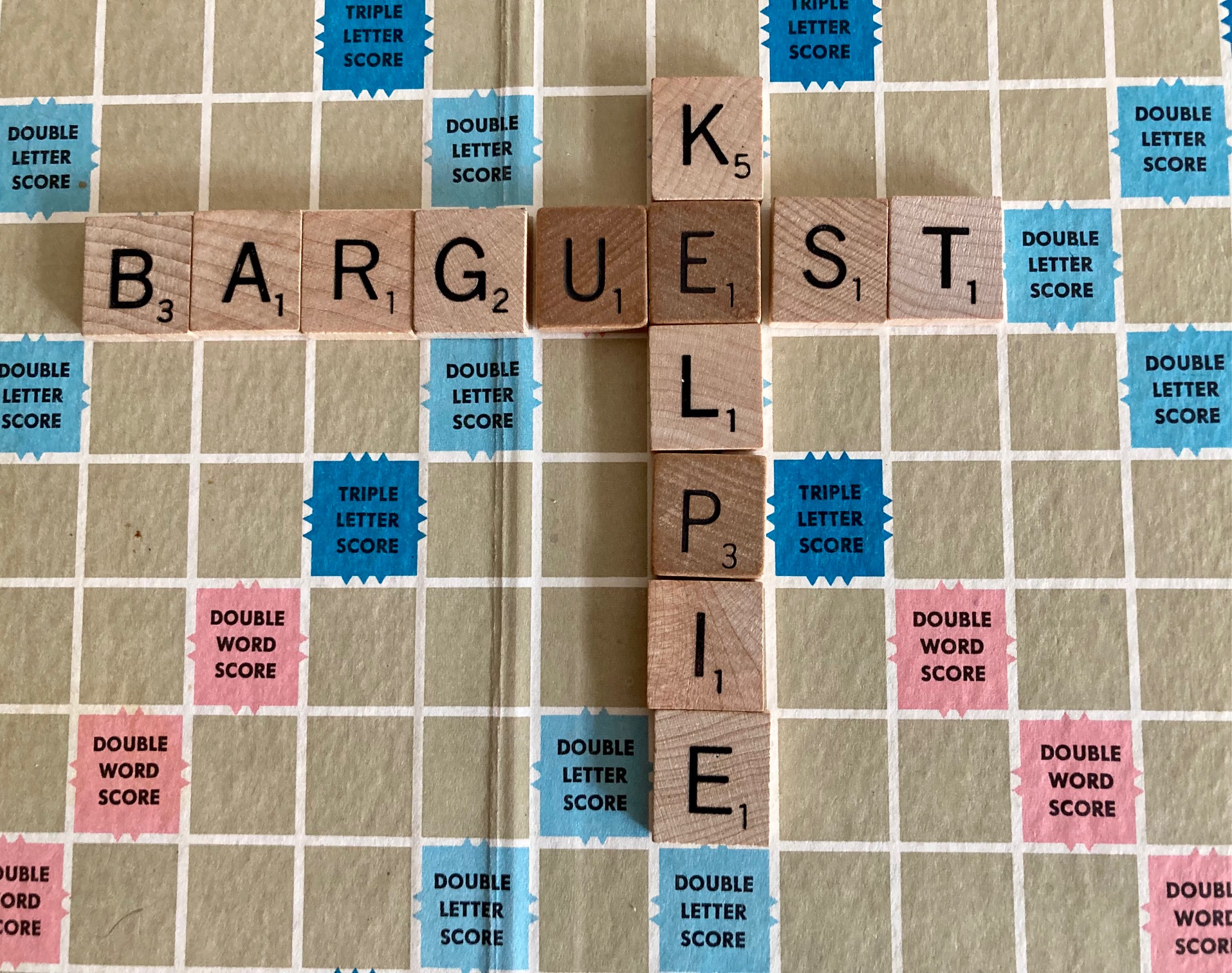
Since we studied Stephen King’s “Strawberry Spring” earlier this week, today’s Scrabble blog post is a King-inspired one devoted to words for ghosts, including banshee, which appears in the story.
banshee: a female spirit in Gaelic folklore that wails to warn of a family member’s imminent death. Note that this word is featured in Stephen King’s short story “Strawberry Spring,” which we examined in class yesterday.
barguest: a goblin (also barghest)
bogy: a goblin
daimon: a spirit (also daemon and demon)
eidolon: a phantom or specter
fairyism: the quality of being like a fairy (not really a ghost but a great word)
haint: a ghost
kelpie: a water sprite in Scottish folklore known for drowning sailors
wraith: a ghost of a person, often appearing just before that person’s death
zombi: a zombie
Next Up
Wordplay Day! To prepare for class, revisit the Dictionary and World Builder pages on the Scrabble website. Also review the blog posts devoted to Scrabble tips, including this one.
Last Wednesday in class, on the worksheet you completed, you were required to select a phrase or sentence from your interview and introduce it with a signal phrase. You were also required to compose a complete annotated bibliographic entry.
Although you are not required to transcribe your complete interview, I encourage you to do so. If you decide that you want to include in your annotated bibliography and/or final essay a phrase or sentence other than the one you included on your worksheet, having a file of your complete interview will enable you to easily copy and paste lines from your interview into your essay and/or your bibliography.
Transcripts of my own interviews with students are included below as models for your own.
Interview with Jesse Brewer
Q: Jesse, what experience did you have with playing Scrabble before you encountered the game in English 1103?
A: So, whenever I would go up to my grandmother and grandfather’s house in Pennsylvania, we would play Scrabble pretty consistently there. We had a lot of fun playing Scrabble at my grandmother’s house whenever I was a young child.
Q: Has Scrabble changed your perspective on reading and/or writing? If so, how?
A: While I wouldn’t necessarily say it has changed my perspective on reading or writing, it has most certainly introduced me to new words which allows me to read or write more capably in everyday situations.
Q: Will you continue to play Scrabble after the conclusion of the semester?
A: Yes, my grandmother is still going to want to play it every summer.
Interview with Ava Salvant
Q: Ava, what experience did you have with playing Scrabble before you played it in English 1103?
A: I didn’t have any experience with Scrabble beforehand. I didn’t know how to play it at all.
Q: Has Scrabble changed your perspective on reading and/or writing? If so, how?
A: Probably it has influenced my ability to write. Not always when you sit down to write do you know the exact words you want to say. You kind of have to go with the flow. You have to put as many words as you can down on the board in Scrabble or on the paper when writing.
Q: Will you continue to play Scrabble after the end of the semester?
A: I might come back to it a few times to refresh or just use as a pastime.
Next Up
Wordplay Day! To prepare for class, revisit the Dictionary and World Builder pages on the Scrabble website. Also review the blog posts devoted to Scrabble tips.
Today in class you will use the HPU Libraries website and Google Scholar to locate, read, and annotate additional sources for your final essay and annotated bibliography. The work that you submit at the end of class today should include at least one MLA-style annotated bibliographic entry. The sample entry that I composed as a model for you appears below.
Cardell, Kylie, and Victoria Kuttainen. “The Ethics of Laughter: David Sedaris and Humour Memoir.” Mosaic: An Interdisciplinary Critical Journal, vol. 45, no. 3, 2012, pp. 99-114. JSTOR, http://www.jstor.org/stable/44030697.
“The Ethics of Laughter: David Sedaris and Humour Memoir” explores the implications of the blending of truth and artifice in David Sedaris’s writing. In the words of the authors, Sedaris’s “memoirs have attracted controversy for their blurring (or, as we argue, contesting) of boundaries between fiction and non-fiction” (Cardell and Kuttainen 100). While some critics, such as journalist Alex Heard, believe that “Sedaris exaggerates too much for a writer using the non-fiction label” (qtd. in Cardell and Kuttainen 103), Cardell and Kuttainen assert that Sedaris’s use of hyperbole, a staple of his prose style, is ethical in the context of the humor memoir.
Cardell’s and Kuttainen’s essay would serve as a useful source for a study of Sedaris’s mingling of the real and what he refers to as the “realish” in his writing (qtd. in Cardell and Kuttainen 99). It could also play a significant role as a source for a comparative study of the writing of Sedaris and other memoirists who blur the line between fiction and nonfiction.
Kylie Cardell, Ph.D., author of Dear World: Contemporary Uses of Autobiography, is Associate Professor of Humanities at Flinders University. Her co-author, Victoria Kuttainen, Ph.D., author of Unsettling Stories and The Transported Imagination, is Associate Professor of Art and Creative Media at James Cook University.
Note that the blog format of the annotated bibliographic entry above is different from MLA format, which features paragraph indentations and double spacing.
The bibliographic entry above and the three paragraphs that follow total 241 words. The minimum word count for the entire assignment (essay and bibliography together) is 1,800 words.
If you compose five annotations of the length of the one above, you will be well on your way to completing your 1,800-word minimum, and your bibliography may be longer than your essay.
Literary Allusions in “Strawberry Spring”
Monday’s group exercise asked you to look for literary allusions in Stephen King’s “Strawberry King.” The first is an allusion to J.R.R. Tolkein‘s The Lord of the Rings trilogy: “You half expected to see Gollum or Frodo or Sam go hurrying past” (269). The second is an allusion to a poem by Carl Sandburg, titled–perhaps unsurprisingly–“The Fog” (272).
Next Up
Wordplay Day! To up your game and increase your word power, revisit the Dictionary and World Builder pages on the Scrabble website, and review the blog posts devoted to Scrabble tips.
Tomorrow morning, before you continue work on your final essay and annotated bibliography, we will revisit Stephen King‘s “Strawberry Spring” and discuss the answers to your collaborative exercise on the story.
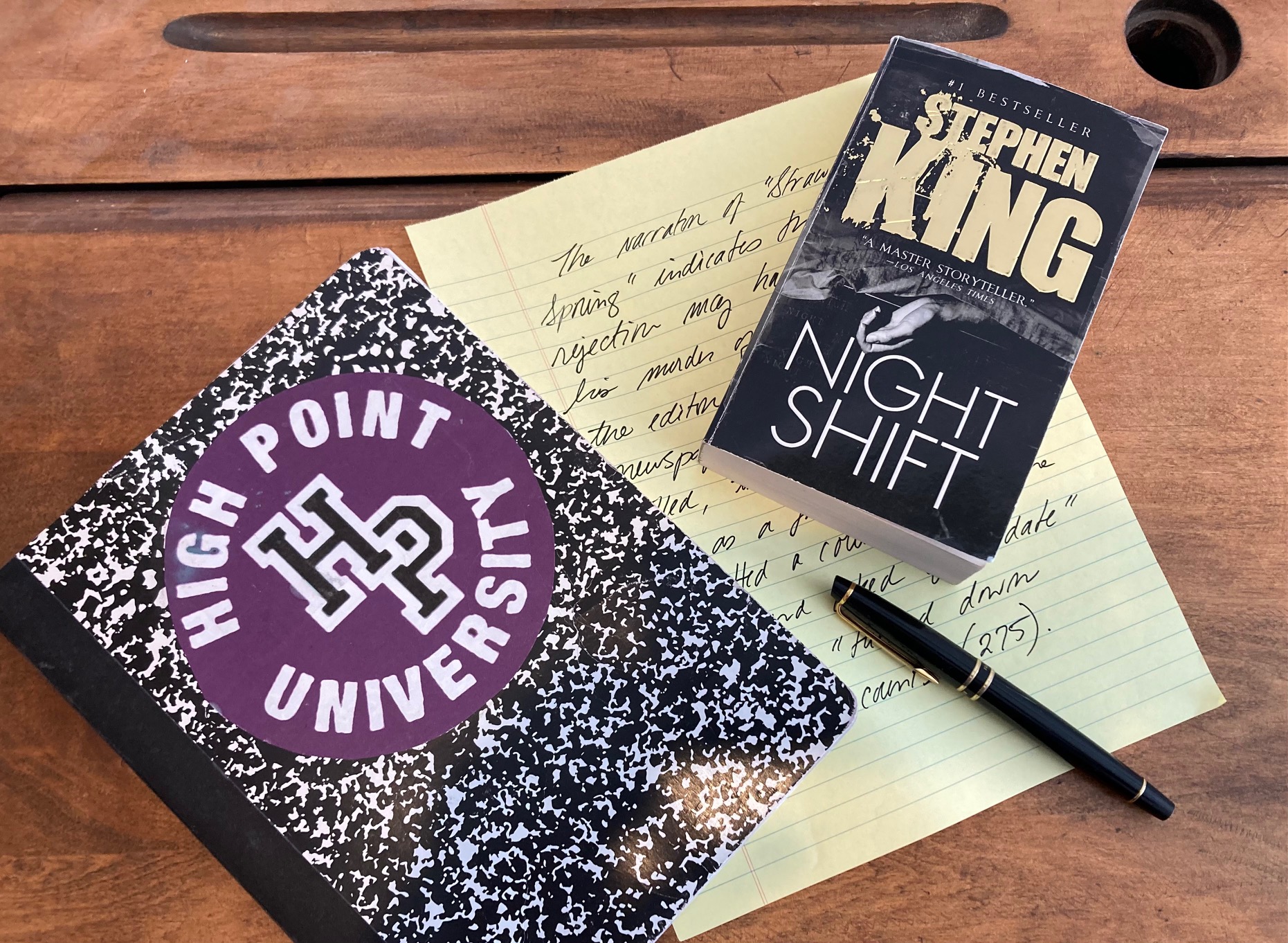
For that exercise, I asked you to determine whether you could identify any details that indicate why the narrator may have murdered any of his victims. Although there is no indication that the narrator knew Gale Cermann, Adelle Parkins, or Marsha Curran, he did know Ann Bray, which he reveals after he tells the readers that she was editor of the school newspaper: “In the hot, fierce bubblings of my freshman youth I had submitted a column idea to the paper and asked for a date–turned down on both counts” (275).
I also asked you to try to identify the two literary allusions in King’s story. The first appears on page 269, the second on 272. We will examine them in detail at the beginning of tomorrow’s class.
Next Up
At the beginning of tomorrow’s class, we will continue our discussion of “Strawberry Spring.” Afterward, you will have the remainder of the period to devote to your final essay and annotated bibliography. Details TBA.
Today in class we will read the second half of Stephen King‘s short story “Strawberry Spring,” which was published in Ubris magazine in 1968 and included in King’s first short story collection, Night Shift (1978).
For the collaborative exercise that you will complete after we read the story, I will ask you to determine whether you can identify any details that indicate why the narrator may have murdered any of his victims. Although there is no indication that the narrator knew Gale Cerman, Adelle Parkins, or Marsha Curran, he did know Ann Bray. I will also ask you to try to identify the two literary allusions in King’s story.
We will address those points near the end of class today, and I will expand on them in tomorrow’s blog. Also in class today, we will discuss King’s story as another possible subject for research and how you might develop a final essay and annotated bibliography on “Strawberry Spring”–or one on your chosen subject–into a larger project for an upper-level course.
Next Up
We will review “Strawberry Spring” at the beginning of Wednesday’s class, and you will have the remainder of the period to continue work on your final essay and annotated bibliography.
The last Scrabble post featured a list of toponyms (place names) in the first half of the alphabet. This post includes a list of toponyms in the second half. These proper nouns are playable in Scrabble because they’re also common nouns. Studying them offers you additional opportunities to broaden your vocabulary and up your game.
oxford: a type of shoe, also known as a bal or balmoral
panama: a type of wide-brimmed hat
paris: a type of plant found in Europe and Asia that produces a lone, poisonous berry
roman: a romance written in meter
scot: an assessed tax
scotch: to put an end to; or to etch or scratch (as in hopscotch)
sherpa: a soft fabric used for linings
siamese: a water pipe providing a connection for two hoses
swiss: a sheer, cotton fabric
texas: a tall structure on a steamboat containing the pilothouse
toledo: a type of sword known for its fine craftsmanship, originally from Toledo
wale: to injure, to create welts on the skin
warsaw: a type of grouper fish
waterloo: a definitive defeat
zaire: a currency of Zaire
Next Up
Wordplay Day! To prepare for class, revisit the Dictionary and World Builder pages on the Scrabble website, and review the posts on my blog devoted to Scrabble tips, including this one.
Today’s blog post features my version of the fifth Check, Please! assignment, which you submitted at the beginning of yesterday’s class. Although you have now completed your final Check, Please! worksheet, this model assignment and the previous four will remain useful to you as you continue to hone your information literacy skills.
Check, Please! Lesson Five
In the fifth lesson of the Check, Please!, Starter Course, Mike Caulfield, author of the course and ra esearch scientist at the University of Washington’s Center for an Informed Public, covers the final step in the five-step SIFT approach: “Trace Claims, Quotes, and Media to Their Original Context.” Caulfield outlines the process of locating the original context as an antidote to the issues of accuracy that occur when information passes through intermediaries.
One of the most instructive portions of lesson five features a passage in which Caulfield cites a study of how stories evolve as gossip through the processes of leveling (stripping details), sharpening (adding or emphasizing details), and assimilating, which combines the two. In the process of assimilation “the details that were omitted and the details that were added or emphasized are chosen because they either fit what the speaker thinks is the main theme of the story, or what the speaker thinks the listener will be most interested in.” Similarly, leveling, sharpening, and assimilating all figure in the altered photographs and memes in lesson four. The abbreviated speech of the NRA’s CEO, Wayne LaPierre, which omits commentary, inaccurately indicates a contradiction in his stance on the presence of guns in schools.
The image of photographer Kawika Singson with flames at his feet serves as an example of leveling. Although the flames are real, they were not caused by the heat of the lava flow where Singson stands with his tripod. Instead, to create the image, a friend of his poured accelerant on the lava before Singson stepped into the frame. The deception wasn’t intentional; Singson simply wanted the image for his Facebook cover photo.
Unlike Singson’s photograph, the altered photograph of the Notorious B.I.G. with Kurt Cobain was created with the intent to deceive. Cropping and merging the two photographs illustrates the assimilation process adopted by photoshop users to appeal to music fans eager to think that such fictional meetings of icons took place. Krist Novoselic, who founded Nirvana with Cobain, replied to the is-it-real question with his own fake photo, making the claim that the hand holding the cigarettes was Shakur’s, that he had been cropped from the right.
Wordplay Day! To prepare for class, revisit the Dictionary and World Builder pages on the Scrabble website, and review the blog posts devoted to Scrabble tips.
This morning, after I collect your final Check, Please! worksheets, you will begin work on the first segment of your final essay/annotated bibliography assignment, which is an interview with one of your classmates.
Interview Assignment
Your final essay and annotated bibliography will focus on one of the authors we have studied or one of elements of the course, including (1) blogging in the classroom, (2) limiting screen time, (3) writing longhand, and (4) playing Scrabble. As a starting point, you will conduct a short personal interview that will serve as one of the sources for your project. If you decide that you do not want to use the interview that you conduct today, you are welcome to include another one in your project. Keep in mind, however, that the interview you include in your project must be conducted with a student currently enrolled in section twenty or twenty-one, and the subject of the interview must be the subject of your project.
Questions to ask your interviewee include the following:
What experience, if any, did you have with the subject (the reading or the aspect of the course) before you encountered it in English 1103?
Has it changed your perspective on reading and/or writing? If so, how?
Will you continue to pursue the subject (read more work by the author, continue the classroom practice or activity) after the conclusion of the semester?
After you conduct your interview, compose on the worksheet provided a sentence in which you introduce a quotation from the interview with a signal phrase or clause, such as, According to . . . , or [insert first and last name] notes or observes or points out that . . . .” Your quotation will not be followed by a parenthetical citation because it is a form of oral communication (without page or paragraph numbers). See the sample on your worksheet.
Follow your quotation with annotated bibliography entry in this format:
Annotated Bibliography*
Last Name, First Name. Interview. Conducted by Your First Name Your Last Name. Day Month Year.
*Note that you will use the header annotated bibliography, not works cited, in your final essay and annotated bibliography.
Below the work cited/bibliography entry, compose a one-paragraph summary of the interview followed by a second shorter paragraph that addresses what role the interview might serve in a larger project. Would it serve as a point of comparison or contrast to another source? Would it support or challenge an idea presented in another source? Follow the second paragraph with a brief third paragraph that notes the student’s major and identifies him or her as a freshman or sophomore at High Point University. See the model below.
Sample Quotation with Signal Clause
English 1103 student Jesse Brewer observes that Scrabble has expanded his vocabulary, saying it has “introduced me to new words, which allows me to read and write more capably in everyday life.”
Sample Annotated Bibliographic Entry
Brewer, Jesse. Interview. Conducted by Jane Lucas. 20 Oct. 2023.
English 1103 student Jesse Brewer recounts how he has played Scrabble for most of his life. Ever since he was a young child, he has played the game with his grandparents whenever he visited their home in Pennsylvania. Brewer will continue to play Scrabble after the end of the semester because the game remains a tradition in his family. In his words, “[M]y grandmother is still going to want to play it every summer.” Brewer also notes that the game has expanded his vocabulary, saying it has “introduced me to new words, which allows me to read and write more capably in everyday life.”
Brewer’s remarks on vocabulary building highlight the game’s verbal benefits, and his observations on Scrabble as a family tradition serve as a point of contrast to that of some other students,’ such as Ava Salvant’s, who have not played Scrabble before playing it as a weekly exercise in English 1103.
Brewer is a sophomore computer science major at High Point University, where was enrolled in English 1103, section 20, in 2023.
Note that the first paragraph of the bibliography entry, the summary, is written in present tense and third person. Also note that after the first mention of the interviewee’s name, he is referred to by last name.
The annotated bibliographic entry for your interview will be shorter than your other entries because (1) you are annotating a brief interview, and (2) your classmate does not have the credentials that you will list in the annotations for your other sources.
The complete final essay/annotated bibliography assignment appears below.
Overview
An annotated bibliography is a list of sources on a subject that includes a summary of each source. Some bibliographies include additional information, such as the authors’ credentials. That is the type of bibliography that you will compose along with your final essay for the course.
Key Features
Your final essay, which is an introductory essay of three or more paragraphs that (1) presents the subject of your bibliography, and (2) addresses your purpose for compiling it. In other words: What drives your research? What interests you about the subject, and what question/s do you seek to answer about your subject? and (3) What larger project might develop from your final essay and annotated bibliography, and what would serve as its theoretical framework? In other words, through what academic lens would you examine your subject?
A complete MLA-style bibliography entry for each source.
A one-paragraph summary of each source followed by a shorter second paragraph that presents the writer’s credentials and addresses the purpose that the source might serve in a larger project. Would it serve as a point of comparison or contrast to another source? Would it support or challenge an idea presented in another source? Is it a secondary source that sheds light on the meaning of a primary source? The last question pertains primarily to bibliographies that focus on one of the writers studied in the course.
Preliminary Work—What to Complete in Class Today
Personal Interview
Your final essay and annotated bibliography will focus on one of the authors we have studied or one of elements of the course, including (1) blogging in the classroom, (2) limiting screen time, (3) writing longhand, and (4) playing Scrabble. As a starting point, you will conduct a short personal interview that will serve as one of the sources for your project. If you decide that you do not want to use the interview that you conduct today, you are welcome to include another one in your project. Keep in mind, however, that the interview you include in your project must be conducted with a student currently enrolled in section 19, and the subject of the interview must be the subject of your project.
Begin by conducting a short personal interview and composing an annotated bibliographic entry for the interview. For more information, see the paragraphs under the header PRELIMINARY WORK—What to Complete in Class Today.
Compose an annotated bibliographic entry for the source that serves as the starting point for your research. See the list of texts that follows.
Use the HPU Libraries site, https://www.highpoint.edu/library/, and Google Scholar to locate a minimum of three additional reliable and relevant print sources (articles, essays, and/or books) devoted to the same subject. Compose your summaries and commentaries in complete sentences, introduce any quotations with signal phrases, and include parenthetical citations where needed. Your bibliography must include five sources, four of which must be print. (Your personal interview is a nonprint source.) If you wish to include an additional non-print source, such as a video, you may include that as a sixth source.
After you have composed your annotated bibliography entries, write an introductory essay that (1) presents the subject of your bibliography, and (2) addresses your purpose for compiling it. In other words: What drives your research? What question do you seek to answer about your subject? Also, (3) What larger project might develop from your bibliography? Would it be a project for a course in psychology, science, education, or another discipline? Address all five of your sources in your essay, and quote at least two of them.
Note: Though your introductory essay will precede your annotated bibliography, you will compose it last because you will need to re-read and summarize your sources before you will know how to address them in your essay.
Directions for Researching, Drafting, Revising, and Submitting
Devote today’s class primarily to conducting a personal interview and composing an annotated bibliography entry for the interview. You will have two additional Wednesdays to work in class on your final essay and annotated bibliography before you post your revision to Blackboard and to your WordPress blog.
Before class on the due date: Post a copy of your revision to Blackboard and to your blog. In your blog post, omit the first-page information included in your file submitted to Blackboard (your name, professor’s name, course and section, and date). Add to your blog post an image that documents some part of your writing process away from the screen, such as the summary of your source in your journal, today’s worksheet, or a page of your draft. Also add an embedded link to a relevant web site. Even though your work for this assignment will take place primarily in front of the screen, your writing process still involves putting pen to paper, and photographic documentation of that on your blog is a requirement of the assignment.
An A final essay and annotated bibliography includes these components:
An introductory essay of three or more paragraphs that (1) presents the subject of your bibliography, and (2) addresses your purpose for compiling it. In other words: What drives your research? What question do you seek to answer about one of the subjects that you’ve studied in the course or about one aspect of the course? Also, (3) what larger project might develop from your bibliography? Would it be a project for a course in science, psychology, education, or another discipline?
A complete works cited/bibliographic entry for a minimum of five reliable and relevant sources, four of which are print. Alphabetize the list by the writers’ last names.
A one-paragraph summary of each source followed by a shorter paragraph of commentary that presents the writer’s credentials.
An A final essay and annotated bibliography complies with the requirements above and is also cohesive and relatively free of surface errors.
A B final essay and annotated bibliography effectively meets all of the requirements above but may be flawed by minor issues of organization and/or surface errors.
A C final essay and annotated bibliography meets most but not all of the requirements above and may also be flawed by issues of organization and/or surface errors.
A D final essay and annotated bibliography meets only a few of the requirements above and may also be flawed by issues of organization and/or surface errors.
An F final essay and annotated bibliography fails to meet the requirements above and may also be flawed by substantial issues of organization and/or surface errors.
Next Up
Wordplay Day! To prepare for class, revisit the Dictionary and World Builder pages on the Scrabble website. Also review the blog posts devoted to Scrabble tips.
Yesterday in class we examined Donald Barthelme’s “The School” as a potential subject for your final essay and annotated bibliography. If you choose to write about his short story, your bibliographic entry for your primary source would follow this model:
Barthelme, Donald. “The School.” The Best American Short Stories 1975, edited by Martha Foley. Houghton Mifflin, 1975. pp. 8-11.
Donald Barthelme’s postmodern short story “The School” recounts a series of classroom lessons that end with the deaths of plants and animals–deaths that serve as a prelude to the unexplained death of a Korean orphan, followed by a surge in deaths of classmates and family members. First published in The New Yorker magazine in 1974, “The School” was selected for inclusion in Best American Short Stories 1975.
“The School”‘s unreliable narrator, it’s shift in fictional mode, and its dark humor combine to create an ideal introduction to postmodern fiction. Researchers interested in exploring how literary scholars have interpreted Barthelme’s story may draw on the details of the narrative to examine how their own analyses of Bartheleme’s postmodernism align with or diverge from their own. They may also look to the story’s particulars as hallmarks of the author’s style in particular or postmodernism in general.
Donald Barthelme taught creative writing at Boston University, SUNY Buffalo, and the City College of New York, where he served as distinguished visiting professor from 1974 to 1975. He was the author of four novels and a dozen short story collections, including Sixty Stories, which was nominated for the National Book Critics Circle Award.
Next Up
In class on Wednesday, you will receive your final essay and annotated bibliography assignment, you will conduct a short interview with a classmate, and you will compose your first annotation. Details TBA.



 Jane Lucas