
Yesterday in class, after we studied Ian Falconer’s New Yorker cover The Competition, we examined Tetsuya Ishida’s painting Seedlings (1998), and you chose one of those two visual texts as the subject of a writing exercise–a bibliographic entry, followed a paragraph of summary and a second paragraph of commentary–as practice is your ongoing annotation work. My versions of the assignment, which I wrote as samples for you, appear below.
Summary
Tetsuya Ishida’s Seedlings depicts a classroom of uniformed Japanese teenagers, all males, whose teacher, seen only from the shoulders down, holds a textbook in one hand. The teacher drapes his other hand on the head of one of the pupils, one of two students presented as microscopes with human faces.
Commentary
Although the subject at hand is biology, the study of living organisms, the student seedlings barely seem alive themselves as they stare blankly into the distance. The uniformity Ishida depicts with their haircuts, crested blazers, striped neck ties, and rows of desks, takes a surrealistic twist with the images of the two pupils who have transformed into microscopes. By placing the teacher’s hand on one of the students-turned-microscope, Ishida indicates that the instructor—himself objectified by the absence of his head—approves of the metamorphosis, that for him, the goal of education is for the individual to be consumed by the subject itself, becoming merely a cold metallic instrument.
. . . and a Second Look at The Competition
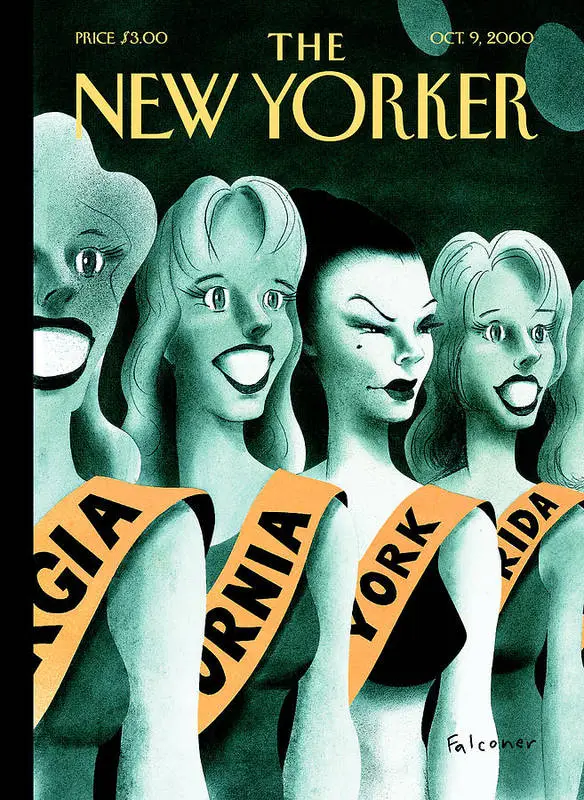
Summary
Ian Falconer’s mostly black-and-white New Yorker cover The Competition depicts four beauty pageant contestants, three of whom stand in stark contrast to Miss New York. Her dark hair, angular body, narrowed eyes, tightly pursed lips, and two-piece bathing suit set her apart from the nearly-identical blondes–Miss Georgia, Miss California, and Miss Florida–with wide-open eyes and mouths and one-piece bathing suits.
Commentary
The self-satisfied expression of Miss New York suggests what the authors of Writing Analytically present as the second of two possible interpretations for The Competition: “[T]he magazine is . . . admitting , yes America, we do think that we’re cooler and more individual than the rest of you, but we also know that we shouldn’t be so smug about it” (Rosenwasser and Stephen 112).
Work Cited
Rosenwasser, David and Jill Stephen. Chapter 3: “Interpretation: Asking So What?” Writing Analytically, 9th edition. Wadsworth/Cengage, 2024. pp. 81-118.
Next Up
In class on Wednesday, you will compose a short essay that reflects on the process of researching, drafting and revising your final essay and annotated bibliography. In it, you will include one relevant quotation from the article that served as a starting point for your project or a relevant quotation from Writing Analytically.
 Jane Lucas