
This morning in class, after your Scrabble debriefing, we will examine David Sedaris‘ essay “Me Talk Pretty One Day,” and you and three of your classmates will collaborate on an exercise that asks you to examine–and subsequently address in writing–these elements of his literacy narrative:
- Scene and summary–you will examine how and where Sedaris shifts from one to the other
- Figurative language–you will identify examples of metaphors, similes, and hyperbole
Each of these elements can play an important role in a narrative, none more so than scene, which is vital to a story’s life. Without it, a narrative falls flat. With summary, a writer compresses time to offer an overview of events. Through scene, a writer lets time unfold in front of the readers’ eyes, which is what readers prefer. They are drawn into a narrative when they can see for themselves what is happening.
Figurative language is an expression not meant to be taken literally but instead stands for something related. Figures of speech make writing more vivid and can deepen a reader’s understanding of and connection to a piece of writing. In Imaginative Writing, novelist Janet Burroway observes, “Both metaphor and simile compare things that are both alike and different, and it is the tension between this likeness and difference that their literary power lies” (25).
Tomorrow’s blog post will list some of the examples of scene, summary, and figurative language that you identify in “Me Talk Pretty One Day.”
Work Cited
Burroway, Janet. Imaginative Writing: The Elements of Craft. Pearson, 2014.
Scrabble Debriefings
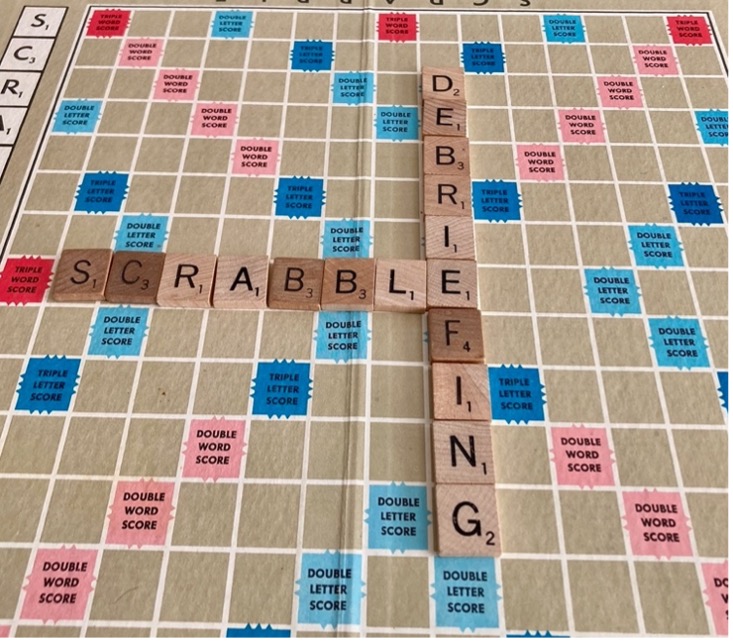
At the beginning of class every Monday, I will return your Scrabble score sheets from Friday, and you and your group members will participate in a Scrabble debriefing in which you will (1) review and discuss your game, and (2) individually compose journal entries on the game. Questions to address include but are not limited to the ones on the handout that I will distribute this morning in class. Those questions for consideration are also listed below.
- Did you learn any new words from your teammate or from your opponents? If so, what were they?
- What plays involved analyzing multiple options? Did your team opt not to make the highest-scoring play possible in order to either (1) block your opponent, or (2) keep letters that might enable you to score more points later?
- Where did creative problem-solving figure in the game? If your team had a rack of all consonants or vowels–or mostly consonants or vowels–how were you able to advance the game by playing only one or two letters?
- What was the largest number of words formed in a single play and what were they?
- Scrabble, like writing, is a process of composing, only the board game involves composing smaller units, words rather than sentences and paragraphs. What parallels, if any, can you draw between your Scrabble play and your writing process?
You will have the opportunity to draw on the journal entries that you write during debriefings when you compose your midterm and final reflections for the course. If you choose Scrabble as the focus of your final essay and annotated bibliography, you may incorporate portions of your Scrabble debriefings into that assignment as well.
Scrabble Skibidi?
The picture below, which also appears in the August 21 post, demonstrates how a player, or team, can form multiple words through parallel play.
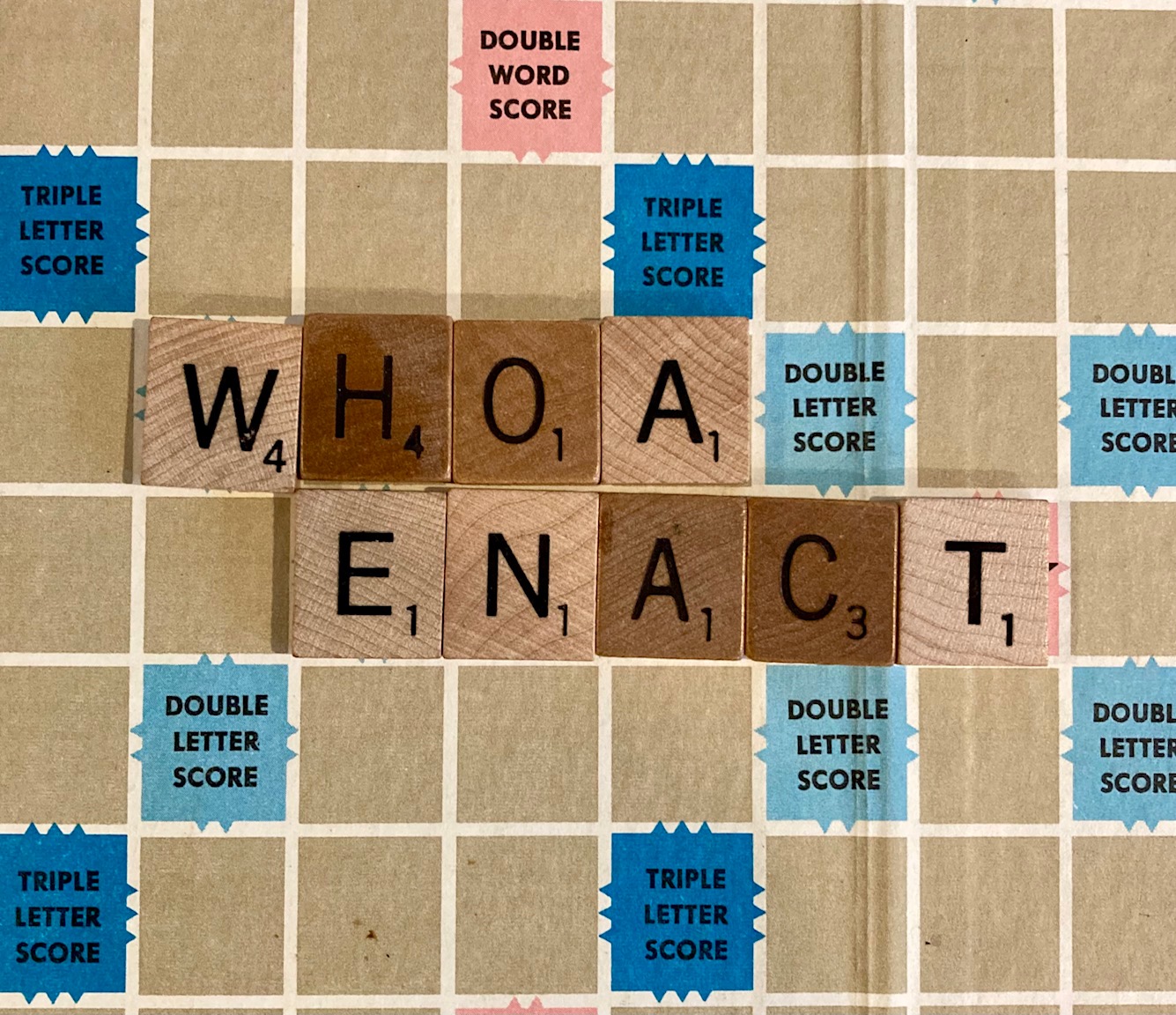
The second player’s, or team’s, four-word play in a single turn is viable because all of the letters that touch form playable words:
- whoa: used to command an animal to stop
- he: a male person
- on: a function word to indicate position (on top of)
- aa: a type of lava
The pictures below, from last Friday’s Wordplay Day, show several instances of incorrect play where letters that touch are nonwords.
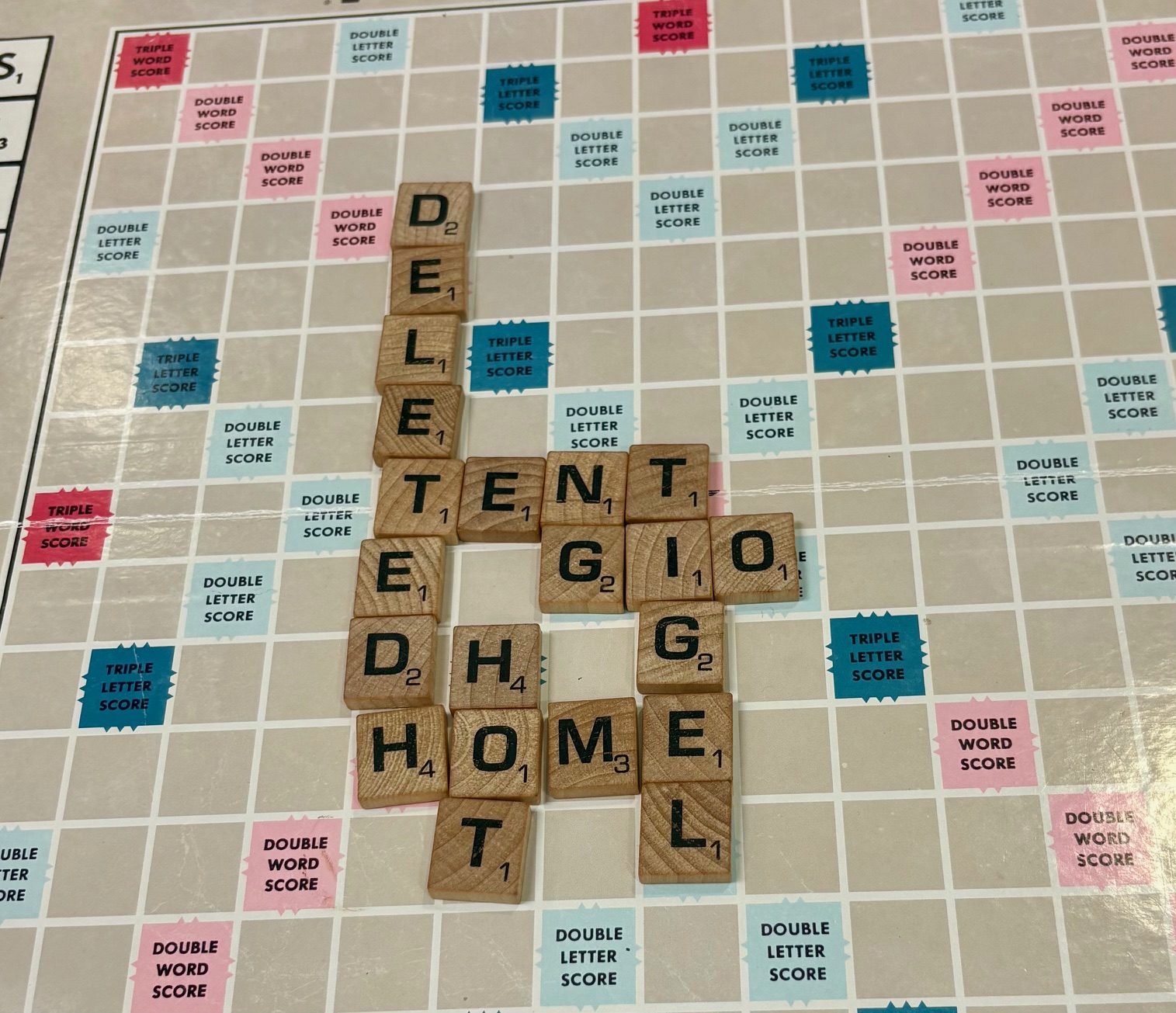
Deletedh, dh, and ng are all nonwords; Tigel and Gio are not playable in Scrabble because they are proper nouns–specifically product brands–that are not also common nouns.
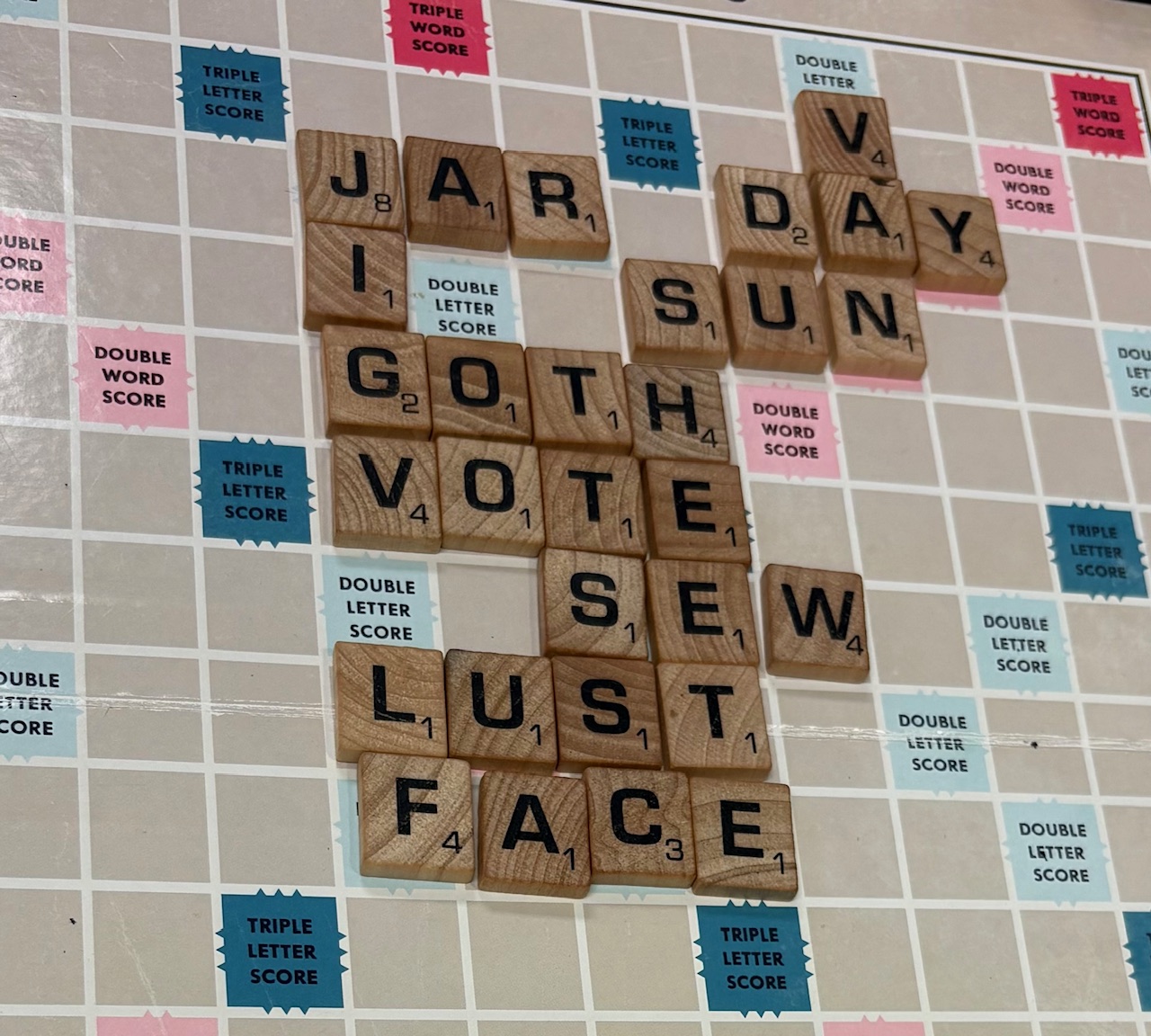
Jigv, du, oo, lf, ua, ttssc, and sheete are all nonwords.
Keep your eyes on the board when you and your opponents are playing words. If you are uncertain whether letters that touch form a playable word, don’t play it. And if you question the validity of a word that your opponents play, challenge the word immediately. A challenge must directly follow a questionable play.
And by the way, skibidi is not playable in Scrabble yet. It was recently added to the Cambridge Dictionary but will not be playable until it is added to The Official Scrabble Players Dictionary.
Next Up
In class on Wednesday, you will begin drafting your first major writing assignment longhand. The assignment, a literacy narrative, is an account of a learning experience involving reading, writing, or learning to speak a language. As part of your prewriting process, look back at “Me Talk Pretty One Day” and consider how you might incorporate into your own essay some of the same elements that David Sedaris includes in his.

 Jane Lucas