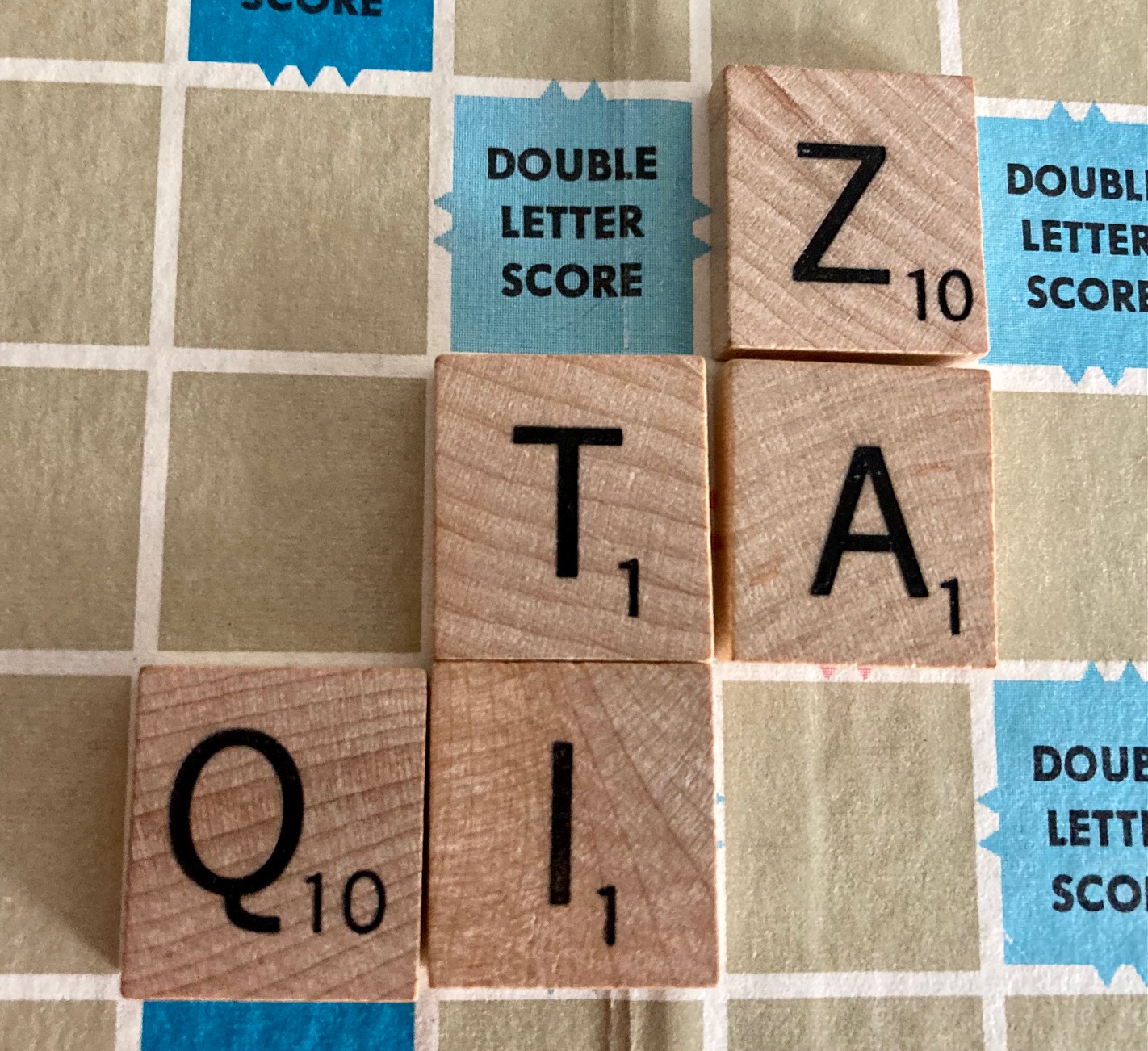
Today’s blog post is the final installment in the series of posts devoted to playable two-letter words. Learning these two-letter words, as well as the other two-letter words in the alphabet, will enable you to see more options for play and increase the number of points you earn in a single turn.
- qi: the central life force in Chinese culture (also ki)
- re: a tone of the diatonic scale
- sh: used to encourage silence
- si: a tone of the diatonic scale (also ti)
- so: a tone of the diatonic scale (also sol)
- ta: an expression of thanks
- ti: a tone of the diatonic scale
- to: in the direction of
- uh: used to express hesitation
- um: used to express hesitation
- un: one
- up: to raise (-s, -ped, -ping)
- us: a plural pronoun
- ut: the musical tone C in the French solmization system, now replaced by do
- we: a first-person plural pronoun
- wo: woe
- xi: a Greek letter
- xu: a former monetary unit of Vietnam equal to one-hundreth of a dong (also sau, pl. xu)
- ya: you
- ye: you
- yo: an expression used to attract attention
- za: pizza
“‘Interesting,’ ‘Revealing,’ ‘Strange’” Exercise
If you have not completed the journal exercise that I assigned on Wednesday, be sure to do so before Monday’s class. The directions on the handout I distributed are included below.
Directions
- Review your reading handouts—”MeTalk Pretty One Day,” “The Day Language Came into Life,” the excerpt from the first chapter of To Kill a Mockingbird, and the excerpt from “The Falling Man”—and select the one that appeals to you most as a subject of analysis. If you think that you would prefer to write an analysis of “The School,” complete this exercise using a line from Barthelme’s story that’s different from the one that you used in your group assignment.
- Choose a line that could be described as interesting, revealing or strange, and compose a sentence that demonstrates what makes it so. Do not include the word interesting, revealing, or strange in your answer. Instead, show what the line achieves. Introduce the quotation with a signal phrase and follow it with a parenthetical citation.
- Below your sentences, write the header Work Cited and follow it with an MLA work cited entry for the text.
Sample Works Cited Entries
Bartheleme, Donald. “The School.” The Best American Short Stories 1975, edited by Martha Foley. Houghton Mifflin, 1975. pp. 8-11.
Junod, Tom. “The Falling Man.” Esquire, vol. 140, no. 3, Sept. 2003, pp. 176+. Gale Academic OneFileSelect, https://link.gale.com/apps/doc/A106423422/EAIM?u=hpu_main&sid=bookmark-EAIM&xid=ce48797f.
Keller, Helen. “The Day Language Came into My Life.” Square Space, https://janelucasdotcom. files.wordpress.com/2025/08/a0461-3.thedaylanguagecameintomylife_keller.pdf.
Lee, Harper. To Kill a Mockingbird. Lippincott, 1960. p. 12.
Sedaris, David. “Me Talk Pretty One Day.” Me Talk Pretty One Day. Little Brown, 2000. pp. 166-73.
Next Up
Wordplay Day! To prepare for class, revisit the Dictionary and World Builder pages on the Scrabble website, the Merriam-Webster Scrabble Word Finder page, and review the blog posts devoted to Scrabble tips, including this one.
As an introduction to Michael Lewis, whose writing we will examine in class on Monday, read this overview of his publications. After you read it, compose a one- or two-paragraph journal entry that addresses these questions: (1) Lewis’ two books on one subject have both been adapted for film. What is the subject, and what are the titles of the two books (and films)? (2) A third book of his, one devoted to a different subject, has also been adapted for film. What is the subject, and what is the title of the book (and film)?
Coming Soon
In class on Wednesday, you will begin planning and drafting your second major writing assignment, your analysis. The chapter of Michael Lewis’ writing that we examine in class on Monday and the other texts we have studied thus far in English 1103–“Me Talk Pretty One Day,” “The Day Language Came into Life,” the excerpt from the first chapter of To Kill a Mockingbird,” the excerpt from “The Falling Man,” and “The School“–are among the pieces of writing that may serve as the subject of your upcoming analysis.

 Jane Lucas