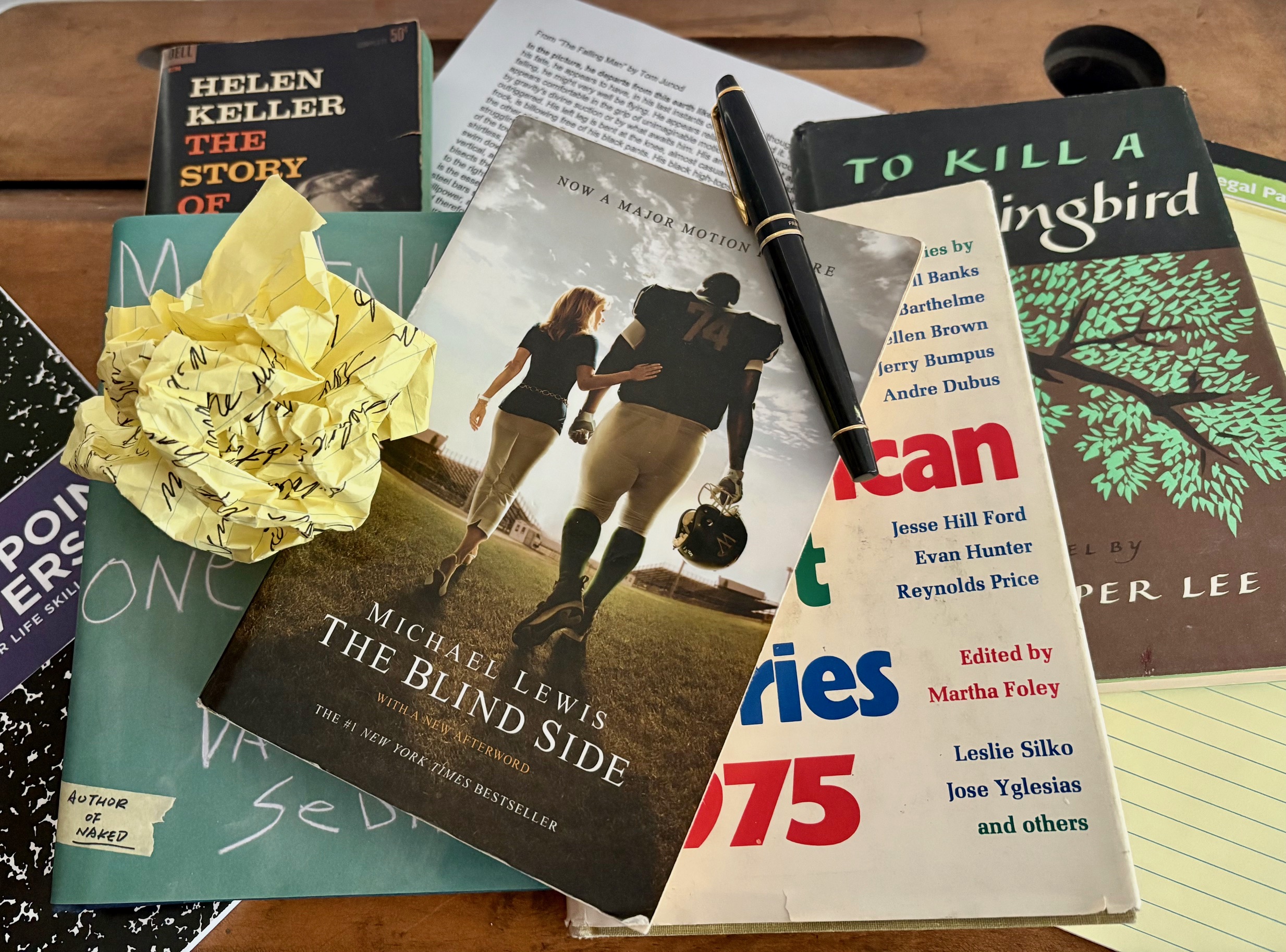
This morning in class, you will begin planning and drafting your analysis. You will receive a hard copy of the assignment in class. The instructions are also included below.
Directions for Planning and Drafting
- Review the texts that you have read for class, and determine which one appeals to you most as a subject of analysis.
- Identify one or more elements that contribute to its effectiveness.
- Develop your analysis through a close examination of those elements.
- Write in dark ink, preferably black. You are welcome to use both sides of the page.
- Before you leave class today, staple your assignment handout on top of your draft and submit it to me. Next Wednesday I will return your draft with notes, and you will have the class period to begin revising and editing on your laptop or tablet.
Directions for Revising
The revision of your analysis should include the following:
- A title that offers a window into your analysis
- An introduction that presents a summary of the essay, essay excerpt, article excerpt, or chapter
- A thesis statement, or main claim, that presents your take on text, based on your close study of it
- Textual evidence that supports your claims
- A minimum of one relevant quotation from the text, introduced with a signal phrase and followed by a parenthetical citation
- A conclusion that revisits the thesis without restating it verbatim
- A work cited entry
- A minimum of 600 words
Sample Works Cited Entries
Barthelme, Donald. “The School.” The Best American Short Stories 1975, edited by Martha Foley. Houghton Mifflin, 1975. pp. 8-11.
Junod, Tom. “The Falling Man.” Esquire, vol. 140, no. 3, Sept. 2003, pp. 176+. Gale Academic OneFile Select, https://link.gale.com/apps/doc/A106423422/EAIM?u=hpu_main&sid=bookmark-EAIM&xid=ce48797f.
Keller, Helen. “The Day Language Came into My Life.” https://janelucas.com/wp-content/uploads/2025/08/a0461-3.thedaylanguagecameintomylife_keller.pdf.
Lee, Harper. Chapter One. To Kill a Mockingbird. Lippincott, pp. 9-19.
Lewis, Michael. “Back Story.” The Blind Side. 2006. Norton, 2009, pp. 15-23.
Sedaris, David. “Me Talk Pretty One Day.” Me Talk Pretty One Day. Little Brown, 2000. pp. 166-73.
Think of your preliminary draft as your down draft; your aim in the early stage of the process is to get your ideas down on the page. You may need the process of drafting to discover what you think the essay, essay excerpt, article excerpt, or chapter means and how it makes its meaning.
Directions for Formatting and Posting Your Revision—See the Course Calendar for the Due Date and Hard Deadline
- Save your revised essay as a Microsoft Word file or PDF and submit it to Blackboard in compliance with MLA manuscript guidelines.
- Publish your revision as a blog post. In your post, omit the first-page information included in your file submitted to Blackboard (your name, course, section, instructor’s name, and date). Add to your blog post an image that documents some part of your writing process away from the screen, such as a photo of your reading notes or a page of your draft. Also add to your blog post an embedded link to a relevant website.
MLA Style
Look to my sample assignments on Blackboard as models of MLA style. For more information on MLA style, see the MLA Style Center and OWL sites linked to my blog and the August 29 blog post devoted to MLA style.
Parethetical Citations
In your analysis, you will include parenthetical citations for quotations and paraphrases. Since you are writing a textual analysis, I recommend quoting rather than paraphrasing because the writer’s particular word choices are vital to the text’s overall effect. If your subject is the “The Day Language Came into My Life” or “The Falling Man,” which are unpaginated, your parenthetical citations will include the abbreviation par. for paragraph, followed by the paragraph number. If your subject is any of the other four texts (“Me Talk Pretty One Day,” the first chapter of To Kill a Mockingbird, “The School,” or “Back Story,” your parenthetical citations will include the page number by itself.
Including the author’s last name as well is redundant because you have established in your introduction that your essay focuses solely on a work by him or her. When you write a paper in which you cite multiple sources, you will need to include the author’s last name in the parenthetical citation to clarify which of your sources you are citing.
Here are some examples of how to use parenthetical citations in your analysis:
For “Me Talk Pretty One Day”:
- The nonsense words “meimslsxp” and “lgpdmurct” underscore his utter lack of comprehension in French class (167).
For “The Day Language Came into My Life”:
- The line “‘like Aaron’s rod, with flowers’” alludes to Numbers 17.8 (par. 9).
For the first chapter of To Kill a Mockingbird:
- In her recollection of the Radley house, Scout mentions that “[t]he remains of a picket drunkenly guarded the front yard” (14).
For the excerpt from “The Falling Man”:
- He notes that in contrast to the Falling Man, the others who jumped appeared “confused, as though trying to swim down the side of a mountain” (par. 1).
For “The School”:
- With the words, “[I]s death that which gives meaning to life?” (10), the story shifts from realism to surrealism (10).
For “Back Story”:
- He employs the “One Mississippi . . . Two Mississippi” count to mark the seconds leading up to Joe Theismann’s career-ending injury (15).
Next Up
Wordplay Day! To prepare for class, revisit the Scrabble Dictionary and World Builder pages and the Merriam-Webster Scrabble Word Finder page, and review the blog posts devoted to Scrabble tips.
 Jane Lucas