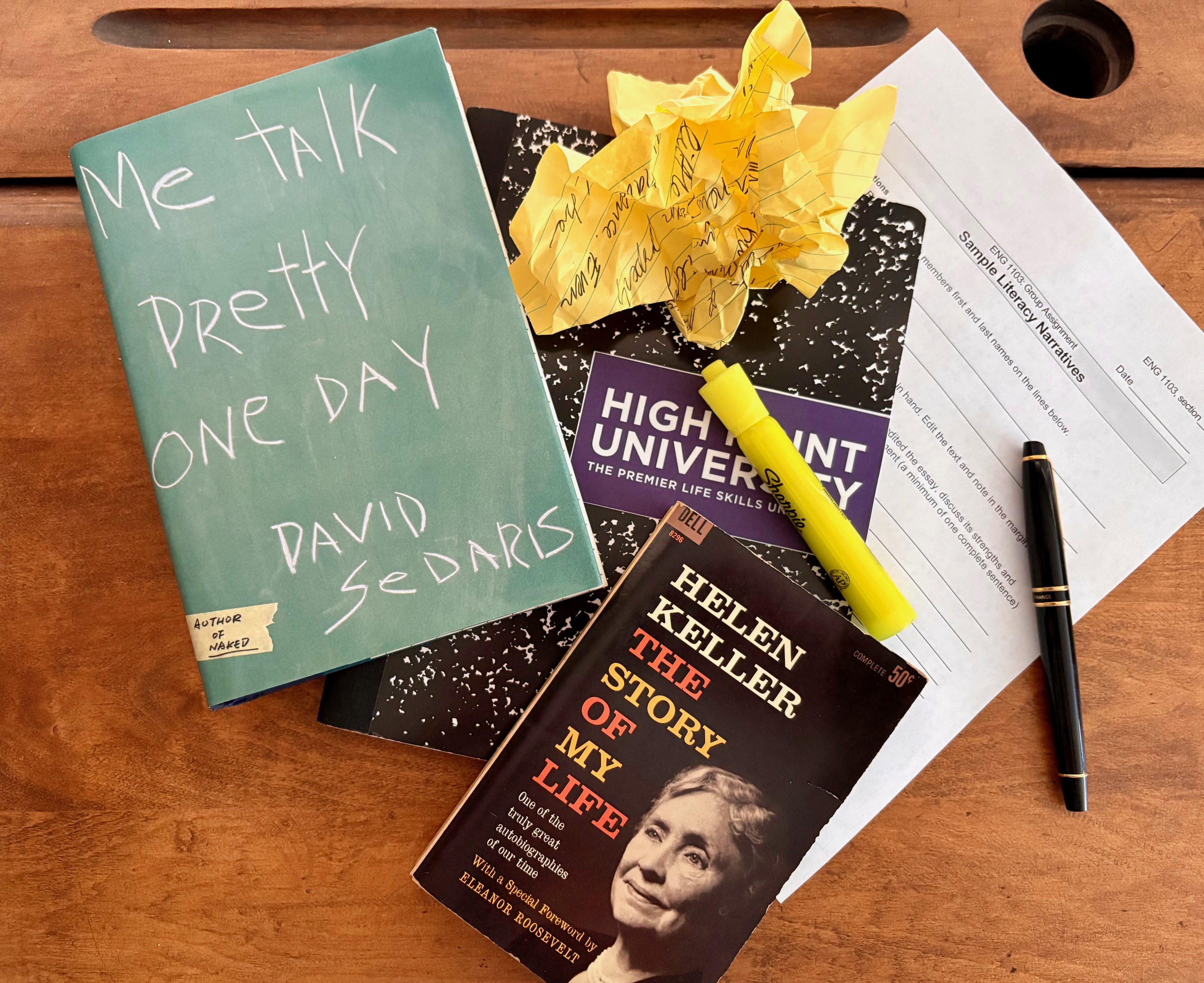
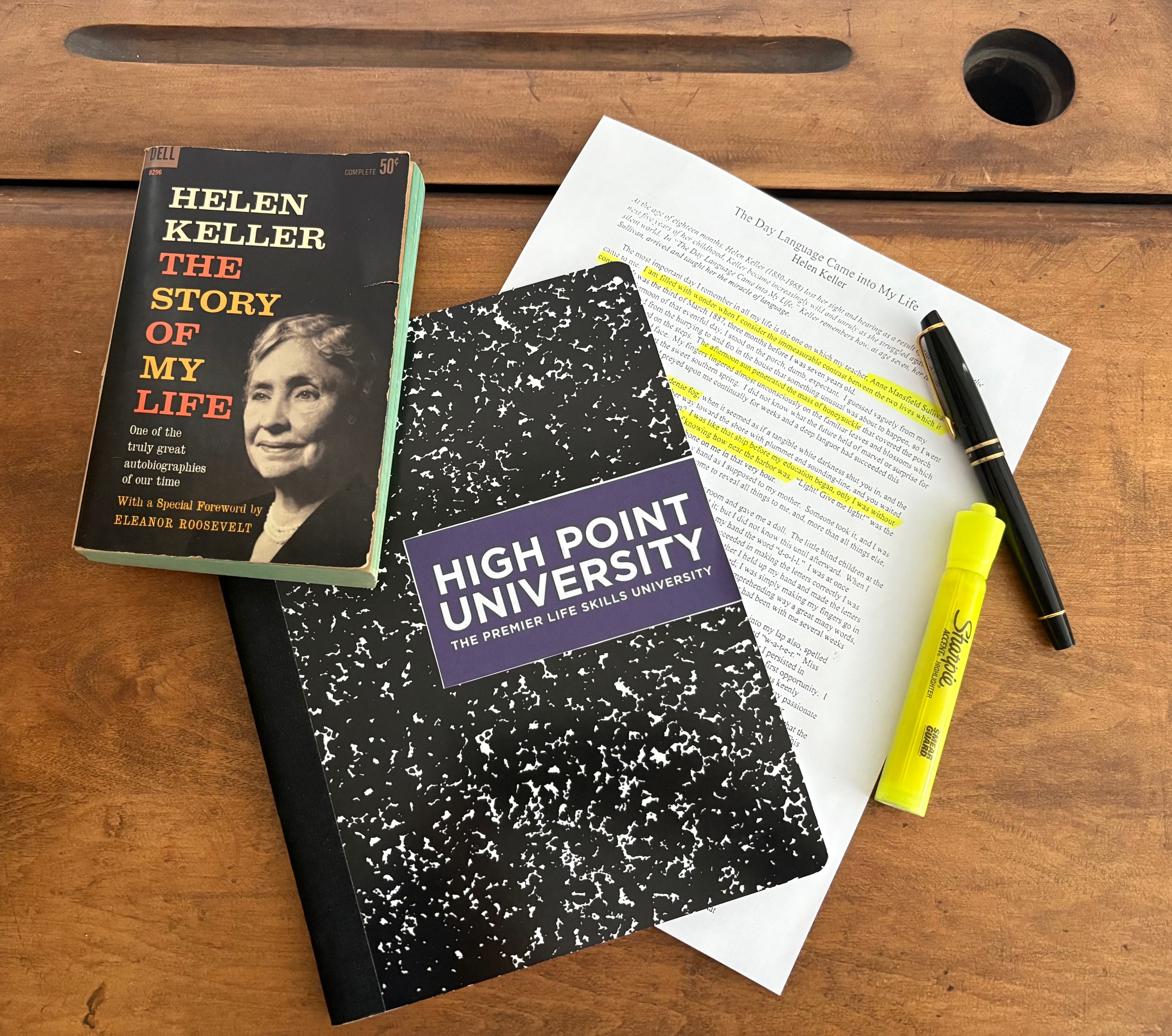
Yesterday morning, after your quiz and Scrabble debriefing, we examined “The Day Language Came into My Life,” the fourth chapter of Helen Keller’s autobiography, The Story of My Life. The details of her literacy narrative that we considered include these:
- Keller draws on her sense of touch to render her world to us because she cannot see or hear. She writes of the warmth of the sun “on her upturned face” (par. 2) as she depicts herself waiting for the arrival of her teacher, Anne Mansfield Sullivan. Aim to use relevant sensory details in your own literacy narrative.
- In the conclusion of her chapter, Keller writes, “I learned a great many words that day. I do not remember what they all were; but I do know that mother, father, sister, teacher were among them” (par. 9). In writing those words, Keller makes both what she doesn’t remember and what does remember part of her story. You may not remember all of the details of a memory from your childhood, but the details you do remember will render your narrative more vividly. And if there’s something you don’t remember, that uncertainty–as Keller demonstrates–can be on the page, too.
- She spells out the words that her teacher spells for her by forming each letter one at a time in Keller’s hand. If you are writing about learning to spell words, let the reader see that on the page as Keller lets her reader see: “‘w-a-t-e-r’ is water” (par. 6).
In “Me Talk Pretty One Day,” David Sedaris does not spell out the French words he is learning to speak, but he does include nonsense words, such as “meimslsxp” (167), to convey his lack of understanding. If you are writing about learning a second language, consider following Sedaris’ lead and using nonsense words–not his but ones of your own making–to convey your initial confusion. Also, try including one or more words of the language itself. Remember that words you write that are not English words–nonsense words included–are italicized.
Work Cited
Keller, Helen. “The Day Language Came Into My Life.” https://janelucasdotcom. files.wordpress.com/2025/08/a0461-3.thedaylanguagecameintomylife_keller.pdf.
Sedaris, David. “Me Talk Pretty One Day.” Me Talk Pretty One Day. Little Brown, 2000. pp. 166-73.
A Pair of Samples
As you prepare to revise your own literacy narrative, review the two samples that we examined in class. While the first, “Creativity is Key,” is admirable for its conversational voice, it lacks the structure and development it needs. It is not a story, it does not meet the minumum length requirement, and it is marred by errors of punctuation, mechanics, and style.
The second sample, “Giving a Speech: Worst Nightmare to Best Feeling” is a much better effort. The essay is a narrative, not simply a series of sentences, and the writer gracefully shifts from summary to scene. Note that a significant portion of the story is presented through scenes with diaogue.
The second part of the title, “Worst Nightmare to Best Feeling,” is an appositive, which is a phrase that offers additional information about the word or phrase that precedes it. Appositives are effective ways to develop your writing. You are welcome to include one in the title of your literacy narrative, but don’t fashion one that tells the reader too much. Your title should offer a window into your essay, but it should not be a spoiler.
Pop Quiz
Rather than listing the answers to the questions on yesterday’s quiz, I have followed each question below with a note regarding where to find the answer. By finding the answers yourself, you will learn more than you would from simply reading them in a list.
- In “The Day Language Came into My Life,” Helen Keller recounts what happened on that day, three months before she turned seven. Name one detail from that day. See your copy of “The Day Language Came into My Life.”
- What is the style used for formatting files and documenting sources in papers for courses in English and many other courses in the humanities (philosophy, classics, religious studies, art history, and foreign languages)? See the August 29 class notes.
- The class notes “ENG 1103: Matters of Style” includes details about formatting papers in the style you will use for English 1103. Name one of those details. See the August 29 class notes.
- What is the topic of the most recent blog post devoted to Scrabble? Note that Scrabble is the subject, not the topic. The topic is something more specific. See the August 28 class notes.
- What have you learned about writing from the Writing Notes handout distributed on August 20 or from the annotations on your introductory reflection or on one of your group exercises? Briefly note the rule or guideline. See your Writing Notes handout, your introductory reflection, and your group exercises.
Your quiz also included a bonus opportunity. Possible answers for that bonus are found in the class notes for August 21, August 22, and August 28.
Next Up
Tomorrow you will continue work on your own literacy narratives. At the beginning of class, I will return your rough drafts with my notes, and you will have the remainder of the class period to revise on your laptops. You will have an additional week to continue revising before posting your literacy narrative to Blackboard and to your WordPress blog. The due date is Wednesday, September 10 (before class); the hard deadline is Friday, September 12 (before class).
 Jane Lucas