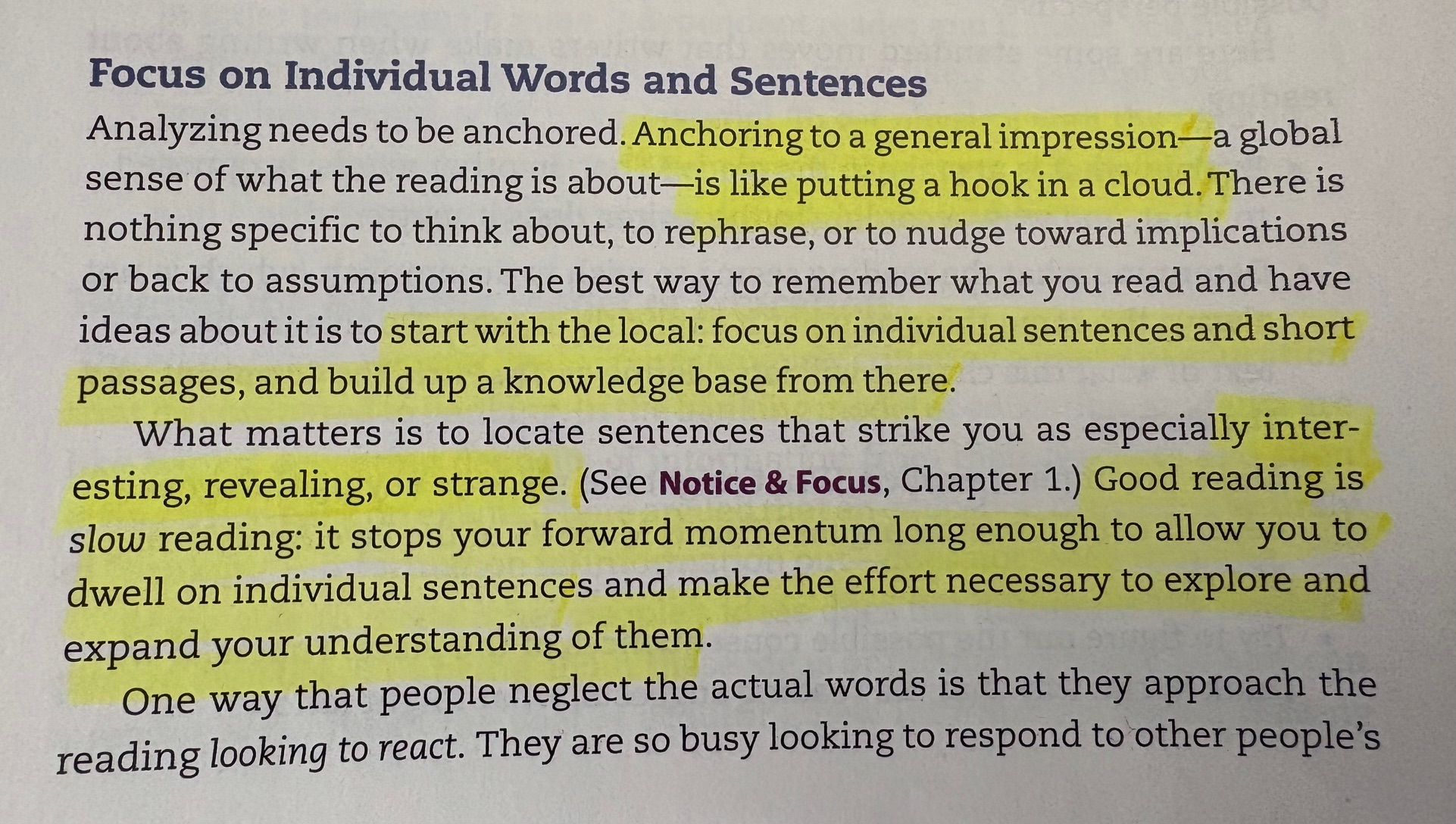
As you continue to revise your analysis, review these sections of Writing Analytically: “Focus on Individual Words and Phrases” (48), “What a Good Analytical Thesis Is and Does” (241-42), and “The Person Question: When and When Not to Use ‘I'” (415-17).
Individual Words and Sentences
Even though the subject of my model analysis, “The Strange Fruit of Sosnowiec,” is the page of a graphic novel, focusing on the individual sentence, “I did much business with Cohn!” and within it, the word “with” (83), provided me with one of the points about connection that supports my thesis that the page “simultaneously conveys connection and separation” (par. 1).
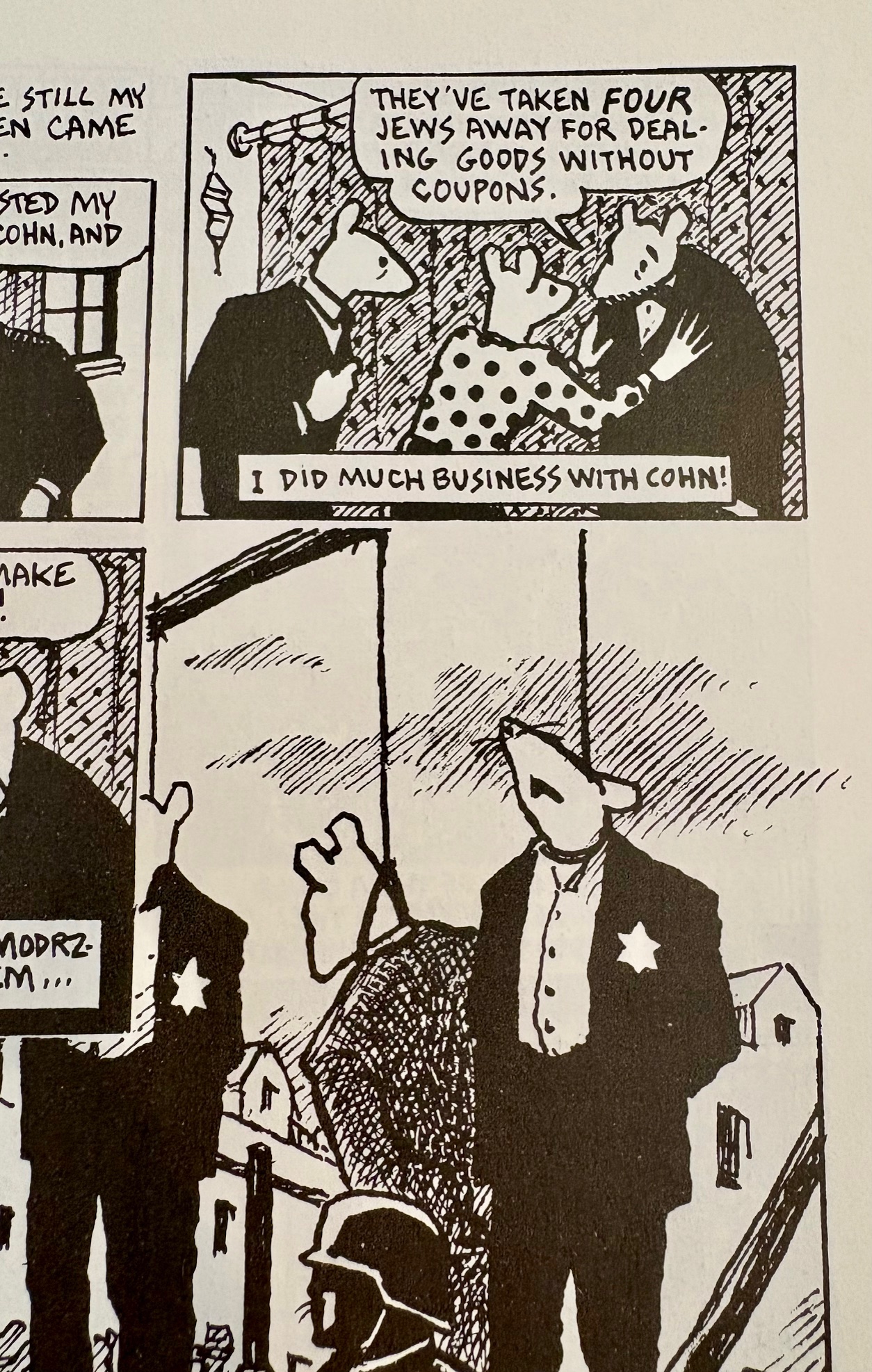
Writing of those words, I assert that “Spiegelman underscores the link with Vladek’s line of narration at the bottom of the smaller panel: ‘I did much business with Cohn!’ (83). The word ‘with’ appears directly above the rope, punctuating the connection between both Nahum Cohn and his friend Mr. Zyberberg and Mr. Zylberberg’s son-in-law, Vladek (par. 3).
A Good Analytical Thesis
The authors of Writing Analytically observe that an effective thesis results from closely examining a subject and “arriv[ing] at some point about its meaning and significance that would not have been immediately obvious to your readers” (Rosenwasser and Stephen 241). With that in mind, note that the thesis of my model analysis does not present an idea that’s stated explicitly on the page. On its surface, the page depicts Mr. Zylberberg’s account of Nazi soldiers hanging Jewish merchants. After repeatedly studying the words and panels on the page, I discovered patterns of both connection and separation: “both the grieveing survivors’ ties to the dead and the hanged men’s objectification at the hands of the Nazis” (par. 1).
First Person and Academic Writing
Although first person is appropriate in some academic prose, as the authors of Writing Analytically note, when you eliminate it, “what you lose in personal conviction, you gain in concision and directness” (Rosenwasser and Stephen 415). Read the two versions of my thesis below, and note the “concision and directness” of the latter.
First-Person Thesis
In my opinion, that haunting panel and the smaller ones that frame it illustrate the complexity of Spiegelman’s seemingly simple composition. I believe his rendering of the panels of the living in conjunction with the fragmented panels of the hanged merchants simultaneously conveys connection and separation. I think it shows the grieving survivors’ ties to the dead and the hanged men’s objectification at the hands of the Nazis.
Third-Person Thesis
That haunting panel and the smaller ones that frame it illustrate the complexity of Spiegelman’s seemingly simple composition. His rendering of the panels of the living in conjunction with the fragmented panels of the hanged merchants simultaneously conveys connection and separation: both the grieving survivors’ ties to the dead and the hanged men’s objectification at the hands of the Nazis.
The first-person thesis is less concise and direct because it states that the ideas are the writer’s rather than simply stating the ideas. The result is a thesis that is needlessly longer, by eight words, and that divides the reader’s attention between the writer and the subject.
Works Cited
Lucas, Jane. “‘The Strange Fruit of Sosnowiec.’” Jane Lucas, 13 Oct. 20205, https://janelucas.com/2025/09/17/eng-1103-the-strange-fruit-of-sosnowiec/.
Spiegelman, Art. Maus I. Pantheon, 1986. p. 83.
Midterm Statistics
- A 30%
- B 57%
- C or lower 13%
Notably, 82% of the students who earned midterm grades in the A range earned bonus points for meeting with a Writing Center tutor to review their literacy narrative, and 80% of the students who earned As completed at least one of the three bonus assignments.
If you didn’t take advantage of those bonus point and bonus assignment opportunities in the first half of the semester, be sure to take advantage of them in the second half.
Next Up
In class on Wednesday, you will compose a reflective essay that focuses on the processes of planning, drafting, and revising your analyses. The due date for your revised analysis is Wednesday, October 15, before class, but you have until the hard deadline, Friday, October 17, before class, to post your revision to Blackboard and publish it on your WordPress blog.
If you are still revising your analysis on Wednesday, in your reflection, you will refer to your writing as ongoing.
Also, in your reflection, you will include a minimum of one relevant quotation from Writing Analytically or from the essay, chapter, or article excerpt that serves as the subject of your analysis. Before Wednesday’s class, identify the passage you plan to quote, and draft a sentence with it in your journal. That preparation will ensure that you have ample time to integrate the quotation into your reflection before the end of Wednesday’s class period.
 Jane Lucas