This morning in class you will compose a short reflective essay that documents the processes of planning, drafting, and revising your analysis. In your reflection, you will include at least one relevant quotation from Writing Analytically or from the chapter, essay, or article excerpt that serves as the subject of your analysis.
Questions to Consider in Your Reflection
- When you began transferring the words from your handwritten draft onto the screen of your laptop or tablet, what did you observe about the process?
- What aspect of the writing seemed the most challenging? Choosing your topic? Deciding which text would serve as your subject? Determining your thesis? Identifying details to support your claims? Organizing the body of the essay? Composing the conclusion? Why did that aspect of the writing seem the most challenging?
- Did the subject of your analysis change? If so, what was your original subject, and what did you change it to?
- What do you consider the strongest element of your analysis?
- At what point in the process did you decide on a title? Did you change the title during the writing process? If so, what was the original title?
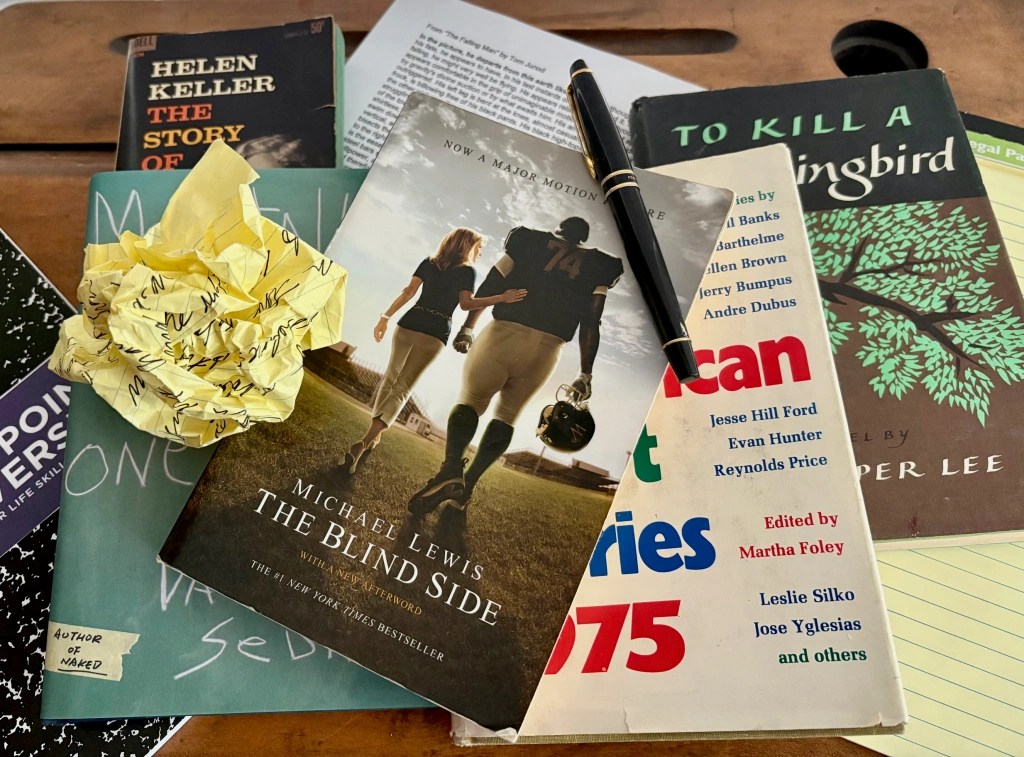
- What image that documents part of your writing process away from the screen did you include in your blog post? Why did you choose that particular image?
- What relevant website did you include an embedded link to in your blog post? Why did you choose that site?
In your reflective essay, introduce your quotation with a signal phrase and follow it with a parenthetical citation. Also include a work cited entry for the text that you quote, Writing Analytically or the essay, chapter, or essay excerpt that serves as the subject of your analysis.
Sample Works Cited Entries
Junod, Tom. “The Falling Man.” Esquire, vol. 140, no. 3, Sept. 2003, pp. 176+. Gale Academic OneFileSelect, https://link.gale.com/apps/doc/ A106423422/EAIM?u=hpu_main&sid=bookmark-EAIM&xid=ce48797f.
Keller, Helen. “The Day Language Came into My Life.” https://janelucasdotcom. files.wordpress.com/2025/08/a0461-3.thedaylanguagecameintomylife_keller.pdf.
Lewis, Michael. Chapter One: “Back Story.” The Blind Side. 2006. Norton, 2009, pp. 15-23.
Rosenwasser, David and Jill Stephen. “Focus on Individual Words and Phrases.” Writing Analytically, 9th edition. Wadsworth/Cengage, 2024. p. 48.
Rosenwasser, David and Jill Stephen. “The Person Question: When and When Not to Use I.” Writing Analytically, 9th edition. Wadsworth/Cengage, 2024. pp. 415-17.
Rosenwasser, David and Jill Stephen. “Seems to Be About X, But Could Also Be (Or is ‘Really’) About Y.’” Writing Analytically, 9th edition. Wadsworth/Cengage, 2024. pp. 104-7.
Rosenwasser, David and Jill Stephen. “What a Good Analytical Thesis Is and Does.” Writing Analytically, 9th edition. Wadsworth/Cengage, 2024. pp. 241-42.
Sedaris, David. “Me Talk Pretty One Day.” Me Talk Pretty One Day. Little Brown, 2000. pp. 166-73.
Next Up
Wordplay Day! To prepare for class, revisit the Dictionary and World Builder pages on the Scrabble website, the Merriam-Webster Scrabble Word Finder page, and review the blog posts devoted to Scrabble tips.

 Jane Lucas