Rather than listing the answers to the questions on Monday’s quiz, I have followed each question below with a note regarding where to find the answer. By finding the answers yourself, you will learn more than you would from simply reading them in a list.
- Write a brief but vivid description—a minimum of one complete sentence—of the page that you were assigned to read for today. See the page of Art Spiegelman’s memoir Maus posted in the Blackboard readings folder and featured in the October 13 class notes.
- The blog post devoted to the sample student analysis that we studied includes several points about the content and form of the essay. Compose a sentence that specifies one of those points that was not addressed in class. See the October 2 class notes, specifically the five bullet points under the heading “Content” and the six bullet points under the heading “Form.”
- What is the topic of the most recent Scrabble blog post? Note that Scrabble is the subject, not the topic. The topic is something more specific about the game. See the October 3 class notes.
Your quiz also included a bonus opportunity. Possible answers for that bonus are found in the class notes for October 3.
Scrabble Journal Exercise
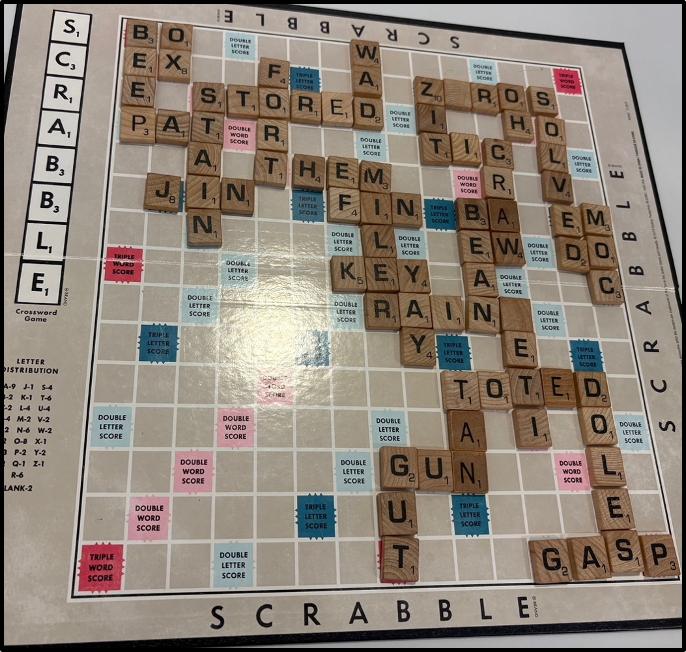
In the game pictured above, the first team played “ZIT” with “Z” on a triple-letter square for thirty-two points. Using a blank for an “E,” the second team followed with “ZEROS,” with the “S” on a double-letter square for twenty-six points. The first team then played “SOLVED,” building from the “S” in “ZEROES.”
With “SOLVED,” the only letter that the first team played on a bonus square was the “E”* on a triple-letter, giving that “E” a value of three points. How many points total did the first team earn for “SOLVED”? Would they have benefited from playing elsewhere on the board? If so, why? The first team earn a total of twelve points for “SOLVED.” They would have benefited from playing elsewhere on the board because playing “SOLVED” below “ZEROS” set up the second team to score a triple-word play with “MOC” and simultaneously form two additional words, “EM” and “DO” for a total of twenty-seven points, more than double the first team’s score for the previous play.
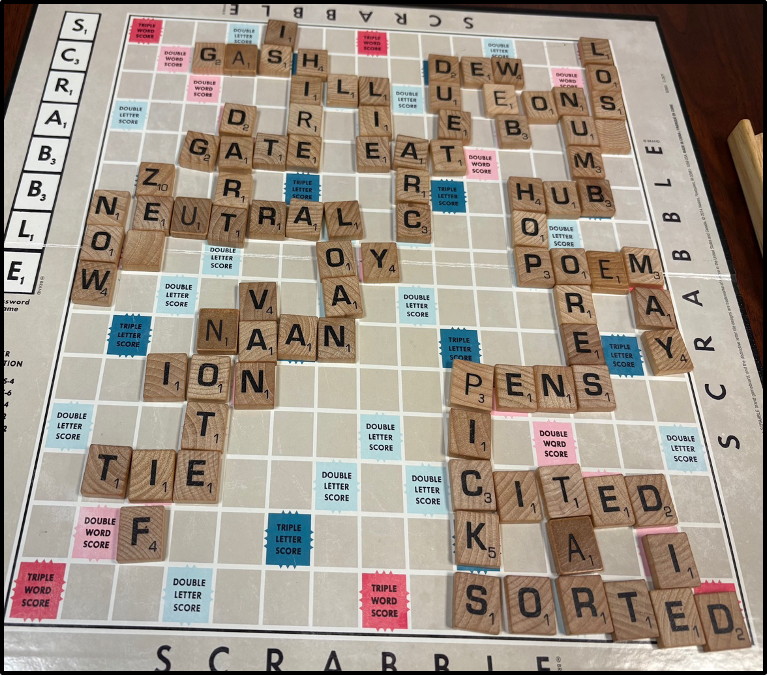
In the game pictured above, the first team earned twelve points for the first play, “TOY,” which appears as “OY” on the board. (Remember to make sure that all letters played remain on the squares where they are played.) The second team followed with “LOAN” for six. Then, using the “L” in “Loan” and the “T” in “TOY,” the first team played “NEUTRAL” and “AT.”
With “NEUTRAL,” the only letter that the first team played on a bonus square was “U” on a double-letter square, giving it two points. How many points total did the first team earn for “NEUTRAL”? Would they have benefited from playing elsewhere on the board? If so, why? The first team earned a total of ten points for “NEUTRAL” and “AT.” They would have benefited from playing elsewhere on the board because playing “N-E-U-T-R-A” in front of the “L” in loan set up the second team to score a triple word under the “N.” It also placed the vowel “E” under a triple-letter score, where the opponent would be able to play a high-value consonant. Although the first team may have played “NOW” and/or “ZEN” themselves, they set up their opponents to play on the squares where those words were played.
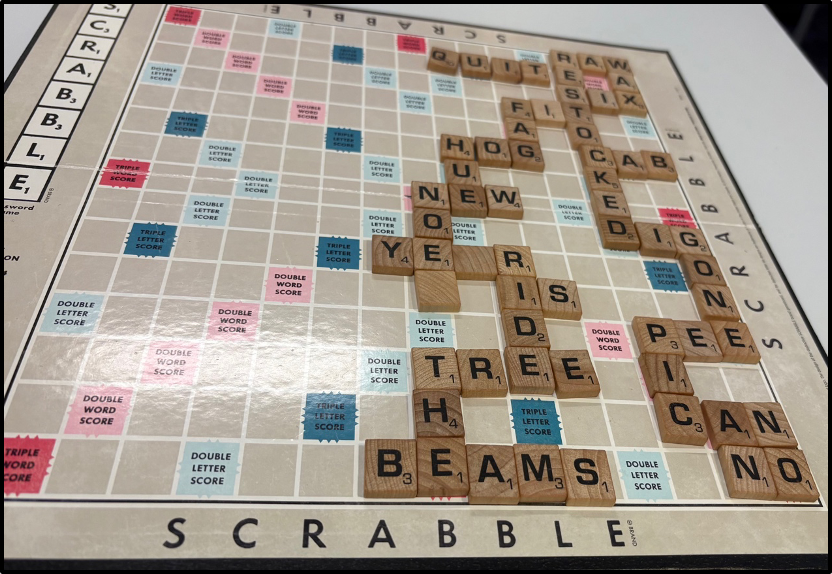
In the game above, the play is limited almost exclusively to the right quadrants. What words could the teams play horizontally below the “Q,” horizontally above or below the “Y,” and elsewhere to advance the game to the left quadrants?
Here are a few of the ways that the players might advance the game into the left quadrants:
- Because no more than two letters can be played below the “Q,” the words that either team could play there are limited to “QAT,” “QUA,” and “QI.” A Team could play both below and above the “Q” by spelling “AQUA,” but that play would not be prudent because it would set up the opponents to play on the triple-word square. Playing “QAT” would be preferable because of the large number of words that end with “T.”
- A team could play “T-A-T-T-O” above the “Y” and in front of the “O” to spell “TATTOO” and “OY.” A team could also play “I-D-E-A” below the “Y” and in front of the blank (“L”) to spell “IDEAL” and “YA.”
- “NEW” offers more opportunities for advancing the board into the left quadrants. Spelling an a-ending word, such as “ALPHA” or “AREA” vertically with the final “A” in front of the “N” would form both the vertical word and “ANEW.”
- “A-A,” “B-A,” “L-A,” M-A,” “P-A,” “R-A,” “W-A,” or “Y-A” could be played in front of the “H” to spell “AAH,” “BAH,” “LAH,” “MAH,” “PAH,” “RAH,” “WAH,” or “YAH” horizontally, along with “AB” vertically.
In the first game pictured above, playing down from the “J” would advance the game into the lower left quadrant, but playing only as much as the single letter “O” below it would set up the opponents to score a triple-word play.
Spelling a word that ends with “K-E-Y” would enable the first game to advance into the lower left quadrant, but “MONKEY” isn’t a possibility because both “M”s and both blanks have already been played. Ditto for “HICKEY,” “HOCKEY,” and “HOKEY” because both “H”s have been played. “JOCKEY” isn’t an option either because the “J” has been played. Three possibilities are “POKEY,” “SMOKEY,” and “TURNKEY.”
The last two rows of the board offer additional opportunities to advance into the left quadrant. Using the “U” or the “T” in “GUT” as one of the last letters in a horizontal word would advance the game into the left side of the second-to-last or last row of the board.
Next Up
Wordplay Day! To prepare for class, revisit the Dictionary and World Builder pages on the Scrabble website, the Merriam-Webster Scrabble Word Finder page, and review the blog posts featuring Scrabble tips, including this one.

 Jane Lucas