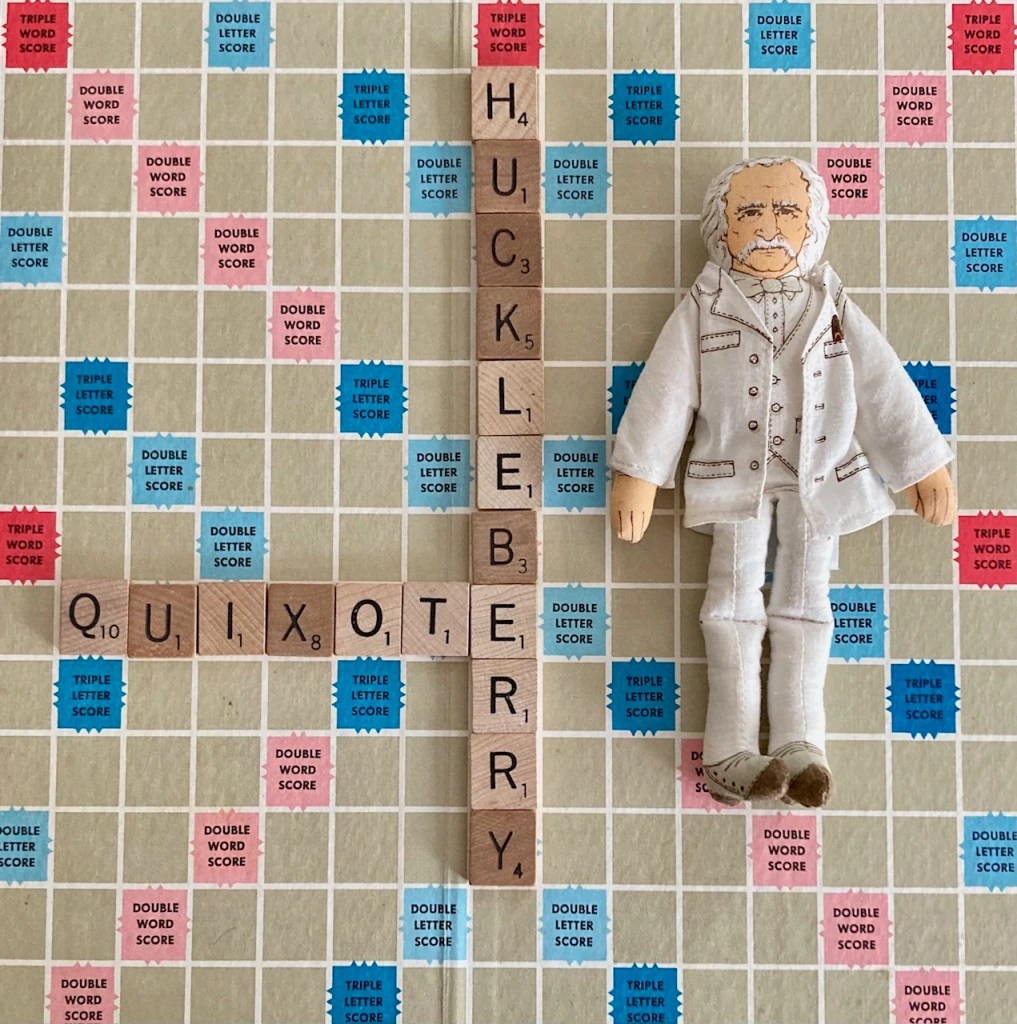
This final Scrabble post of the semester features the names of authors and characters that are playable words. Learning these will not only increase your word power and up your game, it will also broaden your knowledge of literature. If you haven’t read some of classics listed here, I encourage you to check them out.
- eyre: a long journey (the last name of of the title character in Charlotte Bronte’s Jane Eyre, 1847)
- dickens: a devil (Charles Dickens, 1812-1870)
- fagin: a person, usually an adult, who instructs others, usually children, in crime (from a character of that type in Dickens’ Oliver Twist, 1838)
- holden: the past participle of hold (Holden Caulfield, the protagonist in J.D. Salinger’s The Catcher in the Rye, 1951)
- huckleberry: a berry like a blueberry (the first name of the title character in Mark Twain’s Adventures of Hucklebery Finn, 1884)
- oedipal: describing libidinal feelings of a child toward the parent of the opposite sex (from the title character in Sophocles’ Oedipus Rex, c. 429 B.C.)
- quixote: a quixotic, or extremely idealistic person; also quixotry, a quixotic action or thought (the title character in Michael de Cervantes’ Don Quixote, Part I: 1605, Part II: 1615)
Note that “huckleberry” and “quixote” could not be the first two words played in a Scrabble game because “huckleberry” is more than seven letters long. However, “huckleberry” and “quixote” could constitute the first three plays. The first two plays could be “berry” and “quixote,” and the third play could add “huckle” to “berry.”
Next Up
Wordplay Day! To prepare for class, revisit the Dictionary and World Builder pages on the Scrabble website, and review the blog posts devoted to Scrabble tips, including this one.

 Jane Lucas