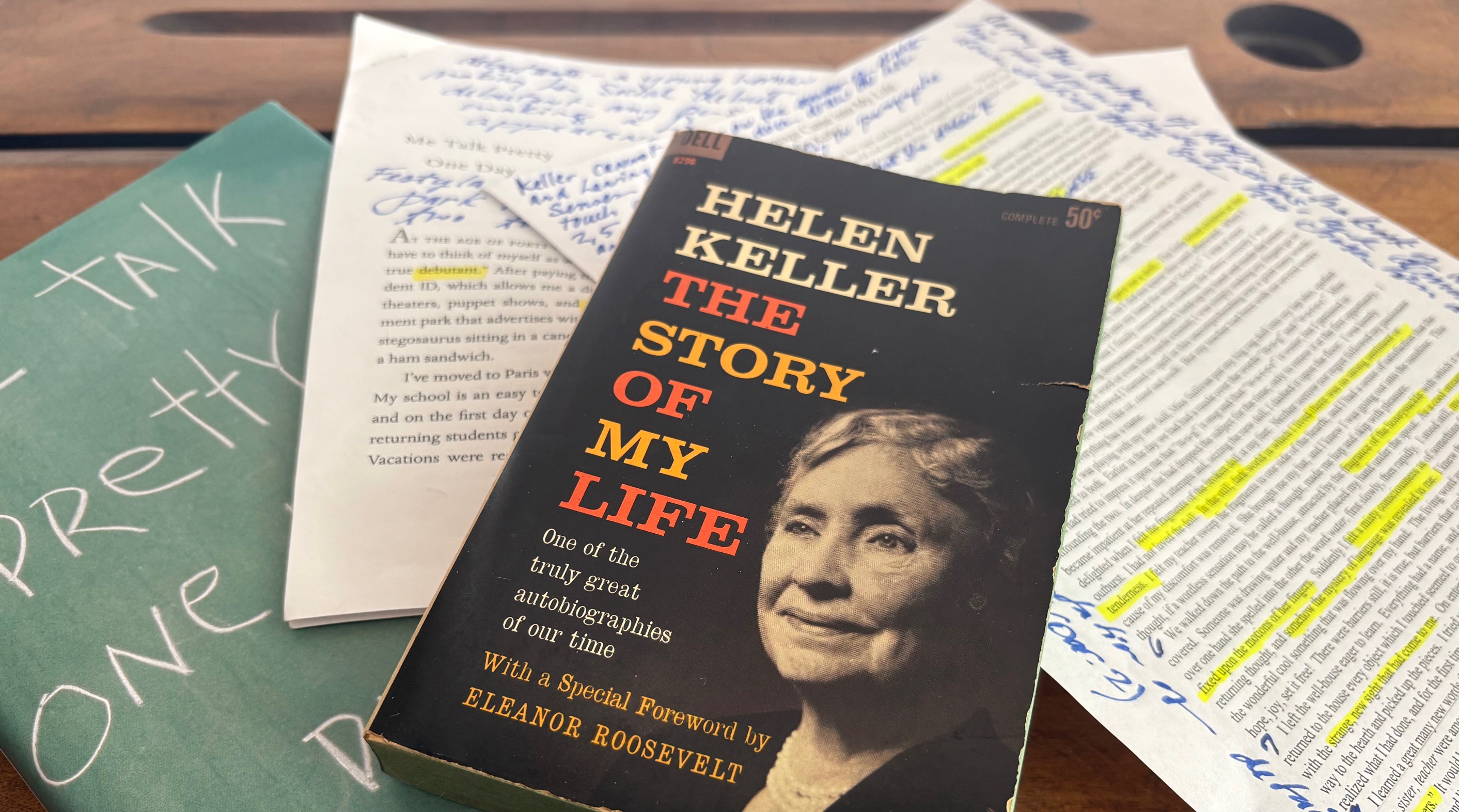
As you prepare to revise your literacy narrative, look back at Helen Keller’s “The Day Language Came into My Life,” the fourth chapter of her autobiography, The Story of My Life, and consider how you can employ some of the same elements in your revision.
- Keller draws on her sense of touch to render her world to us because she cannot see or hear. She writes of the warmth of the sun “on her upturned face” (par. 2) as she depicts herself waiting for the arrival of her teacher, Anne Mansfield Sullivan. Aim to use relevant sensory details in your own literacy narrative.
- In the conclusion, Keller writes, “I learned a great many words that day. I do not remember what they all were; but I do know that mother, father, sister, teacher were among them” (par. 9). In writing those words, Keller makes both what she doesn’t remember and what she does remember part of her story. You may not remember all the details of a memory from your childhood, but the details you do remember will render your narrative more vividly. And if there’s something you don’t remember, that uncertainty–as Keller demonstrates–can be on the page, too.
- She spells out the words that her teacher spells for her by forming each letter one at a time in Keller’s hand. If you are writing about learning to spell words, let the reader see that on the page as Keller lets her reader see: “‘w-a-t-e-r’ is water” (par. 6).
In “Me Talk Pretty One Day,” David Sedaris does not spell out the French words he is learning to speak, but he does include nonsense words, such as “meimslsxp” (167), to convey his lack of understanding. If you are writing about learning a second language, consider following Sedaris’ lead and using nonsense words–not his but ones of your own making–to convey your initial confusion. Also, try including one or more words of the language itself. Remember that words you write that are not English words–nonsense words included–are italicized. For more details on Sedaris’s essay, see the January 13 class notes.
Work Cited
Keller, Helen. “The Day Language Came Into My Life.” https://janelucasdotcom. files.wordpress.com/2025/08/a0461-3.thedaylanguagecameintomylife_keller.pdf.
Sedaris, David. “Me Talk Pretty One Day.” Me Talk Pretty One Day. Little Brown, 2000. pp. 166-73.
Pop Quiz
Rather than listing the answers to the questions on last Friday’s quiz, I have followed each question below with a note regarding where to find the answer. By finding the answers yourself, you will learn more than you would from simply reading them in a list.
- In “The Day Language Came into My Life,” Helen Keller recounts what happened on that day, three months before she turned seven. Name one detail from that day that is notable for Keller’s rendering of it. See your copy of “The Day Language Came into My Life.”
- How is a dead metaphor different from a cliché? (Briefly explain the two.) See the class notes for January 13.
- What is the style used for formatting files and documenting sources in papers for courses in English and many other courses in the humanities (philosophy, classics, religious studies, art history, and foreign languages)? See the January 15 class notes.
- Name one of the formatting requirements for the style you will use for your papers in English 1103. See the class notes for January 15.
- What have you learned about writing from the annotations on your introductory reflection or on one of your Monday or Wednesday group exercises? Briefly note the rule or guideline. See your introductory reflection and your Monday and Wednesday group exercises.
Your quiz also included a bonus opportunity. Possible answers for that bonus are found in the class notes for January 8, January 9, and January 16.
Be sure to write notes in your journal on all of your readings, including the notes posted on my blog. Before each class begins, take out your journal and review your notes. That will increase your knowledge of what you read and ensure that you will earn high grades on your pop quizzes.
Next Up
Tomorrow, you will continue working on your own literacy narratives. After the Scrabble debriefing and our discussion of “Letter from Birmingham Jail,” I will return your rough drafts with my notes, and you will have the remainder of the class period to revise on your laptops. You will have an additional week to continue revising before posting your literacy narrative to Blackboard and to your WordPress blog. The due date is Wednesday, January 28, before class; the hard deadline is Friday, January 30, before class.
 Jane Lucas