Today’s class will be devoted primarily to revision work. After your Scrabble debriefing and our examination of “Letter from Birmingham Jail,” I will return the drafts of your literacy narratives, and you will have the remainder of the class period to begin revising on your laptops. You will have an additional week to continue revising before posting to Blackboard and WordPress. The due date for your literacy narrative is Wednesday, January 28, before class; the hard deadline is Friday, January 30, before class. Next Monday, January 26, I will guide you through the submission processes step by step.
As you continue to revise your literacy narrative, consider visiting the Writing Center. If you do so, you will earn five bonus points for the assignment.

To schedule an appointment, visit the Writing Center’s sign-up page, email the Writing Center’s director, Professor Justin Cook, at jcook3@highpoint.edu, or scan the QR code above. To earn bonus points for your literacy narrative, consult with a Writing Center tutor no later than Thursday, January 29.
I have attached a writing notes handout to your drafts. Keep it in your portfolio and refer to it when composing assignments. I have included an additional copy of that list below.
Writing Notes
- &: Do not use an ampersand (&) in place of the word and in formal writing.
- Abbreviations should often be avoided in formal writing. Do not write vocab for vocabulary. On first reference, spell out Advanced Placement in the name of a course. In subsequent references, AP is acceptable.
- A lot: Don’t use a lot a lot. There are a lot of better ways to express that idea, such as many, often, considerable, etc. If you use a lot in your writing, I will mark it with a d, which denotes diction or word choice.
- Compound modifiers are linked with a hyphen. Write twelve-page paper, not twelve page paper.
- Do: What specifically did you do? (There is almost always a stronger verb than do.) Drafted, revised, edited, reviewed, studied, and memorized are all verbs that denote a particular action. Use action verbs whenever possible.
- English and the names of other languages are always capitalized. If you write English with a lower-case e, I will underscore the letter with three vertical lines. Those three lines are the proofreader’s mark that denotes the need for a capital letter.
- Modifiers: Place modifiers and modifying phrases as close as possible to the words they are meant to describe. Consider this sentence: As a four-year-old, my grandmother taught me to print the letters of the alphabet. In it, the person who is four is the grandmother, which makes no sense. (She cannot be a grandmother at four.) The sentence should be revised to read something like this: As a four-year-old, I learned from my grandmother how to print the letters of the alphabet.
- Numbers that can be expressed as one or two words are written as words, not figures, in MLA style, which is the style used in English courses as well as some other courses in the humanities. Write twenty-five, not 25.
- Paragraphs: Business writing calls for block paragraphs, but English 1103 and many of your other classes will require you to indent the first lines of each paragraph five spaces or one-half inch.
- Passive voice should often be avoided in formal writing. The subject should perform the action. Write, we read several nineteenth-century novels, not several nineteenth-century novels were read.
- Separate: an easy way to remember the spelling of this often-misspelled word is to tell yourself, there’s a rat in separate.
- That/Who: The relative pronoun who, not that, refers to people. (That refers to things.) Do not write He is the teacher that taught me how to develop my writing. Instead, write He is the teacher who taught me how to develop my writing.
- That/This: The relative pronoun this refers to something at hand or occurring now. That class is the one you’re writing about in your literacy narrative. This class is English 1103.
- Then/Than: Than is used in comparisons; then refers to a point in time.
- Titles: In MLA style, the titles of book-length works are italicized. If you are writing longhand, the titles of book-length works are underlined. The titles of shorter works—such as essays, short stories, and poems—are enclosed in quotation marks.
- Whether/If: Whether introduces alternatives or a choice. If introduces a condition. Write, I don’t know whether my mother or my father read to me first, and If my pen runs out of ink, I will write in pencil instead.
Occasionally, I will post additional writing notes on my blog and will include notes on diction, mechanics, and style—as well as other writing elements—in my feedback on your major writing assignments.
Journal Exercise: Alternate Portraits
If you reach a stopping point in your revision before the end of the class period, begin this journal exercise. If you continue to work on your revision until the end of class, complete this exercise on your own.
Aim to explore how a writer creates an unconventional portrait of a subject by forgoing physical description and focusing on other elements, such as mood and contrast.
Directions for Option One
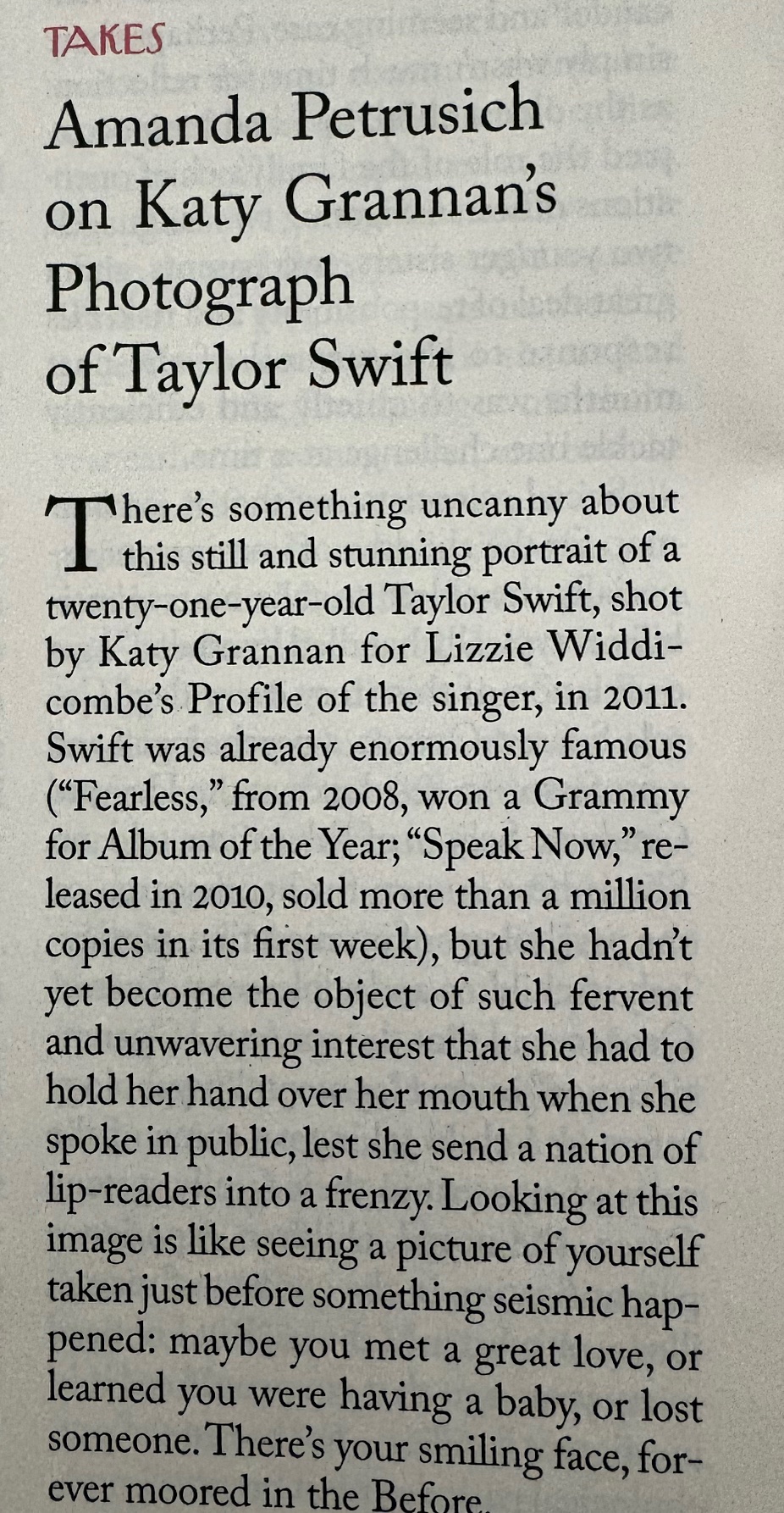
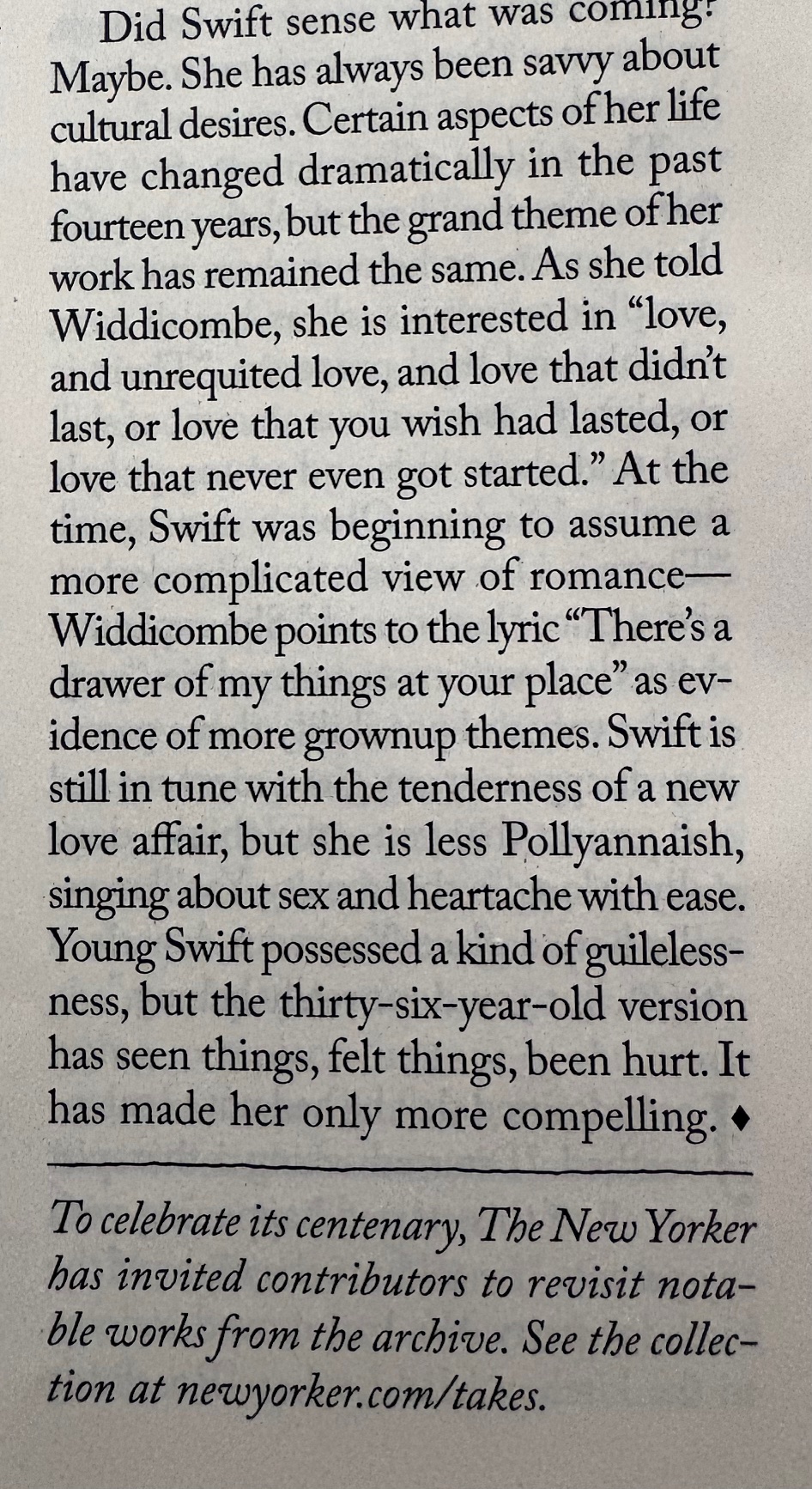
- Read “Amanda Petrusich on Katy Grannan’s Photograph of Taylor Swift.”
- Compose a one- or two-paragraph journal entry that addresses a detail that demonstrates how the writing develops an alternate portrait of Swift, not of her physical features but of the mood the image evokes or the now-then contrast that the writer explores.
- In your journal entry, quote a word, phrase, or sentence of Petrusich’s. Introduce the quotation with a signal phrase and follow it with a parenthetical citation. See the example below.
- At the end of your journal entry, include the header “Work Cited,” followed by an entry for “Amanda Petrusich on Katy Grannan’s Photograph of Taylor Swift.” See the example below. follows.
- Complete your journal entry on or before Monday, February 2.
Example:
The simile that ends with the words “seismic happened” (44) could be a sentence ender. But instead, the writer, Amanda Petrusich, follows it with an appositive: a noun or noun phrase that identifies, renames, or explains it. That appositive builds on the simile and develops the sentence, offering readers a series of possible seismic events. Petrusich writes, “maybe you met a great love, or learned you were having a baby, or lost someone” (44).
Work Cited
Petrusich, Amanda. “Amanda Petrusich on Katy Grannan’s Photograph of Taylor Swift.” The New Yorker, 12 Jan. 2026, pp. 44.
Directions for Option Two
If you do not want to write about Taylor Swift, complete the exercise using one of your class readings. The work cited entry for each of those texts is included on the handout.
Next Up
Wordplay Day! To prepare for class, revisit the Dictionary and World Builder pages on the Scrabble website, or the Merriam-Webster Scrabble Word Finder page. Also, review the Scrabble notes in your journal and the blog posts devoted to Scrabble.
 Jane Lucas