Today, in place of our in-person class, you will read and evaluate two student literacy narratives: “Creativity is Key” and “The Journey of the Greatest Story.” You will also read my model literacy narrative, “A Bridge to Words,” which appears below as a model for your own blog post.
Directions for writing and posting your evaluations of the student literacy narratives are included in the second half of this post, below the notes on “A Bridge to Words.”
A Bridge to Words
To a small child, the pages of a newspaper are enormous. Looking far back through the years, I see myself, not yet school age, trying to hold up those long, thin sheets of newsprint, only to find myself draped in them, as if covered by a shroud. Of course, back then, my inability to hold a newspaper properly was of little consequence. Even if I could have turned the pages as gracefully as my parents did, I couldn’t decipher the black marks on the page; thus, my family’s ritual reading of the newspaper separated them from me. As the youngest and the only one who couldn’t read, I was left alone on the perimeter to observe. My family’s world of written words was impenetrable; I could only look over their shoulders and try to imagine the places where all those black marks on the page had carried them—these people, my kin, who had clearly forgotten that I was in the room.
My sister, who was three years older, had her very own news source: The Mini Page, a four-page miniature paper that arrived at our house as an insert in the Sunday edition. While our parents sat in their easy chairs poring over the state and local news, my sister, Jo, perched at the drop-front desk and occupied herself with articles, puzzles, and connect-the-dots.
Finally, one Sunday, someone noticed me on the margin and led me into our family’s reading circle. Whether it was one of my parents or my sister, I don’t know. I remember only the gesture and the words: someone handing me the Sunday comics and saying, “You can read part of the funny pages, too. You can read Henry.”
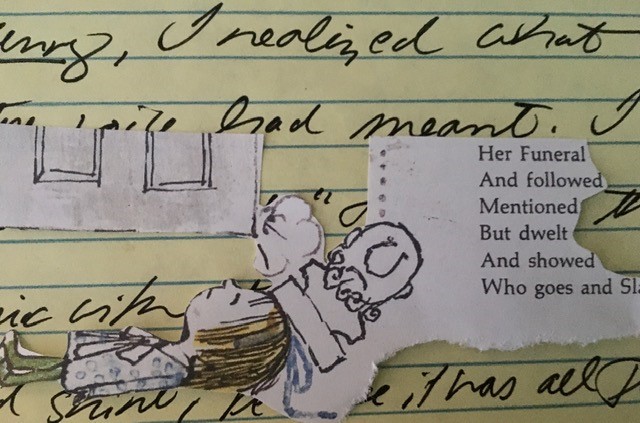
I took the giant page and laid it flat in the middle of the oval, braided rug on the floor of the den. Once I situated the page, I lay on top of it with my eyes just inches above the panels of the comic strip. To my parents, my prone position was a source of amusement, but for me it was simply a practical solution. How else was someone so small supposed to manage such a large piece of paper?
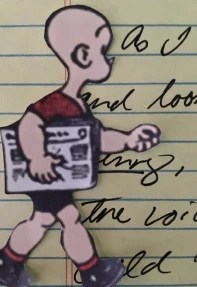
As I lay on the floor and looked at the comic strip’s panels, I realized what the voice had meant. I could “read” Henry, the comic with the bald boy in a red shirt, because it consisted entirely of pictures. In between panels of Henry walking, there were panels of him standing still, scratching his hairless head. I didn’t find Henry funny at all. I wondered how that pale forerunner of Charlie Brown had earned a prime spot in the funnies. Still, I was glad he was there. He was the bridge that led me to the written word.
Reading the wordless comic strip Henry for the first time was the beginning of a years-long habit of stretching out on the floor with newspapers and large books—not thick ones but ones that were tall and wide, among them one of my childhood favorites: The Golden Book of Fun and Nonsense. My sister and I spent hours lying on our bedroom floor, the pink shag carpet tickling our legs as we delighted in the antics of Rebecca, the mischievous title character of one of the poems.
“Rebecca”—which my sister read to me before I could read it myself—introduced me to the word “abhors,” the very sound of which appealed to me. Sometimes before Jo had finished reading the opening lines, my uncontrollable giggles collided with her perfect mock-serious delivery. As the last word in the first line, “abhors” serves as a lead-in to an enjambment: the continuation of a sentence or clause in a line break. It would be years before I learned the term “enjambment,” but I was immediately swept away by its effect in the opening lines: “A trick that everyone abhors/ In Little Girls is Slamming Doors” (Belloc 61). The first line lured me into the second one, and so on and so on. I was drawn both to the individual word “abhors”—with its side-by-side “b” and “h,” rare in English—and the way the words joined, like links in a chain, to yank me giggling through Rebecca’s cautionary tale:
It happened that a marble bust
Of Abraham was standing just
Above the door this little lamb
Had carefully prepared to slam,
And down it came! It knocked her flat!
It laid her out! She looked like that.
Her funeral sermon (which was long
And followed by a sacred song)
Mentioned her virtues, it is true,
But dwelt upon her vices too,
And showed the dreadful end of one
Who goes and slams the door for fun. (61)
Why these particular early memories visit me now, I don’t know. Perhaps rereading Art Spiegelman’s graphic memoir Maus with my students has roused the wordless Henry and the word-filled Golden Book of Fun and Nonsense from the corner of my brain where they’ve slumbered. The former wakes and stretches out in my mind as a bridge to the latter: a spot in the world of words I’ve inhabited ever since.
Work Cited
Belloc, Hilaire. “Rebecca.” The Golden Book of Fun and Nonsense, edited by Louis Untermeyer, illustrated by Alice and Martin Provenson, Golden Press, 1970, p. 61.
Continuing Your Revisions, Notes on “A Bridge to Words”
As you revise your literacy narrative, look back at “A Bridge to Words” and note the elements listed below.
- Appositives
- Scene
- Figurative language
- Gaps in memory/what the narrator doesn’t know
- The story’s significance, how the writer conveys it subtly
The sections that follow focus on the elements listed above, ones you should aim to include as you continue to revise your own literacy narrative.
Appositives
Using an appositive–a group of words that renames or defines a noun or noun phrase–not only helps you develop your writing but also enables readers to better relate to your writing through the specifics that the appostives offer. Examine each of the four passages below, and note how each appositive expands on the ideas presented in the noun, the noun phrase, or the noun clause that precedes it.
- Early in the essay, I write that “[m]y sister, who was three years older, had her very own news source, The Mini Page, a four-page miniature paper that arrived at our house as an insert in the Sunday edition (par. 2).
- I incude another appositive to specify the gesture and the words of a family member: “I remember only the gesture and the words: someone handing me the Sunday comics and saying, “You can read part of the funny page, too. You can read Henry” (par. 3).
- When I turn to an appositive again, I do so define a term that may be unfamiliar to some readers: “As the last word in the first line, ‘abhors’ serves as the lead-in to an enjambment: the continuation of a sentence or clause in a line break” (par. 7).
- Lastly, I fashion an appostive in the conclusion to convey the significance of the memories I have recounted: “The former wakes and stretches out in my mind as a bridge to the latter: a spot in the world of words I’ve inhabited ever since” (par. 8).
Scene
With the words, “[f]inally, one Sunday,” I shift from summary to scene for the first time (par. 3). The previous paragraphs describe the reading ritual that occurred every Sunday.
Figurative Language
Instances of figurative language in the narrative include “as if covered by a shroud” (par. 1), “like links in a chain” (par. 7), and an extended metaphor in the conclusion, where I personify the comic strip Henry and The Golden Book of Fun and Nonsense, depicting them as slumbering in my brain:
“Perhaps rereading Art Spiegelman’s graphic memoir Maus with my students has aroused the wordless Henry and the word-filled Golden Book of Fun and Nonsense from the corner of my brain where they’ve slumbered. The former wakes and stretches out in my mind as a bridge to the latter: a spot in the world of words I’ve inhabited ever since” (par. 8).
Directions for Writing and Posting Your Evaluations
- After you have read and written notes on the two student literacy narratives, review the requirements and grade criteria on your literacy narrative assignment sheet. (Your draft is attached to that handout, and an additional copy is posted in the Major Paper Assignments folder on Blackboard.)
- Determine a grade for each of the two literacy narratives, and compose a response of two or more complete sentences that includes (1) the complete title of each student literacy narrative, (2) the letter grades for each, and (3) a brief explanation of why each narrative merits the grade you assigned. Post your comment as a reply to this blog post by 11:50 a.m. today, Monday, January 26.
- To post your comment, click the title of the post, “ENG 1103: Model Literacy Narrative, ‘A Bridge to Words . . . ,'” then scroll down to the bottom of the post. There you will see the image of an airmail envelope with a box for your comment. Type your comment in the box and click Comment.
I will make your evaluations visible after the 11:50 a.m. deadline.
Posting Your Literacy Narrative to Blackboard and WordPress
If we had met in person today, in the second half class, I would have taken you through the steps of posting your literacy narrative to Blackboard and WordPress. Tomorrow’s post will include step-by-step instructions. In the meantime, consider watching these YouTube videos on submitting an assignment to Blackboard and publishing a post on WordPress.
Next Up
In class on Wednesday, you will compose a short reflective essay focusing on the process of planning, drafting, and revising your literacy narrative. If you are still in the process of completing your essay on Wednesday (since you have until Friday morning’s hard deadline to post it), your reflection will address your work in progress. Bring your copy of the textbook, Writing Analytically, to class.
Before class, read “On Keeping a Writer’s Notebook” (157-58) and “Writing from Life: The Personal Essay” (161-64). Those sections of the textbook serve as companion pieces to your writing thus far in English 1103, and reading and taking notes on those sections will prepare you to compose part of the reflective essay you will write in class on Wednesday.
After you have read and taken notes on “On Keeping a Writer’s Notebook” and “Writing from Life: The Personal Essay,” choose a phrase, clause, or sentence relevant to your writing process and draft in your journal a short passage that connects that quotation to your writing. That passage will serve as part of your reflection. Detailed instructions for composing your reflection and including your chosen quotation will be included on the handout that I distribute on Wednesday.
 Jane Lucas