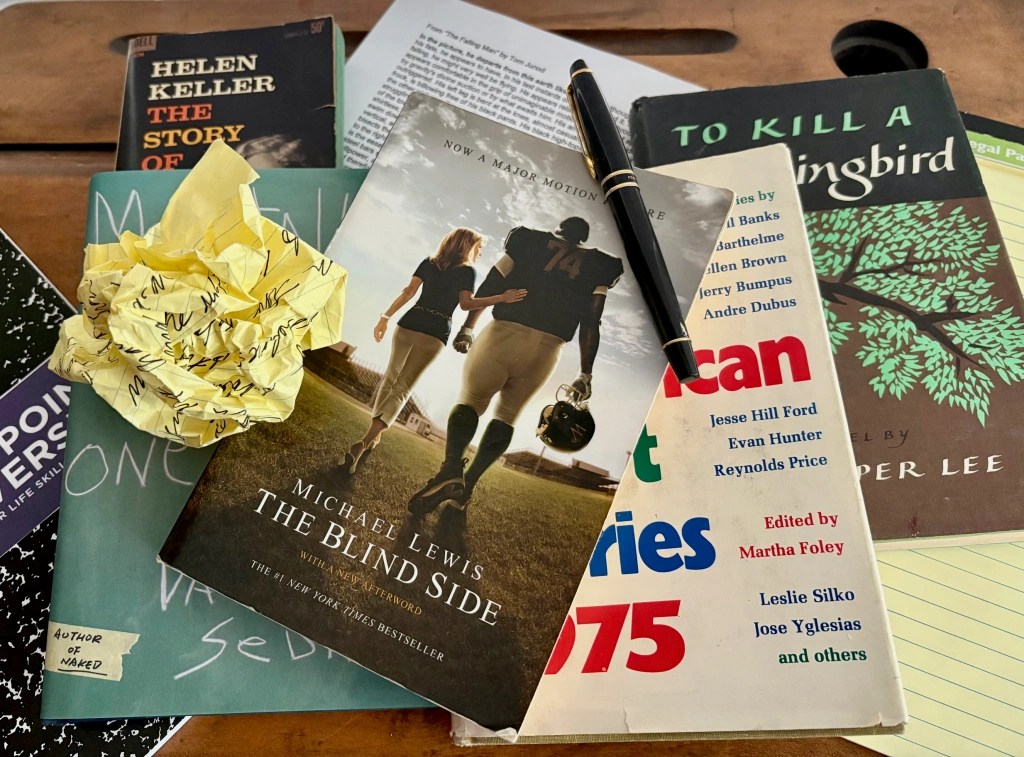
This morning in class, you will compose a reflective essay that documents the process of planning, drafting, and revising your analysis. Include at least one relevant quotation from Writing Analytically, introduced with a signal phrase and followed by a parenthetical citation. Questions to consider in your reflection include the following:
Questions to Consider in Your Reflection
- When you began transferring the words from your handwritten draft onto the screen of your laptop or tablet, what did you observe about the process?
- What aspect of the writing seemed the most challenging? Choosing your topic? Deciding which text would serve as your subject? Determining your thesis? Identifying details to support your claims? Organizing the body of the essay? Composing the conclusion? Why did that aspect of the writing seem the most challenging?
- Did the subject of your analysis change? If so, what was your original subject, and what did you change it to?
- Did any of the sample analyses (“Wait Means Never,” “Princess of the Rock,” “The Strange Fruit of Sosnowiec”) prove helpful to you? If so, which one? How was it helpful?
- What do you consider the strongest element of your analysis?
- At what point in the process did you decide on a title? Did you change the title during the writing process? If so, what was the original title?
- What image that documents part of your writing process away from the screen did you include in your blog post? Why did you choose that image?
- What relevant website did you include an embedded link to in your blog post? Why did you choose that site?
Sample Works Cited Entries
Rosenwasser, David, and Jill Stephen. “Focus on Individual Words and Phrases.” Writing Analytically, 9th edition. Wadsworth/Cengage, 2024. pp. 48-49.
Rosenwasser, David, and Jill Stephen. “How Long?: Paragraphs, Readers, and Writers.” Writing Analytically, 9th edition. Wadsworth/Cengage, 2024. p. 308.
Rosenwasser, David, and Jill Stephen. “‘Interesting,’ ‘Revealing,’ ‘Strange’” Writing Analytically, 9th edition. Wadsworth/Cengage, 2024. p. 24.
Rosenwasser, David, and Jill Stephen. “Seems to Be About X, But Could Also Be (Or is ‘Really’) About Y.’” Writing Analytically, 9th edition. Wadsworth/Cengage, 2024. pp. 104-7.
Rosenwasser, David, and Jill Stephen. “What a Good Analytical Thesis Is and Does.” Writing Analytically, 9th edition. Wadsworth/Cengage, 2024. pp. 241-42.
Rosenwasser, David, and Jill Stephen. “Words Matter.” Writing Analytically, 9th edition. Wadsworth/Cengage, 2024. pp. 49-50.
Monday in class, I distributed copies of my study of a page of Art Spiegelman’s Maus, which I wrote as a model analysis in a previous semester. An additional copy, which complies with the guidelines of your analysis blog post, appears below.
The Strange Fruit of Sosnowiec
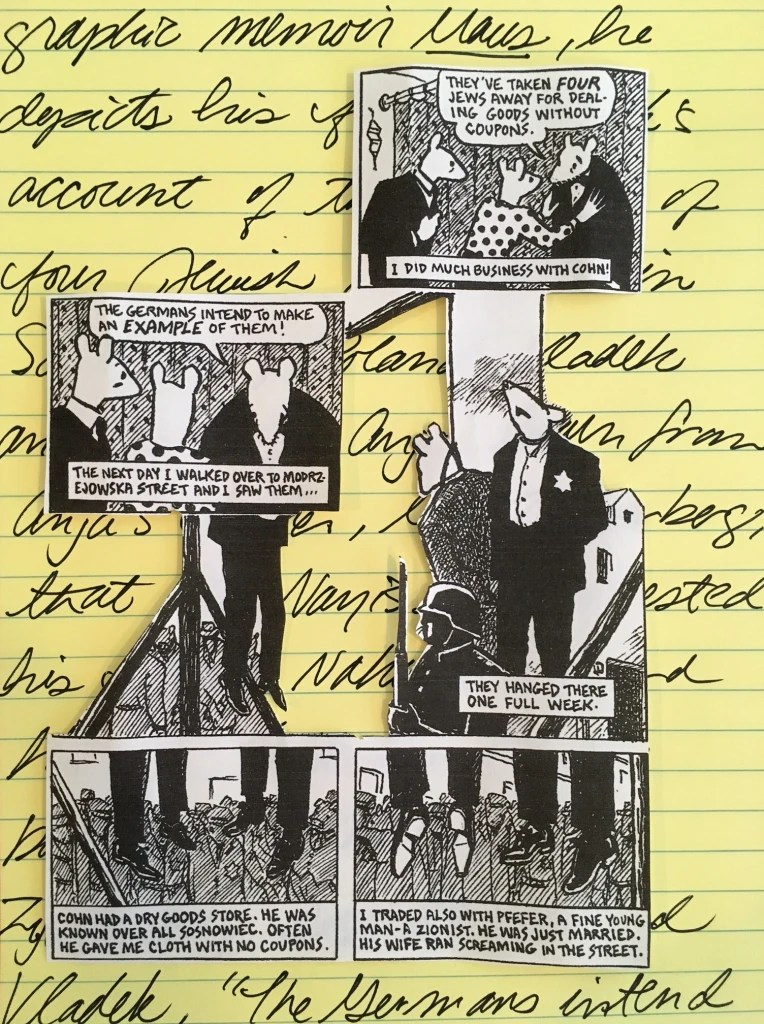
In his graphic memoir Maus, Art Spiegelman devotes a page to his father Vladek’s account of the hangings of four Jewish merchants in Sosnowiec, Poland. Vladek and his wife, Anja, learn from Anja’s father, Mr. Zylberberg, that the Nazis have arrested his friend Nahum Cohn and his son. With his head bowed in sorrow, Mr. Zylberberg says to Anja and Vladek, “The Germans intend to make an example of them!” (83). That image of Mr. Zylberberg speaking with Vladek and Anja overlies the larger panel that dominates the page, one that depicts the horror that Mr. Zylberberg anticipates: the murder of his friend Nahum Cohn, Cohn’s son, and two other Jewish merchants. That haunting panel and the smaller ones that frame it illustrate the complexity of Spiegelman’s seemingly simple composition. His rendering of the panels of the living in conjunction with the fragmented panels of the hanged merchants simultaneously conveys connection and separation: both the grieving survivors’ ties to the dead and the hanged men’s objectification at the hands of the Nazis.
The placement of the overlying panel not only hides part of the horror behind it, but it also connects Vladek’s father-in-law to one of the victims. Mr. Zylberberg’s head and torso appear directly above the suspended legs and feet of one of the hanged men, creating an image that merges the two.
Spiegelman further emphasizes the mourners’ identification with the hanged men by extending two of the nooses’ ropes upward to the smaller panel above them, linking the living to the dead. Additionally, Spiegelman underscores the link with Vladek’s line of narration at the bottom of the smaller panel: “I did much business with Cohn!” (83). The word with appears directly above the rope, punctuating the connection between both Nahum Cohn and his friend Mr. Zylberberg and Zylberberg’s son-in-law, Vladek.
While the panels of the hangings yoke the living to the dead, Spiegelman’s presentation of the hanged men in fragments also objectifies them. The final panels on the page depict only their shoes and part of their pant legs suspended above the onlookers, images that may evoke in some readers thoughts of the last remnants of the Jews who stepped barefoot into the gas chambers of Auschwitz.
Whether the hanged men’s shoes call to mind those mountains of leather left behind by the Jews, the separation of their lower legs and feet from the rest of their bodies turns them into something less than human—not people, but mere parts. Thus, Spiegelman creates a picture of the hangings that illustrates both the mourners’ identification with the victims and the Nazis’ perception of the Jews as less than human.
Spiegelman’s transformation of the Nazi propaganda portrayals of Jews as rats remains an astounding achievement thirty-five years after the publication of the first volume of Maus. But seeing the hanged merchants in Modrzejowska Street in the midst of the George Floyd murder trial in Minneapolis and less than three months after the January 6 Capitol riot reminds readers that the panels of Spiegelman’s memoir have grown more prescient. The nooses evoke images of Officer Derek Chauvin’s knee on George Floyd’s neck, the January 6 chants to hang the Vice President, and a T-shirt glimpsed in the Capitol crowd, one with a Nazi eagle below the acronym 6MWE (Six Million Wasn’t Enough), a reference to the number of Jews slaughtered in the Holocaust. Our heads are bowed in sorrow with Mr. Zylberberg’s. The strange fruit of our past, both distant and recent, should seem far stranger.
Work Cited
Spiegelman, Art. Maus I. Pantheon, 1986. p. 83.
Next Up
Wordplay Day! To prepare for class, revisit the Dictionary and World Builder pages on the Scrabble website, or the Merriam-Webster Scrabble Word Finder page, and review the blog posts devoted to Scrabble tips.
 Jane Lucas