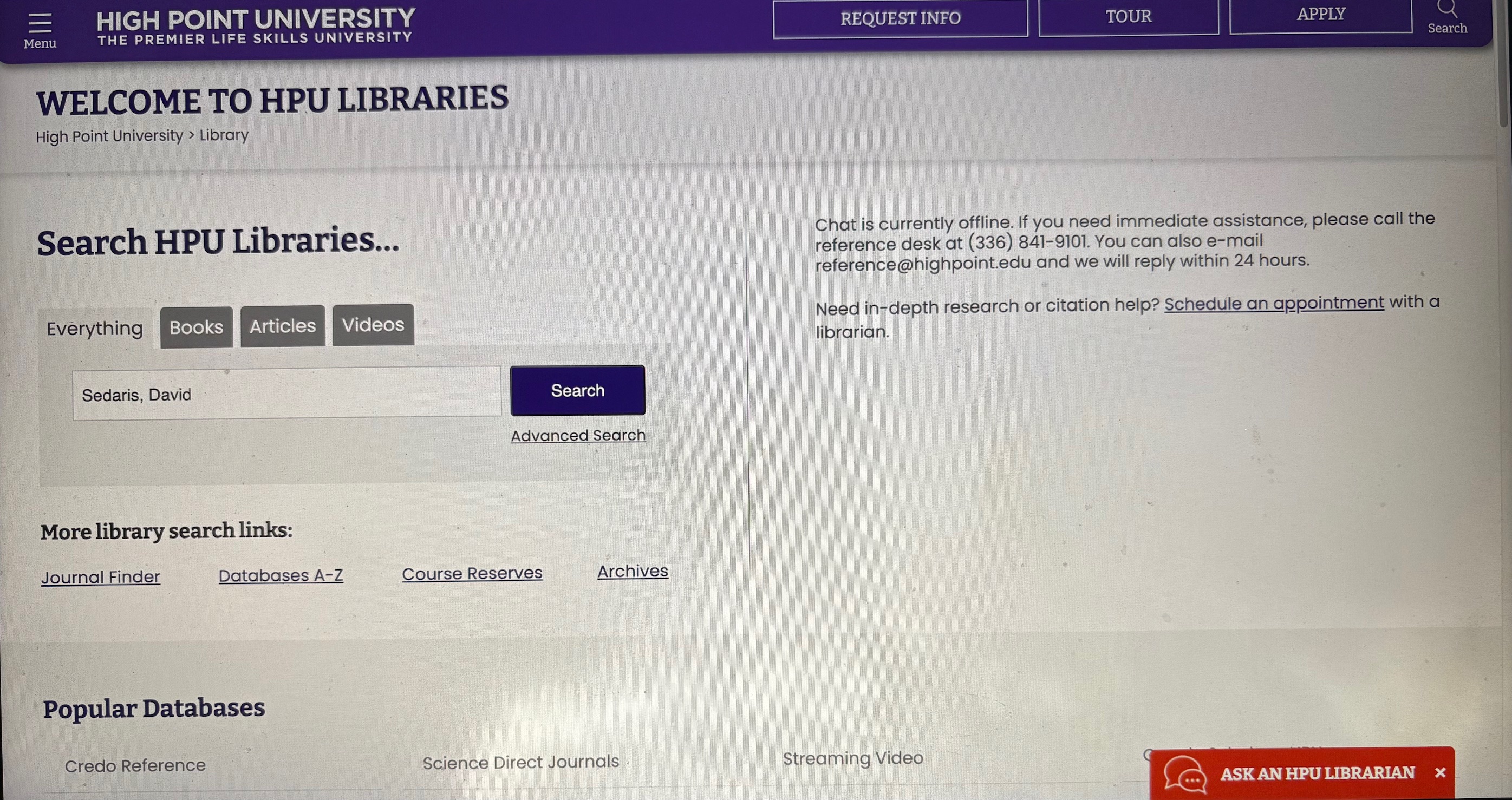
Today in class, you will explore the HPU Libraries website to locate, read, and annotate additional sources for your final essay and annotated bibliography. The work that you submit at the end of class today should include at a minimum one partial MLA-style annotated bibliographic entry.
To begin my sample search, seen in the image above, I typed David Sedaris’s name in the search bar on the left. Though I could have chosen to narrow my search by source type (Books, Articles, or Videos), I chose the default, Everything, option to see the number and variety of sources it would yield.
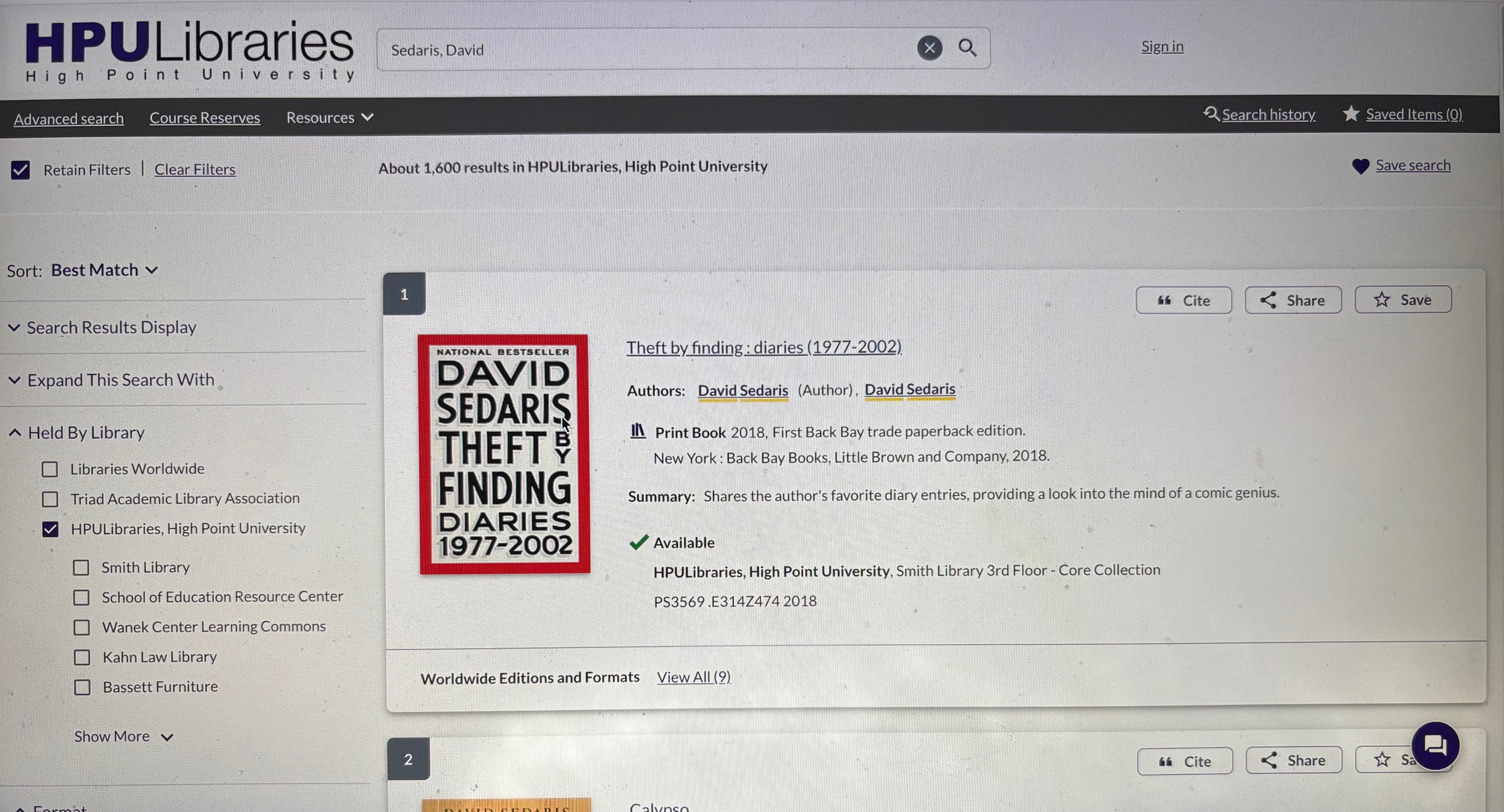
The first item my search yielded was David Sedaris’s Theft by Writing, as shown above. That collection of his diaries could serve as an additional primary source, but sifting through all the items that follow would be arduous. Near the top of the screen, you can see that the search yielded “[a]bout 1,600 results.”
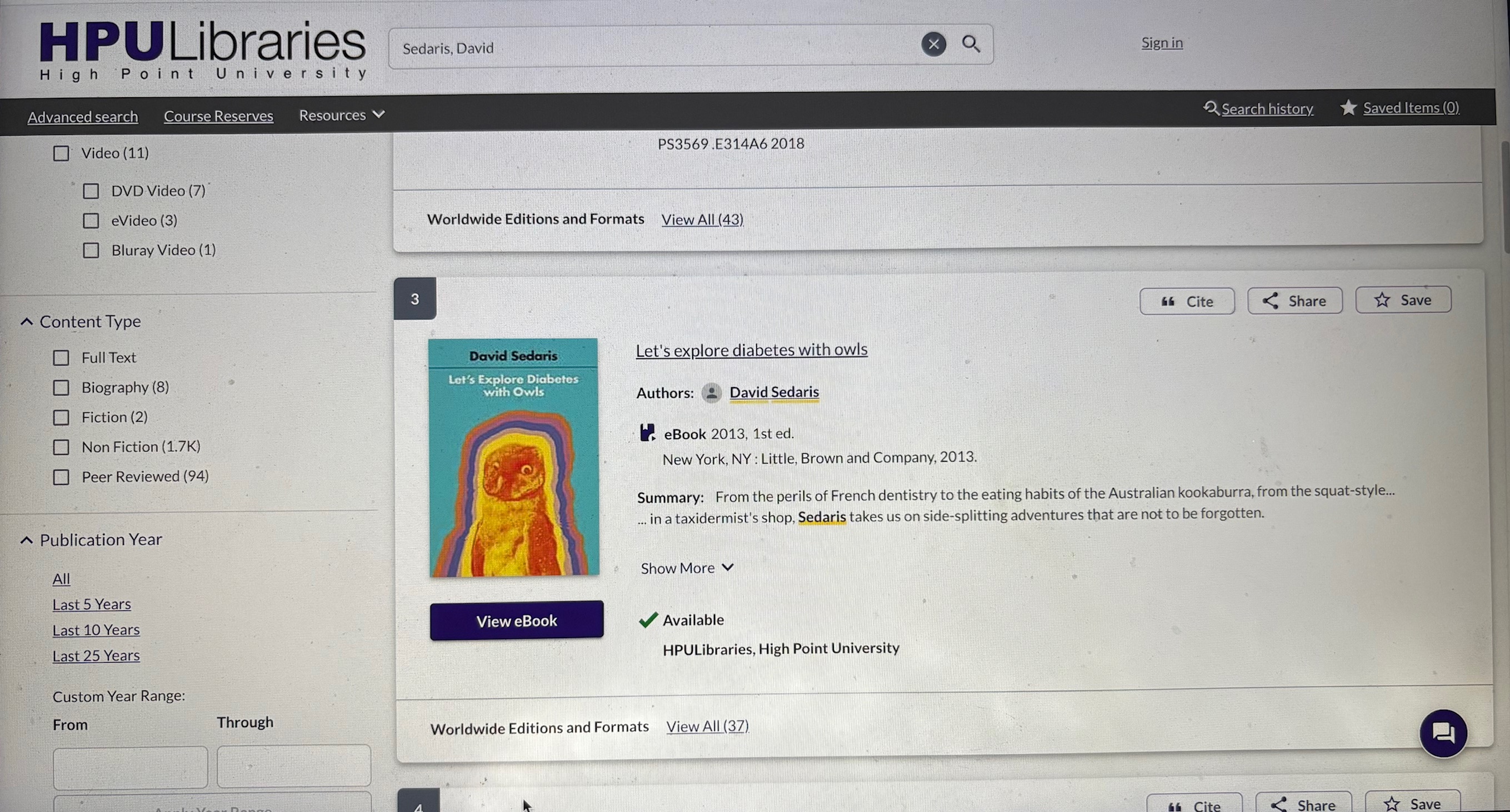
Scrolling down the page shows several options for narrowing a search with filters. On the left in the picture above, you can see that those include Content Type and Publication Year. Since I would like to find a critical study of Sedaris’s writing, under Content Type, I chose Peer Reviewed.
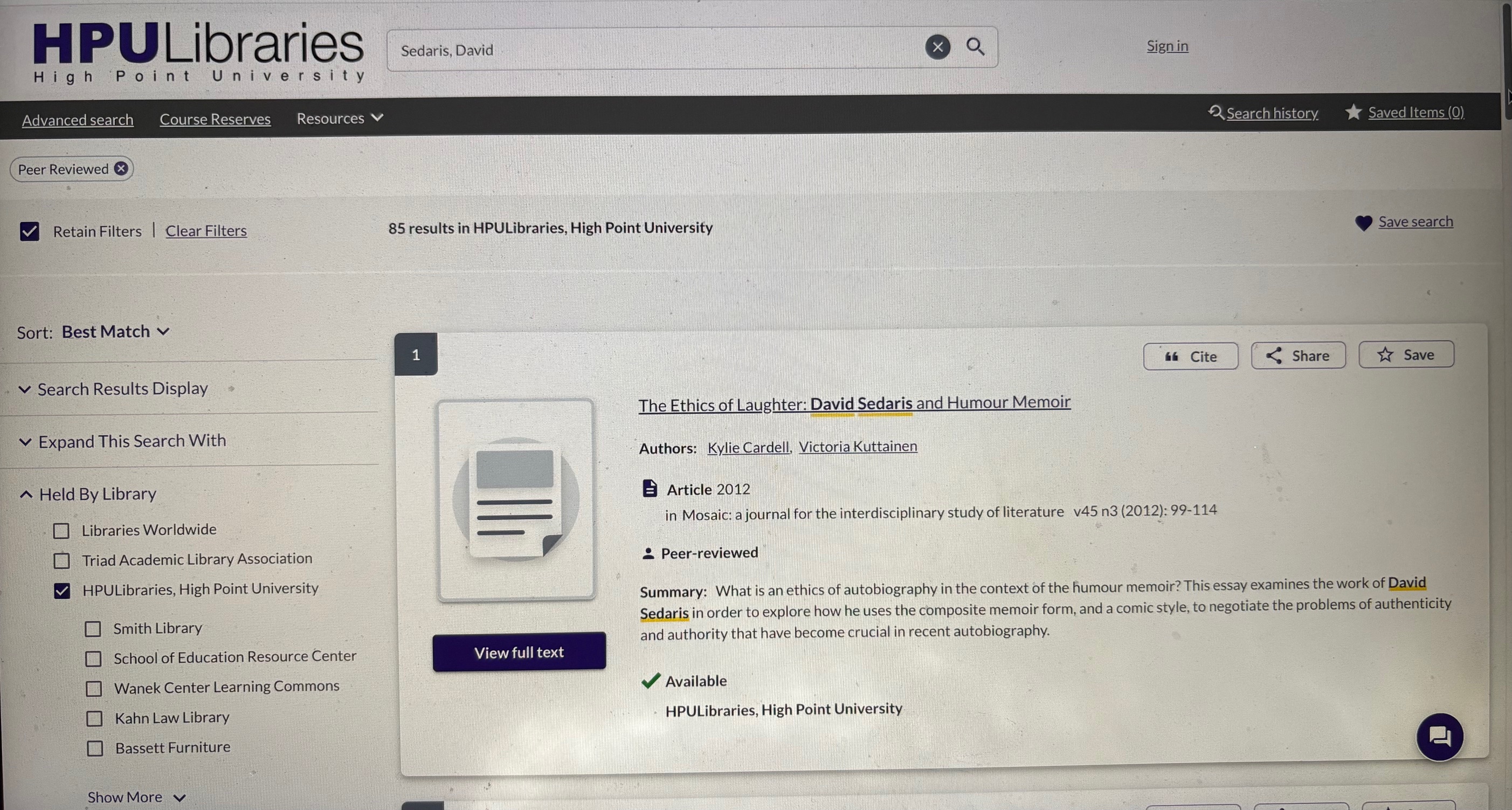
Limiting my search to peer-reviewed articles reduced the number of results by nearly 95%. In the image above (near the top), you can see there are eighty-five results, the first of which interests me because the title, “The Ethics of Laughter: David Sedaris and the Humour Memoir,” indicates that the authors consider the ethical nature of Sedaris’s blurring of fact and fiction in his humor.
Clicking View full text opens the page pictured below, which offers five options for accessing the full text of the article.
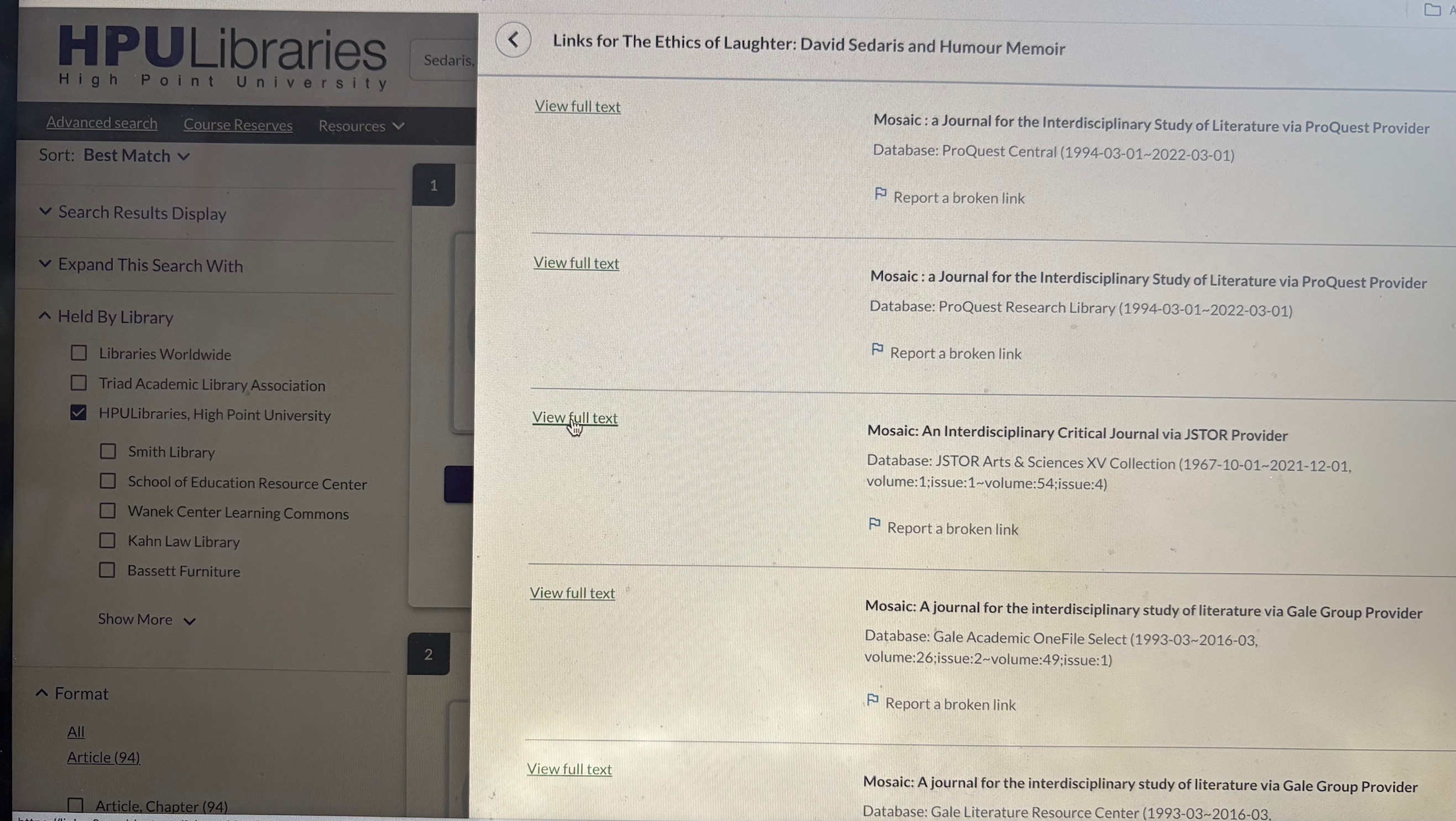
Though I could have chosen any of the five, I selected the JSTOR option. Unlike the other four database choices, JSTOR provides photographic images of the pages as they appear in the physical issue of the journal. (See the document on the lower right in the photo below.) If I had chosen one of the two ProQuest or Gale options, the full text would be unpaginated, which would require me to number the paragraphs in preparation for citing the article.
JSTOR (short for Journal Storage), a nonprofit digital library and database, houses thousands of journals and e-books, and millions of primary sources. If a search of yours yields a JSTOR option, I recommend you choose it. Its PDFs ease both the processes of reading and citing articles.
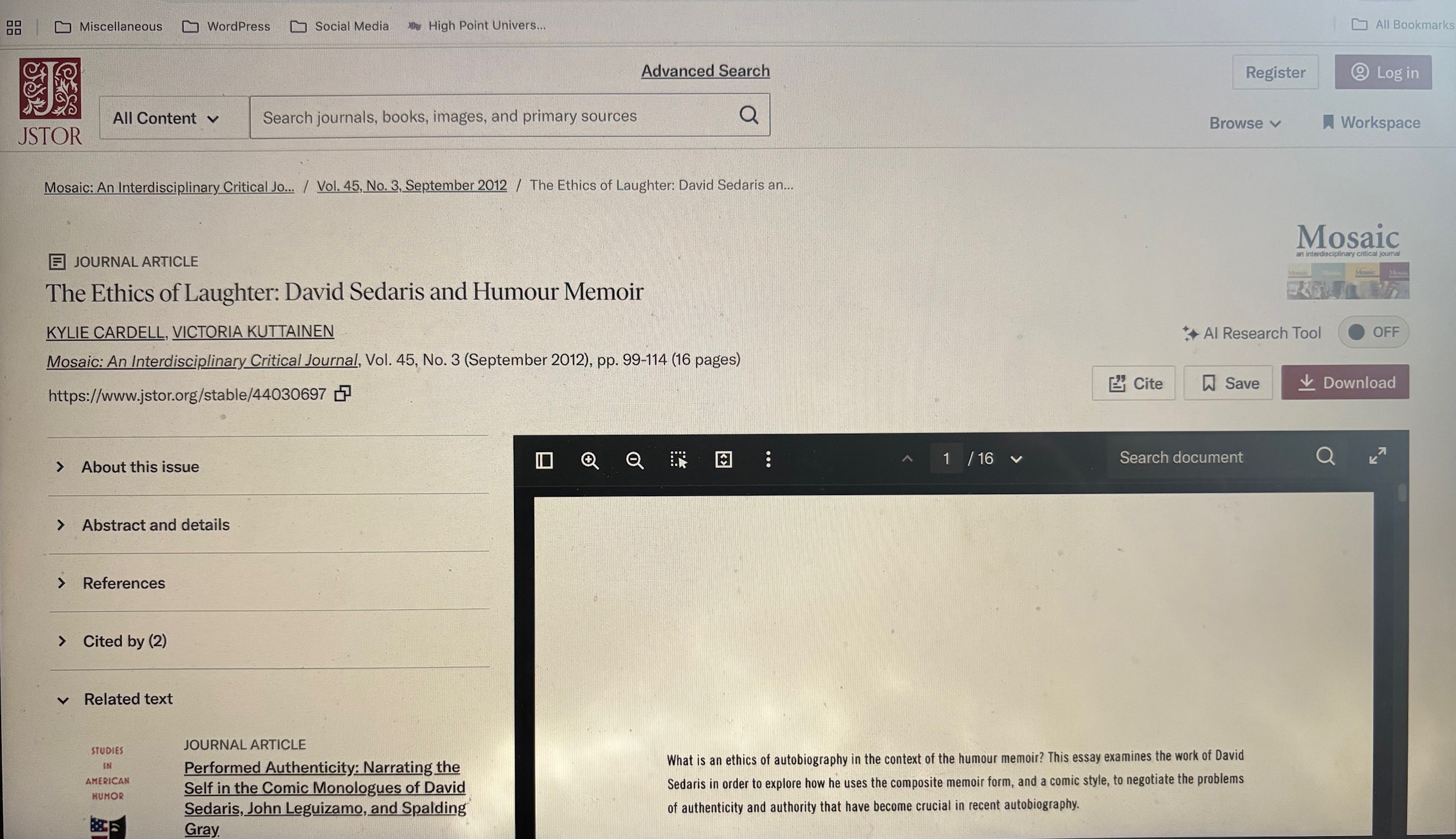
Another benefit of JSTOR is the list of links to related texts. In the lower left of the photo above, you can see a link to a study of the monologues of David Sedaris, John Leguizamo, and Spalding Gray. Although the article does not focus solely on Sedaris, the section devoted to him may be vital to a study of his humor–perhaps specifically his public readings of his work.
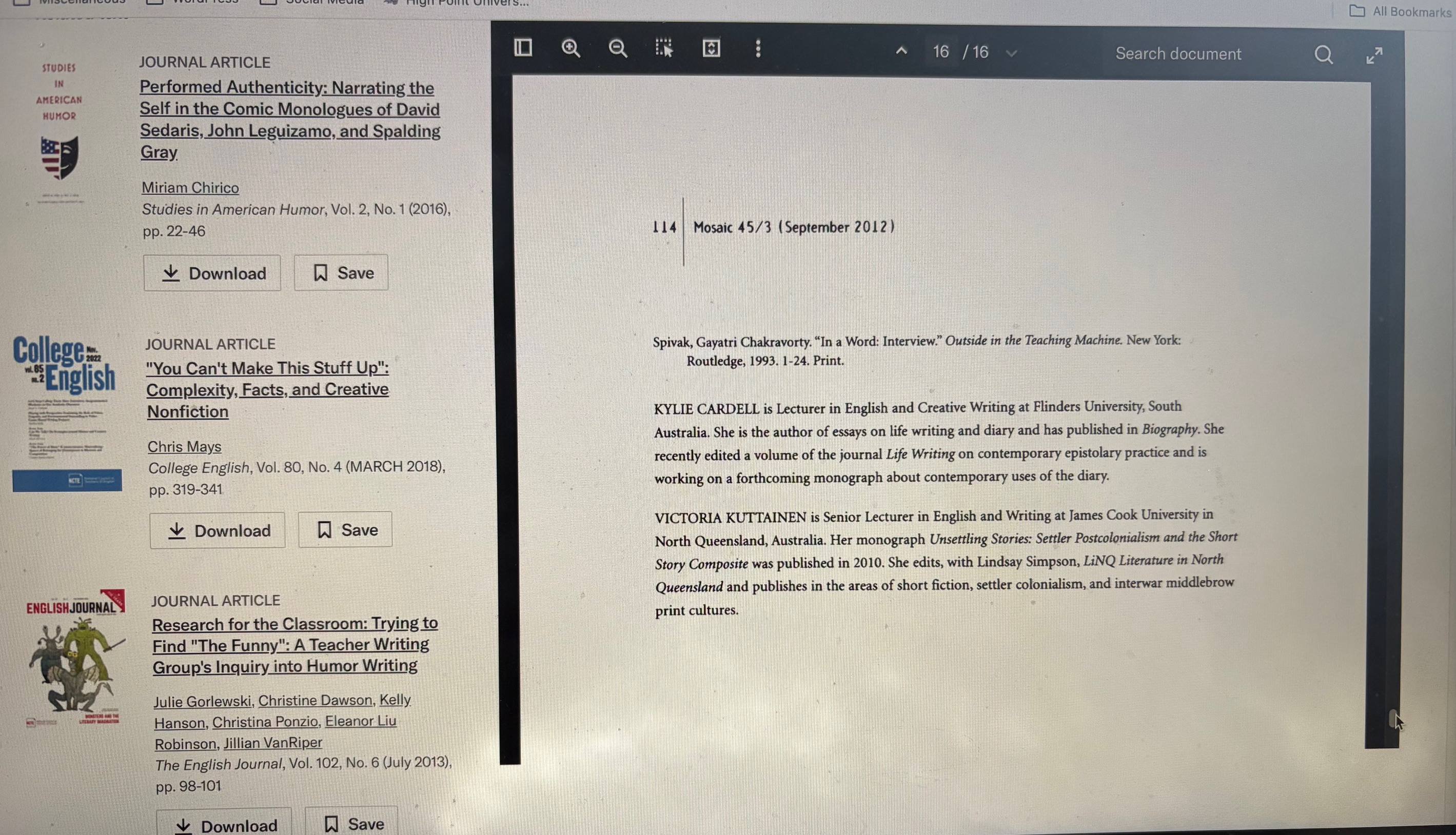
At the end of the article, seen above on the right, are the credentials for its co-authors. Often, credentials will appear at the beginning or end of an article. Look carefully at both the title page and the final page. If the article doesn’t include the author’s credentials–which is unlikely but nevertheless possible in an academic database–you will need to conduct a separate online search for them. Keep in mind that the absence of credentials may be a red flag. If you can’t locate details about a writer’s qualifications and achievements, that writer’s article may not be a reliable source.
If one of your sources has two authors, you may present the credentials for both of them in one paragraph. If you choose a source with three or more authors, include only the credentials for the lead author, the one whose name appears first on the title page.
After I conducted the search detailed above, I read and annotated “The Ethics of Laughter” in preparation for composing an annotated bibliographic entry. That annotated bibliographic entry appears below.
Sample Annotated Bibliographic Entry
Cardell, Kylie, and Victoria Kuttainen. “The Ethics of Laughter: David Sedaris and Humour Memoir.” Mosaic: An Interdisciplinary Critical Journal, vol. 45, no. 3, 2012, pp. 99-114. JSTOR, http://www.jstor.org/stable/44030697.
“The Ethics of Laughter: David Sedaris and Humour Memoir” explores the implications of the blending of truth and artifice in David Sedaris’s writing. In the words of the authors, Sedaris’s “memoirs have attracted controversy for their blurring (or, as we argue, contesting) of boundaries between fiction and non-fiction” (Cardell and Kuttainen 100). While some critics, such as journalist Alex Heard, believe that “Sedaris exaggerates too much for a writer using the non-fiction label” (qtd. in Cardell and Kuttainen 103), Cardell and Kuttainen assert that Sedaris’s use of hyperbole, a staple of his prose style, is ethical in the context of the humor memoir.
Cardell and Kuttainen’s article highlights the complexity of assessing the validity of Sedaris’s mingling of the real and what he refers to as the “realish” in his writing (qtd. in Cardell and Kuttainen 99). “The Ethics of Laughter” could play a significant role in studies that focus solely on Sedaris’s humor, as well as ones that examine both Sedaris’s writing and that of other memoirists who blur the line between fiction and nonfiction.
Kylie Cardell, Ph.D., author of Dear World: Contemporary Uses of Autobiography, is Associate Professor of Humanities at Flinders University. Her co-author, Victoria Kuttainen, Ph.D., author of Unsettling Stories and The Transported Imagination, is Associate Professor of Art and Creative Media at James Cook University.
Note that the blog format of the annotated bibliographic entry above is different from MLA format, which features paragraph indentations and double spacing. The bibliographic entry above and the three paragraphs that follow total 241 words. The minimum word count for the entire assignment (essay and bibliography together) is 1,800 words. If you compose five annotations of the length of the one above, you will be well on your way to completing your 1,800-word minimum. However, keep in mind that a bibliography that is close to, or reaches, the minimum word count by itself does not warrant an insubstantial introductory essay.
Next Up
Wordplay Day! To prepare for class, revisit the Dictionary and World Builder pages on the Scrabble website, or the Merriam-Webster Scrabble Word Finder page, and review the blog posts devoted to Scrabble tips.
 Jane Lucas