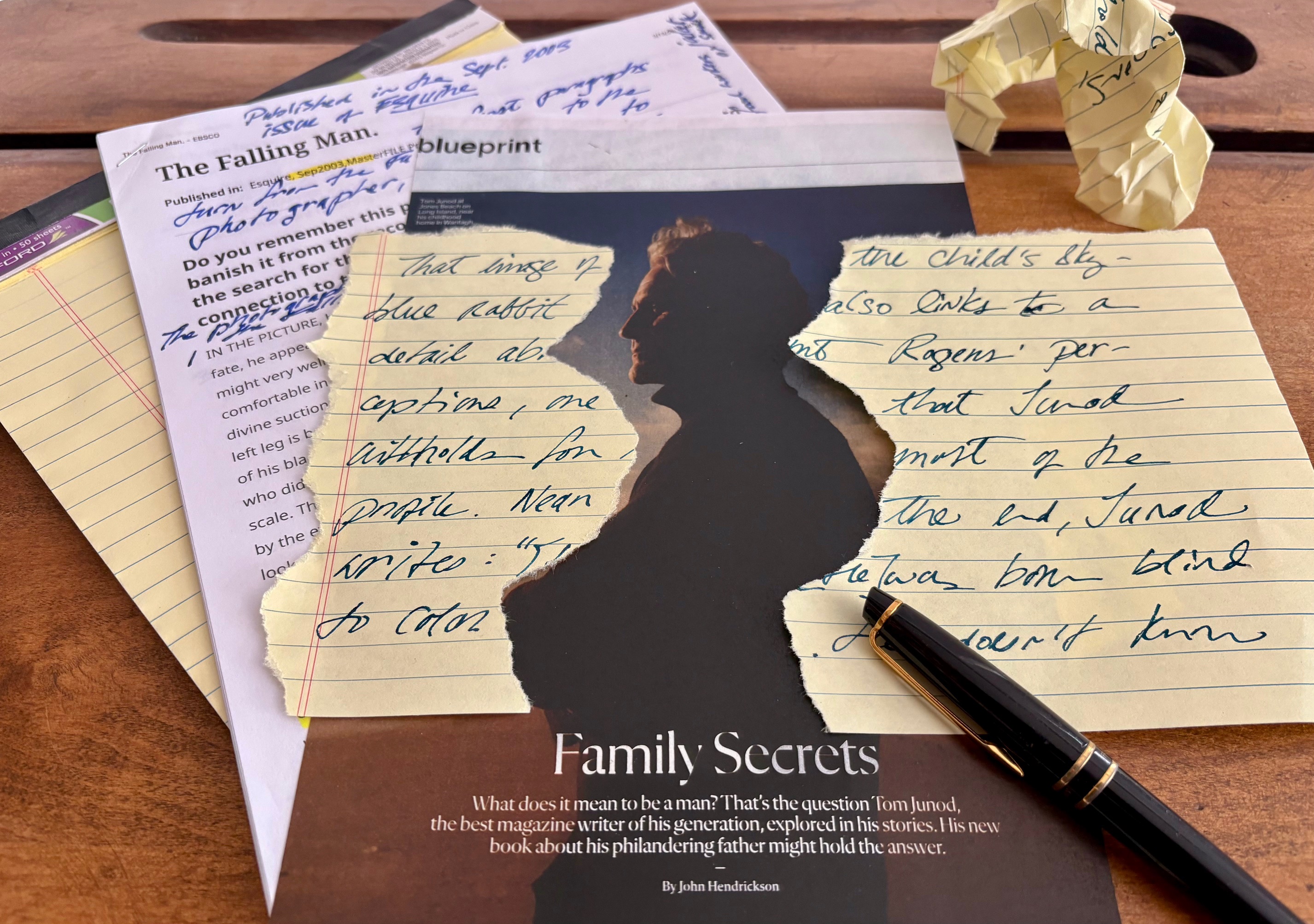
As you revise your essay and your bibliographic entries, read “Strategy 1: Make Your Sources Speak” (328-29) and “Integrating Quotations into Your Paper” (343-46) in Writing Analytically. After you have read those sections of the textbook, ask yourself whether your reasons for the quotations you have included are clear to the reader. If your reasons aren’t clear, revise the passages that precede and follow each quotation to ensure that your source’s words are an integral part of your writing, rather than a seemingly random insertion.
You are required to quote only two of your sources in your essay, but you are welcome to include additional quotations in your essay and your annotations. Remember that you should avoid the word quotations in your project. We do not write and speak in quotations; we write and speak in words, phrases, and sentences.
Note how the lines that precede the quotations in the passage below introduce the quotations and how the lines that follow the quotations demonstrate their significance.
Take, for instance, the first and last words of the opening line of Junod’s Rogers’ profile, “Can You Say . . . ‘Hero’?”: “Once upon a time, a little boy loved a stuffed animal whose name was Old Rabbit” (par. 1). Once upon a time, a staple of bedtime stories, recurs five times (pars. 6, 15, 21, 34, and 45). That repetition not only emphasizes the children’s world that the subject inhabits—as the host of the long-running Mr. Rogers’ Neighborhood—but also connects the once-upon-a-time anecdotes of Rogers’ life with those of some of the viewers whose lives have been profoundly affected by his television show, and by him. A case in point: The first once-upon-a-time sentence ends with “Old Rabbit” (par. 1). Because readers know from the article’s headnote that the subject is Fred Rogers, they assume that the opening anecdote about a young boy who throws his stuffed rabbit out of the car window is Rogers himself, but later—a quarter of the way through the article—readers learn that the little boy is actually Junod, who uses the once-upon-a-time trope to link his story, and others’, to Rogers.’
The complete model essay and bibliography on Tom Junod’s writing, from which the passage above is drawn, is included at the end of this post.
Indirect Sources/Secondary Quotations
If you are quoting someone quoted by the author of a source, do not incorrectly attribute the words to the author.
- Journalist Bronwen Dickey, a visiting professor at Duke, observes in Tom Junod’s writing, “a recognition of people’s pain that you don’t have unless you’ve been through some extraordinary pain yourself” (qtd. in Hendrickson 29).
- A journalist who teaches Tom Junod’s writing in her college classes observes in his writing, “a recognition of people’s pain that you don’t have unless you’ve been through some extraordinary pain yourself” (Dickey qtd. in Hendrickson 29).
The two examples above demonstrate how to present an indirect source or secondary quotation. Qtd. in indicates that the speaker or writer of the words, Bronwen Dickey, is quoted on page twenty-nine of a source written by John Hendrickson. In the first example, Bronwen Dickey’s last name does not appear in the parenthetical citation because she is named in the sentence. In the second example, her last name is included in the parenthetical citation because she is not named in the sentence.
The same rules apply to indirect quotations in unpaginated sources:
- Tom Junod writes of his subject’s desire to produce television programming for “the broadcasting of grace through the land” (Rogers qtd. in Junod, par. 32).
- Tom Junod writes of Fred Rogers‘ desire to produce television programming for “the broadcasting of grace through the land” (qtd. in Junod, par. 32).
Note that in a parenthetical citation for an unpaginated source, a comma separates the author’s last name from the abbreviation par.
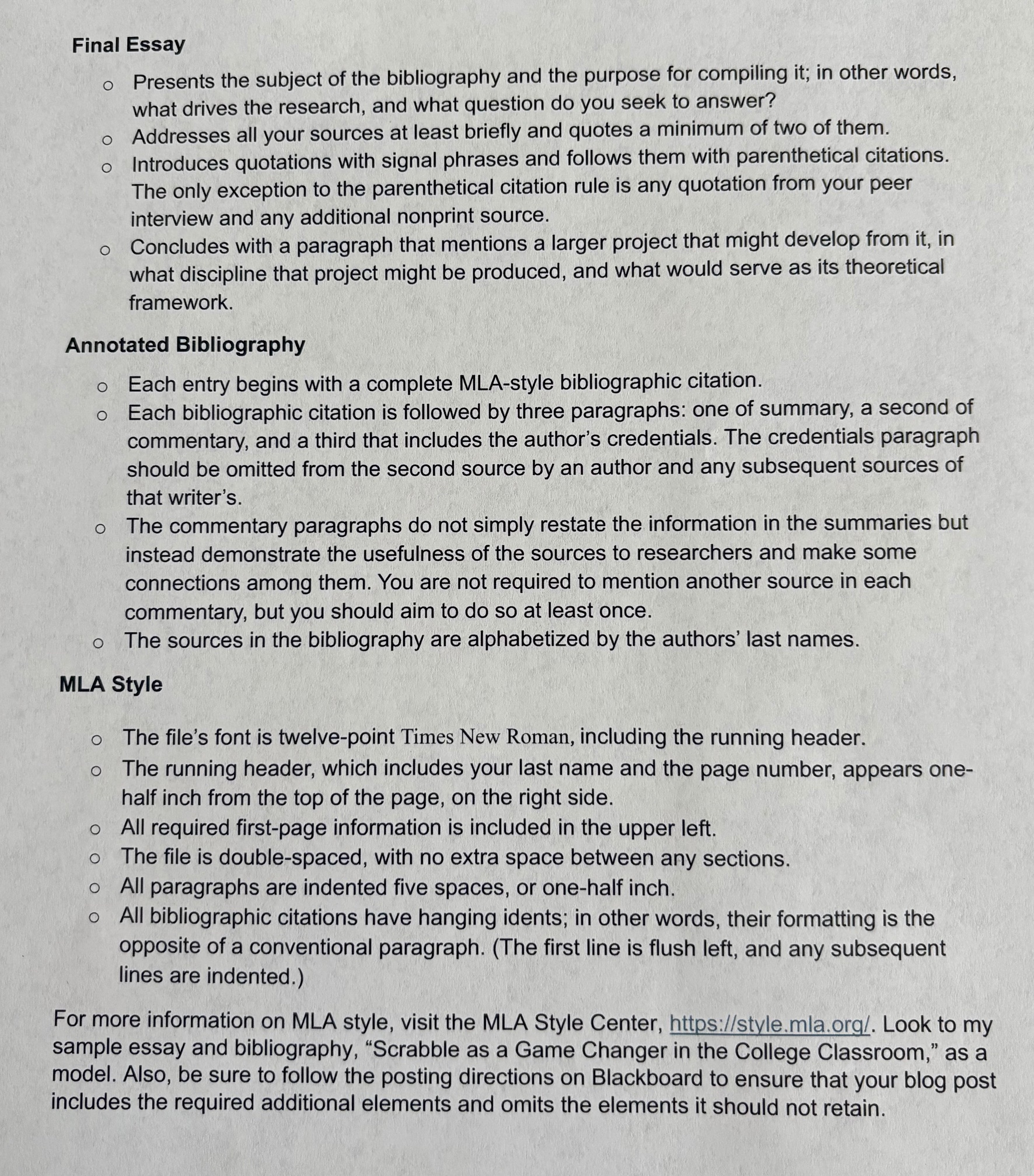
As one of the last steps in your revision process, consult the checklist I distributed in class. An additional copy is included below.
Checklist
Preparing for Your Reflection
In tomorrow’s class, you will compose a reflective essay focusing on the processes of researching, drafting, and revising your final essay and annotated bibliography. In your reflection, you will include a relevant quotation from Writing Analytically or from one of the sources included in your bibliography.
If you quote a line from “Integrating Quotations into Your Paper” or “Strategy 1: Make Your Sources Speak,” include a work cited entry for that section of the textbook at the end of your reflection. Write the work cited entry in the correct format in your journal, along with the line you will quote in your reflection for your reference.
- Rosenwasser, David, and Jill Stephen. “Integrating Quotations into Your Paper.” Writing Analytically, 9th edition. Wadsworth/Cengage, 2024. pp. 343-36.
- Rosenwasser, David, and Jill Stephen. “Strategy 1: Make Your Sources Speak.” Writing Analytically, 9th edition. Wadsworth/Cengage, 2024. pp. 328-29
You are welcome to quote another relevant section of Writing Analytically, but be sure to record the work cited entry in the correct format in your journal. Do the same if you plan to quote one of the sources in your annotated bibliography. During the writing of your reflection, which is a handwritten assignment, you will not have the option of referring to any parts of your essay and bibliography in electronic form. You may refer only to your journal, your textbook, your class handouts, and a physical copy of your essay and bibliography, if you opt to print one. You are not required to submit a paper copy of the assignment, but you are welcome to print one for your own reference.
Model Final Essay and Annotated Bibliography
I have included below the essay and bibliography on Tom Junod’s writing that I composed as a model for you. In my remarks about the project-in-progress in last Wednesday’s class, I mentioned that although the addition of a final essay of four hundred words (or slightly fewer) would fulfill the project’s 1,800-word minimum requirement, I would likely exceed the minimum to adequately chronicle my writing and research.
I far exceeded four hundred words, by roughly one thousand, making the complete project (essay and bibliography combined) about 2,800 words. If a 1,400-word final essay seems daunting as a model, look to my previous model, “Scrabble as a Game Changer in the College Classroom.” That essay and its bibliography are much shorter, a total of about 2,000 words, only three hundred more than the minimum word requirement. PDFs of both model essay and bibliography projects are posted in the sample papers folder on Blackboard.
“Writing by Ouija Board”: The Art of Tom Junod’s Prose
In late August 2003, the September issue of Esquire arrived at my house. The door of my town home had a mail slot—as many houses in Richmond’s Fan district do—so the magazine first appeared to me not in the confines of a mailbox but on the floor of the foyer amid a sea of catalogs and junk mail. I picked up the magazine with the intention of thumbing through it only briefly before placing it on the coffee table. But as I turned the pages, I glimpsed Richard Drew’s now-iconic 9/11 photograph of the unidentified Falling Man appearing to bisect the Twin Towers. I scanned the opening lines on the facing page—again with the intention of reading only briefly—but I was captivated by the first words: “In the picture, he departs from this earth like an arrow” (Junod, par. 1). I sat down and kept reading.
I didn’t stop until I’d read them all, all 7,334 words.
The next day, I walked into my freshman composition classes with copies of the opening paragraphs of “The Falling Man” in hand. Together, my students and I pored over Tom Junod’s words in what would become a yearly September ritual. Later, it became a twice-a-year ritual. For freshman writers, the value of examining those words extended beyond commemoration.
More than twenty years and two houses later, the current issue of Esquire arrived in the mailbox of my craftsman bungalow in High Point, North Carolina. As I thumbed through the pages, I was surprised to see the name, Tom Junod. It wasn’t a byline I saw; Junod had left Esquire in 2016 to join the staff of ESPN. Instead, his name appeared in the first lines of a profile by John Hendrickson, written on the occasion of the publication of Junod’s first book, his memoir, In the Days of My Youth I was Told What it Means to Be a Man—a title that alludes to Led Zeppelin’s “Good Times, Bad Times,” which opens with that line.
In my mind, I’d been turning over ideas for a bibliography project to complete as a model for my students. When I saw Hendrickson’s profile, I knew I’d found my subject.
Ever since “The Falling Man” first captured my attention, the pull of Junod’s prose has intrigued me. The renewed attention to his writing—prompted by the publication of his memoir—provided the impetus for a search for what specifically imbued his words with what seemed to be the proverbial je ne sais quoi, but in fact could be identified through careful study.
The starting point for my students’ research was a text they’d read for class—either by a writer we’ve studied or one that focuses on one of the aspects of the course (blogging, writing longhand, limiting screen time, playing Scrabble). For any student focusing on the writing of Tom Junod, “The Falling Man” was the starting point, so that’s where I began.
As I reread and marked up print-outs of “The Falling Man” and Junod’s Esquire profile of Fred Rogers, clear but complex patterns emerged. Repetition, which at first glance appeared solely for emphasis, was also a device linking images and ideas.
Take, for instance, the first and last words of the opening line of Junod’s Rogers’ profile, “Can You Say . . . ‘Hero’?”: “Once upon a time, a little boy loved a stuffed animal whose name was Old Rabbit” (par. 1). Once upon a time, a staple of bedtime stories, recurs five times (pars.6, 15, 21, 34, and 45). That repetition not only emphasizes the children’s world that the subject inhabits—as the host of the long-running Mr. Rogers’ Neighborhood—but also connects the once-upon-a-time anecdotes of Rogers’ life with those of some of the viewers whose lives have been profoundly affected by his television show, and by him. A case in point: The first once-upon-a-time sentence ends with “Old Rabbit” (par. 1). Because readers know from the article’s headnote that the subject is Fred Rogers, they assume that the opening anecdote about a young boy who throws his stuffed rabbit out of the car window is Rogers himself, but later—a quarter of the way through the article—readers learn that the little boy is actually Junod, who uses the once-upon-a-time trope to link his story, and others’, to Rogers’.
Another instance of Junod’s strategic repetition occurs in his locker-room description of Fred Rogers as he changes into swim trunks for his daily laps in the pool. Junod repeats the word slightly to emphasize how Rogers’ aging has altered many aspects of his appearance: “slightly wattled at the neck, slightly stooped at the shoulders, slightly sunken in the chest” (par. 5). The signs of Rogers’ aging are numerous, the repetition reminds readers, but the choice of slightly also stresses its limits. He has aged, yes, but he is still the young-at-heart host beloved by viewers. In Junod’s words, “[W]hen he speaks, it is in that voice, the famous one, the unmistakable one, the televised one, the voice dressed in sweater and sneakers . . . the sly voice that sounds adult to the ears of children and childish to the ears of adults” (par. 5).
In that description, Junod also describes Rogers as “white as an Easter Bunny” (par. 5), a simile that not only adds another element to the portrait of the aging Rogers, but also connects to the Old Rabbit of the opening line, to the return of Old Rabbit a quarter of the way into the story—where he is identified as Junod’s stuffed toy—and to a child whose encounter with Rogers appears midway through the profile, a little girl holding “a small stuffed animal, a sky-blue bunny” (par. 22).
That image of the child’s sky-blue rabbit also links to a detail about Rogers’ perceptions, one that Junod withholds for most of the profile. Near the end, Junod writes: “[H]e was born blind to color. He doesn’t know the color of his walls, and one day, when I caught him looking toward his painted skies [in his TV studio], I asked him to tell me what color they are, and he said, ‘I imagine they’re blue, Tom.’ Then he looked at me and smiled. ‘I imagine they’re blue’” (par. 37). I could go on, but those deceptively simple instances of repetition demonstrate the complex mosaics of Junod’s prose.
In a podcast interview marking the twentieth anniversary of 9/11, Junod told the Press Box’s host, Bryan Curtis, that writing “The Falling Man” was “a little bit like writing by Ouija board.” For readers who marvel at the quality of Junod’s writing, that simile applies to his other stories as well. Picture his hand on the board’s planchette, gliding mystically from the letters O-L-D-R-A-B-B-I-T to E-A-S-T-E-R-B-U-N-N-Y, to S-K-Y-B-L-U-E . . . .
The interview that reveals Junod’s Ouija-board image of his composing process is one of the six sources in the bibliography that follows. Two of the others are a couple of his most admired stories: “Can You Say . . . ‘Hero’?”—the focus of the commentary you have just read—and “The Falling Man.” Rounding out the list are Hendrickson’s profile in the current issue of Esquire, an interview with a current student of mine, and a peer-reviewed article on Don DeLillo’s novel The Falling Man (2007), which references Junod’s article of the same name as a point of contrast.
That last source, written by a University of Buffalo professor, could serve as a starting point for a cultural or historical study of 9/11 writing. But as a teacher of freshman composition and a lifelong student of writing, I am interested primarily in Junod’s writing not for its treatment of 9/11, or any of his other subjects, but rather in how he renders them—with an artfulness that led his ESPN colleague Wright Thompson to call his oeuvre “the greatest collection of magazine stories that’s ever been assembled by one person” (qtd. in Hendrickson 29). Whether my continued study of Junod’s writing will lead me to pen a large-scale literary analysis of his prose, I do not know. Either way, the deeper understanding I have gained of his writing through the process of studying his words—and the commentary they’ve prompted—will inform my teaching, especially on those days when I hand my students the opening paragraphs of “The Falling Man.”
Annotated Bibliography
Conte, Joseph M. “Don DeLillo’s The Falling Man and the Age of Terror.” Modern Fiction Studies, vol. 57, no. 3, 2011, pp. 559-83. JSTOR, http://www.jstor.org.libproxy.highpoint.edu/stable/26287214.
In “Don DeLillo’s Falling Man and the Age of Terror,” Joseph M. Conte probes novelist Don DeLillo’s fictional chronicle of the destruction of the Twin Towers and the scarred lives of a survivor, Keth Neudecker, a corporate lawyer who escapes the North Tower; and his estranged wife, Lianne, who was not at the World Trade Center but who is subsequently haunted by images of a Manhattan performance artist who dangles from bridges and buildings, imitating the posture of the Falling Man in Richard Drew’s now-iconic photograph. Conte explores the characters and landscape of DeLillo’s novel, as well as the challenges of rendering in fiction the virtually unspeakable events of 9/11.
Although the focus of Conte’s analysis is not Tom Junod’s own Falling Man, his study is pertinent to those researching Junod’s work, as it references his 2003 article “The Falling Man,” and demonstrates the contrast between DeLillo’s aims as a novelist and Junod’s as a journalist. While Junod aimed to depict photographer Richard Drew’s Falling Man as a human symbol of what the United States became on 9/11, DeLillo’s fictional Falling Man haunts the New Yorkers who witness him imitating the posture of the still-unidentified Falling Man in Drew’s photo. Notably, Conte cites Junod’s criticism of DeLillo’s The Falling Man in his June 2007 Esquire review of the novel, addressing his objections to DeLillo’s decision to write a 9/11 novel whose scope is not equal to that of the loss.
Joseph M. Conte, a professor of English at the University of Buffalo, is the author of Transnational Politics in the Post-9/11 Novel, Design and Debris: A Chaotics of Postmodern American Fiction, and Unending Design: The Forms of Postmodern Poetry.
Hendrickson, John. “Family Secrets.” Esquire, March 2026, pp. 28-31.
As a prelude to the publication of Tom Junod’s new memoir, In the Days of My Youth I was Told What it Means to be a Man, journalist John Hendrickson profiles Junod at his home outside Atlanta, where he asks the author about his relationship with his father, Lou (the focus of his memoir), as well some of his most well-known magazine stories, including the highly-praised feature on Fred Rogers and the much-maligned profile of Kevin Spacey. Hendrickson incorporates observations on Junod’s prose by a host of other writers and editors, includingmemoirist J. R. Moehringer; Peter Griffin, former deputy editor at Esquire; Taffy Brodesser-Akner, New York Times staff writer; Wright Thompson, Junod’s colleague at ESPN; and journalist Bronwen Dickey, who teaches Junod’s work at Duke University.
“Family Secrets” provides researchers with the personal history that informs Junod’s writing, especially his new memoir, which Hendrickson refers to as a book whose “concerns hum beneath almost every magazine story Tom has ever written” (29). Along with its vital background on Junod’s formative years, Hendrickson’s article offers the insights of other writers and editors who admire Junod’s prose.
John Hendrickson’s stories have appeared in The New York Times, New York magazine, Esquire, Rolling Stone, and The Atlantic, where he is a contributing writer. He is also the author of Life on Delay, a memoir about his lifelong struggle with stuttering.
Junod, Tom. “Can You Say . . . ‘Hero’?” Esquire, vol. 130, no. 5, Nov., 1998, pp. 132-138+. ProQuest, https://libproxy.highpoint.edu/login?url=https://www.proquest.com/magazine/can-you-say-hero/docview/210269328/se-2.
“Can You Say . . . ‘Hero’?” brings together Tom Junod’s conversations with Fred Rogers in New York City, where he met architect Maya Lin at her giant clock in Penn Station, to tape a segment for his TV show; in Pittsburgh, at his studio, where he produced Mr. Rogers’ Neighborhood for thirty-one years and 865 episodes; and in Latrobe, Pennsylvania, where he navigated the perimeter of his childhood home on Weldon Street. Together, those conversations build the foundation for Junod’s profile of Fred Rogers, a portrait of a music major at a small Florida College who shelved his plans for divinity school when he first watched his parents’ new television. He detested what he saw—slapstick pie throwing—but, in Junod’s words, “[H]e believed, right then, that he was strong enough to enter into battle with that—that machine, that medium—and to wrestle with it until it yielded to him” (par. 32).
Junod draws on the repetition used both by and for children to chronicle the life of a man who dedicated himself to creating and sustaining an imaginary neighborhood where he and his Land of Make-Believe characters say the words that children need to hear. Junod’s profile offers vital background information for researchers examining the life and legacy of Fred Rogers and also serves as a primer for Junod’s signature style. Paired with “The Falling Man,” “Can You Say . . . ‘Hero’?” showcases the patterns that are hallmarks of his prose, such as the metaphors and similes he crafts, which not only provide comparisons but also link the recurring images and ideas in his stories.
Tom Junod, a senior writer for ESPN, has also written for Life, Sports Illustrated, and GQ, where his articles garnered two National Magazine Awards. Among Junod’s other notable works are his Esquire feature “The Falling Man” and his newly published memoir In the Days of My Youth I was Told What it Means to be a Man.
—. “The Falling Man,” Esquire, vol. 140, no. 3, Sept. 2003, pp. 176+. ProQuest, https://libproxy.highpoint.edu/login?url=https://www.proquest.com/magazines/falling-man/docview/210268344/se-2.
Published in the September 2003 issue of Esquire, Tom Junod’s “The Falling Man” focuses on the now-iconic 9/11 image of an unidentified man in downward flight, who appears to bisect the Twin Towers. Junod chronicles the moments leading up to AP photographer Richard Drew capturing the photo, Toronto Globe and Mail reporter Peter Chaney’s search for the true identity of the Falling Man, the reactions to the picture—both those of the public and of grieving families (whose loved one could be its subject), and the photograph’s status as a national symbol.
Junod’s thorough and riveting account of Richard Drew’s photograph and its life beyond the frame illuminates the role of the Falling Man in American culture and highlights the writer’s award-winning prose. “The Falling Man” remains an essential reference for studies of the iconography of 9/11, as well as studies of Junod’s writing.
—. “James B. Stewart and Tom Junod on Writing about 9-11.” The Press Box, 2 Sept. 2021, https://podcasts.apple.com/us/podcast/james-b-stewart-and-tom-junod-on-writing-about-9-11/id1058911614?i=1000534129966.
In his interview with Tom Junod, Bryan Curtis, editor-at-large of The Ringer and cohost of The Press Box podcast, talks with Junod on the occasion of 9/11’s then-upcoming twentieth anniversary. In his Q and A with Junod and the one with James B. Stewart that precedes it, Curtis asks the writers about their approaches to writing about 9/11, their writing processes, and the public’s reactions to their magazine features devoted to 9/11: Tom Junod’s on the unidentified Falling Man and James B. Stewart’s “The Real Heroes are Dead.” The latter, published in The New Yorker, focuses on Rick Rescorla, the decorated Vietnam War veteran and head of security for Morgan Stanley, who died in the South Tower’s collapse after leading an evacuation that saved hundreds from the same fate.
The September 2, 2021, episode of The Press Box podcast offers insights into the intricacies of writing about 9/11 and the writing processes of two journalists who reflected on the tragedy after the initial shock subsided: Stewart, six months later, and Junod, two years later. Their conversations with Bryan Curtis provide key first-person accounts for researchers studying the writing of Junod or Stewart in particular, or the journalism of 9/11 in general.
Welch, Sierra. Interview. Conducted by Jane Lucas. 23 March 2026.
English 1103 student Sierra Welch discusses first encountering Tom Junod’s writing when she read the opening paragraphs of “The Falling Man” in class and recognizing the distinctive qualities of his prose. In her words, “[H]e could have explained what he saw, but instead, he went into a description of one man, how he was falling, his pants, his legs, and used different similes to convey how significant 9//11 was and capture the emotional aspects for the readers.”
Welch’s remarks provide a detailed first-person account of a reader’s initial response to Junod’s prose. Her observations provide insights relevant to researchers examining general readers’ reactions to Junod’s words, as well as educators contemplating his writing as a subject of classroom study.
Sierra Welch is a criminal justice major at High Point University, currently enrolled in English 1103.
Up Next and Coming Soon
Tomorrow, Thursday, or Friday morning, you will complete your final essay and annotated bibliography. The due date for posting it to Blackboard and WordPress is Wednesday, April 8 (before class); the hard deadline is Friday, April 10 (before class).
In class tomorrow, you will compose an essay that reflects on the processes of researching, drafting, and revising your annotated bibliography and final essay. If you do not submit your essay and bibliography before class, refer to your work as ongoing. Carefully review the section of this post devoted to preparing, to ensure that you will be able to comply with all the assignment’s guidelines. Your reflection by itself will not be assigned a grade, but a reflective essay that doesn’t comply with the guidelines will lower the grade for your final essay and annotated bibliography.
 Jane Lucas