This morning, I will return your drafts with my notes, and you will have the remainder of the class period to begin revising your analyses on your laptops. Because next week is fall break, you will have two additional weeks to continue your revision work before you submit the assignment to Blackboard and publish it as a WordPress blog entry. The due date is Wednesday, October 16 (before class). The hard deadline is Friday, October 18 (before class). Directions for submitting your analysis are included on your assignment sheet and on the Blackboard submission site.
As you continue to revise your analysis, consider visiting The Writing Center. If you do so, you will earn five bonus points for the assignment.
To schedule an appointment, visit https://highpoint.mywconline.com, email the Writing Center’s director, Professor Justin Cook, at jcook3@highpoint.edu, or scan the QR code below. To earn bonus points for your analysis, consult with a Writing Center tutor no later than Thursday, October 17.
Nearly all of you in section nineteen consulted a Writing Center tutor as you worked on your literacy narrative, while less than half of you in section twenty did so:
Section 19: 18 of 20 students, 90%
Section 20: 7 of 19 students, 36.8%
Please encourage your classmates to take advantage of the opportunity to have an additional reader for your analysis-in-progress–and earn five bonus points to boot.
Next Up
Wordplay Day! To prepare for class, revisit the Dictionary and World Builder pages on the Scrabble website and review the blog posts devoted to Scrabble.
Rosenwaser, David and Jill Stephen. Chapter 7: “Finding an Evolving a Thesis.” Writing Analytically, 9th edition. Wadsworth/Cengage, 2024. pp. 234-78.
As you prepare to begin revising your analysis, read the section of Writing Analytically devoted to composing thesis statements (247-52). Also review the opening paragraph of my analysis of Art Spiegelman’sMaus and my sample opening for a possible analysis of Donald Bartheleme’s “The School,” both of which follow.
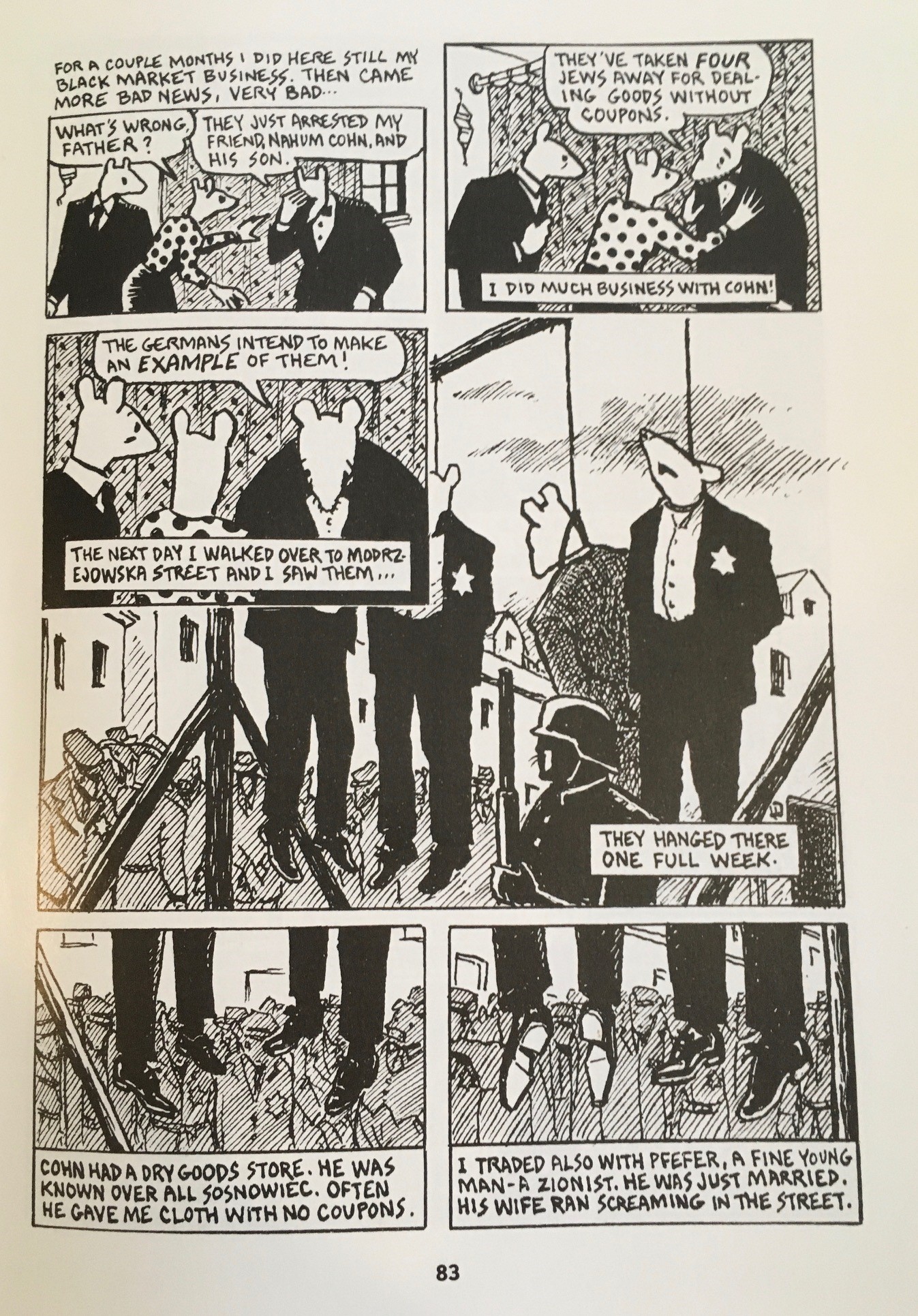
In Chapter 4 of Art Spiegelman’s graphic memoir Maus, he depicts his father Vladek’s account of the hangings of four Jewish merchants in Sosnowiec, Poland. Vladek and his wife, Anja, learn from Anja’s father, Mr. Zylberberg, that the Nazis have arrested his friend Nahum Cohn and his son. With his head bowed in sorrow, Mr. Zylberberg says to Anja and Vladek, “The Germans intend to make an example of them!” (83). That image of Mr. Zylberberg speaking with Vladek and Anja overlays the larger panel that dominates the page, one that depicts the horror that Mr. Zylberberg anticipates: the murder of his friend Nahum Cohn, Cohn’s son, and two other Jewish merchants. That haunting panel and the smaller ones that frame it illustrate the complexity of Spiegelman’s seemingly simple composition. His rendering of the panels of the living in conjunction with the fragmented panels of the hanged merchants simultaneously conveys connection and separation: both the grieving survivors’ ties to the dead and the hanged men’s objectification at the hands of the Nazis.
The authors of Writing Analytically note that “a productive thesis statement usually contains tension, the balance of this against that” (Rosenwasser and Stephen 248). Reread the thesis above (in bold) and consider the instances of “this against that”: larger panel and smaller one, complexity and simplicity, connection and separation.
Now consider the “this against that” in the sample opening for a possible analysis of Donald Bartheleme’s “The School,”
Donald Barthelme’s short story “The School” recounts a series of classroom lessons that end with the death of plants and animals–deaths that serve as a prelude to the death of a Korean orphan, followed by the deaths of classmates and family members. With conversational narration, accumulation of detail, and a shift in fictional mode, Barthelme deftly depicts the reality of the fleeting nature of life, even as the story itself veers from reality.
The sample opening paragraph above lacks the detail of the first paragraph of my Maus analysis because it’s the draft of an introduction for a paper I haven’t written. Completing a draft would enable me to develop the introduction and refine my thesis statement. That said, the introduction already has an instance of “this against that”: the reality of life depicted and the veering from reality with the shift in fictional mode.
Citing Others’ Ideas
If your analysis includes any ideas drawn from my remarks, which I subsequently posted as class notes on my blog, you should cite the blog post as you would any other online source.
Example: Dr. Lucas notes, “For Junod, choosing not to divide the first paragraph creates an unbroken movement that parallels the unbroken flight of his subject” (par. 3).
Tomorrow I will return your drafts with my notes, and you will have the class period to begin revising on your laptops. Because next week is fall break, you will have two additional weeks to continue your revision work. The due date is Wednesday, October 16 (before class). The hard deadline is Friday, October 18.
This morning in class you will plan and compose a midterm reflective essay that documents your work in the first half of the semester, focusing on two or three assignments or aspects of the course that have contributed to your development as a writer and a student. Since you have already written a reflection devoted solely to your literacy narrative, your midterm reflection should focus primarily on other assignments or aspects of the course, including the following:
Keeping a journal
Completing Check, Please! assignments
Studying one of the readings examined class, including “Letter from Birmingham Jail,” “Me Talk Pretty One Day,” “The Day that Language Came into My Life,” “The Power of the Pun,” “Back Story” (from The Blind Side), “The Falling Man,” “The School,” or the sample literacy narrative (“A Bridge to Words”)
Reading and editing samples of student writing
Writing for an online audience beyond the classroom/creating and maintaining a WordPress blog
Collaborating with your classmates on in-class writing assignments
Playing Scrabble/Collaborating with your teammates on Wordplay Day
Writing longhand
Limiting screen time
Include in your reflective essay the following elements:
A title that offers a window into your reflection
An opening paragraph that introduces your focus and presents your thesis
Body paragraphs that offer concrete details from your work to support your thesis.
A conclusion that revisits the thesis without restating it verbatim
Optional: A quotation from one the readings, introduced with a signal phrase and followed by a parenthetical citation. See the citation handout for models.
Sample MLA Works Cited Entries
Bartheleme, Donald. “The School.” The Best American Short Stories 1975, edited by Martha Foley, Houghton Mifflin, 1975. pp.8-11.
Sedaris, David. “Me Talk Pretty One Day.” Me Talk Pretty One Day. Little, Brown, 2000. 166-73.
Grade Criteria
GRADE CRITERIA
An A midterm reflection complies with all assignment guidelines, demonstrates a depth of understanding by using relevant and accurate detail, and is also well organized and relatively free of surface errors.
A B midterm reflection complies with all assignment guidelines and presents an adequate reflection that is well organized and relatively free of surface errors.
A C midterm reflection complies with most but not all assignment guidelines and may also be flawed by issues of organization and/or surface errors.
A D midterm reflection complies with only a few of the assignment guidelines and may also be flawed by issues of organization and/or surface errors.
An F midterm reflection fails to comply with most or all assignment guidelines and may also be flawed by substantial issues of organization and/or surface errors.
Next Up
On Wednesday, I will return the drafts of your analyses with my notes, and you will have the class period to devote to your revisions. The due date for your final revision is Wednesday, October 16 (before class). The hard deadline is Friday, October 18 (before class).
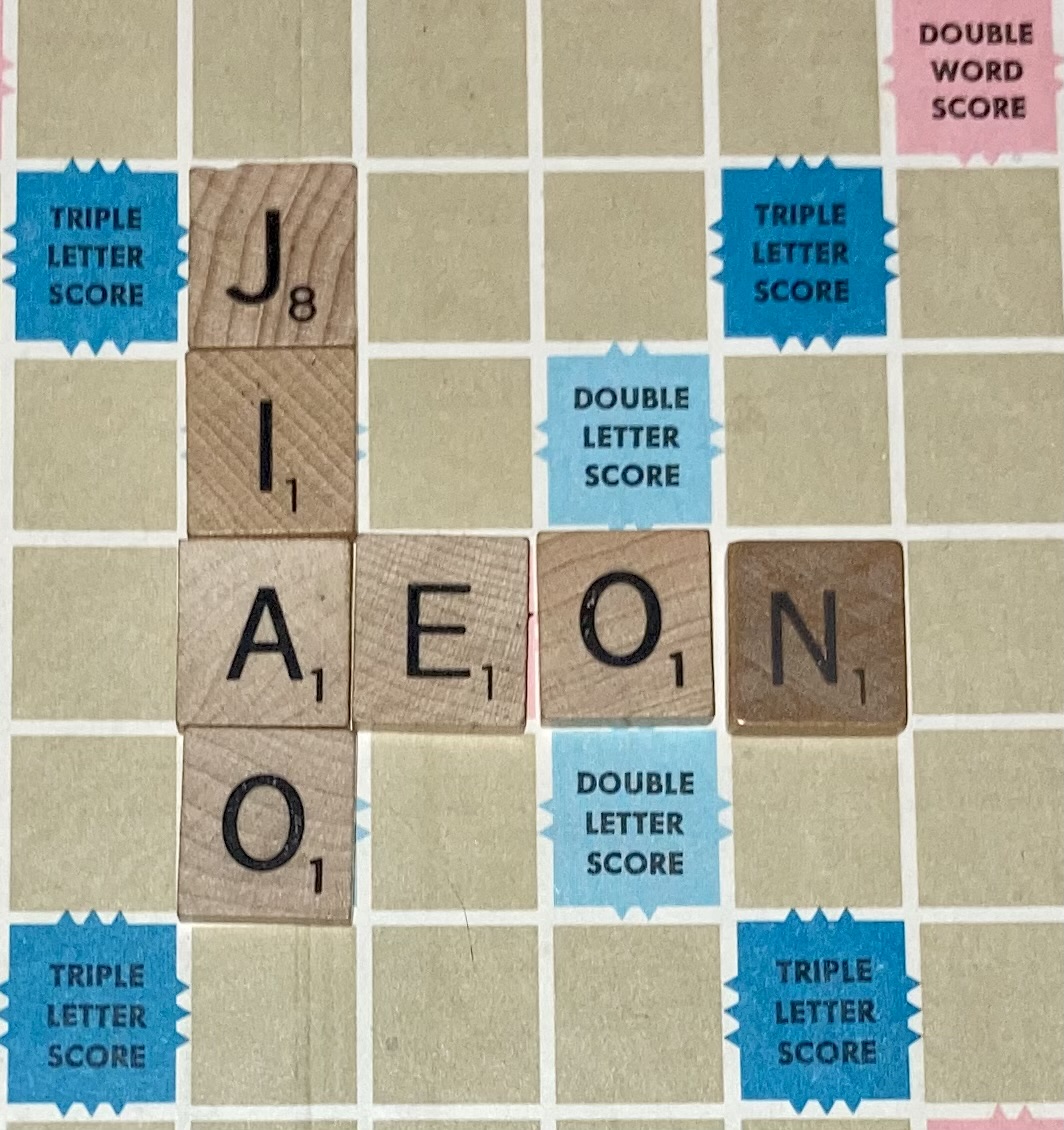
Knowing words with multiple vowels proves useful when you’re faced with a rack of mostly, or all, vowels. Here’s a list of the first twenty-two playable four-letter words with three vowels:
aeon: a long period of time (also eon)
agee: to one side (also ajee)
agio: a surcharge applied when exchanging currency
ague: a sickness associated with malaria
ajee: to one side (also agee)
akee: a tropical tree
alae: wings (pl. of ala)
alee: on the side shielded from wind
amia: a freshwater fish
amoa: a kind of small buffalo
awee: a little while
eaux: waters (pl. of eau)
eide: distinctive appearances of things (pl. of eidos)
emeu: an emu
etui: an ornamental case
euro: an Australian marsupial, also known as wallaroo, for being like the kangaroo and the wallaby; also a unified currency of much of Europe
ilea: the terminal portions of small intestines (pl. of ileum)
ilia: pelvic bones (pl. of ilium)
jiao: a Chinese currency (also chiao)
luau: a large Hawaiian feast
meou: to meow
moue: a pouting expression
Next Up
Wordplay Day! To prepare for class, revisit the Dictionary and World Builder pages on the Scrabble website. Also review this post.
Today’s blog post features my version of the fifth Check, Please! assignment, which you submitted at the beginning of yesterday’s class. Although you have now completed your final Check, Please! worksheet, this model assignment and the previous four will remain useful to you as you continue to hone your information literacy skills.
Next month, you will revisit the Check, Please! course when you and two or three of your classmates plan and deliver a five-minute presentation on one of the lessons.
Check, Please! Lesson Five
In the fifth lesson of the Check, Please!, Starter Course, Mike Caulfield, author of the course and ra esearch scientist at the University of Washington’s Center for an Informed Public, covers the final step in the five-step SIFT approach: “Trace Claims, Quotes, and Media to Their Original Context.” Caulfield outlines the process of locating the original context as an antidote to the issues of accuracy that occur when information passes through intermediaries.
One of the most instructive portions of lesson five features a passage in which Caulfield cites a study of how stories evolve as gossip through the processes of leveling (stripping details), sharpening (adding or emphasizing details), and assimilating, which combines the two. In the process of assimilation “the details that were omitted and the details that were added or emphasized are chosen because they either fit what the speaker thinks is the main theme of the story, or what the speaker thinks the listener will be most interested in.” Similarly, leveling, sharpening, and assimilating all figure in the altered photographs and memes in lesson four. The abbreviated speech of the NRA’s CEO, Wayne LaPierre, which omits commentary, inaccurately indicates a contradiction in his stance on the presence of guns in schools.
The image of photographer Kawika Singson with flames at his feet serves as an example of leveling. Although the flames are real, they were not caused by the heat of the lava flow where Singson stands with his tripod. Instead, to create the image, a friend of his poured accelerant on the lava before Singson stepped into the frame. The deception wasn’t intentional; Singson simply wanted the image for his Facebook cover photo.
Unlike Singson’s photograph, the altered photograph of the Notorious B.I.G. with Kurt Cobain was created with the intent to deceive. Cropping and merging the two photographs illustrates the assimilation process adopted by photoshop users to appeal to music fans eager to think that such fictional meetings of icons took place. Krist Novoselic, who founded Nirvana with Cobain, replied to the is-it-real question with his own fake photo, making the claim that the hand holding the cigarettes was Shakur’s, that he had been cropped from the right.
And thank you to the students who took the opportunity to earn bonus points on their final Check, Please! assignment by commenting on the merits of one of their classmates’ essays: JonCarlos Altamura, Nicole Edelman, Dalton Holbrook (section 19), and Aiden Bazzell (section 20)
Next Up
Wordplay Day! To prepare for class, revisit the Dictionary and World Builder pages on the Scrabble website, and review the blog posts devoted to Scrabble tips.
This morning in class, after I collect your fifth Check, Please! worksheets, you will begin planning and drafting your analysis. You will receive a hard copy of the assignment in class, and I am including an additional copy below.
Directions for Planning and Drafting
Review the texts that you have read for class, and determine which one appeals to you most as a subject of analysis.
Identify two or more elements that contribute to its effectiveness.
Develop your analysis through a close examination of those elements.
Write in dark ink, preferably black. You are welcome to use both sides of the page.
Before you leave class today, staple this handout on top of your draft and submit it to me. Next week I will return your draft with notes, and you will have the class period to begin revising and editing on your laptop or tablet.
Directions for Revising
The revision of your analysis should include the following:
A title that offers a window into your analysis
An introduction that includes a summary of the essay, essay excerpt, chapter, or story
A thesis statement, or main claim, that presents your take on the essay, essay excerpt, or chapter based on your close study of it
Textual evidence that supports your claims
A minimum of one relevant quotation from the text, introduced with a signal phrase and followed by a parenthetical citation
A conclusion that revisits the thesis without restating it verbatim
A work cited entry
A minimum of 600 words
Sample Works Cited Entries
Barthelme, Donald. “The School.” The Best American Short Stories 1975, edited by Martha Foley, Houghton Mifflin, 1975. pp.8-11.
Lewis, Michael. Chapter One: “Back Story.” The Blind Side. 2006. Norton, 2009, pp. 15-23.
Sedaris, David. “Me Talk Pretty One Day.” Me Talk Pretty One Day. Little Brown, 2000. pp. 166-73.
Think of your preliminary draft as your down draft; your aim in the early stage of the process is to get your ideas down on the page. You may need the process of drafting to discover what you think the essay, essay excerpt, or chapter means and how it makes its meaning.
Directions for Formatting and Posting Your Revision—See the Course Calendar for the Due Date and Hard Deadline
Save your revised essay as a Microsoft Word file or PDF and submit it to Blackboard in compliance with MLA manuscript guidelines.
Publish your revision as a blog post. In your post, omit the first-page information included in your file submitted to Blackboard (your name, course, section, instructor’s name, and date). Add to your blog post an image that documents some part of your writing process away from the screen, such as a photo of your reading notes or a page of your draft. Also add to your blog post an embedded link to a relevant website.
Grade Criteria
An A analysis complies with all assignment guidelines, demonstrates a depth of understanding by using relevant and accurate detail, and is also well organized and relatively free of surface errors.
A B analysis complies with all assignment guidelines and presents an adequate analysis but examines little more than what was addressed in class. A B analysis is also well organized and relatively free of surface errors.
A C analysis complies with most but not all assignment guidelines and may also be flawed by issues of organization and/or surface errors, or more consequential factual errors.
A D analysis complies with only a few of the assignment guidelines and may also be flawed by issues of organization and/or surface errors, or more consequential factual errors.
An F analysis fails to comply with most or all assignment guidelines and may also be flawed by substantial issues of organization and/or surface errors, or more consequential factual errors.
MLA Style
Look to my sample assignments on Blackboard as models of MLA style. For more information on MLA style, see the MLA Style Center and OWL sites linked to my blog.
Next Up
Wordplay Day! To prepare for class, revisit the Dictionary and World Builder pages on the Scrabble website, and review the blog posts devoted to Scrabble tips.
In the final revision of your analysis, you will include a minimum of one quotation, introduced by a signal phrase and followed by a parenthetical citation. The rough draft that you will begin in class tomorrow does not need to include a quotation because you may still be focused on determining which of the texts will serve as your subject. However, as your analysis progresses, you should be sure to review the citation notes in this blog post (and on the handout you will receive in class tomorrow) to ensure that you are citing the text correctly.
Parenthetical Citations
In your analysis, you will include parenthetical citations for quotations and paraphrases. Since you are writing a textual analysis, I recommend quoting rather than paraphrasing because the writer’s particular word choices are vital to the text’s overall effect. If your subject is one of the unpaginated texts (“The Day Language Came into My Life,” “The Power of the Pun,” or “The Falling Man”), your parenthetical citations will include the abbreviation par. for paragraph, followed by the paragraph number. If your subject is one of the paginated texts (“Me Talk Pretty One Day,” “Back Story,” or “The School”), your parenthetical citations will include the page number by itself.
Including the author’s last name as well would be redundant because you have established in your introduction that your essay focuses solely on a work by him or her. When you write a paper in which you cite multiple sources, you will need to include the author’s last name in the parenthetical citation to clarify which of your sources you are citing.
Here are some examples of how to use parenthetical citations in your analysis:
For “Me Talk Pretty One Day”:
The nonsense words “meimslsxp” and “lgpdmurct” underscore his utter lack of comprehension in French class (167).
For “The Day Language Came into My Life”:
The line “‘like Aaron’s rod, with flowers’” alludes to Numbers 17.8 (par. 9).
For “The Power of the Pun, from Shakespeare to Walter Cronkrite to Roy Peter Clark”:
He observes that in Act I, Scene IV of Hamlet, “Four words collide with multiple meanings: memory, seat, distracted, globe” (par. 10).
For the excerpt from “The Falling Man”:
He notes that in contrast to the Falling Man, the others who jumped appeared “confused, as though trying to swim down the side of a mountain” (par. 1).
For “Back Story” (the first chapter of The Blind Side):
He employs the “One Mississippi . . . Two Mississippi . . .” count to mark the seconds leading up to Joe Theismann’s career-ending injury (15).
For “The School”:
With the words, “[I]s death that which gives meaning to life?,” the story shifts from realism to surrealism (10).
Work Cited Entries
At the end of your analysis, you will include an MLA-style work cited entry. Refer to the models below.
Barthelme, Donald. “The School.” The Best American Short Stories 1975, edited by Martha Foley, Houghton Mifflin, 1975. pp. 8-11.
Lewis, Michael. Chapter One: “Back Story.” The Blind Side. 2006. Norton, 2009, pp. 15-23.
Sedaris, David. “Me Talk Pretty One Day.” Me Talk Pretty One Day. Little Brown, 2000. pp. 166-73.
Next Up
In class on Wednesday you will begin planning and drafting your analysis of one of the texts we have studied in class: “Me Talk Pretty One Day,” “The Day Language Came into My Life,” “The Power of Pun . . . ,” the excerpt from “The Falling Man,” “Back Story” (Chapter One of The Blind Side), or “The School.” If you were not in class on the day that I distributed copies of one of the texts or you misplaced your copy, you can download and print the text file posted in the readings folder on Blackboard.
Looking Ahead
A week from tomorrow, October 2, I will return your analysis drafts with my comments, and you will have the remainder of the class period to begin revising on your laptops. Because fall break is the week of October 7, you will have an additional week to continue revising before your revision is due on Blackboard and on your WordPress blog. The due date is Wednesday, October 16 (before class). The hard deadline is Friday, October 18 (before class).
Today in class, after the Scrabble debriefing and the discussion of last Friday’s quiz, we will closley examine the page of Art Spiegelman’s Maus featured above.
Afterward, we will study an analysis of the page that I wrote as a model for my students in a previous semester, and you and two or three of your classmates will collaborate on an assignment that asks you to consider these questions:
Where in the essay does the writer present an instance of the connection that she addresses in her thesis? Offer one example in your answer.
Where in the essay does the writer present an instance of the separation that she addresses in her thesis?
Effective strategies for concluding analyses include (1) offering an insight about the text or an additional quotation from it, (2) revisiting the thesis without stating it verbatim, and (3) pointing to the broader implications of the analysis. Reread the conclusion of “The Strange Fruit of Sosnowiec” and compose a paragraph that identifies the strategy or strategies listed above that the writer employs.
Friday’s Quiz
The first question asked you to list one punctuation rule that you learned or were reminded of in class. Some of you simply listed a term rather than a rule. Merely writing “comma splices” does not demonstrate that you know what a comma splice, or fused sentence, is or how to avoid or eliminate one. Here is one way to demonstrate your understanding of the term in your answer:
A writer creates a comma splice, or a fused sentence, when he or she places a comma, rather than a period or semicolon, between two independent clauses (complete sentences).
The second question asked you to list one style rule that you learned or were reminded of in class. Again, some of you simply listed a term rather than a rule. Merely writing “MLA style” does not demonstrate that you know the rules of MLA style. Here are some ways to demonstrate your understanding of the term in your answer:
In MLA style, numbers that can be expressed in one or two words are written as words, not figures.
In MLA style, titles of short works, such as essays, are enclosed in quotation marks, and titles of long works, such a book-length texts and feature films, are italicized (or underlined in longhand).
Thoughts are not enclosed in quotation marks; they are italicized.
The third question asked you to identify Michael Lewis, who is the author of The Blind Side, which you read an excerpt from on Monday.
Michael Lewis’s name appears on your copy of the excerpt from The Blind Side. It should also appear in the first sentence of the summary of the excerpt that you wrote in your journal, as well as in your journal notes on my September 16 blog post. We write to remember. Write notes in your journal on every reading and every blog post to retain what we have covered in class.
The fourth question asked you to identify the mostversatile consonant. Some of you answered s, but the most common consonant is not the same as the most versatile. M is the most versatile In the first position in two-letter words, it pairs with every vowel: ma, me, mi, mo, mu, and also my. In the second position, it pairs with every vowel except i: am, em, om, um.
The fifth question asked you to explain why that letter is the most versatile consonant. M is the most versatile one because in the first position in two-letter words, it pairs with every vowel: ma, me, mi, mo, mu, and also my. In the second position, it pairs with every vowel except i: am, em, om, um.
The sixth question asked you to identify the topic of Friday’s blog post. Some of you answered “Scrabble.” Others answered “Wordplay Day.” Scrabble is the subject of the post; Wordplay Day is the occasion for it. The topic of a Scrabble post is always something more specific. Last Friday’s topic was two-letter words beginning with the letters q-z.
Lastly, you had the opportunity to earn bonus points by listing words that you had learned from last Friday’s Scrabble blog and any of the other previous Scrabble posts. Many of you earned points by listing playable names from the August 23 playable names blog post and/or the two-letter words blog posts published on August 22 and 30, and September 7, 13, and 30.
Next Up
On Wednesday, after I collect your fifth and final Check, Please! worksheets, you will begin planning and drafting your textual analyses. Review all of the texts that we have studied in class, reread your journal notes on them, and determine which one appeals to you most as a subject for analysis. As your writing progreses, you may decide to focus on a different text, but making a preliminary selection before Wednesday’s class will likely lead to a more productive planning and drafting period.
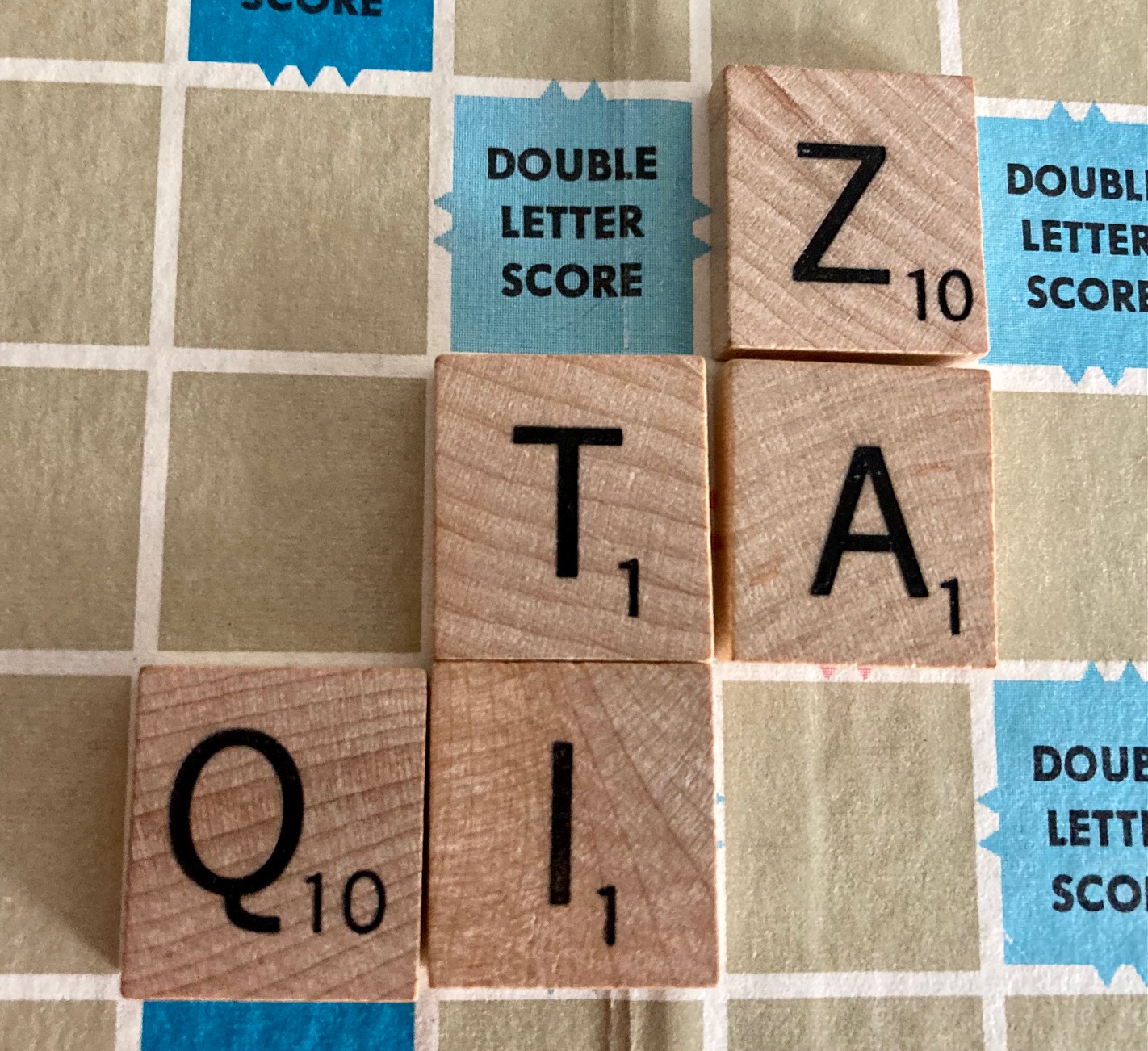
Today’s blog post is the final installment in the series of posts devoted to playable two-letter words. Learning these two-letter words, as well as the other two-letter words in the alphabet, will enable you to see more options for play and increase the number of points you earn in a single turn.
qi: the central life force in Chinese culture (also ki)
re: a tone of the diatonic scale
sh: used to encourage silence
si: a tone of the diatonic scale (also ti)
so: a tone of the diatonic scale (also sol)
ta: an expression of thanks
ti: a tone of the diatonic scale
to: in the direction of
uh: used to express hesitation
um: used to express hesitation
un: one
up: to raise (-s, -ped, -ping)
us: a plural pronoun
ut: the musical tone C in the French solmization system, now replaced by do
we: a first-person plural pronoun
wo: woe
xi: a Greek letter
xu: a former monetary unit of Vietnam equal to one-hundreth of a dong (also sau, pl. xu)
ya: you
ye: you
yo: an expression used to attract attention
za: pizza
Next Up
Wordplay Day! To prepare for class, revisit the Dictionary and World Builder pages on the Scrabble website. Also review the posts on my blog devoted to Scrabble tips, including this one.
This blog post features my version of the fourth Check, Please! assignment, which you submitted at the beginning of class on Wednesday. In preparation for submitting your worksheet for lesson five, review this post as well as the assignment notes that I posted on September 3.
Check, Please! Lesson Four
In the fourth lesson of the Check, Please!, Starter Course, Mike Caulfield, author of the course and a research scientist at the University of Washington’s Center for an Informed Public, focuses his instruction on the third step in the four-step SIFT approach to determining the reliability of a source. Lesson four, “Find Trusted Coverage,” addresses these topics: (1) scanning Google News for relevant stories, (2) using known fact-checking sites, and (3) conducting a reverse-image search to find a relevant source for an image.
One of the concepts Caulfield introduces in lesson four is click restraint, which was given its name by Sam Wineberg, Professor of History and Education at Stanford, and Sarah McGrew, Assistant Professor of Education at the University of Maryland. Click Restraint is an activity that fact checkers practice regularly, but average people do not. Fact checkers resist the impulse to click on the first result, opting instead to scan multiple results to find one that combines trustworthiness and relevance.
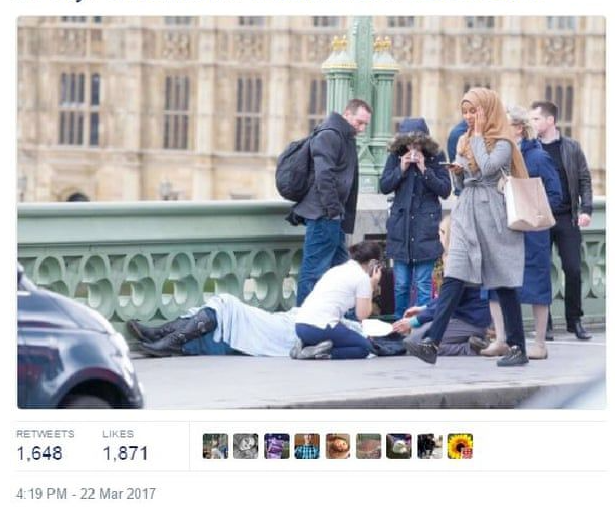
Caulfield also considers the issue of false frames and offers as an example the miscaptioned photo of a young woman that circulated widely after the 2017 London Bridge attack. In the photo, the woman, who is wearing a hijab, is looking down at her phone as she walks past one of the victims lying by the side of the road, surrounded by members of the rescue team. Because the woman’s face is blurred, viewers of the miscaptioned picture cannot see the look of shock that is visible in her face in another image taken by the same photographer. Subsequently, her apparent lack of concern for the victim seems to confirm the caption in the infamous tweet.
Choosing a general search term over a specific one is a useful and unexpected tip Caulfield includes in his discussion of image searches. He explains that the benefit of such a bland term as “letter” or “photo” will prevent the confirmation bias that can lead to the proliferation of disinformation through false frames.
Wordplay Day! To prepare for class, revisit the Dictionary and World Builder pages on the Scrabble website, and review the blog posts devoted to Scrabble tips.





 Jane Lucas