Today in class, after I collect your worksheets for lesson four of Check, Please! we will examine Donald Barthelme’s short story “The School,” and in groups of three or four you will address in writing some of the elements of the story that you might explore in an analysis. Among the elements of Barthelme’s story that you will considered are these:
the narrator and the narrative voice
conflict
narrative shift (Where does “The School” make an unexpected turn?)
Whether the subject of your analysis is Bartheleme’s story or one of our earlier readings, you will begin your first paragraph with a summary of the text. Remember that a summary is an objective synopsis of a text’s key points. It should be written in third person and present tense. For example, if you choose to analyze “The School,” you might summarize it this way:
Donald Barthelme’s short story “The School” recounts a series of classroom lessons that end with the deaths of plants and animals–deaths that serve as a prelude to the unexplained death of a Korean orphan, followed by the senseless deaths of classmates and family members.
Notice that the summary above does not comment on the story in any way. What follows the summary will be the beginning of your commentary, or analysis, the thesis statement that offers your particular close reading, or interpretation, of the story. The passage below is the same as the one above, but at the end of it I have added a thesis statement in bold.
Donald Barthelme’s short story “The School” recounts a series of classroom lessons that end with the death of plants and animals–deaths that serve as a prelude to the death of a Korean orphan, followed by the deaths of classmates and family members. With conversational narration, accumulation of detail, and a shift in fictional mode, Barthelme deftly depicts the reality of the fleeting nature of life, even as the story itself veers from reality.
If I were to continue to write the analysis that I began in the previous paragraph, I would follow that opening paragraph with body paragraphs that address each of the three story elements that I include in my thesis: (1) “conversational narration,” (2) “accumulation of detail,” and (3) “shift in fictional mode.”
Next Up
Wordplay Day! To prepare for class, revisit the Dictionary and World Builder pages on the Scrabble website, and review the blog posts devoted to Scrabble tips.
Rosenwaser, David and Jill Stephen. Chapter 12: “Nine Basic Writing Errors and How to Fix Them.” Writing Analytically, 9th edition. Wadsworth/Cengage, 2024. pp. 421-55.
Yesterday in class you composed a blog comment in repsonse to one of your classmates’ literacy narratives. That assignment required you to either (1) identify and address one of the nine basic writing errors outlined in Writing Analytically, or (2) identify and address a particularly effective phrase, clause, or sentence.
In the sample comments that follow, I demonstrate my careful examination of the narratives through my use of concrete details.
Sample Comments
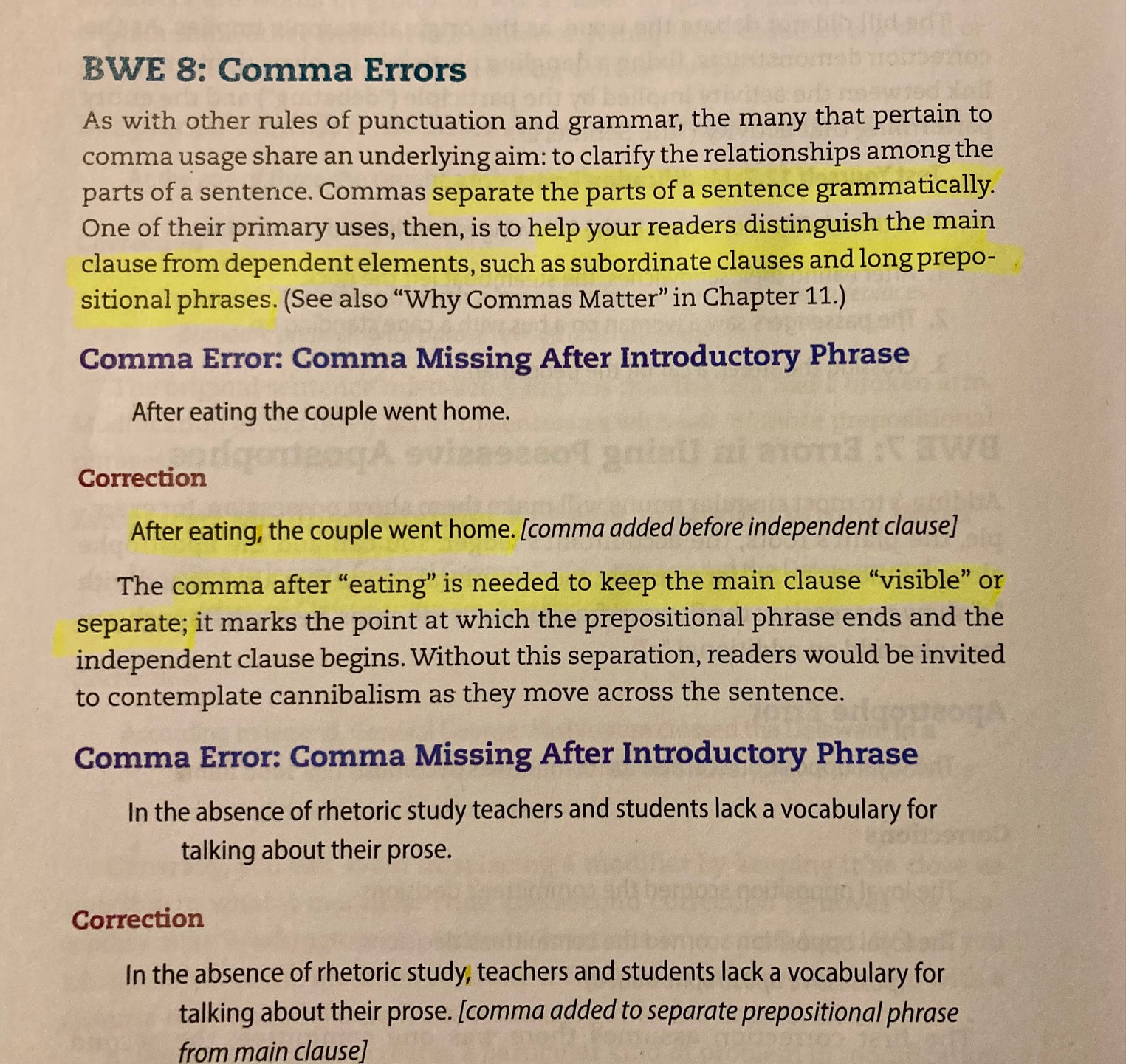
The final paragraph of your literacy narrative, includes an instance of BWE (Basic Writing Error) 8, Comma Errors, in the sentence, “For me to be a a good writer I really have to enjoy what I’m writing about” (par. 3). The omission of the required comma after “writer” is what the textbook authors label “Comma Missing After Introductory Phrase” (Rosenwasser and Stephen 440).
When you write, “my hands would break out in a sweat, my breathing would get shortened, and my knees would start to shake” (par. 18), you effectively convey your dread of public speaking, a dread you could express more succinctly with this revision: “my hands would sweat, my breathing would shortenen, and my knees would shake.”
Citations
Yesterday’s assignment required you to include a parenthetical citation for your quotation. It did not require you to include a work cited entry because the writing was a blog comment. If the assignment had been an essay, such as the reflection that you wrote last Wednesday, you would have been required to include a work cited entry, such as this:
Work Cited
Rosenwaser, David and Jill Stephen. Chapter 12: “Nine Basic Writing Errors and How to Fix Them.” Writing Analytically, 9th edition. Wadsworth/Cengage, 2024. pp. 421-55.
Reviewing Chapter 12
Returning to the pages of Chapter 12 throughout the semester will help you better understand the errors that you make and will enable you to better proofread your writing and the writing of your classmates.
Bonus-Point Opportunity
Taking advantage of the following bonus-point opportunity will not only earn you five points toward your final Check, Please! assignment, it will also provide one of your classmates with additional feedback on his or her literacy narrative.
Directions
Read your classmates’ literacy narratives on their blogs, and make brief notes on them in your journal.
Determine which literacy narrative you think is the strongest. Think in terms of both form and content.
Compose a comment that includes the writer’s first and last name, the section number, the title of the literacy narrative, and a specific detail that demonstrates the strength of the essay.
Post your response as a comment on this blog post no later than 9 a.m. on Wednesday, September 25. (To post your comment, click on the posts’s title, and scroll down to the bottom of the page. You will then see the image of an airmail envelope with a leave comment option.)
I will approve (make your comments visible) after the 9 a.m. deadline on September 25.
Next Up
In class on Wednesday, after you submit your worksheets for the fourth lesson of Check, Please!, we will examine Donald Barthelme’s short story “The School.” You do not need to print a copy of “The School”; you will receive a copy in class.
Today’s class will be devoted primarily to reading and responding to the blog post of one of your classmates’ literacy narratives. Elements you will consider in your response included these:
the title
vivid details
dialogue, the use of scene and/or summary
You should also identify one or more of the “Nine Basic Writing Errors” (see Writing Analytically, 423-44), and address that error in your response. If you cannot identify one, include a sentence in your response that quotes a sentence of your peer’s and explains what makes it effective.
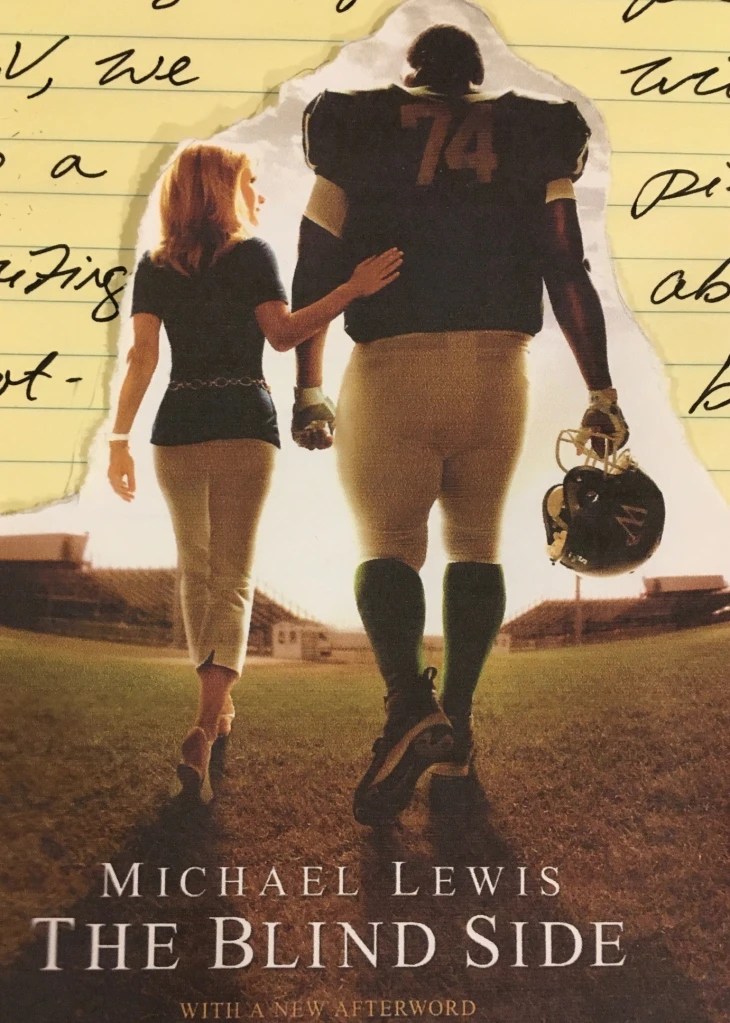
Before you begin that assignment, we will examine the opening pages of “Back Story,” the first chapter of Michael Lewis‘s The Blind Side, which dramatizes the moments in the November 1985 Redskins-Giants football game leading up to the injury that ended quarterback Joe Theismann’s career:
“From the snap of the ball to the snap of the first bone is closer to four seconds than to five. One Mississippi: The quarterback of the Washington Redskins, Joe Theismann, turns and hands the ball to running back John Riggins. He watches Riggins run two steps forward, turn, and flip the ball back to him. It’s what most people know as a ‘flea-flicker,’ but the Redskins call it a ‘throw-back special.’ Two Mississippi: Theismann searches for a receiver but instead sees Harry Carson coming straight at him. It’s a running down—the start of the second quarter, first and 10 at midfield, with the score tied 7–7—and the New York Giants’ linebacker has been so completely suckered by the fake that he’s deep in the Redskins’ backfield. Carson thinks he’s come to tackle Riggins but Riggins is long gone, so Carson just keeps running, toward Theismann. Three Mississippi: Carson now sees that Theismann has the ball. Theismann notices Carson coming straight at him, and so he has time to avoid him. He steps up and to the side and Carson flies right on by and out of the play. The play is now 3.5 seconds old. Until this moment it has been defined by what the quarterback can see. Now it–and he–is at the mercy of what he can’t see” (15).
What Theismann cannot see is Lawrence Taylor. A second later, as Taylor sacks Theismann, Taylor’s knee drives straight into Theismann’s lower right leg, leading to the “snap of the first bone” that Lewis mentions in the first line of the chapter. He hooks the reader by linking the beginning of the play, “the snap of the ball” to the gruesome “snap of the first bone” that will follow. Lewis develops the opening paragraph using the common one-Mississippi, two-Mississippi method of marking seconds to present the events leading up to the compound fracture that ends Theisman’s career.
Lewis doesn’t dramatize the injury itself because his interest lies instead in the blind side that led to it and subsequently elevated the status and salary of the left tackle, the player who protects the quarterback’s blind side.
When you’re struggling to develop a piece of writing, reread the opening paragraph of The Blind Side. Observe how Lewis dramatizes 3.5 seconds–yes, only 3.5 seconds–with about two-hundred words.
Next Up
In class on Wednesday, after you submit your worksheets for the fourth lesson of Check, Please!, we will examine Donald Barthelme’s short story “The School.” You do not need to print a copy of “The School”; you will receive a copy in class.
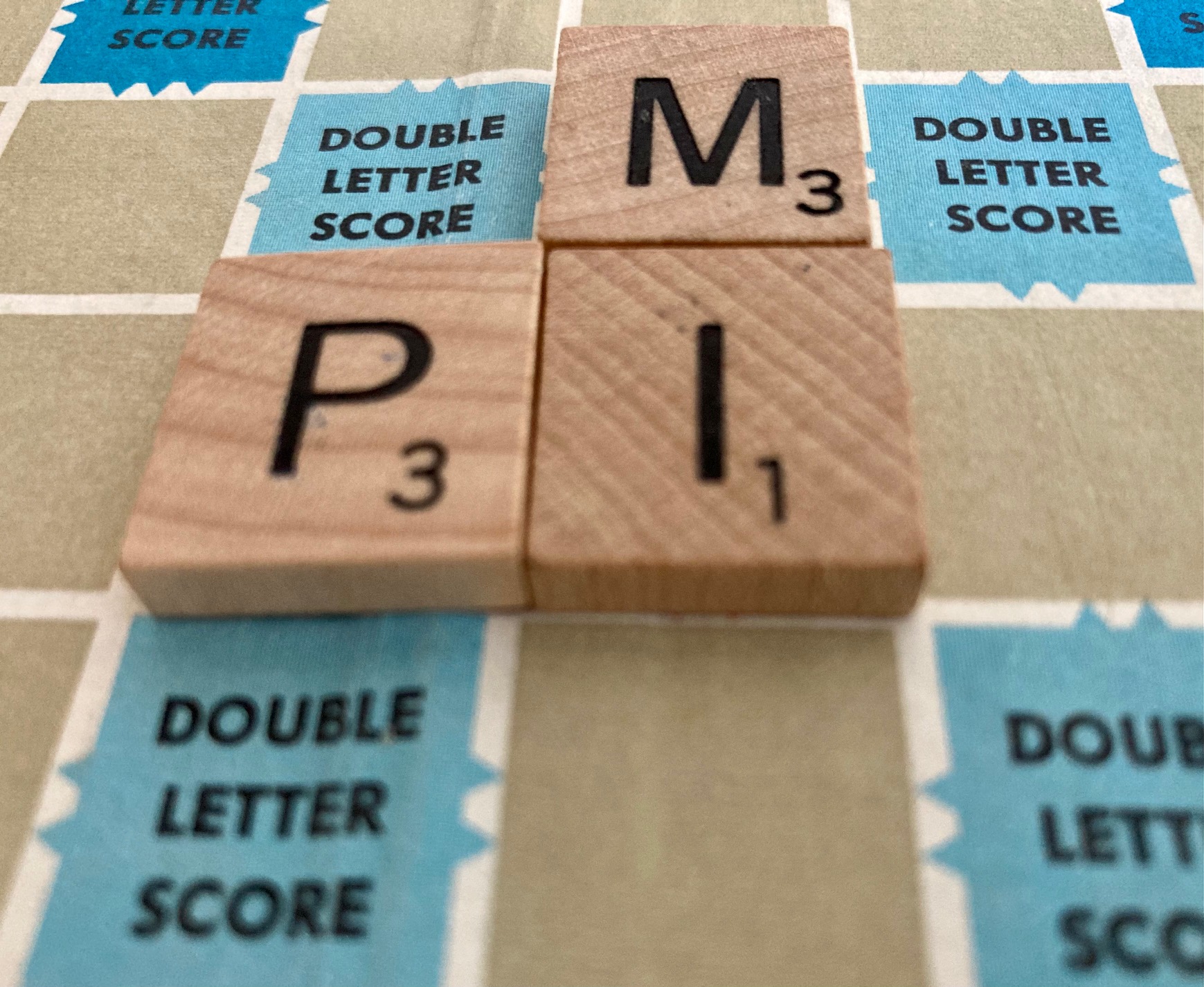
In the previous weeks, I published blog posts featuring the playable two-letter words that begin with a, b, d, e, f, g, h, i, j, k, and l. Today’s post features the playable two-letter words beginning with m, n, o, and p. Learning these two-letter words, as well as the other two-letter words in the alphabet, will enable you to see more options for play and increase the number of points you earn in a single turn.
M, by the way, is the most versatile consonant. In the first position, m pairs with every vowel: ma, me, mi, mo, mu, and also my. In the second position, m pairs with every vowel except i: am, em, om, um.
ma: a mother
me: a singular objective pronoun
mi: a tone of the diatonic scale
mm: an expression of assent
mo: a moment
mu: a Greek letter
my: a first-person possessive adjective
na: no, not
ne: born with the name of (also nee)
no: a negative answer
nu: a Greek letter
od: a hypothetical force
oe: a whirlwind off the Faero Islands
of: originating from
oh: an exclamation of surprise
oi: an expression of dismay (also oy)
om: a sound used as a mantra
on: the batsman’s side in cricket
op: a style of abstract art dealing with optics
or: the heraldic color gold
os: a bone
ow: used to express pain
ox: a clumsy person
oy: an expression of dismay (also oi)
pa: a father
pe: a Hebrew letter
pi: a Greek letter
Next Up
Wordplay Day! To prepare for class, revisit the Dictionary and World Builder pages on the Scrabble website, and review this post.
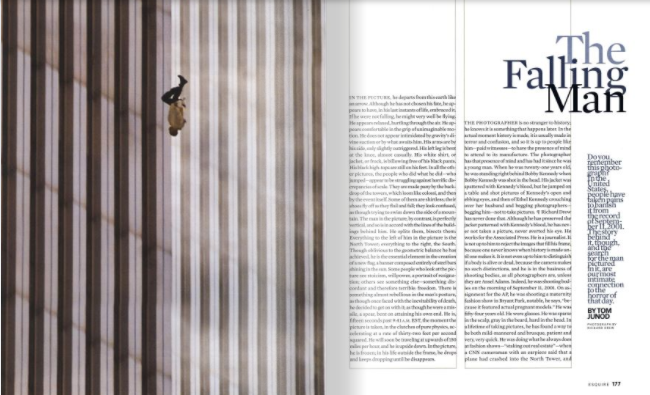
Yesterday in class, before you composed your reflective essays on your literacy narratives, we examined the beginning of Tom Junod‘s essay “The Falling Man,” published in Esquire magazine two years after 9-11. After we read the first paragraph, I asked you to consider these questions:
The long first paragraph of Junod’s essay could be two or more paragraphs. If you were Junod, where might you have divided the paragraph?
Why do think he chose not to divide it?
Junod might have started a second paragraph with the words “[i]n all the other pictures,” because there he shifts the focus from the Falling Man to the photographs of other people who jumped from the Twin Towers. An opportunity for a third paragraph comes with the words “[t]he man in the picture, by contrast,” where Junod turns his attention back to the Falling Man. And he might have begun a fourth paragraph with “[s]ome people who look at the picture,” because there he shifts to viewers’ perceptions of the Falling Man.
The first paragraph is over four-hundred words long, a length I advise you to avoid in your own paragraphs. Generally, one-hundred to one-hundred-and-fifty words is a suitable length. As a rule, you should begin a new paragraph whenyou present a new idea or point. If you have an extended idea that spans multiple paragraphs, each new point within that idea should have its own paragraph. But the first paragraph of “The Falling Man” is an exception. For Junod, choosing not to divide the first paragraph creates an unbroken movement that parallels the unbroken downward flight of his subject, the Falling Man. Outside of the photograph, “he drops and keeps dropping until he disappears.” With “disappears,” the last word of the paragraph,” the Falling Man disappears from the page, and Tom Junod turns to the photographer, whom we learn later in the essay is Richard Drew.
Unless you subscribe to Esquire, the magazine’s paywall will deny you access to the full text of “The Falling Man”; but if you’re interested in reading it in full, you can access it through the HPU Library site by following these steps:
The second half of this blog post features my version of the third Check, Please! assignment, which you submitted at the beginning of class on Wednesday. In preparation for submitting your worksheet for lesson four, review this post as well as the assignment notes that I posted on September 3.
Sample Assignment
In the third lesson of the Check, Please!, Starter Course, Mike Caulfield, author of the course and a research scientist at the University of Washington’s Center for an Informed Public, continues his instruction on the second step in four-step SIFT approach to determining the reliability of a source. Lesson three, “Further Investigation” covers these topics: (1) Just add Wikipedia for names and organizations, (2) Google Scholar searches for verifying expertise, (3) Google News searches for information about organizations and individuals, (4) the nature of state media and how to identify it, and (5) the difference between bias and agenda.
One of the most instructive parts of lesson three focuses on two news stories about MH17, Malyasia Airlines Flight 17, a passenger flight scheduled to land in Kuala Lumpur that was shot down over eastern Ukraine on July 17, 2014. While the second story, a television news segment, appears to present detailed investigative reporting challenging the conclusion of the Dutch Safety Board and Dutch-led joint investigation team–the conclusion that Russia was to blame–a quick just-add-Wikipedia check reveals that RT (formerly Russia Today) is a Russian state-controlled international TV network, a government propaganda tool rather than a source of fair and balanced news. The first video, the one produced by Business Insider, a financial and business news site, delivers accurate coverage of MH17.
Another notable segment of “Further Investigation” addresses the important distinction between “bias” and “agenda.” There, Caulfield observes that “[p]ersonal bias has real impacts. But bias isn’t agenda, and it’s agenda that should be your primary concern for quick checks,” adding that “[b]ias is about how people see things; agenda is about what a news or research organization is set up to do.”
Wordplay Day! To prepare for class, revisit the Dictionary and World Builder pages on the Scrabble website, and review the blog posts devoted to Scrabble tips.
Today in class you will compose a short reflective essay that documents the processes of planning, drafting, and revising your literacy narrative. Questions to consider include the ones below. You don’t need to address all of the questions; focus on the ones whose answers reveal the most about your work.
Include in your reflection a minimum of one relevant quotation from the textbook, Writing Analytically. Introduce your quotation with a signal phrase and follow it with a parenthetical citation.
Examples:
The authors of Writing Analytically observe that “[o]ne goal of a writer’s notebook is to teach yourself through repeated practice that you are capable of finding things to write about” (Rosenwasser and Stephen 157).
In Writing Analytically, Rosenwasser and Stephen note, “to a significant extent, writing of all kinds tells a story—the story of how we have come to understand something” (162).
In the first example above, the authors’ last names appear in the parenthetical citation because they are not named in the signal phrase. In the second example, only the page number appears in the parenthetical citation because the authors are named in the signal phrase.
Sample Work Cited Entries:
Rosenwasser, David and Jill Stephen. “On Keeping a Writer’s Notebook.” Writing Analytically, 9th edition. Wadsworth/Cengage, 2024. pp. 157-58.
Rosenwasser, David and Jill Stephen. “Writing from Life: The Personal Essay.” Writing Analytically, 9th edition. Wadsworth/Cengage, 2024. pp. 161-68.
What aspect of the writing seemed the most challenging? Determining the focus of your narrative? Developing the story? Crafting the conclusion? Why did that aspect of the writing seem the most challenging?
Did you change the subject of your narrative? If so, what was the original subject? What did you change it to? Why?
Did you change the organization of the narrative? For example: Did you initially present the story chronologically, then begin in the present and move to flashback?
Did any of the sample essays we examined (“Me Talk Pretty One Day,” “The Day Language Came into My Life,” “A Bridge to Words”) prove helpful to you as a model? If so, how? (Offer one or more concrete details to support your claim.)
What do you consider the strongest element of your literacy narrative?
At what point in the process did you decide on a title? Did you change the title during the writing process? If so, what was the original title?
What photograph did you include in your blog that documents part of your writing process away from the screen? Why did you choose that particular image?
What relevant website did you link to your blog post. Why is that particular site relevant to your narrative?
In addition to metacognition, did any of the other habits of mind of successful college students play a significant role in your writing process? If so, which one? The other seven are curiosity, openness, engagement, creativity, persistence, responsibility, and flexibility.
Next Up
Wordplay Day! To prepare for class, revisit the Dictionary and World Builder pages on the Scrabble website, and review the blog posts devoted to Scrabble tips.
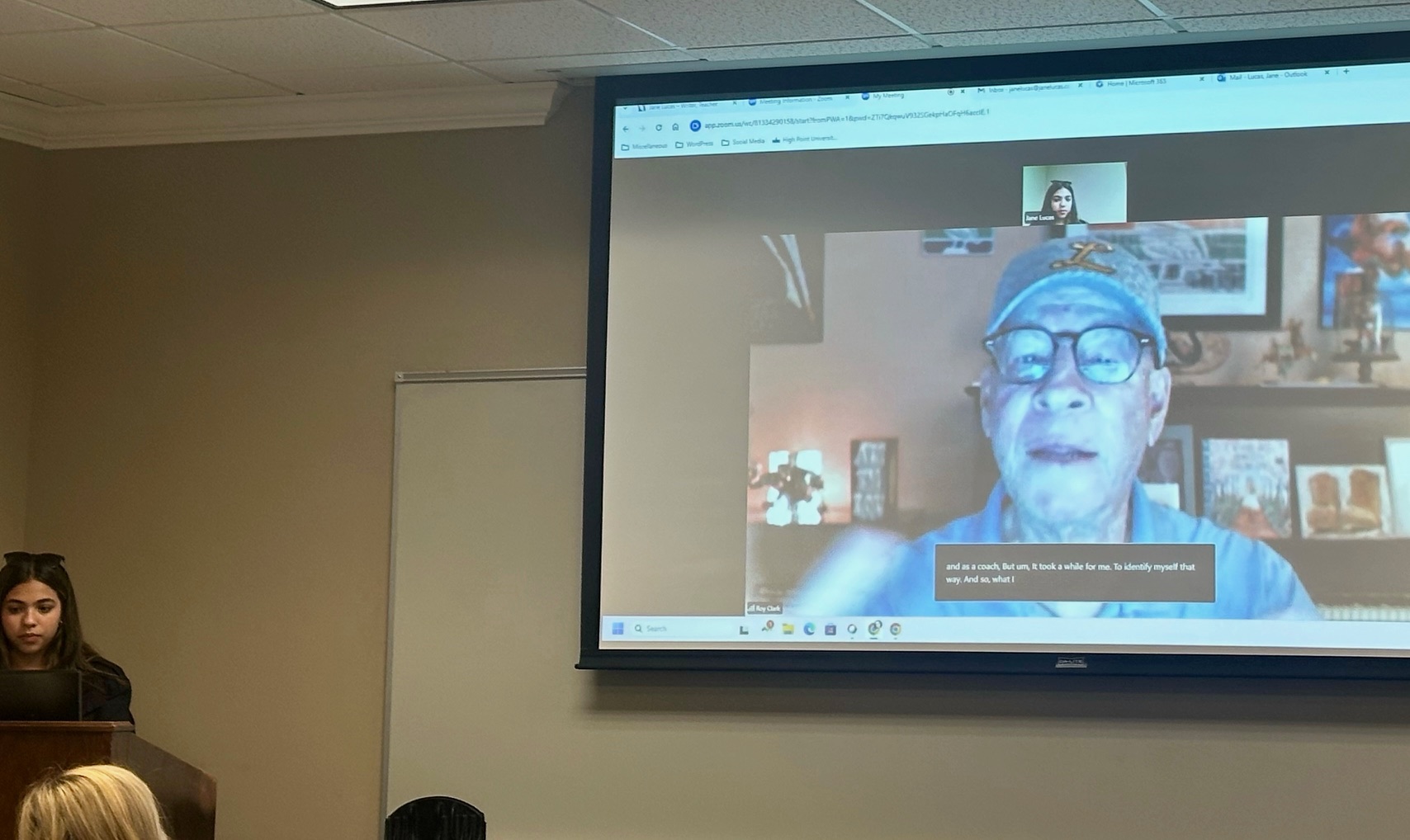
J.J. Pollender (left) asks a question of Roy Peter Clark (on screen).
Yesterday morning, you and your classmates in sections 19 and 20 hosted virtual visits with award-winning author and teacher Roy Peter Clark.
Clark, whose books include the popular Writing Tools, is a senior scholar at the Poynter Institute and is often referred to as America’s Writing Coach.
Among the topics Clark discussed were the importance of thinking of yourselves as writers, developing your writing with concrete details, and placing the most vital words at the beginning and the end of sentences.
Six students, three in each section, asked questions of Clark:
Section 19
Bailey Dawkins
Lexi Painter
J.J. Pollender
Section 20
Chase Eller
Stella Galindo Haas
Lydia Henderson
Roy Peter Clark (on screen) fields a question from Stella Galindo Haas (left).
The students questions included (1) When did you know that you wanted to be a writer? (2) How do you incorporate humor into writing? (3) How do you address writer’s block? and (4) Which of your own books on writing is your favorite?
Clark noted that at a very young age he was fascinated by words and loved reading and writing. Of incorporating humor into writing, he said that if the writer himself isn’t funny on the page, he should try citing the words of someone who is. To address writer’s block, he recommended setting low standards. Writers have difficulty beginning drafts because they want them to be better than first drafts can be. In response to the favorite-book question, Clark said Writing Tools, adding that he did not choose that as his favorite among his books, his readers did; it’s his most popular and best-selling book.
To demonstrate the effectiveness of beginning and ending sentences with the most vital words, Clark offered an example from Shakespeare’s MacBeth. After the suicide of MacBeth’s wife, Seyton, an attendant to MacBeth, tells his master, “The queen, my lord, is dead” (2.2.19). Clark said that Shakespeare might have instead written, “The queen is dead, my lord.” But ending with “dead” rather than “lord” makes for a more powereful line; what’s vital to the sentence is the announcement of the death, not that Seyton is announcing it to his master, MacBeth
The Zoom meetings came about after Clark conducted an online search of his name that yielded one of my blog posts devoted to one of his essays. After Clark reviewed my blog last May he emailed me. Clark wrote, “I have concluded that you are a remarkable teacher of writing. Your students are lucky to have you. I enjoy making the occasional cameo appearance via Zoom in classes where my work has been under discussion. If I can ever be of help, just holler.”
Work Cited
Shakespeare, William. Folger Shakespeare Library: The Tragedy of MacBeth. Edited by Barbara A. Mowat and Paul Werstine, Simon and Schuster, 2013.
Thanks, to Bailey Dawkins, Lexi Painter, J.J. Pollender, Chase Eller, Stella Galindo, Haas, and Lydia Henderson for asking questions–and thanks to Madison Kline and Chase for photographing Roy Peter Clark’s virtual visit.
Next Up
At the beginning of class on Wednesday, you will submit your worksheet for the third lesson in the Check, Please! course. After that, you will compose a reflective essay on your literacy narrative.
Your reflective essay assignment requires you to include a minimum of one relevant quotation from our textbook, Writing Analytically. To prepare for that portion of the assignment, read the sections titled “Keeping a Writer’s Notebook” (157-58) and “Writing from the Life: The Personal Essay” (161-68). Make note in your journal of any phrases or sentences that speak to your experience of planning, drafting, and/or revising your literacy narrative. Remember to bring your textbook to class.
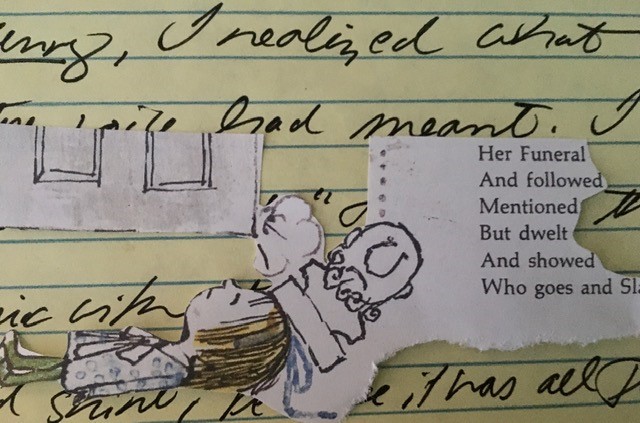
Hillaire Belloc’s “Rebecca,” illustrated by Alice and Martin Provensen
Today in class, after our virtual class visit with Roy Peter Clark, we will examine the model literacy narrative “A Bridge to Words,” which appears below, and you and two or three of your classmates will collaboratively compose a piece of writing that addresses one of these elements of the essay:
concrete details
figurative language
scene (see paragraphs two through five)
the adult retrospective narrator
the writer as a child
As you continue to revise, consider the role of those elements your own literacy narrative, and ask yourself what changes may enhance them.
A Bridge to Words
To a small child, the pages of a newspaper are enormous. Looking far back through the years, I see myself, not yet school age, trying to hold up those long, thin sheets of newsprint, only to find myself draped in them, as if covered by a shroud. But of course, back then, my inability to hold a newspaper properly was of little consequence. Even if I could have turned the pages as gracefully as my parents did, I couldn’t decipher the black marks on the page; thus, my family’s ritual reading of the newspaper separated them from me. As the youngest and the only one who couldn’t read, I was left alone on the perimeter to observe. My family’s world of written words was impenetrable; I could only look over their shoulders and try to imagine the places where all those black marks on the page had carried them—these people, my kin, who had clearly forgotten that I was in the room.
My sister, who was three years older, had her very own news source: The Mini Page, a four-page miniature paper that arrived at our house as an insert in the Sunday edition. While our parents sat in their easy chairs poring over the state and local news, my sister, Jo, perched at the drop-front desk and occupied herself with articles, puzzles, and connect-the-dots.
Finally, one Sunday, someone noticed me on the margin and led me into our family’s reading circle. Whether it was one of my parents or my sister, I don’t know. I remember only the gesture and the words: someone handing me the Sunday comics and saying, “You can read part of the funny pages, too. You can read Henry.”
I took the giant page and laid it flat in the middle of the oval, braided rug on the floor of the den. Once I situated the page, I lay on top of it with my eyes just inches above the panels of the comic strip. To my parents, my prone position was a source of amusement, but for me it was simply a practical solution. How else was someone so small supposed to manage such a large piece of paper?
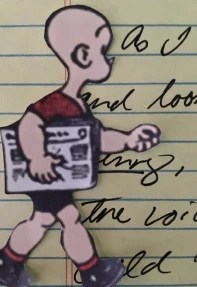
As I lay on the floor and looked at the comic strip’s panels, I realized what the voice had meant. I could “read” Henry, the comic with the bald boy in a red shirt, because it consisted entirely of pictures. In between panels of Henry walking, there were panels of him standing still, scratching his hairless head. I didn’t find Henry funny at all. I wondered how that pale forerunner of Charlie Brown had earned a prime spot in the funnies. Still, I was glad he was there. He was the bridge that led me to the written word.
Reading the wordless comic strip Henry for the first time was the beginning of a years-long habit of stretching out on the floor with newspapers and large books—not thick ones but ones that were tall and wide, among them one of my childhood favorites: The Golden Book of Fun and Nonsense. My sister and I spent hours lying on our bedroom floor, the pink shag carpet tickling our legs as we delighted in the antics of Rebecca, the mischievous title character of one of the poems.
Carl Thomas Anderson’s comic strip character Henry
“Rebecca”—which my sister read to me before I could read it myself—introduced me to the word “abhors,” the very sound of which appealed to me. Sometimes before Jo had finished reading the opening lines, my uncontrollable giggles collided with her perfect mock-serious delivery. As the last word in the first line, “abhors” serves as a lead-in to an enjambment: the continuation of a sentence or clause in a line break. It would be years before I learned the term “enjambment,” but I was immediately swept away by its effect in the opening lines: “A trick that everyone abhors/ In Little Girls is Slamming Doors” (Belloc 61). The first line lured me into the second one, and so on and so on. I was drawn both to the individual word “abhors”—with its side-by-side “b” and “h,” rare in English—and the way the words joined, like links in a chain, to yank me giggling through Rebecca’s cautionary tale:
It happened that a marble bust Of Abraham was standing just Above the door this little lamb Had carefully prepared to slam, And down it came! It knocked her flat! It laid her out! She looked like that.
Her funeral sermon (which was long And followed by a sacred song) Mentioned her virtues, it is true, But dwelt upon her vices too, And showed the dreadful end of one Who goes and slams the door for fun. (61)
Why these particular early memories visit me now, I don’t know. Perhaps rereading Art Spiegelman’s graphic memoir Maus with my students has roused the wordless Henry and the word-filled Golden Book of Fun and Nonsense from the corner of my brain where they’ve slumbered. The former wakes and stretches out in my mind as a bridge to the latter: a spot in the world of words I’ve inhabited ever since.
At the beginning of class on Wednesday, you will submit your worksheet for the third lesson in the Check, Please! course. After that, you will compose a reflective essay on your literacy narrative.
Your reflective essay assignment requires you to include a minimum of one relevant quotation from our textbook, Writing Analytically. To prepare for that portion of the assignment, read the sections titled “Keeping a Writer’s Notebook” (157-58) and “Writing from the Life: The Personal Essay” (161-68). Make note in your journal of any phrases or sentences that speak to your experience of planning, drafting, and/or revising your literacy narrative. Remember to bring your textbook to class.
As you read “The Power of the Pun,” consider these questions:
In the section of the article “A Career Launched by Word Play,” where does Clark shift from summary to scene?
In the next section, what example of layered language does he offer?
What observations about writing or strategies that he mentions might prove useful to you as you continue to revise your literacy narrative?
Extra-Credit Opportunity
Completing the following extra-credit assignment will earn you five bonus points for your third Check, Please! worksheet:
Directions
On a three-by-five note card, write your first and last name, course and section number, and Monday’s date. If you do not have three-by-five note cards, ask for one at the circulation desk at the library.
Below that information, write a question that you might ask Roy Peter Clark during his virtual visit. The question may be about your own writing, his writing or his career as a writer, or his work as a teacher of writing.
Be prepared to stand at the instructor’s station and ask Mr. Clark your question. He may have time to field only one or two questions, but you should be prepared to volunteer.
Submit your notecard at the end of the class period.
Next Up
On Monday, after our virtual visit with Roy Peter Clark, we will examine the sample literacy narrative “A Bridge to Words.” You do not need to print the file posted on Blackboard. You will receive a paper copy in class.
Previously, I published a blog post featuring playable two-letter words beginning with a, as well as a blog post featuring playable two-letter words beginning with b, d, and e. Today’ s blog post features playable two-letter words beginning with f, g, h, i, j, k, and l. Learning these two-letter words, as well as the other two-letter words in the alphabet, will enable you to see more options for play and increase the number of points you earn in a single turn.
fa: a tone on the diatonic scale
fe: a Hebrew letter
gi: a white garment worn in martial arts
go: a Japanese board game
ha: used to express surprise
he: a pronoun signifying a male
hi: an expression of greeting
hm: used to express consideration
ho: used to express surprise
id: the least censored part of the three-part psyche
if: a possibility
in: to harvest (a verb, takes -s, -ed, -ing)
is: the third-person singular present form of “to be”
it: a neuter pronoun
jo: a sweetheart
ka: the spiritual self in ancient Egyptian spirituality
ki: the vital life force in Chinese spirituality (also qi)
la: a tone of the diatonic scale
li: a Chinese unit of distance
lo: an expression of surprise
Next Up
Wordplay Day! To prepare for class, revisit the Dictionary and World Builder pages on the Scrabble website. Also review this post.





 Jane Lucas