This morning in class, you and two or three of your classmates will deliver a short presentation on your designated lesson in the Check, Please! starter course. Afterward, time permitting, you will compose a short piece of writing (one paragraph, minimum) that reflects on your group’s presentation. Elements to address include the following:
the introduction of your group members and their opening remarks
the brief discussion of one or more points in the lesson
the close examination of one segment
the conclusion
optional element: observations about the relevance of the lessons to your other work in English 1103 and/or your other courses
poise, eye contact, and the avoidance of filler words
After you complete your reflection of your group’s presentation, compose an additional paragraph that addresses a presentation by one of the other groups. Choose the one that stands out the most to you. What element or elements of that presentation made it particularly effective, or not, and why?
Next Up
You will have the opportunity to weigh in on the titles of your classmates’ analyses and earn five bonus for Friday’s Wordplay Day to boot. See tomorrow morning’s blog post for details.
As you make your final preparations for your group presentations, be sure to complete the steps below, which are also included on your assignment sheet.
If your notes are written in complete sentences, rewrite them to include only words and short phrases for your key points. If your notes are too detailed, you will risk relying too heavily on them and making minimal eye contact with the audience. Plan to make as much eye contact as possible and be sure to make eye contact with people throughout the room rather than fixing your eyes on one or two people.
Familiarize yourself with the presentation station. Each group is required to project a portion of its designated lesson on the screen and refer to it during the presentation. If you have not used the presentation station, I encourage you to devote a couple of minutes before the class period to familiarizing yourself with its setup.
Practice good posture. As you deliver your presentation, your ears should be directly above your shoulders. If you tend to shift your weight from one foot to the other—a distracting habit that’s sometimes called rocking the boat—stand with your feet perpendicular to each other. If you do so, you will not be able to shift your weight from one foot to the other.
Avoid filler words, such as uh, um, like, and you know. If you tend to use filler words, practice pausing at the points where you are likely to use fillers.
Time permitting, after the presentations, you will compose a reflection that addresses your group’s presentation as well as the presentation delivered by one of the other groups.
Next Up
Group presentations. Afterward, time permitting, you will compose a reflection that addresses your group’s presentation as well as one of the other group’s.
As an exercise in reviewing one of the lessons in the Check, Please! course and also as an exercise in collaboration and oral communication, you and three or four of your classmates will deliver a short presentation that addresses the most significant points covered in one of the five lessons in the Check, Please! Course.
This morning in class, after you complete your Scrabble debriefing, you will receive your group assignments and begin planning for your presentation. I will give you a handout in class with directions for your presentation, and I am including the directions below as well.
Directions for Planning
Plan a presentation of five to ten minutes that addresses the most significant points covered in your group’s designated lesson in the Check, Please! course. (See pages 2-3 for the lists of groups and lesson assignments)
Include in your presentation (a) an opening in which you state each member’s first and last name, (b) a close examination of one segment of the lesson, and (c) a conclusion that provides closure and invites questions.
You are encouraged but not required to address how the lesson has been relevant to your other work in English 1103 and/or your other courses.
Directions for Rehearsing
In preparation for rehearsing, write your notes on an index card. If your initial notes are written in complete sentences, rewrite them to include only words and short phrases for your key points. If your notes are too detailed, you will risk relying too heavily on them and making minimal eye contact with the audience. Plan to make as much eye contact as possible and be sure to make eye contact with people throughout the room rather than fixing your eyes on one or two people.
Familiarize yourself with the presentation station. Each group is required to project a portion of its lesson and refer to it during the presentation. If you have not used the presentation station, I encourage you to devote part of today’s class period to familiarizing yourself with its setup.
Practice good posture. As you deliver your presentation, your ears should be directly above your shoulders. If you tend to shift your weight from one foot to the other—a distracting habit that’s sometimes called rocking the boat—stand with your feet perpendicular to each other. If you do so, you will not be able to shift your weight from one foot to the other.
Avoid filler words, such as uh, um, like, and you know. If you tend to use filler words, practice pausing at the points where you are likely to use fillers.
Take turns delivering your portions of the presentation, and offer feedback to your group members. Offer both suggestions for improvement and words of encouragement.
Group Assignments
Section 19
Check, Please! Lesson One:
Jon Carlos Altamura
Nicole Edelman
Annalise Lindsay
J. J. Pollender
Check, Please! Lesson Two:
Cait Bartlett
James Emery
Tai Marchese
Stephanie Salters
Check, Please! Lesson Three:
Willow Conelly
Aidan Garcia
Jed Negley
Ananda Williams
Check, Please! Lesson Four:
Bailey Dawkins
Ryan Kelley
Madison Kline
Vince Nicholson
Check, Please! Lesson Five:
Lindsay Dimenna
Dalton Holbrook
Leyla Oruc
Lexi Painter
Section 20
Check, Please! Lesson One:
Aiden Bazzell
Moriah Evans
Eva Kelley
Zach Moellendick
Check, Please! Lesson Two:
Cristique Duvall
Chase Eller
Kaitlyn Krause
Bo Raitto
Check, Please! Lesson Three:
Allie Early
Noah Gordy
Melody Smith
Roshan Tamaddon
Check, Please! Lesson Four:
Claire Farrington
Lydia Henderson
Steve Lee
Brad Weiner
Check, Please! Lesson Five:
Stella Galindo Haas
Abby Jacavanco
Mark McLaughlin
Grade Criteria
An A presentation includes all elements outlined in the directions for planning and rehearsing and demonstrates the group members’ poise and ability to avoid filler words.
A B presentation includes all elements outlined in the directions for planning and rehearsing but may be marred by group members’ lack of poise and/or inability to avoid filler words.
A C presentation includes most but not all elements outlined in the directions for planning and rehearsing and may also be marred by group members’ lack of poise and/or inability to avoid filler words.
A D presentation includes only some elements outlined in the directions for planning and rehearsing and may also be marred by group members’ lack of poise and/or inability to avoid filler words.
An F presentation includes few if any elements outlined in the directions for planning and rehearsing and may also be marred by group members’ lack of poise and/or inability to avoid filler words.
Next Up
In class on Wednesday, you will deliver your group presentations. Afterward, time permitting, you will compose a short piece of writing that reflects on your group’s presentation as well as the presentation by one of the other groups.
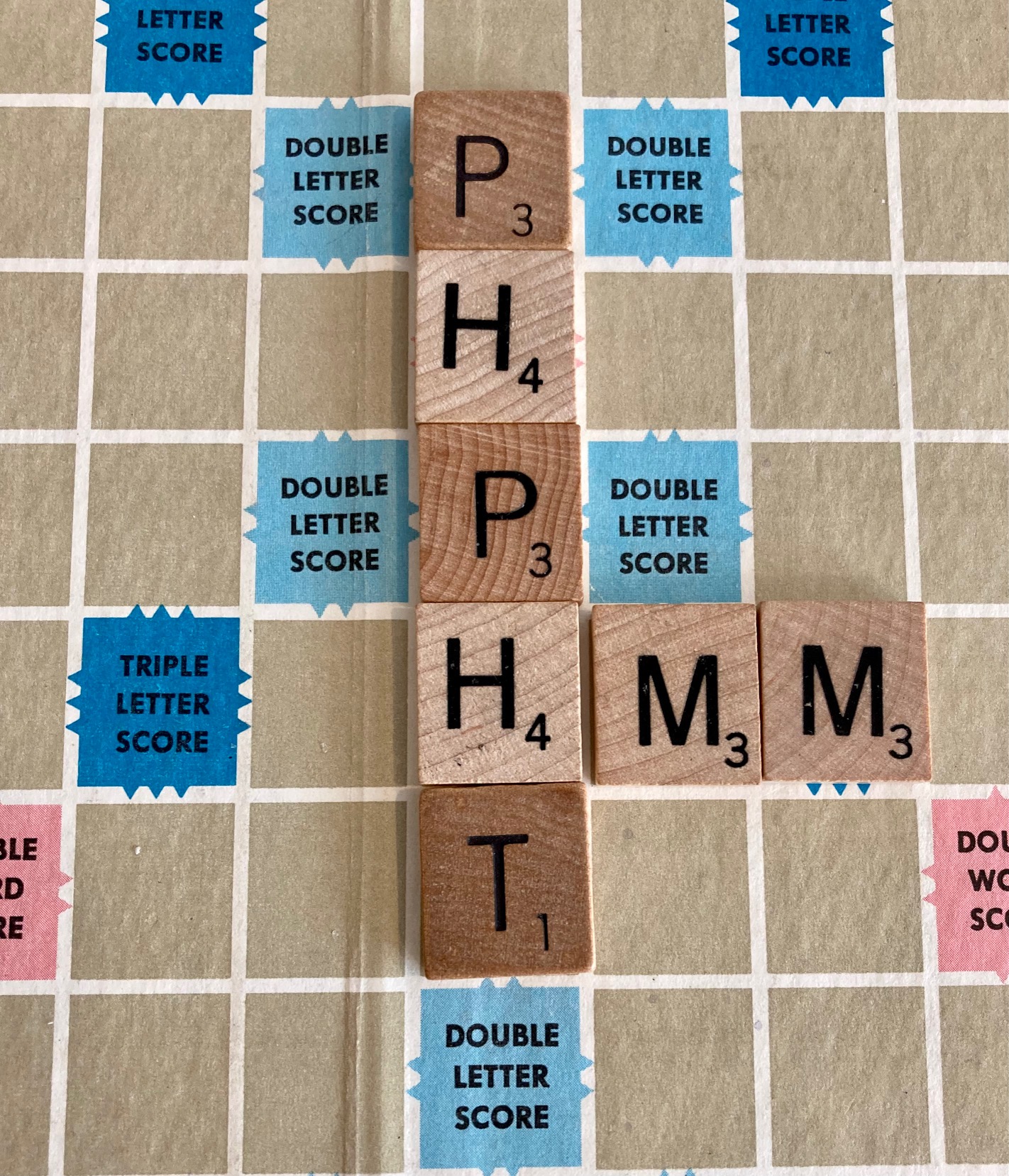
Learning nth (an unspecified number) and other all-consonant words can enable you to continue the game when you’re faced with a rack without vowels.
brr: used to indicate that one is cold
crwth: an ancient stringed instrument (pl. -s)
cwm: a cirque (a deep, steepwalled basin on a mountain, pl. -s, prounounced to rhyme with “boom”)
hm: used to express thoughtful consideration (also “hmm“)
mm: used to express assent or satisfaction
nth: describing an unspecified number in a series
phpht: used as an expression of mild anger or annoyance (also “pht“)
psst: used to attract someone’s attention
sh: used to urge silence (also “shh” and “sha“)
tsk: to utter an exclamation of annoyance (-ed, -ing, -s)
tsktsk: to “tsk” (-ed, -ing, -s)
Next Up
Wordplay Day! To prepare for class, revisit the Dictionary and World Builder pages on the Scrabble website. Also review the blog posts devoted to Scrabble tips, including this one.
This morning in class you will compose a short reflective essay that documents the processes of planning, drafting, and revising your analysis. In your reflection, you will include at least one relevant quotation from one of the sections of Writing Analytically listed below or from another section of the textbook.
Sample Works Cited Entries for Writing Analytically
Rosenwasser, David and Jill Stephen. “Late-Stage Editing and Revising: Some Tips.” Writing Analytically, 9th edition. Wadsworth/Cengage, 2024. pp. 151-52.
Rosenwasser, David and Jill Stephen. “On Keeping a Writer’s Notebook.” Writing Analytically, 9th edition. Wadsworth/Cengage, 2024. pp. 157-58.
Rosenwasser, David and Jill Stephen. “Putting X in Tension with Y.” Writing Analytically, 9th edition. Wadsworth/Cengage, 2024. pp. 248-49.
Rosenwasser, David and Jill Stephen. “The Thesis and the Writing Process.” Writing Analytically, 9th edition. Wadsworth/Cengage, 2024. pp. 237-38.
Questions to Consider in Your Reflection
What aspect of the writing seemed the most challenging? Choosing your topic? Deciding which text would serve as your subject? Determining your thesis? Identifying details to support your claims? Organizing the body of the essay? Composing the conclusion? Why did that aspect of the writing seem the most challenging?
Did the subject of your analysis change? If so, what was your original subject, and what did you change it to?
What do you consider the strongest element of your analysis?
At what point in the process did you decide on a title? Did you change the title during the writing process? If so, what was the original title?
What image that documents part of your writing process away from the screen did you include in your blog post? Why did you choose that particular image?
Next Up
Wordplay Day! To prepare for class, revisit the Dictionary and World Builder pages on the Scrabble website. Also review the blog posts devoted to Scrabble tips.
This morning in class you will read the sample student analysis “Wait Means Never” and collaboratively answer the questions that follow.
Does the writer present a summary of Martin Luther King, Jr.’s “Letter from Birmingham Jail” before he presents his thesis?
The authors of Writing Analytically note that “a productive thesis statement usually contains tension, the balance of this against that” (Rosenwasser and Stephen 248). Reread the thesis and note whether it includes any instances of “this against that.”
What specific example stands as the writer’s most effective support for his thesis
Effective strategies for concluding analyses include (1) offering an insight about the text or an additional quotation from it, (2) revisiting the thesis without stating it verbatim, and (3) pointing to the broader implications of the analysis. Does the writer employ any of those strategies? If so, which one or ones?
After you answer the questions above, review the grade criteria on your analysis assignment handout, and assign a grade. If you cannot reach a consensus, write each recommended grade.
Next Up
In class on Wednesday, you will compose a reflective essay on your analysis.
Last week I published a blog post that listed the first twenty-two playable four-letter words with three vowels. Knowing those words, and others with multiple vowels, proves useful when you’re faced with a rack of mostly, or all, vowels. Here’s a list of the remaining fourteen playable four-letter words with three vowels:
naoi: ancient temples (pl. of naos)
obia: form of sorcery practiced in the Caribbean (also obeah)
odea: concert halls (pl. of odeum)
ogee: an S-shaped molding
ohia: a Polynesian tree with bright flowers (also lehua)
olea: corrosive solutions (pl. of oleum)
olio: a miscellaneous collection
ouzo: a Turkish anise-flavored liquor
raia: a non-Muslim Turk (also rayah)
roue: a lecherous old man
toea: a currency in Papua, New Guinea
unai: a two-toed sloth (pl. unai; an ai is a three-toed sloth)
zoea: the larvae of some crustaceans
Next Up
Wordplay Day! To prepare for class, revisit the Dictionary and World Builder pages on the Scrabble website. Also review the blog posts devoted to Scrabble tips.
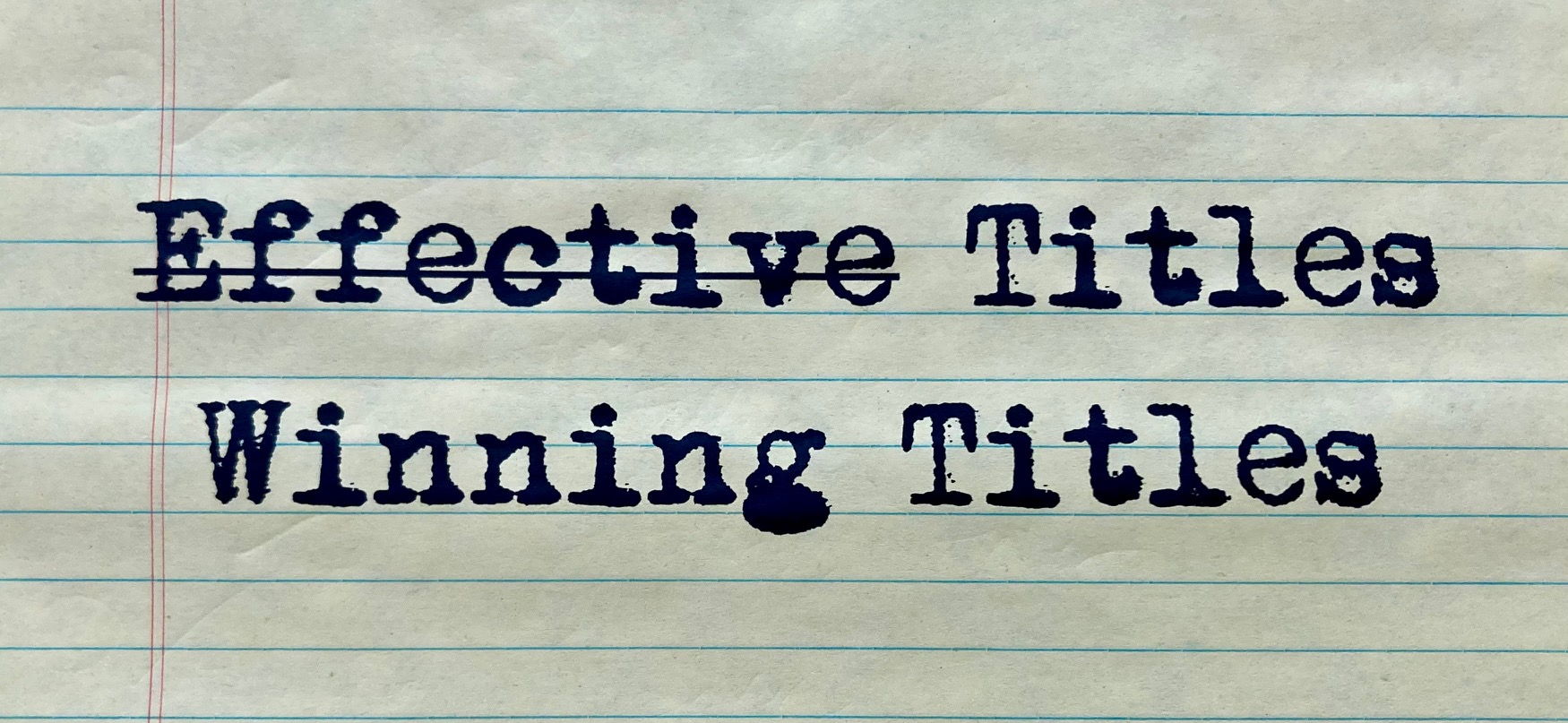
What makes for an effective title? That’s an important question to consider since the title contains the first words of yours that a reader will encounter. First, it should be descriptive; it should evoke an image in the reader’s mind. It should also be relevant to your subject; it should convey something about the writing to follow. Lastly, it should be intriguing; it should create in the reader a desire to keep reading. With those traits in mind, review the titles of your classmates’ midterm reflections listed below. Which of these is most effective and why?
“Aspects Leading to Success”
“The Awakening of My Inner Writer”
“Becoming a Better Writer
“Becoming a Stronger Writer”
“Controlled Writing”
“Developing as a Writer”
“Developing Skills”
“The First Half”
“Growth as a Writer”
“Growth in Analyzing”
“Growth-Mindedness”
“Highlights of Working with Others”
“How a Board Game Changed My Writing”
“How I have Grown”
“Impact of a Class”
“Impact of Collaboration”
“Improvements in My Writing”
“The Key to Writing”
“My Personal Development”
“My Road to Success”
“Professionalism”
“A Semester of Improvement”
“Seven Tiles but a Lifetime of Knowledge”
“The Start of a New Beginning”
“Think before You Write”
“Thinking beyond What I Knew”
“Transition to College”
“Unforeseen Clarity”
“Ways of Learning”
Bonus-Point Opportunity
Directions:
Determine which of your classmates’ titles you deem most effective.
Compose a comment that includes the title enclosed in quotation marks and a brief explanation of its effectiveness.
Post your comment as a reply to this blog entry no later than 4 p.m. today, Thursday, October 3. (To post your comment, click on the post’s title, and scroll down to the bottom of the page. You will then see the image of an airmail envelope with a leave comment option.)
I will approve your responses (make your comments visible) after the 4 p.m. deadline on October 3. Commenters will receive five bonus points for their October 4 Scrabble assignment.
Postscript
Congratulations to Ryan Kelley and Annalise Lindsay (section 19) whose titles were chosen as the most effective. Nicole Edelman (section 19) chose Ryan’s title “Impact of a Class,” and Cristique Duvall (section 20) chose Annalise’s title “Seven Tiles but a Lifetime of Knowledge.” Nicole and Cristique will each receive five bonus points for their October 4 Scrabble assignment/score sheet.
Next Up
Wordplay Day! To prepare for class, revisit the Dictionary and World Builder pages on the Scrabble website. Also review the blog posts devoted to Scrabble.
This morning, I will return your drafts with my notes, and you will have the remainder of the class period to begin revising your analyses on your laptops. Because next week is fall break, you will have two additional weeks to continue your revision work before you submit the assignment to Blackboard and publish it as a WordPress blog entry. The due date is Wednesday, October 16 (before class). The hard deadline is Friday, October 18 (before class). Directions for submitting your analysis are included on your assignment sheet and on the Blackboard submission site.
As you continue to revise your analysis, consider visiting The Writing Center. If you do so, you will earn five bonus points for the assignment.
To schedule an appointment, visit https://highpoint.mywconline.com, email the Writing Center’s director, Professor Justin Cook, at jcook3@highpoint.edu, or scan the QR code below. To earn bonus points for your analysis, consult with a Writing Center tutor no later than Thursday, October 17.
Nearly all of you in section nineteen consulted a Writing Center tutor as you worked on your literacy narrative, while less than half of you in section twenty did so:
Section 19: 18 of 20 students, 90%
Section 20: 7 of 19 students, 36.8%
Please encourage your classmates to take advantage of the opportunity to have an additional reader for your analysis-in-progress–and earn five bonus points to boot.
Next Up
Wordplay Day! To prepare for class, revisit the Dictionary and World Builder pages on the Scrabble website and review the blog posts devoted to Scrabble.
Rosenwaser, David and Jill Stephen. Chapter 7: “Finding an Evolving a Thesis.” Writing Analytically, 9th edition. Wadsworth/Cengage, 2024. pp. 234-78.
As you prepare to begin revising your analysis, read the section of Writing Analytically devoted to composing thesis statements (247-52). Also review the opening paragraph of my analysis of Art Spiegelman’sMaus and my sample opening for a possible analysis of Donald Bartheleme’s “The School,” both of which follow.
In Chapter 4 of Art Spiegelman’s graphic memoir Maus, he depicts his father Vladek’s account of the hangings of four Jewish merchants in Sosnowiec, Poland. Vladek and his wife, Anja, learn from Anja’s father, Mr. Zylberberg, that the Nazis have arrested his friend Nahum Cohn and his son. With his head bowed in sorrow, Mr. Zylberberg says to Anja and Vladek, “The Germans intend to make an example of them!” (83). That image of Mr. Zylberberg speaking with Vladek and Anja overlays the larger panel that dominates the page, one that depicts the horror that Mr. Zylberberg anticipates: the murder of his friend Nahum Cohn, Cohn’s son, and two other Jewish merchants. That haunting panel and the smaller ones that frame it illustrate the complexity of Spiegelman’s seemingly simple composition. His rendering of the panels of the living in conjunction with the fragmented panels of the hanged merchants simultaneously conveys connection and separation: both the grieving survivors’ ties to the dead and the hanged men’s objectification at the hands of the Nazis.
The authors of Writing Analytically note that “a productive thesis statement usually contains tension, the balance of this against that” (Rosenwasser and Stephen 248). Reread the thesis above (in bold) and consider the instances of “this against that”: larger panel and smaller one, complexity and simplicity, connection and separation.
Now consider the “this against that” in the sample opening for a possible analysis of Donald Bartheleme’s “The School,”
Donald Barthelme’s short story “The School” recounts a series of classroom lessons that end with the death of plants and animals–deaths that serve as a prelude to the death of a Korean orphan, followed by the deaths of classmates and family members. With conversational narration, accumulation of detail, and a shift in fictional mode, Barthelme deftly depicts the reality of the fleeting nature of life, even as the story itself veers from reality.
The sample opening paragraph above lacks the detail of the first paragraph of my Maus analysis because it’s the draft of an introduction for a paper I haven’t written. Completing a draft would enable me to develop the introduction and refine my thesis statement. That said, the introduction already has an instance of “this against that”: the reality of life depicted and the veering from reality with the shift in fictional mode.
Citing Others’ Ideas
If your analysis includes any ideas drawn from my remarks, which I subsequently posted as class notes on my blog, you should cite the blog post as you would any other online source.
Example: Dr. Lucas notes, “For Junod, choosing not to divide the first paragraph creates an unbroken movement that parallels the unbroken flight of his subject” (par. 3).
Tomorrow I will return your drafts with my notes, and you will have the class period to begin revising on your laptops. Because next week is fall break, you will have two additional weeks to continue your revision work. The due date is Wednesday, October 16 (before class). The hard deadline is Friday, October 18.





 Jane Lucas