If your midterm grade isn’t as high as you hoped it would be, keep in mind that many additional assignments–including the analysis that you just submitted–will factor in your final grade for the course.
The lists that follow present the midterm grade distribution, the combined distribution for sections nineteen and twenty, followed by the distribution for each section individually.
ENG 1103.19 and 20 Midterm Grade Distribution
A 3
A- 13
B+ 5
B 7
B- 3
C+ 3
C 1
C- 1
D- 1
F 2
ENG 1103.19
A 1
A- 6
B+ 4
B 4
C+ 2
C 1
C- 1
F 1
ENG 1103.20
A 2
A- 7
B+ 1
B 3
B- 3
C+ 1
D- 1
F 1
Next Up
Fall break! I look forward to seeing you back in class on Monday, October 16.
Today’s blog post is the final installment in the series of posts devoted to playable two-letter words. Learning these two-letter words, as well as the other two-letter words in the alphabet, will enable you to see more options for play and increase the number of points you earn in a single turn.
qi: the central life force in Chinese culture (also ki)
re: a tone of the diatonic scale
sh: used to encourage silence
si: a tone of the diatonic scale (also ti)
so: a tone of the diatonic scale (also sol)
ta: an expression of thanks
ti: a tone of the diatonic scale
to: in the direction of
uh: used to express hesitation
um: used to express hesitation
un: one
up: to raise (-s, -ped, -ping)
us: a plural pronoun
ut: the musical tone C in the French solmization system, now replaced by do
we: a first-person plural pronoun
wo: woe
xi: a Greek letter
xu: a former monetary unit of Vietnam equal to one-hundreth of a dong (also sau pl. xu)
ya: you
ye: you
yo: an expression used to attract attention
za: pizza
Next Up
Wordplay Day! To prepare for class, revisit the Dictionary and World Builder pages on the Scrabble website. Also review the posts on my blog devoted to Scrabble tips, including this one.
This morning in class you will plan and draft a short reflective essay that documents your writing process and includes at least one relevant quotation from one of the sections of Writing Analytically devoted to analysis.
Sample Works Cited Entries for Writing Analytically
Rosenwasser, David and Jill Stephen. “Analysis Does More than Break a Subject into Its Parts.” Writing Analytically, 8th edition. Wadsworth/Cengage, 2019. pp. 4-5.
—. “Distinguishing Analysis from Summary, Expressive Writing, and Argument.” Writing Analytically, 8th edition. Wadsworth/Cengage, 2019. pp. 5-8.
Questions to Consider in Your Reflection
What aspect of the writing seemed the most challenging? Choosing your topic? Deciding which text would serve as your subject? Determining your thesis? Identifying details to support your claims? Organizing the body of the essay? Composing the conclusion? Why did that aspect of the writing seem the most challenging?
Did the subject of your analysis change? If so, what was your original subject, and what did you change it to?
What do you consider the strongest element of your analysis?
At what point in the process did you decide on a title? Did you change the title during the writing process? If so, what was the original title?
What image that documents part of your writing process away from the screen did you include in your blog post? Why did you choose that particular image?
Up Next
Wordplay Day! To prepare for class, revisit the Dictionary and World Builder pages on the Scrabble website. Also review the posts on my blog devoted to Scrabble tips.
Draft collage with Iron Maiden’s Steve Harris and Bruce Dickinson (L-R) and an illustration of Gustave Dore’s edition of Samuel Taylor Coleridge’s “The Rime of the Ancient Mariner.”
To offer you a second sample analysis, I have posted the essay that follows, one that I wrote as a model for my English literature students in 2020. “Rockin’ the Boat: Iron Maiden’s Metal Mariner” examines a heavy metal reimagining of Samuel Taylor Coleridge’s poem “The Rime of the Ancient Mariner” (1798, 1817).
Rockin the Boat: Iron Maiden’s Metal Mariner
A sailor kills a bird of good omen, his destructive act dooms his shipmates and curses him with retelling the tale over and over: So the story of the Ancient Mariner goes. Yet those plot details convey neither the epic nature of Samuel Taylor Coleridge’s poem nor its influence on later writers. Only the poem itself places readers fully in the imaginative realm of the tale, but its late eighteenth-century diction creates a gulf between the poem and contemporary readers. Consequently, one of the challenges of introducing “The Rime of the Ancient Mariner” to millennial students is bridging that gulf. Iron Maiden’s adaptation offers one solution. By eliminating the shifts in the narrative voice and updating the story with contemporary language, their heavy-metal version draws listeners into the story with emphatic rhythms that capture the spirit of the original lines.
Archaic words, such as “stoppeth” (line 2), have a way of stopping readers in their tracks, calling attention to their temporal distance from the poem. Along with the distancing effect of the language, the shifts from one speaker to another can pose problems for twenty-first century readers. Although the Mariner tells his own story, the first words that he speaks are in the fifth stanza. The four stanzas that precede his first words are voiced alternately by an unnamed narrator and the wedding guest who becomes the Mariner’s captive audience. In prose such shifts are easily navigated with paragraphing and dialogue tags. Most poems, however, lack such signals, and their absence in Coleridge’s poem compounds its difficulty. Not only are some of the words obstacles, it’s not always clear who is speaking them.
Iron Maiden’s adaptation eliminates those issues with updated diction and a consistent narrative voice. Rather than shifting speakers, Iron Maiden’s version presents the tale sung by a single storyteller, not the sailor himself, but a narrator who tells listeners to “[h]ear the rime of the ancient mariner” (1). Those first words of the song, penned by lead singer Bruce Dickinson, form an imperative sentence: a command with the understood subject “you”—“[You] hear the rime . . . ” (1). I am master and commander of this story, Dickinson seems to say, and you will hear it now. Such is the power of the imperative. Rather than leaving the reader questioning, as Coleridge’s first stanzas may, Iron Maiden’s song speaks directly to listeners, taking hold of them with the pull of a powerful tide, drawing them out to sea to witness the Mariner as he kills the albatross and seals his fate.
The nature of that fate, that the Mariner must tell his tale over and over, is effectively emphasized by the song’s repetition. The recurrence of the words “on and on,” which first appear to underscore the length of the voyage (17, 18) are repeated in the last line: “And the tale goes on and on and on” (89). That ending may be more fitting than the original. The “sadder and wiser” (624) listener at the end of Coleridge’s poem also appears in the last verse of the song. But by returning to the retelling of the story, the song’s ending shifts the focus from the wedding guest who hears the story only once to the teller who must tell it over and over.
Making the Mariner’s story more accessible through song is valuable not only as an introduction to the poem but also as a starting point for understanding its influence on later English writers, including Mary Shelley, the second-generation Romantic who featured both images and lines from the poem in her novel Frankenstein. Coleridge’s poem was one of Shelley’s favorites, one that she first encountered as a child when the poet recited it in her father’s study (Karbeiner xiii). Iron Maiden’s version captures the spirit of what Mary Shelley, Coleridge’s fan girl, heard: the epic ballad of an eighteenth-century rock star.
Works Cited
Coleridge, Samuel Taylor. “The Rime of the Ancient Mariner.” The Norton Anthology of British Literature: The Romantic Period. 10th ed. Stephen Greenblatt, General Editor. W. W. Norton, 2017. pp. 448-64.. EMI, 1984.
Iron Maiden. “Rime of the Ancient Mariner.” Power Slave. EMI, 1984.
Karbeiner, Karen. Introduction: “Cursed Tellers, Compelling Tales—The Endurance of Mary Shelley’s Frankenstein.” Frankenstein by Mary Shelley. 1818, 1831. Barnes and Noble, 2003.
The analysis that follows is one that I wrote as a model for my students in 2021. As you read it, note how I turn from summary to thesis (in bold) in the first paragraph. Also note how the paragraphs that follow offer support for the thesis with concrete details from the comic’s panels.
Since concluding paragraphs can be particularly difficult to write without repeating the introduction, today’s group work will include a close look at strategies for conclusions.
The Strange Fruit of Sosnowiec
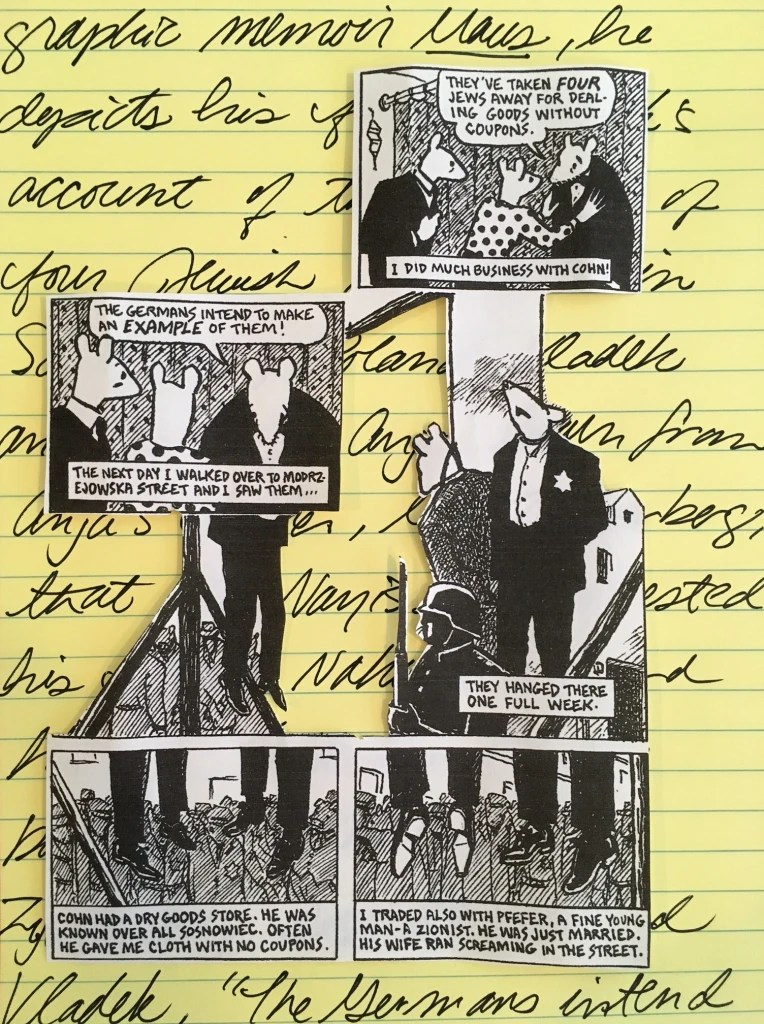
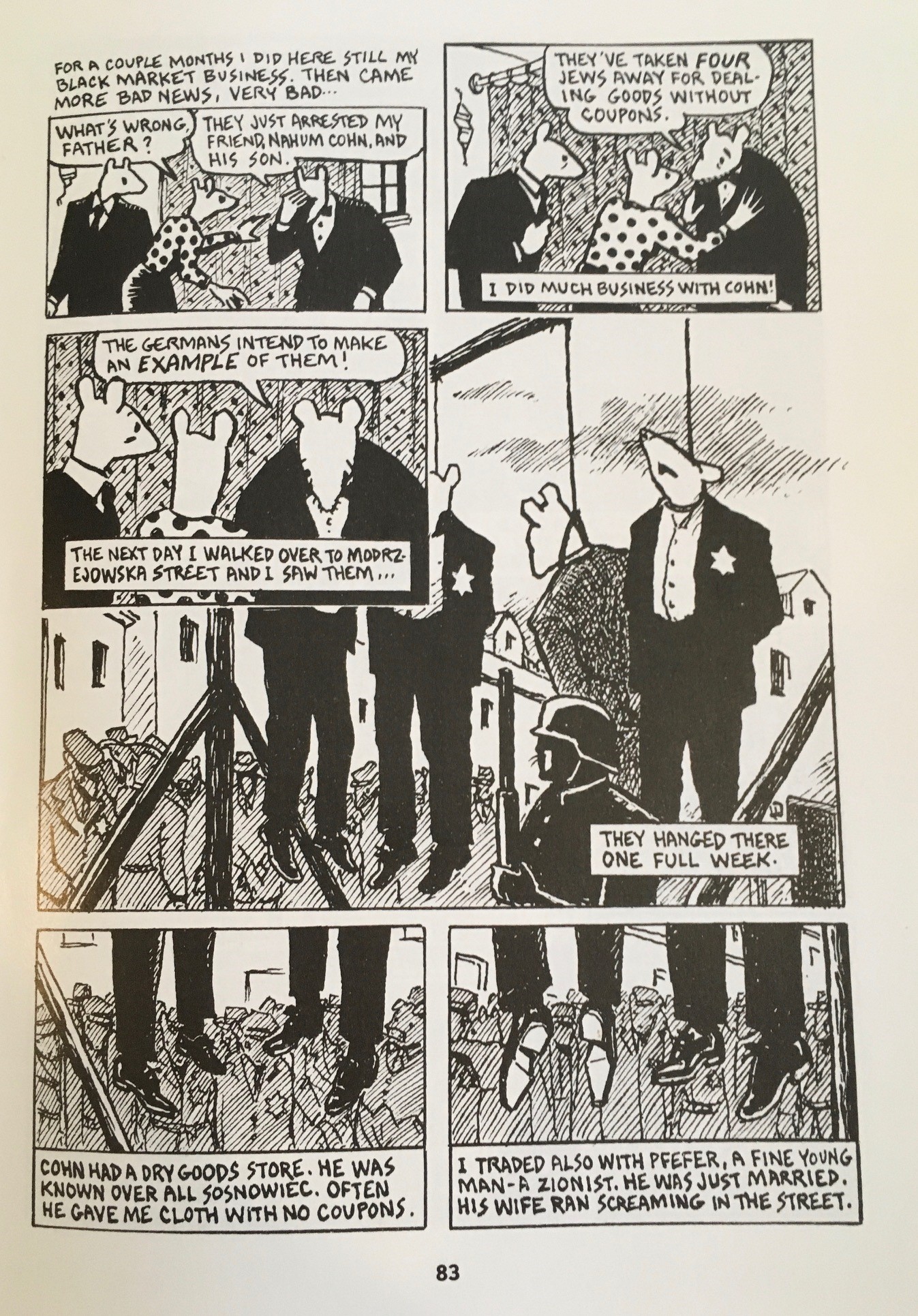
In Chapter 4 of Art Spiegelman’s graphic memoir Maus, he depicts his father Vladek’s account of the hangings of four Jewish merchants in Sosnowiec, Poland. Vladek and his wife, Anja, learn from Anja’s father, Mr. Zylberberg, that the Nazis have arrested his friend Nahum Cohn and his son. With his head bowed in sorrow, Mr. Zylberberg says to Anja and Vladek, “The Germans intend to make an example of them!” (83). That image of Mr. Zylberberg speaking with Vladek and Anja overlays the larger panel that dominates the page, one that depicts the horror that Mr. Zylberberg anticipates: the murder of his friend Nahum Cohn, Cohn’s son, and two other Jewish merchants. That haunting panel and the smaller ones that frame it illustrate the complexity of Spiegelman’s seemingly simple composition. His rendering of the panels of the living in conjunction with the fragmented panels of the hanged merchants simultaneously conveys connection and separation: both the grieving survivors’ ties to the dead and the hanged men’s objectification at the hands of the Nazis.
The placement of the overlaying panel not only hides part of the horror behind it, but it also connects Vladek’s father-in-law to one of the victims. Mr. Zylberberg’s head and torso appear directly above the suspended legs and feet of one of the hanged men, creating an image that merges the two.
Spiegelman further emphasizes the mourners’ identification with the hanged men by extending two of the nooses’ ropes upward to the smaller panel above them, linking the living to the dead. Additionally, Spiegelman underscores the link with Vladek’s line of narration at the bottom of the smaller panel: “I did much business with Cohn!” (83). The word “with” appears directly above the rope, punctuating the connection between both Nahum Cohn and his friend Mr. Zylberberg and Zylberberg’s son-in-law, Vladek.
While the panels of the hangings yoke the living to the dead, Spiegelman’s presentation of the hanged men in fragments also objectifies them. The final panels on the page depict only their shoes and part of their pant legs suspended above the onlookers, images that may evoke in some readers thoughts of the last remnants of the Jews who stepped barefoot into the gas chambers of Auschwitz.
Whether the hanged men’s shoes call to mind those mountains of leather left behind by the Jews, the separation of their lower legs and feet from the rest of their bodies turns them into something less than human—not people, but mere parts. Thus, Spiegelman creates a picture of the hangings that illustrates both the mourners’ identification with the victims and the Nazis’ perception of the Jews as less than human: the malignant ideology that the artist has pinpointed “at the very heart of the killing project.”
Spiegelman, Art. Maus 1. Pantheon, 1986, p. 83.
Spiegelman’s transformation of the Nazi propaganda portrayals of Jews as rats remains an astounding achievement thirty-five years after the publication of the first volume of Maus. But seeing the hanged merchants in Modrzejowska Street in the midst of the George Floyd murder trial in Minneapolis and less than three months after the January 6 Capitol riot reminds readers that the panels of Spiegelman’s memoir have grown more prescient. The nooses evoke images of Officer Derek Chauvin’s knee on George Floyd’s neck, the January 6 chants to hang the Vice President, and a T-shirt glimpsed in the Capitol crowd, one with a Nazi eagle below the acronym “6MWE” (Six Million Wasn’t Enough), a reference to the numbers of Jews slaughtered in the Holocaust. Our heads are bowed in sorrow with Mr. Zylberberg’s. The strange fruit of our past, both distant and recent, should seem far stranger.
After we examine “The Strange Fruit of Sosnowiec,” you and two or three of your classmates will collaborate on an exercise that asks you to consider an example of the connections and separations that I address in my thesis. The exercise will also ask you to explore the conclusion strategies that I employ in the final paragraph.
Next Up
In class on Wednesday, you will compose a short reflective essay on your analysis. In your reflection, you will be required to include at least one relevant quotation from a section of Writing Analytically devoted to analysis: “Analysis Does More than Break a Subject into Its Parts” (4-5) or “Distinguishing Analysis from Summary, Expresive Writing, and Argument” (5-8).
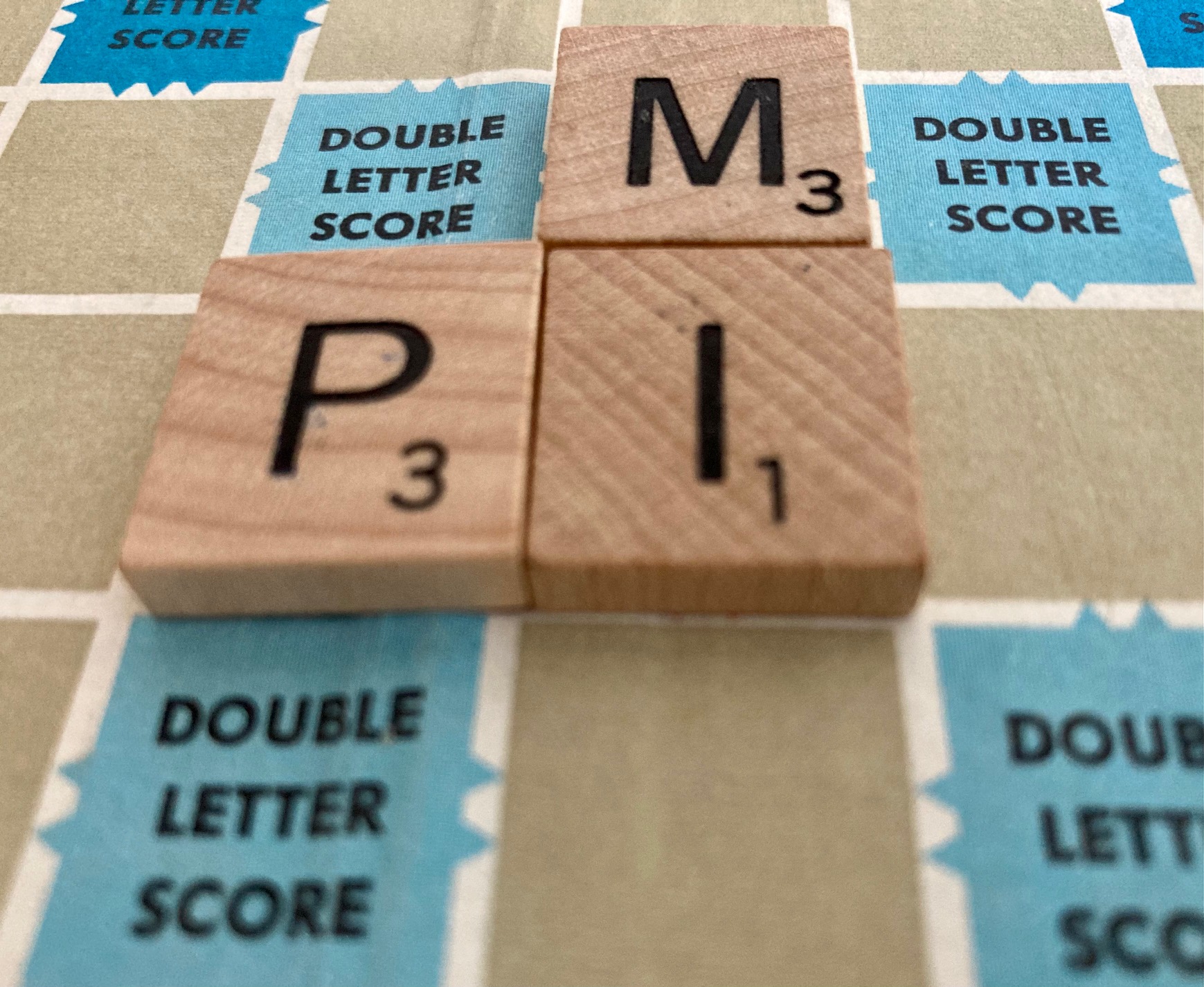
In the previous weeks, I published blog posts featuring the playable two-letter words that begin with a, b, c, d, e, f, g, h, i, j, k, and l. Today’s post features the playable two-letter words beginning with m, n, o, and p. Learning these two-letter words, as well as the other two-letter words in the alphabet, will enable you to see more options for play and increase the number of points you earn in a single turn.
M, by the way, is the most versatile consonant. In the first position, m pairs with every vowel: ma, me, mi, mo, mu, and also my. In the second position, m pairs with every vowel except i: am, em, om, um.
ma: a mother
me: a singular objective pronoun
mi: a tone of the diatonic scale
mm: an expression of assent
mo: a moment
mu: a Greek letter
my: a first-person possessive adjective
na: no, not
ne: born with the name of
no: a negative answer
nu: a Greek letter
od: a hypothetical force
oe: a whirlwind off the Faero Islands
of: originating from
oh: an exclamation of surprise
oi: an expression of dismay (also oy)
om: a sound used as a mantra
on: the batsman’s side in cricket
op: a style of abstract art dealing with optics
or: the heraldic color gold
os: a bone
ow: used to express pain
ox: a clumsy person
oy: an expression of dismay (also oi)
pa: a father
pe: a Hebrew letter
pi: a Greek letter
Next Up
Wordplay Day! To prepare for class, revisit the Dictionary and World Builder pages on the Scrabble website. Also review the posts on my blog devoted to Scrabble tips, including this one.
This morning, after I collect yourfinal Check, Please! worksheets, I will return your drafts, and you will have the remainder of the class period to begin revising your analyses on your laptops. You will have an additional week to continue your revision work before you submit the assignment to Blackboard and publish it as a WordPress blog entry. The due date is next Wednesday, October 4 (before class). The hard deadline is 10:30 a.m. on Friday, October 6. Directions for submitting your analyses are included on your assignment sheet and on the Blackboard submission site.
Parenthetical Citations
In your analysis, you will include parenthetical citations for quotations and paraphrases. Since you are writing a textual analysis, I recommend quoting rather than paraphrasing because the writer’s particular word choices are vital to the text’s overall effect. If your subject is one of the unpaginated texts (“Me Talk Pretty One Day,” “The Day Language Came into My Life,” or “The Falling Man”), your parenthetical citations will include the abbreviation par. for paragraph, followed by the paragraph number. If your subject is one of the paginated texts (“Back Story” or “The School”), your parenthetical citations will include the page number by itself. Including the author’s last name as well would be redundant because you have established in your introduction that your essay focuses solely on a work by him or her.
Here are some examples of how to use parenthetical citations in your analysis:
The nonsense words “meimslsxp” and “lgpdmurct” underscore his utter lack of comprehension in French class (par. 2).
The line “‘like Aaron’s rod, with flowers'” is a biblical allusion to Numbers 17.8 (par. 9).
He notes that in contrast to the Falling Man, the others who jumped appeared “confused, as though trying to swim down the side of a mountain” (par. 1).
He employs the “One Mississippi . . . Two Mississippi . . .” count to mark the seconds leading up to Joe Theismann’s career-ending injury (15).
With the words, “is death that which gives meaning to life?,” the story shifts from realism to surrealism (10).
Work Cited Entry
At the end of your analysis, you will include an MLA-style work cited entry. Refer to the models below.
Barthelme, Donald. “The School.” The Best American Short Stories 1975, edited by Martha Foley, Houghton Mifflin, 1975. pp. 8-11.
Lewis, Michael. Chapter One: “Back Story.” The Blind Side. 2006. Norton, 2009, pp. 15-23.
Sedaris, David. “Me Talk Pretty One Day.” Me Talk Pretty One Day. Little Brown, 2000. pp. 166-73.
As you continue to revise your analysis, consider visiting the Writing Center. If you do so, you will earn five bonus points for the assignment.
To schedule an appointment, visit https://highpoint.mywconline.com, email the Writing Center’s director, Professor Justin Cook, at jcook3@highpoint.edu, or scan the QR code below. To earn bonus points for your analysis, consult with a Writing Center tutor no later than Thursday, October 5.
I recommend taking a copy of the text that serves as the subject of your analysis (“Me Talk Pretty One Day,” “The Day Language Came into My Life,” “The Falling Man,” “Back Story,” or “The School”) to your Writing Center appointment.
Next Up
Wordplay Day! To prepare for class, revisit the Dictionary and World Builder pages on the Scrabble website, and review the posts on my blog devoted to Scrabble tips.
“The School,” originally published in The New Yorker magazine, was one of twenty-one stories chosen for the annual Best American Short Stories anthology in 1975.
This morning in class we will examine Donald Barthelme’s short story “The School,” and in groups of three or four you will address in writing some of the elements of the story that you might explore in an analysis. As I mentioned last week, if you find the prospect of analyzing “The School” more appealing than analyzing one of the texts we studied previously (“Me Talk Pretty One Day,” “The Day Language Came into My Life,” the opening of “The Falling Man,” “Back Story”), you are welcome to change the subject of your analysis to “The School.”
The elements of Barthelme’s story that you will consider this morning are these:
the narrator and the narrative voice
conflict
narrative shift (Where does “The School” make an unexpected turn?)
Whether you analyze Bartheleme’s story or one of our earlier readings, you will begin your first paragraph with a summary of the text. Remember that a summary is an objective synopsis of a text’s key points. It should be written in third person and present tense. For example, if you choose to analyze “The School,” you might summarize it this way:
Donald Barthelme’s short story “The School” recounts a series of classroom lessons that end with the deaths of plants and animals–deaths that serve as a prelude to the unexplained death of a Korean orphan, followed by the senseless deaths of classmates and family members.
Notice that the summary above does not comment on the story in any way. What follows the summary will be the beginning of your commentary, or analysis, the thesis statement that offers your particular close reading, or interpretation, of the story. The passage below is the same as the one above, but at the end of it I have added a thesis statement in bold.
Donald Barthelme’s short story “The School” recounts a series of classroom lessons that end with the death of plants and animals–deaths that serve as a prelude to the death of a Korean orphan, followed by the deaths of classmates and family members. With conversational narration, accumulation of detail, and a shift in fictional mode, Barthelme deftly depicts the reality of the fleeting nature of life, even as the story itself veers from reality.
If were to continue to write the analysis that I began in the previous paragraph, I would follow that opening paragraph with body paragraphs that address each of the three story elements that I include in my thesis: (1) “conversational narration,” (2) “accumulation of detail,” and (3) shift in fictional mode.
Next Up
In class on Wednesday, after I collect your fifth Check, Please! assignments, I will return your handwritten analysis plans and drafts (with my notes), and you will have the remainder of the class period to devote to revising on your laptops and tablets. You will have an additional week to continue revising. Your revision is due on Blackboard and on your WordPress blog the morning of Wednesday, October 4. The hard deadline in Friday, October 6.
In the previous weeks, I published one blog post featuring playable two-letter words that begin with a and a second blog post featuring playable two-letter words that start with b, c, d, and e. Today’ s blog post features playable two-letter words beginning with f, g, h, i, j, k, and l. Learning these two-letter words, as well as the other two-letter words in the alphabet, will enable you to see more options for play and increase the number of points you earn in a single turn.
fa: a tone on the diatonic scale
fe: a Hebrew letter
gi: a white garment worn in martial arts
go: a Japanese board game
ha: used to express surprise
he: a pronoun signifying a male
hi: an expression of greeting
hm: used to express consideration
ho: used to express surprise
id: the least censored part of the three-part psyche
if: a possibility
in: to harvest (a verb, takes -s, -ed, -ing)
is: the third-person singular present form of “to be”
it: a neuter pronoun
jo: a sweetheart
ka: the spiritual self in ancient Egyptian spirituality
ki: the vital life force in Chinese spirituality (also qi)
la: a tone of the diatonic scale
li: a Chinese unit of distance
lo: an expression of surprise
Competitive Scrabble
Last week some students asked whether Scrabble is played competitively. It is, and the culture of competitive Scrabble is documented in detail in journalist Stephan Fatsis’ Word Freak (2001). In his author’s note, Fatis outlines what distinguishes casual play from competitive Scrabble:
“A twenty-three-page game book governs everything from how to select tiles properly (the bag containing them must be held at eye level or higher) to what to do if a player needs to to go to the bathroom during a game (a situation that just happens to fall under Rule II P).”
Competitive Scrabble is a also the subject of a documentary film, Word Wars (2004).
Next Up
Wordplay Day! To prepare for class, revisit the Dictionary and World Builder pages on the Scrabble website. Also review the posts on my blog devoted to Scrabble tips, including this one.
This morning, after I collect your fourth Check, Please! assignment, you will begin your analysis of one of the texts we have studied in class, which include these:
The first paragraphs of “Back Story” by Michael Lewis
“The Day Language Came into My Life” by Helen Keller
The first paragraphs of “The Falling Man” by Tom Junod
“Me Talk Pretty One Day” by David Sedaris
On Monday we will read a short story, “The School” by Donald Barthelme, which will serve as an additional option for your analysis. If you begin an analysis of one of the texts listed above and decide you would rather write about “The School,” you are welcome to change your focus.
As a starting point for your analysis planning, this morning you will read the pages in Writing Analytically devoted to analysis. Among the key points to keep in mind as you write are these:
“One common denominator in all effective analytical writing is that it pays close attention to detail” (5).
“In order to understand a subject, we need to discover what it is ‘made of,’ the particulars that contribute most strongly to the character of the whole” (5).
“[A]sk not just ‘What is it made of?’ but also ‘How do these parts help me to understand the meaning of the subject as a whole?”’ (5).
“Analytical writing is more concerned with arriving at an understanding of a subject than it is with either self-expression or changing readers’ views” (5).
Next Wednesday, September 27, I will return your handwritten drafts with notes, and you will have the class period to begin revising on your laptops and tablets. You will have an additional week to continue to revise. Your revisions are due on Blackboard and on your blogs on Wednesday, October 4. The hard deadline is Friday, October 6.
Next Up
Wordplay Day! To prepare for class, revisit the Dictionary and World Builder pages on the Scrabble website, and review the posts on my blog devoted to Scrabble tips.




 Jane Lucas