Posted in English 1103, Reading, Teaching, Writing

ENG 1103: Reflecting on the Second Half of the Semester


Posted in English 1103, Reading, Teaching, Writing

ENG 1103: Stephen King on the Horrors of Passive Voice . . .


Posted in English 1103, Reading, Teaching, Writing

ENG 1103: Revisiting “The Competition”

Falconer, Ian. “The Competition.” Writing Analytically by David Rosenwaser and Jill Stephen, 8th edition, Wadsworth/Cengage, 2019. p. 85.

Yesterday in class, we examined Ian Falconer’s The Competition, and as a collaborative exercise, you and two or three of your classmates composed a one-paragraph summary of the magazine cover, followed by a second paragraph that presented your close reading or analysis of The Competition and integrated your interpretation with a quotation from one of the textbook authors’ two interpretations.

Below are three sample paragraphs that I wrote as models for you. The first is a summary of Falconer’s cover. The second and third offer close readings of the magazine cover. Each integrates one of the two interpretations that the authors of Writing Analytically offer on page 89.

Summary

Ian Falconer’s mostly black-and-white New Yorker cover The Competition depicts four beauty pageant contestants, three of whom stand in stark contrast to Miss New York. Her dark hair, angular body, narrowed eyes, tightly pursed lips, and two-piece bathing suit set her apart from the nearly-identical blondes–Miss Georgia, Miss California, and Miss Florida–whose wide-open eyes and mouths and one-piece bathing suits are typical of pageant contestants.

Analyses

The contrast between the raven hair and eyes of Miss New York and the platinum-blonde and pale-eyed contestants from Georgia, California, and Florida in The New Yorker cover The Competition by Ian Falconer suggests what the authors of Writing Analytically present as the first of two possible interpretations: The cover “speak[s] to American history, in which New York has been the point of entry for generations of immigrants, the ‘dark’ (literally and figuratively) in the face of America’s blonde European legacy” (Rosenwasser and Stephen 89).

The self-satisfied expression of Miss New York in The New Yorker cover The Competition by Ian Falconer suggests what the authors of Writing Analytically present as the second of two possible interpretations: “[T]he magazine is . . . admitting , yes America, we do think that we’re cooler and more individual and less plastic than the rest of you, but we also know that we shouldn’t be so smug about it” (Rosenwasser and Stephen 89).

Work Cited

Rosenwasser, David and Jill Stephen. Chapter 3: “Interpretation: Moving from Observation to Implication.” Writing Analytically, 8th edition. Wadsworth/Cengage, 2019. pp. 70-97.


As you continue to work on your final essay and annotated bibliography, review these samples as models for your own summaries and close readings of your sources.


Posted in English 1103, Reading, Teaching, Writing

ENG 1103: Annotating “The Competition”

Falconer, Ian. “The Competition.” Writing Analytically by David Rosenwasser and Jill Stephen, 8th edition, Wadsorth/Cengage, 2019. p. 85.

Posted in English 1103, Reading, Teaching

ENG 1103: “Strawberry Spring” Follow-Up

Posted in English 1103, Reading, Teaching

ENG 1103: A Reading for the Eve of All Hallows’ Eve

King, Stephen. Night Shift. Doubleday, 1978.

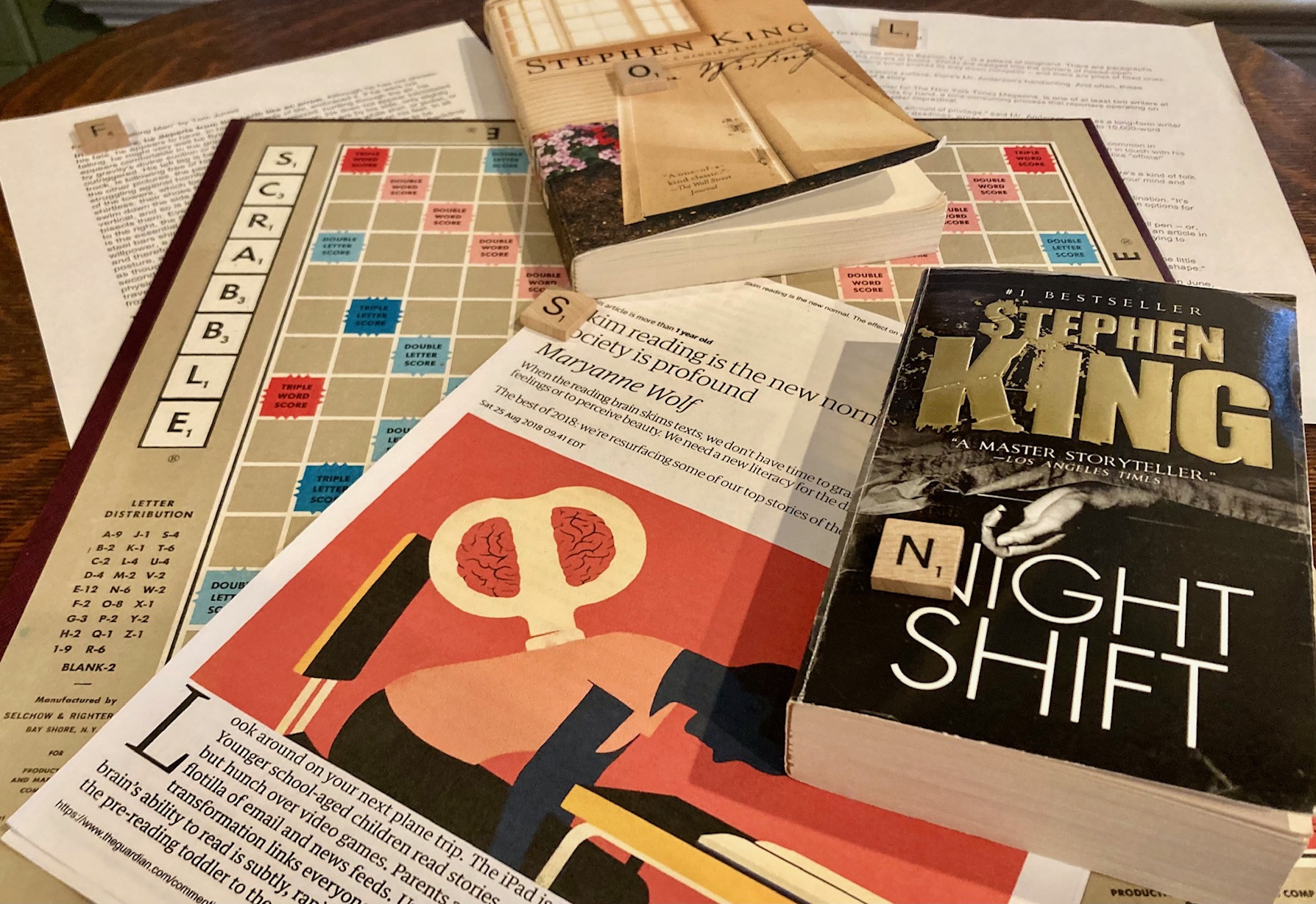
Today in class we will read Stephen King‘s short story “Strawberry Spring,” which was published in Ubris magazine in 1968 and included in King’s first short story collection, Night Shift (1978).

For the collaborative exercise that you will complete after we read the story, I will ask you to determine whether you can identify any details that indicate why the narrator may have murdered any of his victims. Although there is no indication that the narrator knew Gale Cerman, Adelle Parkins, or Marsha Curran, but he did know Ann Bray.

I will also ask you to identify words and phrases that illustrate how the story is not only a horror story but also a commentary on war, the Vietnam War in particular, and the Vietnam era.


Posted in English 1103, Reading, Teaching, Writing

ENG 1103: Rockin’ the Boat: Iron Maiden’s Metal Mariner

Draft collage with Iron Maiden’s Steve Harris and Bruce Dickinson (L-R) and an illustration of Gustave Dore’s edition of Samuel Taylor Coleridge’s “The Rime of the Ancient Mariner.”
Posted in English 1103, Reading, Teaching, Writing

ENG 1103: Donald Barthelme’s “The School”

“The School,” originally published in The New Yorker magazine, was one of twenty-one stories chosen for the annual Best American Short Stories anthology in 1975.

Posted in English 1103, Reading, Teaching, Writing

ENG 1103: Beginning Your Analysis

This morning, after I collect your fourth Check, Please! assignment, you will begin your analysis of one of the texts we have studied in class, which include these:

  • The first paragraphs of “Back Story” by Michael Lewis
  • “The Day Language Came into My Life” by Helen Keller
  • The first paragraphs of “The Falling Man” by Tom Junod
  • “Me Talk Pretty One Day” by David Sedaris

On Monday we will read a short story, “The School” by Donald Barthelme, which will serve as an additional option for your analysis. If you begin an analysis of one of the texts listed above and decide you would rather write about “The School,” you are welcome to change your focus.

As a starting point for your analysis planning, this morning you will read the pages in Writing Analytically devoted to analysis. Among the key points to keep in mind as you write are these:

  • “One common denominator in all effective analytical writing is that it pays close attention to detail” (5).
  • “In order to understand a subject, we need to discover what it is ‘made of,’ the particulars that contribute most strongly to the character of the whole” (5).
  • “[A]sk not just ‘What is it made of?’ but also ‘How do these parts help me to understand the meaning of the subject as a whole?”’ (5).
  • “Analytical writing is more concerned with arriving at an understanding of a subject than it is with either self-expression or changing readers’ views” (5).

Next Wednesday, September 27, I will return your handwritten drafts with notes, and you will have the class period to begin revising on your laptops and tablets. You will have an additional week to continue to revise. Your revisions are due on Blackboard and on your blogs on Wednesday, October 4. The hard deadline is Friday, October 6.

Next Up

Posted in English 1103, Reading, Teaching, Writing

ENG 1103: Blog Responses and “Back Story”

Today’s class will be devoted primarily to reading and responding to the blog post of one of your classmates’ literacy narratives. Elements to consider in your response include these:

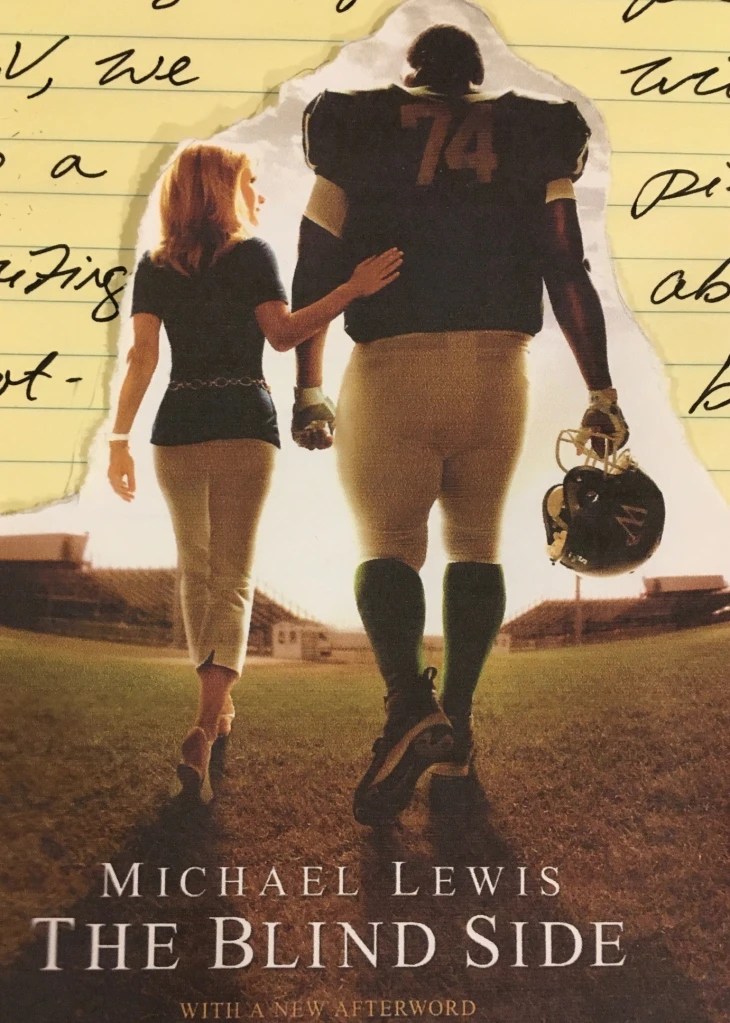
After you complete that assignment, you will begin reading the opening pages of “Back Story,” the first chapter of Michael Lewis’s The Blind Side, which dramatizes the moments in the November 1985 Redskins-Giants football game leading up to the injury that ended quarterback Joe Theismann’s career:

“From the snap of the ball to the snap of the first bone is closer to four seconds than to five. One Mississippi: The quarterback of the Washington Redskins, Joe Theismann, turns and hands the ball to running back John Riggins. He watches Riggins run two steps forward, turn, and flip the ball back to him. It’s what most people know as a “flea-flicker,” but the Redskins call it a “throw-back special.” Two Mississippi: Theismann searches for a receiver but instead sees Harry Carson coming straight at him. It’s a running down—the start of the second quarter, first and 10 at midfield, with the score tied 7–7—and the New York Giants’ linebacker has been so completely suckered by the fake that he’s deep in the Redskins’ backfield. Carson thinks he’s come to tackle Riggins but Riggins is long gone, so Carson just keeps running, toward Theismann. Three Mississippi: Carson now sees that Theismann has the ball. Theismann notices Carson coming straight at him, and so he has time to avoid him. He steps up and to the side and Carson flies right on by and out of the play. The play is now 3.5 seconds old. Until this moment it has been defined by what the quarterback can see. Now it–and he–is at the mercy of what he can’t see” (15).

What Theismann cannot see is Lawrence Taylor. A second later, as Taylor sacks Theismann, Taylor’s knee drives straight into Theismann’s lower right leg, leading to the “snap of the first bone” that Lewis mentions in the first sentence. He hooks the reader by linking the beginning of the play, “the snap of the ball” to the gruesome “snap of the first bone” that will follow. Lewis develops the paragraph using the common one-Mississippi, two-Mississippi method of marking seconds to present the events leading up to the compound fracture that ends Theisman’s career.

Lewis doesn’t dramatize the injury itself because his interest lies instead in the blind side that led to it and subsequently elevated the status and salary of the left tackle, the player who protects the quarterback’s blind side.

When you’re struggling to develop a piece of writing, reread the opening paragraph of The Blind Side. Study how Lewis dramatizes 3.5 seconds–yes, only 3.5 seconds–with 224 words.