Posted in Reading, Teaching, Writing

A Closer Look at Klosterman, on the Page and the Stage

Chuck Klosterman / visitingwriters.lr.edu

To introduce my students to the writing of pop culture critic Chuck Klosterman—last night’s featured writer in Lenoir-Rhyne’s Visiting Writers Series—I assigned “My Zombie, Myself: Why Modern Life Feels Rather Undead.” Of the dozens of columns and essays of Klosterman’s I could have assigned, I chose his commentary on zombies in part because of the continuing popularity of zombies in general, and in particular the comic-book-turned-TV series The Walking Dead, now joined on AMC by its prequel, Fear the Walking Dead. I also chose “My Zombie, Myself” because it’s a well-constructed argument, one that makes the same moves that we make in academic writing.

In class on Wednesday, my students collaboratively examined “My Zombie, Myself,” identified its components, and summarized the essay’s argument with their answers to these questions:

  1. What is the standard view of zombies?
  2. What is Klosterman’s claim about them?
  3. What is Klosterman’s support for his claim?
  4. What naysayers or counterargument does Klosterman address?
  5. What does Klosterman write to convey why it matters? (Who cares why zombies are the monster of the moment?)

As the students in my 8 a.m. class collaboratively composed their summaries, I drafted this one of my own:

In ‘My Zombie, Myself: Why Modern Life Feels Rather Undead,’ Chuck Klosterman challenges the standard view that the monster of the moment personifies our unconscious fears, claiming instead that battling the undead provides us with an allegory for our daily lives. In Klosterman’s words, ‘[t]he principal downside to any zombie  attack is that the zombies will never stop coming; the principal downside to life is that you will never be finished with whatever it is that you do.’ To those who contend that zombies have merely replaced vampires as the current it-monster, Klosterman says their argument is deceptive.  He maintains that the Twilight series isn’t about vampires but about ‘nostalgia for teenage chastity, the attractiveness of its film cast and the fact that contemporary fiction consumers tend to prefer long serialized novels that can be read rapidly.’ Klosterman reminds us that our zombie fixation matters because they “come at us endlessly (and thoughtlessly),” like all of the annoyances of life, but we can manage them.

Last night I was reminded of Klosterman’s claim about the popularity of zombies—how they’re an allegory for our daily lives—when interviewer Mike Collins, host of WFAE’s Charlotte Talks, asked him about the continuing popularity of the reality show Survivor. In response to Collins’ question—why is it still so popular after so many years?—Klosterman said that what you see over and over in Survivor is the elimination of the oldest and the weakest first, then you see the elimination of the strongest, the contestants who are perceived as the biggest threats. What Survivor really rewards is mediocrity, Klosterman said, and that’s something that we see in our own lives.

Near the end of the interview—which covered topics ranging from Klosterman’s childhood in North Dakota, to his work at ESPN and Spin, to his interviews with Taylor Swift and Tom Brady, to the presidential candidates—Klosterman spoke about his writing process. I think that most writers come up with a thesis and then write about it, he said. What I do is write about what interests me and then look for a thesis.

Klosterman’s method is far more common than he realizes. It’s the one I use, and the one I encourage my students to use when their assignments give them the opportunity to see their interests “through academic eyes” (Laff qtd. in Graff 250).

Works Cited

Graff, Gerald. “Hidden Intellectualism.” “They Say/I Say”: The Moves That Matter in Academic Writing. Eds. Gerald Graff and Cathy Birkenstein. 3rd ed. New York: Norton, 2014. 244-51. Print.

Klosterman, Chuck. “My Zombie, Myself: Why Modern Life Feels Rather Undead.” The New York Times. The New York Times, 3 Dec. 2010. Web. 11 Nov. 2015.
Posted in Reading, Teaching, Writing

Q&A with Rob Peace’s Nick Carraway

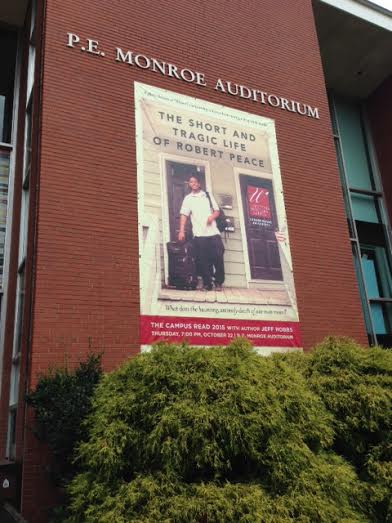
Yesterday afternoon, Jeff Hobbs—one of the featured authors in Lenoir-Rhyne’s Visiting Writers SeriesSTLRP Bannerconducted a Q&A session with an audience primarily of students, mostly freshman who are reading his book The Short and Tragic Life of Robert Peace for their FYE (First-Year Experience) classes. As Hobbs began to speak, I was reminded of the phone conversation that he recounts in Chapter 12: “You sound like a mouse,” Rob says, “same as you did in college” (295). Though I thought his voice was too low-pitched to be mouse-like, I could see how Rob had found it mousy—and admittedly it was, as Hobbs describes in Chapter 12, “soft-spoken” and “halting” (295).

Yet despite the “soft-spoken” and “halting” quality of Hobbs’ voice, he delivered powerful responses to students’ questions. When someone asked, what made you want to write the book? Hobbs answered with remarks about the vast array of mourners—evidence of the variety of people whose lives had been touched by Rob—echoing Hobbs’ words in Chapter 17:

The line for the viewing was two blocks long and one of the most diverse collections of people I’d ever seen: Yale students and professors, people conversing in Portuguese, Croatian, and Spanish, young and old residents of all of the boroughs of New York City and all the townships surrounding Newark. (388)

Near the end of Hobbs’ Q&A, my thoughts returned to Chapter 12, when in response to a question regarding how the process of writing the book had affected him, Hobbs answered that it made him “lament the nature of male friendship,” which he illustrates in his reflections on his conversation with Rob:

Jeff Hobbs / visitingwriters.lr.edu

The distance between us and the maleness of our friendship precluded revealing anything that truly mattered, and at the time I was too naïve to know that if you were friends with someone—truly friends—then you told him what was going on (“It’s called ‘catching up,’” my wife informed me when I asked how it was possible for her to yap with her girlfriends for as long as she did and share every innocuous detail of her life). Instead, I thought that by concisely presenting the most easygoing and put-together version of myself, I was being ‘all good.’ (295-96)

Hobbs did not address his writing process—something he may have spoken about at one of his other two appearances at L-R, Thursday evening and Friday morning—but he did convey what he hoped his biography of Rob would give to readers: a narrative that challenges the “predictable media spin of potential squandered” (386). The questions that audience members asked—as if they, too, had been acquainted with Rob—indicated that Hobbs did achieve that goal, one that any of us writing a book-length narrative would hope for: breathing life into our subjects, whether fictional or real, and enabling readers to see them as three-dimensional human beings, with all of their consistent inconsistencies.

Work Cited

Hobbs, Jeff. The Short and Tragic Life of Robert Peace. New York: Scribner, 2014. Print.

Posted in Reading, Teaching

Grandmaster Flash and the Quiet Fury of Robert Peace

“The Message” / undergroundhiphop.com

Prologue: 33.3 RPM 33 Years Later

When I read the scene in the first chapter of The Short and Tragic Life of Robert Peace where three-year-old Rob sings himself to sleep with Grandmaster Flash and the Furious Five lyrics, I remembered the summer of 1982 when I listened over and over in my bedroom to a recording of “The Message,” taped on a cassette from the WARR radio show hosted by Freddie “The Preacherman” Hargrove.

I kept hearing “The Message” as I continued to read Jeff Hobbs’ biography of Robert Peace and began thinking of the song as the first cut on Rob’s soundtrack.  When I started  to plan the paper that would serve as a model for my students’ own analyses of Hobbs’ book, I knew that “The Message” would be my subject–one that would enable me to heed the advice that I ask my students to follow: to see their interests “through academic eyes” (Laff qtd. in Graff 250) and one that would give me an opportunity to meditate more on “The Message” as a prelude to Rob’s story.

Grandmaster Flash and the Quiet Fury of Robert Peace

In the first chapter of The Short and Tragic Life of Robert Peace, Jeff Hobbs recounts Rob’s mother, Jackie, wincing on those nights when she put her toddler son “to bed with a book and heard him instead singing himself to sleep with Grandmaster Flash and the Fabulous [sic] Five lyrics” (16). Readers of that sentence may wince as well, not because they share Jackie’s sentiments about rap music, but because they recognize the error (of “Fabulous” for “Furious”) that eluded the book’s author and editor. Yet despite that mistake—one that risks marring the memory that Hobbs narrates—his account of young Rob singing Melle Mel’s words still resonates as a prelude to his biography. “The Message” isn’t Rob’s story, but as the implicit first cut on his soundtrack, Grandmaster Flash and Furious Five’s groundbreaking rap introduces Rob’s fascination with music, and its references to illegal drugs, mental breakdowns, and untimely death echo the events of his life.

When Jackie hears Rob singing himself to sleep with the words of Grandmaster Flash and the Furious Five, she thinks not of her three-year-old son’s uncanny ability to learn lyrics but rather of the world that “The Message” depicts. The line “Broken glass everywhere” (Fletcher et al. 5) evokes images of the “bits of glass from crack pipes and vials [that] were embedded in the dirt beneath the swing set” in the park where Rob played (18). The pervasiveness of illegal drugs in the neighborhood, evidenced by the fragments of pipes and vials, prompts Jackie to do whatever she can to ensure that Rob will get away from East Orange. When Jackie looks up at her old high school, she realizes that “with a few more years of determination and sacrifice on her part, Rob would leave. He would do so in spectacular fashion” (69).

Though Rob leaves East Orange in spectacular fashion, he and the handful of other Yale students from the inner city find their new surroundings in New Haven less-than-spectacular, so much less that they’re often pushed “close to the edge” (Fletcher et al. 13, 27 . . .) by the rarefied world of the Ivy League but are reluctant to seek help. One of Rob’s classmates, Raquel Diaz, who grew up in poverty in Miami, “believed that ‘going crazy’ was a luxury of the wealthy, because poor people like her had too many responsibilities to deal with mental health episodes” (178). Rather than seeking help, Raquel opts to take her junior year off to work as an au pair in Italy and to visit China. As Rob helps her lug her furniture to the dorm’s basement for storage, he tells her “not to worry about anything at all except getting yourself right” (178).

Whether he believed, as Raquel did, that losing his head was a luxury he couldn’t afford, Rob and Raquel’s classmate Oswaldo Gutierrez, who grew up in Newark’s predominantly Puerto Rican North Ward, finds himself “in the grip of a full-fledged psychotic break” (177). In Chapter Eight, Hobbs writes that Oswaldo’s “brain had begun to crumple under the weight of all it had to bear; his spiraling family in Newark; his affluent classmates whose constant whining about how hard their lives were made him want to turn a gun on them” and eventually his “[f]antasies of turning a gun on the people around him evolved into turning a gun on his forehead” (177). The events leading up to Oswaldo’s stint in Yale’s Psychiatric Institute seem eerily similar to those that Rob’s high school principal, Friar Leahy, recalls when he contemplates offering Rob a position teaching science at St. Benedict’s:

[Rob’s] situation reminded him of one of his first students [. . .]. The very bright African American student had gone to Harvard and won a Rhodes Scholarship. Then he’d returned to Newark during one of the most accelerated spans of the city’s deterioration. Overeducated and underskilled for most jobs available, he hadn’t been able to find work. The man had cracked up under the pressure of living in two worlds—being surrounded by friends from a hardscrabble youth and yet set apart by his elite education. Eventually, he’d kill himself. (231)

Rob doesn’t visibly crack  the way the unnamed man from St. Benedict’s Class of ’74 does, or his Yale classmates Raquel and Oswaldo do, but his ability to maintain his composure ultimately proves more of a liability than the detours that Raquel and Oswaldo take to get themselves right again. Unlike the man in “The Message,” Rob doesn’t hang himself in a cell, but he remains a prisoner of his drug-dealing—the selling more of a “Neon King Kong standin’ on [his] back” (Fletcher et al. 41) than the use, itself.

Elsewhere in Rob’s biography, references to music reveal his developing intellect and his evolving tastes. In Chapter Three, Hobbs writes of Rob “devot[ing] much of his time to memorizing rap lyrics of groups like A Tribe Called Quest: breaking them down, analyzing them, internalizing the words as poetry” (71). Chapter Four depicts Rob as the “boy in the class who knew the lyrics of every single Bones Thugs-N-Harmony song, every single word to every single song. Because these songs were typically so fast-paced [. . .] learning one song, let alone all of them, was a feat that inspired awe” (79-80). And in Chapter Eight, chronicling Rob and Jeff’s senior year at Yale, Hobbs observes how his roommate’s “musical tastes seemed to have softened over time, and in the room I’d been hearing fewer freestyle-based, full-throttle gangster rappers like Ludacris and more melodic, over-produced songs like the one we were hearing now, [Nelly’s] “Ride Wit Me.” (190). While those songs compose Rob’s soundtrack as well, the opening cut by Grandmaster Flash and Furious Five—unfortunately misnamed by the author—echoes throughout the book, it’s refrain underscoring Rob’s drug-dealing, how “close to the edge” (Fletcher et al. 13, 27 . . .) he and so many of his peers came, and how, though his musical taste “softened over time,” his risk-taking continued “full throttle” (190) in a life in which he “lived so fast and died so young” (Fletcher et al. 106).

Works Cited

Fletcher, E. and M. Glover, S. Robinson, and J. Chase. “The Message.” Grandmaster Flash and the Furious Five. The Message. Sugar Hill, 1982.

Graff, Gerald. “Hidden Intellectualism.” “They Say/I Say”: The Moves That Matter in Academic Writing. Eds. Gerald Graff and Cathy Birkenstein. 3rd ed. Norton, 2014. 244-51.

Hobbs, Jeff. The Short and Tragic Life of Robert Peace. Scribner, 2014.

Posted in Reading, Teaching, Writing

A Storytelling Poet on the Eve of 9/11

Last Thursday, when Jaki Shelton Green appeared at Lenoir-Rhyne as the first featured author in this year’s Visiting Writers Series, she spoke as both a poet and a storyteller, noting that her poems live inside her stories.

Jaki Shelton Green / visitingwriters.lr.edu

I found myself drawn more to her stories than the poems they linked, but my ears welcomed the sound of Green’s own voice reading her poem “i know the grandmother one had hands,” just a day after my students and I studied the poem and read it aloud ourselves in class. As she introduced the poem, Green recounted her stint teaching poetry writing to women on death row, giving them the assignment of writing about hands because of the acts that they had committed with their own hands. She didn’t say that the poem was her answer to the assignment, but it may have been, just as this blog entry and the earlier one on the poem, itself, are my answers to the blog assignment that I have given to my students.

Through her poems and stories, Green spoke of painful subjects on the eve of 9/11: the imminent anniversary, her great-great grandmother’s life in slavery, and the death of her own daughter. But her words offered hope rather than sadness. As I reflect on those words, I hope that the ones that my students and I write this semester will show us what Green’s showed us Thursday night: that writing gives us a way of making sense of the world.

Posted in Reading, Teaching, Writing

A Poem in the Hands of a Composition Class

Jaki Shelton Green’s poem “i know the grandmother one had hands” evokes images of a woman whose busy hands remain unseen as they perform a litany of tasks, some literal: “folding, pinching, rolling the dough” (3), others metaphorical: “growing knives” (14).

As my students and I read Green’s poem in class yesterday–in preparation for her presentation tonight as one of the featured writers in Lenoir-Rhyne’s Visiting Writers Series–I expected that the conversation that followed might be markedly poemdifferent from the ones last semester in my Introduction to Creative Writing class. Those students, after all, were reading poems, short stories, plays, and narrative nonfiction as models for their own work. Yet even though my current students in Critical Thinking and Writing will not produce creative writing for class, their responses to Green’s work were similar to those of my creative writing students.

In retrospect, I realize that the similarities should not surprise me since I asked the students in ENG 131 (Critical Thinking and Writing) to begin their exploration of Green’s poem by considering her choices, just as I asked the students in ENG 281 (Intro. to Creative Writing) to begin.

I do not know why Green uses a lower-case “i,” or why she refers to “the grandmother one,” rather than a grandmother or my grandmother, but posing such questions and considering the effects of those choices places us on the path of writing, whether the destination is a poem of one’s own or a study of someone else’s.

Posted in Reading, Writing

Go Set a Watchful Editor

Watchman and Mockingbird with a draft of this blog post
“Watchman” and “Mockingbird” with a draft of this blog post.

In To Kill a Mockingbird, when Nathan Radley discovers that his brother, Arthur “Boo” Radley, has been leaving gifts for Jem and Scout in the knot-hole of a live oak tree, he fills the hole with cement. Some readers would like to entomb Go Set a Watchman in a similar fashion, troubled as they are by the timing of the novel’s publication—suspicious of the motives of Harper Lee’s estate trustee, Tonja Carter—and angered by the revelation of Atticus Finch’s bigotry.

When readers of Watchman learn along with Scout that Atticus not only opposes desegregation but was also once a member of the Klan, it’s more than we and the twenty-six-year-old Jean Louise can take. She says to her father, “You’ve cheated me in a way that’s inexpressible” (252), and we agree, wondering if Lee was cheated as well. Whatever the motives for its publication, the novel is here for us now, its appearance stopping us the way the knot-hole stops Scout and Jem. Rather than deeming Watchman’s arrival unwelcome, it serves us to examine the book with care, in particular the scene at the courthouse where Jean Louise secretly watches her father at a meeting of the Maycomb County Citizen’s Council. As Scout looks down at Atticus from the balcony, she remembers a very different scene twenty years earlier, one of her father “accomplish[ing] what was never before or afterwards done in Maycomb County: he won an acquittal for a colored boy on a rape charge” (109).

Reading that brief flashback, Harper Lee’s editor at Lippincott, Tay Hohoff, realized what was only a five-paragraph summary could become the moral and structural center of the novel. Though he isn’t acquitted in Mockingbird, the unnamed defendant gains a name, Tom Robinson, an arm—in Watchman it was “chopped off in a sawmill accident” (109)—and, most importantly, his essential human dignity. After more than two years of revision, Harper Lee gave us the re-imagined Tom, and Maudie Atkinson, and Mrs. Henry Lafayette Dubose, and added to them Boo, who along with the rest of the Radley family is absent from Watchman. We know those characters and empathize with them because Lee, with the coaxing of a watchful editor, returned to them again and again, giving us people we can consider from their own points of view, whose skin we “walk around in” (32), as Atticus teaches young Scout to do.

Near the end of Mockingbird, Scout reflects on Boo’s gifts to her and Jem: “two soap dolls, a broken watch and chain, a pair of good luck pennies, and our lives. But neighbors give in return. We never put back into the tree what we took out of it: we had given him nothing, and it made me sad” (253).

The least we can give Go Set a Watchman is our attention. It isn’t Harper Lee’s greatest gift to us, but it’s something more important in a way: it’s the apprentice work that gave life to the classic we love.

Works Cited

Lee, Harper. Go Set a Watchman. New York: HarperCollins, 2015. Print.

—. To Kill a Mockingbird. Philadelphia: Lippincott, 1960. Print.

Posted in Reading, Teaching, Writing

A Slow-moving Reminder

"Mov[ing] like a hovercraft . . ."
“mov[ing] like a hovercraft” across one of the granite steps that lead to the front porch
Earlier this afternoon when I spotted a snail on one of the steps to the front porch, I thought of the snail in Paul Muldoon‘s poem “Hedgehog,” the subject of my post from March 4. As I watched the snail glide across the granite, still wet from the rain, I remembered Muldoon’s snail “mov[ing] like a hovercraft, held up by a/Rubber cushion of itself,/Sharing its secret/With the hedgehog.”

And I thought of these lines from my post on March 4:

I cannot say precisely why Muldoon chose to run the simile ‘The snail moves like a/Hovercraft’ from the first line to the second, but I can say—and did say to my students—that it’s an example of enjambment, something to try if we want to achieve a similar run-on effect.

As we begin drafting our own poems, I keep thinking about the pleasure of reading that simile, the surprise followed by recognition. Never before had I thought of a snail moving like a propeller-driven hovercraft. And never before had I thought of the hedgehog and the snail as kindred animals for their ability to retreat into themselves.

The snail, the hovercraft, the hedgehog, the crown of thorns: these are now linked in my mind. That’s what ‘Hedgehog’ has given me.

Posted in Reading, Teaching, Writing

“La Femme Nadia”

Pastrix (2013) / nadiabolzweber.com

Before Nadia Bolz-Weber spoke yesterday at Lenoir-Rhyne, the students in my 8 a.m. class and I read an excerpt from her memoir Pastrix: The Cranky and Beautiful Life of a Sinner and Saint (2013). The excerpt, “La Femme Nadia,” depicts the events in late 1991 and early 1992 that led Bolz-Weber to sobriety and to God. For my students and me reading in a “writerly” way, “La Femme Nadia” served as an instructive model for its apt sensory detail (“My skin felt like the rough side of Velcro”), and its graceful shifts from summary to scene:

Margery, a leathery-faced woman with a New Jersey accent, was talking about prayer or some other nonsense when suddenly a sound like a pan falling on the tile floor came up from the kitchen below us. I jerked out of my seat like I was avoiding shrapnel, but no one else reacted. Without skipping half a beat, Margery turned to me, with a long slim cigarette in her hand and said, ‘Honey, that’ll pass.’ She took a drag and went on, ‘So anyways, prayer is. . .’

I did not revisit those details from “La Femme Nadia” with my 12:15 students because their class period coincided with the first of Bolz-Weber’s two March 5 appearances as one of the featured writers in the university’s Visiting Writers Series.

In lieu of our scheduled class, we attended the presentation—one that Bolz-Weber nearly missed due to weather-related travel woes that she recounted with humor and grace.

Her remarks focused on faith rather than writing—she would turn her focus to writing at 7 p.m.–but her 12:15 talk was relevant to writers nevertheless. In response to a question about the Eucharist, she paraphrased Flannery O’Connor and spoke eloquently in her own words: “You have to be deeply rooted in tradition to innovate with integrity.” The same is true of writing and of all other art.

Posted in Reading, Teaching, Writing

The Hedgehog and the Snail

. . . and the poet who wasn’t here.

New Weather (1973) / timkcbooks.com

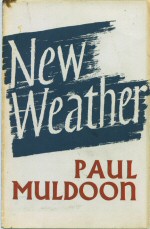
Paul Muldoon was supposed to read at Lenoir-Rhyne last Thursday, as one of the featured authors in the university’s Visiting Writers Series, but the snow kept him away. Day classes were cancelled at the university, too, so my students and I didn’t read his poem “Hedgehog” together as planned. But yesterday, as the rain washed away the lingering snow, we returned to the classroom for our postponed study of poetry, beginning with “Hedgehog.” An early poem of Muldoon’s, “Hedgehog” meditates on the animal of the title as well as the snail, likening the snail to a hovercraft and the hedgehog’s quills to a crown of thorns.

The tentative responses that followed our reading showed how reluctant we can be to express our thoughts about poetry. We are so accustomed to reading straightforward prose that a poem’s roundabout way of making meaning can lead us to doubt ourselves, to sense that there’s something we’re not getting from the poem but should be.

I cannot say precisely why Muldoon chose to run the simile “The snail moves like a/Hovercraft” from the first line to the second, but I can say—and did say to my students—that it’s an example of enjambment, something to try if we want to achieve a similar run-on effect.

As we begin drafting our own poems, I keep thinking about the pleasure of reading that simile, the surprise followed by recognition. Never before had I thought of a snail moving like a propeller-driven hovercraft. And never before had I thought of the hedgehog and the snail as kindred animals for their ability to retreat into themselves.

The snail, the hovercraft, the hedgehog, the crown of thorns: these are now linked in my mind. That’s what “Hedgehog” has given me.


 Writing Ideas Torn from “Hedgehog”

  1. A poem that depicts the similarity between two animals and compares each of the two to something else
  2. A poem that features enjambment
Posted in Reading, Teaching, Writing

An Unfinished Portrait

What distinguishes historical fiction from creative nonfiction about historical events? I’ve been thinking about that question since Katherine Howe’s recent talk at Lenoir-Rhyne. In her February 12 presentation, Howe–L-R’s current writer-in-residence and one of the featured authors in the university’s Visiting Writers Series–spoke about her historical novels and the seemingly contrarian nature of the form:

Historical fiction seems to embody a contradiction. If we want to know what happened, we can consult an archive. If we want a transcendent experience, we read fiction.

As a writer of historical fiction, Howe does both, conducting research for accuracy and crafting fictional worlds that breathe life into the past. When Howe mentioned the question of whether the chandelier in her forthcoming novel burns gas or whale oil—a question her research hasn’t answered yet—I was reminded of Janet Burroway’s reflections on her novel Cutting Stone, set during the Mexican revolution:

In the only historical novel I have ever written, I decided that I could put an ice house in a rural Arizona town several years before there was actually such a thing, but that I could not blow off the arm of a famous Mexican general two years before, historically, it happened (240).

Such blending of fiction and fact differs from creative nonfiction about historical events, not because creative nonfiction doesn’t include a mix—it does, sometimes—but rather because creative nonfiction doesn’t place us in the past.

Holocaust Girls (2002) / indiebound.com

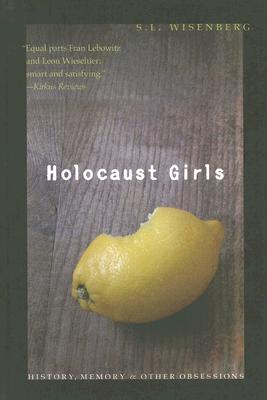
Take for example “Margot’s Diary,” (one of the essays in Burroway’s chapter on creative nonfiction in Imaginative Writing), in which writer S. L. Wisenberg speculates about the life of the Frank sister who is unknown to us because her diary didn’t survive, as Anne’s did. Wisenberg writes an un-diary of sorts, an essay in nine sections, the last titled “At Bergen-Belsen, Winter 1945.” But Wisenberg doesn’t place the readers at the concentration camp where Margot died, nor does she place us in the Frank houses in Frankfurt, Germany and Amsterdam in the earlier sections. Instead, Wisenberg imagines what Margot may have written before she “ran out of language” (255). Her aim is not is not to return us to the past, as Howe does, but to leave us with an unfinished portrait that conveys a profound sense of loss.


Wisenberg, S. L. “Margot’s Diary.” Imaginative Writing: The Elements of Craft by Janet Burroway. 3rd ed. Boston: Pearson/Longman, 2011. Print. 252-55.