In Janet Burroway’s chapter on character in Imaginative Writing, she observes that “one of the ways we understand people is by assessing, partly instinctively and partly through experience, what they express voluntarily and involuntarily” (92). I thought of those lines of Burroway’s when I read the prelude to Katherine Howe’s novel Conversion (2014), which my students and I studied as our own prelude to Howe’s upcoming presentation as one of the featured writers in the Lenoir-Rhyne Visiting Writers Series.
Howe’s Prelude: “Salem, Massachusetts, May 30, 1706,” chronicles the first minutes of the narrator’s visit with Reverend Green, an encounter that will apparently end with her confession. (“I’ve come to Reverend Green to make my confession,” she tells us.)
Though Howe doesn’t initially reveal the name of the first-person narrator, Reverend Green calls her Ann, and a later reference to the Putnam family leads readers familiar with the Salem Witch trials to conclude that the narrator is Ann Putnam, one of the key witnesses who publicly apologized in 1706 for her role in the trials.
It isn’t that history, though, that lingers in my mind. Instead it’s what Reverend Green expresses involuntarily when Ann first sees him in his study:
His tongue creeps out the corner of his mouth while he writes, the tip of it black with ink, the blacking in his gums staining his teeth. He looks like he’s got a mouthful of tar. I’ve been waiting for some time, but Reverend Green’s still writing. His quill runs across the paper, scratching like mouse paws. Scratch scratch, dip, scratch, lick, scratch.
Why does Howe present the image of the minister’s mouth blackened by ink intended for the page? What greater discrepancy might that image suggest?
Writing Ideas Torn from the Prelude of Conversion
1. A portrait of a character based on what he or she reveals involuntarily.
2. A narrative that juxtaposes historical and contemporary characters and events.
Burroway, Janet. Imaginative Writing: The Elements of Craft. 3rd ed. Boston, Longman, 2011.
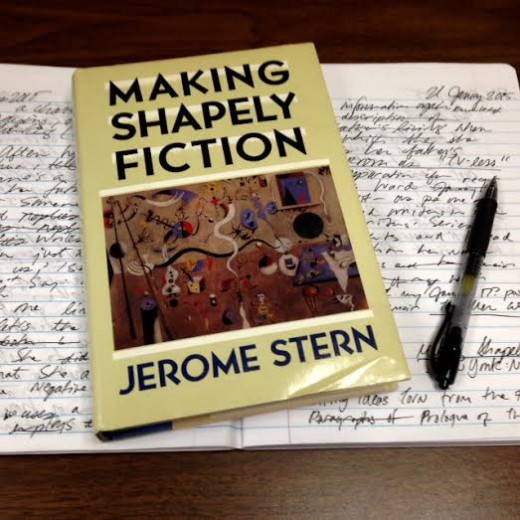
Making Shapely Fiction (1991) with a draft of this blog post
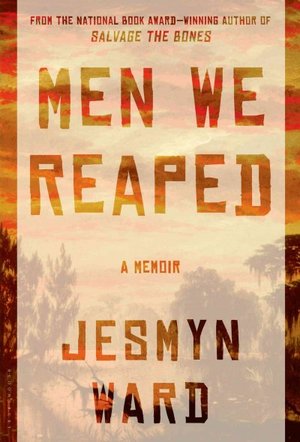
In preparation for Jesmyn Ward’s recent campus visit—as one of the featured writers in the Lenoir-RhyneVisitingWriters Series—my students and I read excerpts from her novel Salvage the Bones (the subject of my January 17 post) and her memoir Men We Reaped. For writers reading greedily, the first paragraphs of Ward’s memoir offer a model of what writing teacher Jerome Stern called negative positive knowledge: “the technique you use when you want to tell readers what is not happening. It addresses the problem of how to call readers’ attention to what a character is not saying, or doing, or thinking” (165). In the prologue, which recounts Ward’s visits to her father in New Orleans after her parents’ separation, her brother, Joshua, tells her that there’s a ghost in her father’s house, that someone died there. After those words, Ward writes: “‘You just trying to scare us,’ I said. What I didn’t say: It’s working” (par. 6). With one line, Ward lets the reader hear both what she did and did not say to her brother. Ward also uses a variation on negative positive knowledge, negative positive setting, when she describes her father’s living room as “TV-less” (par. 2).
Men We Reaped (2013) / npr.org
Writing Ideas Torn from the Prologue of Men We Reaped (and from Making Shapely Fiction)
A scene that conveys what a character is not saying, doing, or thinking
A description of a room that includes something that isn’t there
Stern, Jerome. Making Shapely Fiction. Norton, 1991.
In Imaginative Writing: The Elements of Craft, Janet Burroway notes the importance of becoming a reader of a “writerly sort”:
reading greedily, not just for entertainment but also focusing on the craft, the choices and techniques of the author; ‘reading the greats,’ in novelist Alan Cheuse’s words, ‘in that peculiar way that writer’s read, attentive to the peculiarities of the language . . . soaking up numerous narrative strategies and studying various approaches to that cave in the deep woods where the human heart hibernates’ (3).
Salvage the Bones (2011) / npr.org
Along with reading greedily, my students and I will listen greedily this semester to the observations on craft and technique offered by the writers featured in Lenoir-Rhyne’s Visiting Writers Series, beginning with National Book Award winner Jesmyn Ward, who will read and discuss her work on Monday, January 19. As an introduction to Ward’s fiction, my students and I read the opening pages of her novel Salvage the Bones (2011), which depict a pit bull struggling to give birth. While China, the pit bull, serves as the focus, the beginning of Ward’s novel offers far more than the details of the dog’s labor.
In the first paragraph, Esch, the narrator, says that China “stole all the shoes in the house, all our black tennis shoes Mama bought because they hide dirt and hold up until they’re beaten soft.” With those words, Ward shows how a single sentence can reveal details about more than one character: China, the pit bull that likes to steal “all the shoes,” and Mama, the practical woman, who always bought black tennis shoes “because they hide dirt . . . .”
The second paragraph begins, “What China is doing is nothing like what Mama did when she had my youngest brother, Junior,” introducing Mama’s labor as a point of contrast, providing a transition from the present scene centering on China to the scene seven years earlier of Mama’s own labor and the birth of Junior, who “came out purple and blue as a hydrangea: Mama’s last flower.” Ward doesn’t choose between simile and metaphor; she uses both. Junior is like a hydrangea, and he is a flower, Mama’s last one.
Writing Ideas Torn from the First Paragraphs of Salvage the Bones
A scene that triggers memories of (and cues a flashback to) an earlier event
A sentence that describes more than one character
A sentence that depicts someone or something with both a simile and a metaphor
Burroway, Janet. Imaginative Writing: The Elements of Craft. 3rd ed. Boston: Pearson/Longman, 2011. Print.
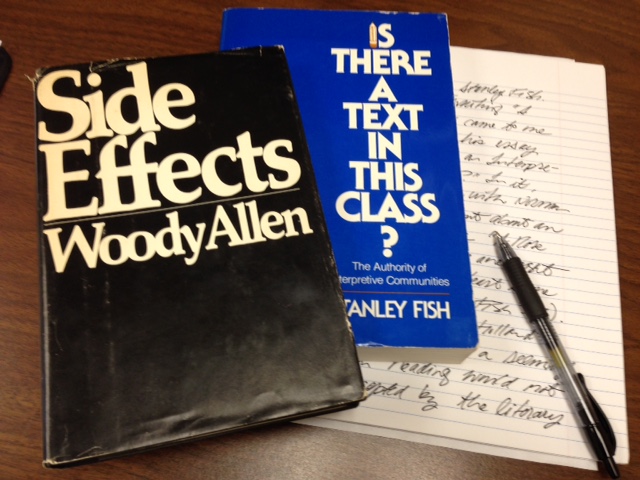
Side Effects (1980) and Is There a Text in This Class? (1980), with a draft of this blog post
Blame it on Stanley Fish. The idea for rewriting “A Rose for Emily” with an Eskimo came to me while reading his essay “What Makes an Interpretation Acceptable?” In it, Fish takes issue with Norman Holland’s argument about an Eskimo reading of “A Rose for Emily”: “We are right to rule out at least some readings” (qtd. in Fish 346). Fish agrees with Holland’s notion that such a seemingly random reading would not be accepted by the literary community, but he disagrees with Holland’s claim that the story cannot accommodate that reading. For Fish, reading the tableau of Emily and her father as an Eskimo could be a legitimate reading of William Faulkner’s story if an interpretive strategy were in place to provide for it.
As I read Fish’s essay, I took little interest in his theory and Holland’s, but I kept picturing an Eskimo inexplicably entering the story and turning it upside down. Because I couldn’t shake that image from my mind, I wrote it down, making “A Rose for Emily,” “another story altogether,” as I subtitled it. Though my adaptation, like Faulkner’s original, consists of five numbered sections, and employs the same first-person plural point of view of the townspeople, Emily finds herself no longer in conflict with her father, with herself, and with societal constraints, but instead with an Eskimo who follows her relentlessly.
In retrospect, I realize that “The Kugelmass Episode” influenced my story as well. Perhaps the first metafiction I ever read, Woody Allen’s story introduced me to the idea of trespassing on a classic work of literature and altering its plot. Though I didn’t draft the story with Allen’s in mind—not consciously, anyway—the Eskimo’s disruption of “A Rose for Emily” echoes the unsettling intrusion of Kugelmass’ in Madame Bovary.
Work Cited
Fish, Stanley. “What Makes an Interpretation Acceptable?” Is there a Text in this Class? The Authority of Interpretive Communities. Cambridge: Harvard UP. 338-55. Print.
From An Eskimo for Emily, or Another Story Altogether
I
When the Eskimo appeared at the Grierson’s house, we all stood by and watched, waiting for Mr. Grierson to chase her away. We knew that he would banish anyone he deemed an intruder, but the Eskimo was another story altogether, which of course is how the trouble began.
At first we suspected that Emily, herself, in the ultimate act of defiance, had willed the appearance of the Eskimo in the tableau. After all, what else could explain the hooded shape that stood in the doorway between Emily and her father?
Thinking that the trespasser was yet another suitor, Mr. Grierson whacked the Eskimo on the head with his horsewhip and stumbled off to fetch some bourbon from the sideboard.
“Who are you?” Emily demanded of the wounded intruder.
Still smarting from the blow, the Eskimo eyed Emily critically and said, “as if you didn’t know.”
Emily didn’t betray her ignorance, as we suspected she wouldn’t. She just tilted her head back and glared at the Eskimo for a while, until she decided to play along, pretending she knew the Eskimo’s kinfolk.
The blog entry that follows differs notably from the version I posted on October 17. The revision, posted October 21, omits many of the plot details of the earlier one and develops the examination of the three types of conflict that Atwood and Paley depict.
Last Thursday, when I gave my students copies of the earlier version as a model for their comparative analyses, I said it was still a work in progress, that there were additional changes I wanted to make. “It’s a serviceable draft”, I told them, “it gets the job done, but it could be better.” This version is better, but it’s still a draft or two from where I’d like it to be.
Why did I give my students the earlier less-polished version? Because I wanted them to have my model in hand a week before their own drafts were due.
That’s the trouble with deadlines: We have to meet them, ready or not.
But that trouble with deadlines also calls attention to the usefulness of imposing earlier deadlines–pre-deadline deadlines–as hard as that is. Two days before my students’ drafts are due, I have an additional model for them.
Stories look like life, but our daily lives don’t follow the pattern of fiction. That discrepancy between art and life forms the basis of both Margaret Atwood’s “Happy Endings” and Grace Paley’s “A Conversation with My Father.” Though stylistically different works of metafiction, Atwood’s how-to guide and Paley’s autobiographical dialogue similarly explore the limitations of plot structure and the artificial quality of endings.
Margaret Atwood’s Murder in the Dark (1983) / wikipedia.org
Atwood’s story takes the form of templates, beginning with A, a happy ending, followed by variations on plot, labeled B, C, D, and so on, that purportedly lead back to A. In B, Atwood’s first story-within-her-story, the narrator chronicles unrequited love as the source of the conflict essential to plot: “Mary falls in love with John but John doesn’t fall in love with Mary” (27). It’s a story, not merely an anecdote, because John and Mary’s opposing desires complicate their relationship: Mary wants love from John; John wants sex, not love, from Mary. The story reaches a crisis when Mary’s friends tell her they’ve seen John in a restaurant with another woman.
In CAtwood’s narrator offers another story of unrequited love but with more complications. Both John and Mary have other partners, and their story develops not only from the conflict between them but also from their internal conflicts: Mary loves James but sleeps with middle-aged John out of pity; while John, despite his love for Mary, cannot bring himself to leave his wife.
Story D lacks the conflicts of B and C. The couple at the center of D “have no problems,” the narrator tells us. Subsequently, D’s plot develops not from the couple’s issues with each other or their internal conflicts. Instead they struggle against a force of nature, namely a tidal wave—until, at the end of the story “[f]inally on high ground they clasp each other, wet and dripping and grateful, and continue as in A” (28).
In the end, Atwood’s narrator doesn’t return to the happy ending of A, though supposedly all of the letter-labeled variations on plot lead back to it. Instead, the narrator asserts that the only authentic ending is death and concludes with these lines:
So much for endings. Beginnings are always more fun. True connoisseurs, however, are known to favor the stretch in between, since it’s the hardest to do anything with.
That’s about all that can be said for plots, which anyway are just one thing after another, a what and a what and a what.
Now try How and Why. (29)
Grace Paley’s Enormous Changes at the Last Minute (1974) / huffingtonpost.com
Atwood’s narrator keeps her distance both emotionally and spatially from the stories she tells, neither becoming a character nor inviting her readers to step into her characters’ lives. That approach makes “Happy Endings” more self-consciously metafictional than Paley’s “A Conversation with My Father.”
Upon the father’s request that his daughter “write a simple story just once more” (756), the daughter-narrator composes a story, which along with their conversation about it, yields the same variations on conflict presented in Atwood’s “Happy Endings” (with B, C, D, etc.), plot propelled by a character’s internal conflict, by a character’s conflict with another character, and by conflict with fate.
The father’s request prompts the first of the story’s conflicts, the daughter’s internal one. She wants to oblige her father by writing the kind of story he yearns to hear, what he calls “the kind de Maupassant wrote, or Chekhov, the kind you used to write” (756). But even as Paley’s narrator expresses her desire to write a story that will appeal to her father, she admits to herself that she hates the kind of story he craves: “I would like to tell such a story, if he means the kind that begins: ‘There was a woman . . .’ followed by plot, the absolute line between two points which I’ve always despised. Not for literary reasons but because it takes all hope away (756).
The story’s second source of conflict, the one between the daughter and her father, stems from the daughter’s story and her father’s dissatisfaction with it. After the daughter reads the first draft aloud, her father says “[y]ou misunderstood me on purpose. You know there’s a lot more to it than that. You know that. You left everything out” (756). To please him, or at least try to, she rewrites the story. She adds what Atwood’s narrator calls the “How and Why” (29), but the daughter’s revision doesn’t satisfy the father, either. He says to her: “I see you can’t tell a plain story” (758), but acknowledges that she was right to conclude the story with the words the end, viewing the end of the story as the end of the woman’s life. The daughter disagrees, telling her father that the end of the story isn’t the end of the character’s life. To give the protagonist, a junkie, a life after her addiction, the daughter revises her story yet again, depicting the woman as overcoming her habit and working as a receptionist at a clinic.
For the father, the daughter’s story still doesn’t ring true. He says to her: “Tragedy! You too. When will you look it in the face?” (759). It’s the same conclusion that Atwood’s narrator reaches, that death is “the only authentic ending” (29). But Paley’s narrator disagrees with her father, and with Atwood’s narrator, proclaiming that “[e]veryone, real or invented, deserves the open destiny of life” (756). The daughter’s resistance to death as the end speaks not only to her frustration with the limitations of plot but also to the sadness and strain of facing her father’s impending death from heart disease: the fate that serves as the third of the story’s conflicts.
The types of conflict Paley dramatizes parallel those of “Happy Endings,” but without Atwood’s templates. Though less self-consciously metafictional, Paley’s conversation and the story-within-a-story that the narrator writes, conveys—as “Happy Endings” does—how the process of story-writing itself is fraught with the conflict that’s essential to the form. As Paley’s narrator says to her father:
Actually that’s the trouble with stories. People start out fantastic. You think they’re extraordinary, but it turns out as the work goes along, they’re just average with a good education. Sometimes the other way around, the person’s a kind of dumb innocent, but he outwits you and you can’t think of an ending good enough. (757)
When the narrator’s father asks how she solves that problem of story-writing, the daughter replies: “Well, you just have to let the story lie around till some agreement can be reached between you and the stubborn hero” (757). In Atwood‘s and Paley’s metafiction, that “stubborn hero” is the writer, herself, and the journey is the process of wrestling once again with the prescribed aesthetic form, with all of the limitations of plot and the artificial quality of the end.
Works Cited
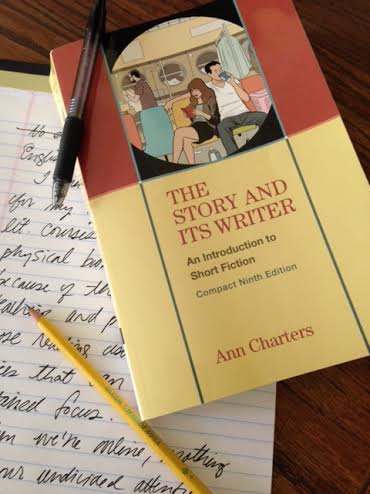
Atwood, Margaret. “Happy Endings.” The Story and Its Writer. Ed. Ann Charters. Compact 9th ed. Boston: Bedford/St. Martin’s, 2014. 27-29. Print.
Paley, Grace. “A Conversation with My Father.” The Story and Its Writer. Ed. Ann Charters. Compact 9th ed. Boston: Bedford/St. Martin’s, 2014. 756-59. Print.
For more on Atwood‘s and Paley’s fiction, see their Paris Review interviews:
Atwood, Margaret. The Art of Fiction No. 121: Interview with Mary Morris. the parisreview.org, The Paris Review, Winter 1990. n.d. Web. 17 Oct. 2014.
Paley, Grace. The Art of Fiction No. 131: Interview with Jonathan Dee, Barbara Jones, and Larissa MacFarquhar. the parisreview.org. The Paris Review, Fall 1992. n.d. Web. 17 Oct. 2014.
In Carlos Fuentes’ “Pain,” Juan Zamora recounts his country’s tradition of “evangelists,” telling Jim Rowlands, his med-school colleague and lover, how old men with typewriters—or “evangelists,” as they were called—would sit in the doorways of Mexico City, dictating the letters of illiterates who wanted to write to their loved ones:
How do they know the scribes are reliable?
They don’t. They have to have faith.
Carlos Fuentes’ Crystal Frontier (1997) / amazon.com
Confidence, Juan.
Right. (362-63)
That brief exchange between Juan and Jim encapsulates one of the defining characteristics of point of view in Fuentes story, specifically the potentially unreliable narrator. Just as the illiterates cannot know if the old men are typing their stories accurately, we as readers cannot know if Fuentes’ narrator offers a reliable portrayal of Juan Zamora. We have to have what Juan calls faith, or Jim calls confidence.
But what if we have neither?
What if we’re simply left with a heightened awareness of the limitations of a story told by someone other than the person who lived it? With the first sentence of “Pain,” Fuentes calls attention to the narrator: “Juan Zamora asked me to tell this story while he kept his back turned” (354). The narrator reminds us repeatedly that he speaks for a man whose back is turned to us because his story is too painful or shameful to tell himself : “So Juan will not offer you a view of his face” (354); “Juan Zamora has his back to you” (354). Though Fuentes’ approach risks distancing readers from the story, we are drawn in nevertheless because of the truths Fuentes conveys about the inherent difficulty of telling stories that we cannot tell ourselves.
For Juan Zamora, “pain’ is a synonym for “shame”—it’s a “peculiarity of Mexican speech,” the narrator tells us (354)—and one of the sources of his pain or shame is the fictional past that he creates. Rather than telling his American host family the truth, that he was the son of an honorable but penniless administrative lawyer, he claims that he traveled to Cornell to study medicine as the scion of a wealthy Mexican family, owners of lands, haciendas, and oil wells. It pains Juan as well that he denies the hypocrisy of the patriarch of his host family, Tarleton Wingate, a prosperous business man who negotiates contracts between weapons factory owners and the US government, a man who embraces Juan while contributing to the suffering in Latin America that they witness together on the nightly news: “He [Juan] doesn’t understand if they [the Tarletons] are pained when terrible pictures of the war in El Salvador appear” (356).
Though Juan’s love affair with Jim doesn’t pain him—in fact the narrator observes that their first encounter marks the first time he “faces us, he turns to look at us, pulls off his mask” (360)—the reality that the affair will end is part of Juan’s story that he cannot face. Conversations about his past prompt considerations of the future. He and Jim cannot simply live in the present, and Jim’s future will take him to Seattle, where “his marriage [has] been arranged since God knows when, since before he knew Juan” (364).
After their break-up, Juan returns to Mexico where his story resumes four years later. At the encouragement of their daughter, Becky, the Wingates agree to surprise Juan with a visit, but it’s the Wingates who are surprised when the address they are led to is not a hacienda but a modest apartment building. While her parents wait in the taxi, Becky speaks with Juan’s mother (Juan is away at work, at a hospital), imploring her not to tell Juan of the visit that reveals his lie about his past.
The fact that Juan isn’t supposed to know that the Wingates visited his apartment but the narrator does know prompts us to ask, did Juan’s mother break her promise? If not, what explains the narrator’s knowledge of their visit? Is the narrator reliable after all?
The question of the narrator’s reliability echoes the one Jim asks about the “evangelists”: “How do they know the scribes are reliable?” (362). By calling into question the narrator’s reliability and emphasizing his role as mediator, Fuentes seems determined to distance us from Juan’s story. But while Fuentes’ approach underscores the story’s artifice, it also conveys the cathartic power of storytelling, enabling Juan to turn “his face toward us” (367). Whether the narrator accurately recounts the events of Juan’s life, he conveys the enduring truth of the difficulty of telling stories too painful to tell.
Work Cited
Fuentes, Carlos. “Pain.” The Story and Its Writer. Ed. Ann Charters. Compact 9th ed. Boston: Bedford/St. Martin’s, 354-67. Print.
For more on Fuentes’ fiction, see his Paris Review interview: Fuentes, Carlos. The Art of Fiction No. 68: Interview with Alfred MacAdam and Charles E. Ruas. the parisreview.org, The Paris Review, Winter 1981. n.d. Web. 23 Sept. 2014.
I considered e-book options for my upcoming introductory lit. classes, but I chose a physical book instead, primarily because of the difficulty of teaching and practicing close reading using digital devices that can impede sustained focus.
When we’re online, nothing has our undivided attention, not for long.
The textbook for ENG 231 with a draft of this blog post
Browsing on our smart phones and tablets doesn’t engage our minds the way that close critical reading does. Recent research bears this out: Studies conducted by neuroscientists in collaboration with Michigan State literature professor Natalie Phillips reveal that “close reading activated unexpected areas: parts of the brain that are involved in movement and touch. It was as though readers were physically placing themselves within the story as they analyzed it” (ctd. Thompson and Vendatam).
Similarly, studies of note-taking by researchers at Princeton and UCLA demonstrate that students who wrote their notes longhand rather than typing them “had a stronger conceptual understanding and were more successful in applying and integrating the material than those who took notes with their laptops” (ctd. in May).
Despite the cognitive benefits of reading offline and putting pen to paper, using those older technologies in the classroom may seem like a step backward. So as the semester approaches, I find myself grappling with how to convey to students the value of putting away their phones. To begin with, I’ll talk about the research I’ve mentioned here.
Thompson, Helen and Shankar Vendatam. “A Lively Mind: Your Brain on Jane Austen.” Narr. Shankar Vendantam. Morning Edition. Nat’l Public Radio, 9 Oct. 2012. NPR.org. Web. 8 Aug. 2014.
How do actors learn their lines? It’s not the same act of memorizing that we perform as students when we commit to memory the steps of photosynthesis for a biology midterm. Actors learn lines to repeat them over and over in performance after performance, and yet must do so as if they have never spoken them before, to create “the illusion of the first time” (Stanislavsky qtd. in Strasberg 35). Earlier this semester, I managed to learn lines for a play and repeat them in six performances, but I still don’t know how I did it. In fact, it was only after the play closed that I could bring myself to count the words. I was curious to know how many I’d memorized, but if I had counted them before I’d learned them, the process of memorizing would have been too daunting. And counting them during the run of the play could have undermined my performance; dwelling on how many words I was keeping in my head might have made me more prone to forget.
So how did I learn those 1,567 words and remember them?
My fascination with learning lines—and admittedly, my anxiety about the possibility of forgetting—led me to research the process. I found that teachers of acting tend to downplay memorizing lines. In fact, the most influential acting teachers of the twentieth century spoke rarely on the subject in their lectures. Though it’s essential to the craft—actors can’t read from their scripts or call “line, please” in performance, after all—it isn’t a focus of instruction. Still, it’s a process worthy of our attention because of what it may reveal about memory and how line-learning may benefit our cognitive health.
Acting teacher Stella Adler instructed her students (among them, Marlon Brando and Robert DeNiro) not to memorize their lines, but instead to build a relationship with the words. In her first lecture to her students in The Art of Acting (“First Steps on Stage”), she tells them to read The Prophet by Kahlil Gibran, and select one idea from it to paraphrase and perform on stage (25). Later, when she returns to that exercise in her fourteenth lecture (“Understanding the Text”), she refers to the process as something “we must do with every text” (162). According to Adler:
Paraphrasing allows the ideas to become part of you. By putting the text into your own words you build a relationship. It becomes part of your heart as well as your head, which is essential before you can communicate the words to an audience. If the ideas are clear to you, they will be clear to them. (162)
Notably, the texts that Adler asked her students to paraphrase aren’t scenes. Kahlil Gibran’s The Prophet isn’t a play but a collection of prose-poem essays. By choosing lines that her students would never perform in a play, Adler emphasized to them the importance of understanding the words on the page rather than the act of rote memorization.
Like Adler, Lee Strasberg instructed his students (including James Dean, Marilyn Monroe, and Paul Newman) to study texts that they wouldn’t perform. But rather than assigning them the prose-poems of The Prophet, as Adler did, Strasberg required his students to read short stories, among them Ernest Hemingway’s “Hills Like White Elephants.” Strasberg chose short stories over scenes because the conversations are often more realistic than the dialogue of plays, which, as Strasberg remarked, include “elements that characters would never say but convey necessary information to the audience” (161). Strasberg also found short stories useful teaching tools because “the short-story material forces the actor to really find out what he is talking about, not just what he is saying, and to find out how that relates to what the scene is all about” (161).
The same emphasis Adler and Strasberg placed on understanding rather than memorizing is apparent in the teaching of their contemporary Sanford Meisner (whose students include Robert Duvall, Diane Keaton, and Sydney Pollack). In the documentary Sanford Meisner: The American Theater’s Best Kept Secret, Pollack discusses how Meisner downplayed the role of dialogue:
What Sandy did is begin to examine the fact that dialogue is the last thing that happens, at any time, between two people. It’s all supported by behavior and attitudes. You say something. You mean a certain thing to me when I see you because of whatever relationship we may have. You say something. I hear it. Depending on the state I’m in when I came into the room, it means something to me. It produces a reaction in me emotionally, and the last thing that happens is that I respond with dialogue.
Similar to Meisner’s notion of dialogue as the “last thing that happens [. . .] between to people,” is the belief of Uta Hagen’s (teacher of Jack Lemmon and Al Pacino) that learning lines is a “by-product of the work” (117). Instead of coaching her students to focus on memorization, she instructed them to make every element of the play real to them, “every person, thing, event, and landscape, even the weather” (117). Hagen asserted that creating those particulars will lead the actor to the lines:
As you make your particularizations, much of what you have to say will become inevitable, and, when followed up in rehearsals by the discovery of your verbal intents and expectations, the words will be further validated until ‘learning the lines’ has become a by-product of the work, replacing the outmoded method of mechanical memorization. (117)
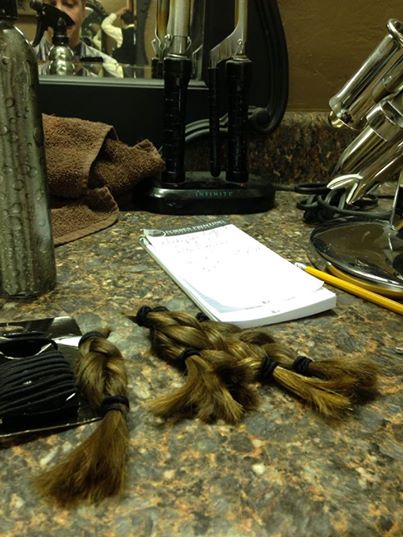
February 20, 2014: seven-eighths of my hair gone for “Third”
I didn’t know that I was following Hagen’s instruction when I asked a hair stylist to cut off seven-eighths of my hair or when I asked a seamstress if she could help me solve a head-scarf problem. My instinct simply told me that I needed to make my character, Nancy Gordon, as real as possible. That meant figuring out how to keep scarves on my head in the fall and winter of Act One, when she’s hiding her hair loss from chemotherapy, and cutting my hair for her appearance in the spring of Act Two, when her hair has started to grow back.
In the first weeks of rehearsal, I simply tied my Act-One scarves over my hair, which I was then wearing in a ponytail (I hadn’t cut it yet), and they repeatedly came undone and fell off on stage. Can you sew these so they appear to be simply tied? I asked a seamstress. They keep falling off on stage, and I need to make sure that doesn’t happen. More importantly, I realized that I needed not to worry about the scarves. Doing so would take me out of the scene. On stage, I had to be Nancy, not myself, wondering if my scarf was about to slip and fall.
The seamstress said yes. She could sew the scarves’ knots for me. But if I do it now, she added, the scarves will be too loose after you cut your hair. So I went back to see her after I cut my hair. I tied on each scarf as tightly as possible, and she sewed the knots. Wearing them with their knots sewn and with double-sided tape securing them at my temples solved the problem.
That head-scarf problem and the seamstress’ solution are details I offer not as digression but as an example of the “particularizations” that Hagen instructs her students to make. With a scarf secured tightly—fused to my head, it seemed—I was Nancy Gordon in a way that I hadn’t been before. She was more real. But I still don’t understand how a particular such as a scarf or a haircut makes “much of what you have to say [. . .] inevitable” (Hagen 117). Still, I know that it was part of the process that transformed me into the character who spoke the words I spoke.
But why should anyone who isn’t an actor care about this? you may ask. Simply put, the answer is cognitive health. Though we aren’t all actors, we all experience diminished memory as we grow older, and cognitive research that explores the memorization process specific to acting indicates that it may improve our memory and other cognitive functions. The research team of Helga and Tony Noice—she a cognitive psychologist and he a director and actor—have studied acting and its cognitive effects for more than twenty years. In “What Studies of Actors and Acting Can Tell Us about Memory and Cognitive Functioning,” the Noices address the process of learning lines—specifically memorizing large amounts of dialogue in a short period of time—and how actors reproduce those lines verbatim with spontaneity. Applying that process to other activities, including learning techniques for undergraduates and memory improvement in older adults, they conclude that the essence of acting—what the Noices term active experiencing or AE—may enhance memory (17).
The Noices’ recent studies of older adults who took part in four-week acting classes found marked improvements not only in memory but also “comprehension, creativity and other cognitive skills”:
Subjects showed a 19 percent increase in immediate word recall (a test of memory), a 37 percent increase in delayed story recall (a comprehension test) and a 12 percent increase in word fluency (a measure of creativity). (Noice and Noice ctd. in Hanc)
So should we enroll in acting classes to improve our cognitive skills? The Noices findings certainly make a case for it, especially when you consider that the acting classroom may be one of the last places where students are required to commit words to memory. In the information age, it’s far more important to develop our critical thinking skills. We don’t need to memorize what’s available at our fingertips, but we need to be able to distinguish the credible information from the dreck. And if the act of memorizing really does improve our cognitive health, perhaps we should look to the stage as a place to do it. I hope to return there, myself. But if I do, don’t ask me how many lines I have to learn. I won’t count them until the play closes.
Works Cited
Adler, Stella. The Art of Acting. Ed. Howard Kissel. New York: Applause, 2000. Print.
Hagen, Uta. A Challenge for the Actor. New York: Scribner’s, 1991. Print.
Noice, Helga, and Tony Noice. “What Studies of Actors and Acting Can Tell Us about Memory and Cognitive Functioning.” Current Directions in Psychological Science 15.1 (2006):14-18. Academic Search Complete. Web. 10 Apr. 2014.
My last blog post, Friday, March 21, featured a sample paper draft that I composed as a model for my students. The draft included lines for a script selected from an academic essay on Sherman Alexie’s short story collection The Lone Ranger and Tonto Fistfight in Heaven and its film adaptation Smoke Signals.
As a model for their collaborative revisions, I revised my script to include lines from an interview with Alexie and lines spoken by his characters Victor Arnold and Thomas Builds-the Fire. And to tie the parts together, I added myself as a moderator. Similarly—but collaboratively, in groups of four and five—my students will fashion their individual drafts into one-act plays, placing their sources in conversation.
The setting for my sample revision, which follows, is the Coeur d’Alene Reservation in Idaho, where Thomas Builds-the-Fire, Victor Joseph, Gordon E. Slethaug, and I sit atop the KREZ weather van.
From “This is What it Means . . .” to Smoke Signals, or Sherman Alexie’s Road Trip from Page to Screen: A One-Act Source Play
Character Guide
Sherman Alexie: A poet and fiction writer who grew up on the Spokane Indian Reservation in Northeastern Washington State. His books include the short story collection The Lone Ranger and Tonto Fistfight in Heaven (1993), which he adapted for the screen. Smoke Signals, the film adaptation, received both the Audience Award and the Filmmakers Trophy at the Sundance Film Festival in 1998. More recently, his semi-autobiographical novel The Absolutely True Diary of a Part-time Indian (2007) received the National Book Award for Young Adult Literature.
Thomas Builds-the-Fire: One of the characters in The Lone Ranger and Tonto Fistfight in Heaven and Smoke Signals
Victor Joseph: The central character in The Lone Ranger and Tonto Fistfight in Heaven and Smoke Signals.
Jane Lucas: An Adjunct Assistant Professor at Lenoir-Rhyne University, who along with her students is studying Sherman Alexie’s short story “This is What it Means to Say Phoenix, Arizona” (from The Lone Ranger and Tonto Fistfight in Heaven) and Smoke Signals in conjunction with Alexie’s appearance as part of the University’s Visiting Writers Series.
Gordon E. Slethaug: An American-Canadian Professor of English at the University of Southern Denmark and author of Teaching Abroad: International Education and the Cross-cultural Classroom (2007), Beautiful Chaos: Chaos Theory and Metachaotics in Recent American Fiction (2000), and The Play of the Double in Postmodern American Fiction (1993). He also co-authored Understanding John Barth (1990) with Stan Fogel.
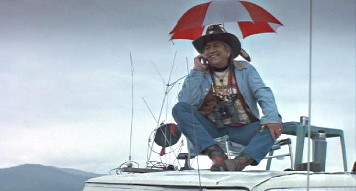
Lester Fallsapart (Leonard George) delivers the KREZ weather report in “Smoke Signals” / ejumpcut.org
At the Coeur d’AleneIndian Reservation in Idaho, Thomas Builds-the-Fire, Victor Joseph, Jane Lucas, and Gordon E. Slethaug sit atop the KREZ weather van, which has been stationed at the crossroads since it broke down there in 1972. Oddly, tribal meteorologist Lester Fallsapart is nowhere in sight. Jane Lucas picks up his red- and white-striped umbrella and looks it over a moment before she speaks.
Jane Lucas: First, I’d like to thank Randy Peone, the voice of Coeur d’Alene’s KREZ, for letting me meet with you atop the weather van. I was hoping Lester Fallsaparts would be here—isn’t he always here, like the weather?—and Sherman Alexie should be here, too. Alexie’s running late, it seems, but we should get started. As someone who’s studying “This is What it Means to Say Phoenix, Arizona” and Smoke Signals, I’m interested in the differences between the two. Gordon, you’ve written of the “different perception” (131) of the film.
Gordon E. Slethaug: Yes, it “presents a different perception from the short story collection [. . .] the short fiction gives a comprehensive representation of the entire Spokane reservation community and includes a typically Alexie critical and cynical view of the systemic problems of unemployment, poverty, hunger, inadequate housing, violence, drugs, alcoholism, and premature death in a culture removed from its traditional moorings” (131).
JL: Aren’t many of those problems that you mentioned apparent in the film as well?
GS: Yes, but “the film presents a warm-hearted, compassionate view of Victor and Thomas through the medium of the road narrative and engages the audience on the level of humor and sentiment even while it gently critiques white society and racist treatments of Native Americans” (131).
JL: It’s an engaging road-trip story, alright, but I’m not so sure about what you call the gentle critique. Some of the characters’ exchanges on screen are less gentle than their counterparts on the page. For example, Victor, there’s what you say on the bus to Cathy, the gymnast, who was an alternate for the 1980 US Olympic Team.
Victor Joseph: Yeah, I was just thinking about that. In the short story, our conversation with Cathy ends with that line of yours, Thomas. What is it you say?
Thomas Builds-the-Fire: (Opening his eyes) “Sounds like you all got a lot in common with Indians” (67).
VJ: Yeah, but in the movie, I keep talking. I say, “you said you were an alternate for the team, right?” And she answers, “yeah.” And I say, “well, if you were an alternate you’d only compete if someone on the team was hurt or something, right? And she answers, “yeah.” And I ask, “was anybody hurt?” And she says, “no.” And I say, “Then you weren’t really on the team, were you? I mean, it didn’t matter if there was a boycott or not. You were staying home anyways. You got nothing to complain about, so why don’t you just be quiet?”
JL: That isn’t what I’d call gentle.
(Sherman Alexie climbs the ladder attached to the back of the van.)
Sherman Alexie: Sorry I’m late—flight delay from Seattle. So it goes.
JL: Sherman, you said in an interview that you “didn’t have any problems with mutating [your] own book” (qtd. in West and West).
SA: (Nodding in agreement) “Right from the get-go, I said, ‘OK, Sherman you’re going to do composite characters, compress time, take bits and pieces from stories you need for this screenplay, and you’re not going to care.’ The narrative integrity of any one story was never the point, it was all about taking situations from the twenty-two short stories—it actually ended up being adapted from four short stories—taking the best you can find in this book to make it a screenplay” (qtd. in West and West).
JL: So the changes you made were your answer to the question, how can this story work best on the screen?
SA: Yes, “I’ve always separated them [books and movies] as two very distinct art forms” (qtd. in West and West).
JL: I wish we had more time, Sherman, but I know you’re heading to Albuquerque for a reading at the University of New Mexico, and I need to get back to Lenoir-Rhyne. I’ll leave a tape of our conversation for Randy Peone. Whether it airs on KREZ or not, I have a feeling that our words here today will become one of those stories told by you-know-who.
TB: Sometimes it’s a good day to die, and sometimes it’s a good day to write a one-act play.
Works Cited
Alexie, Sherman. “This is What it Means to Say Phoenix, Arizona.” The Lone Ranger and Tonto Fistfight in Heaven. 1993. New York: HarperPerrenial, 1994. 59-75. Print.
Slethaug, Gordon E. “Hurricanes and Fires: Chaotics in Sherman Alexie’s Smoke Signals and The Lone Ranger and Tonto Fistfight in Heaven.” Literature and Film Quarterly 31.2 (2003): 130-40. Academic Search Complete. Web. 17 Mar. 2014.
Smoke Signals. Dir. Chris Eyre. Perf. Adam Beach and Evan Adams. Miramax, 1998. DVD.
West, Dennis, and Joan M. West. “Sending Cinematic Smoke Signals: An Interview with Sherman Alexie.” Cineaste 23.4 (1998). Academic Search Complete. Web. 19 Mar. 2014.
Since writing academic papers requires placing sources in conversation, why not begin the writing process with an actual conversation on the page in the form of a play? That’s the idea behind the assignment developed by some of my former colleagues at VCU and one that I adapted for my own UNIV 111 classes.
The Lone Ranger and Tonto Fistfight in Heaven (1993)
Rather than requiring each student to produce a play individually, I altered the project to focus on collaboration, assigning students the responsibility of producing individual preliminary drafts consisting of one character’s lines (quotations and/or paraphrases from one source), which they collaboratively place in conversation with their group members’ characters in a one-act play that they perform in class. The final product consists of quotations and paraphrases from three-to-five sources, a character guide with a biographical note on each source’s author, and a works cited list. I encourage (but don’t require) students to include a description of the setting and stage directions as well.
It’s an assignment that many of my former students at VCU viewed in hindsight as a particularly helpful exercise in synthesizing a variety of materials (articles, essays, books, etc.). Though it involves more compiling than composing—at least in the initial stages—it’s a critical step in the process of writing an academic essay.
Returning to this assignment with my ENG 131 students at Lenoir-Rhyne, I composed the following sample as a model for their preliminary drafts. I chose as my subject Sherman Alexie’s short story “This is What it Means to Say Phoenix, Arizona” and its film adaptation Smoke Signals—adapted for the screen by Alexie, himself—because my students are studying the story and the film in conjunction with Alexie’s appearance on campus March 27 as part of the Lenoir-Rhyne Visiting Writers Series.
Working Title: From “This is What it Means . . .” to Smoke Signals, or Sherman Alexie’s Road Trip from the Page to the Screen
Character Guide
Gordon E. Slethaug: An American-Canadian Professor of English at the University of Southern Denmark and author of Teaching Abroad: International Education and the Cross-cultural Classroom (2007), Beautiful Chaos: Chaos Theory and Metachaotics in Recent American Fiction (2000), and The Play of the Double in Postmodern American Fiction (1993). He also co-authored Understanding John Barth (1990) with Stan Fogel.
Slethaug’s lines for the play follow.
Gordon E. Slethaug: “Although there has been some interest in depicting a more historically authentic view of Native Americans than that presented in the typical post-World War II Western, the reality of their lives and perspectives still seems sadly underrepresented and diminished in mainstream Hollywood film” (131).
GS: “Smoke Signals provides an important step in remedying this problem [of stereotypes]. It’s “based upon the first third of his collection of short stories, The Lone Ranger and Tonto Fistfight in Heaven” (131).
Smoke Signals (1998)
GS: “The film, however, presents a different perception from the short story collection [. . .] the short fiction gives a comprehensive representation of the entire Spokane reservation community and includes a typically Alexie critical and cynical view of the systemic problems of unemployment, poverty, hunger, inadequate housing, violence, drugs, alcoholism, and premature death in a culture removed from its traditional moorings; the film presents a warm-hearted, compassionate view of Victor and Thomas through the medium of the road narrative and engages the audience on the level of humor and sentiment even while it gently critiques white society and racist treatments of Native Americans” (131).
Works Cited
Slethaug, Gordon E. “Hurricanes and Fires: Chaotics in Sherman Alexie’s Smoke Signals and The Lone Ranger and Tonto Fistfight in Heaven.” Literature and Film Quarterly 31.2 (2003): 130-40. Academic Search Complete. Web. 17 Mar. 2014.
To develop this individual draft into a one-act play, I will place Slethaug in conversation with Alexie, using these sources:
Alexie, Sherman. “This is What it Means to Say Phoenix, Arizona.” The Lone Ranger and Tonto Fistfight in Heaven. 1993. New York: HarperPerrenial, 1994. 59-75. Print.
Smoke Signals. Dir. Chris Eyre. Perf. Adam Beach and Evan Adams. Miramax, 1998. DVD.
West, Dennis, and Joan M. West. “Sending Cinematic Smoke Signals: An Interview with Sherman Alexie.” Cineaste 23.4 (1998). Academic Search Complete. Web. 19 Mar. 2014.








 Jane Lucas