Posted in Reading, Teaching, Writing

Flying Without a Map

Movies and the Meaning of Life (2005), which includes the essay “Flying Without a Map: Chasing Amy and the Quest for Satisfying Relationships”

I don’t want my students to feel as if they’re flying without a map.

So, as a model for them—many of whom are currently writing annotated bibliographies–I spent the better part of the morning composing the sample annotation that follows. The process awakened in me an interest in writing about Chasing Amy and Jerry L. Walls’ study of the film. Perhaps that’s a project for the summer.

Walls, Jerry L. “Flying Without a Map: Chasing Amy and the Quest for Satisfying Relationships.” Movies and the Meaning of Life. Ed. Kimberly A. Blessing and Paul J. Tudico. Chicago: Open Court, 2005. 137-149.

“Flying without a Map: Chasing Amy and the Quest for Satisfying Relationships” considers Kevin Smith’s film Chasing Amy (1997) as a reflection of our moral ambiguity. In the words of the essay’s author, Jerry L. Walls, Chasing Amy offers “a vivid picture of what happens to us emotionally, morally, and relationally when we try to revise morality in some fairly radical ways, while still holding onto selected parts of our traditional morality” (140).

In his analysis of the film’s principle characters, Walls cites Edward O. Wilson’s article “The Biological Basis of Morality,” highlighting the two options Wilson identifies as the ones that determine and divide our worldviews: (1) that moral and ethical principles “exist outside of the human mind,” or (2) “they are inventions of human minds” (141). Subsequently, Walls’ examination of Holden McNeil (Ben Affleck), who holds the former view, and Alyssa Jones (Joey Lauren Adams), who holds the latter view, illustrates how Alyssa challenges Holden to rethink his beliefs. While Holden tells Alyssa that he likes girls “Because that is the standard,” he cannot explain to her why he believes what he believes or why he should believe it.

Walls chronicles Holden’s and Alyssa’s moral evolution, noting the irony of Holden’s 180-degree shift, marked by the solution he proposes to Alyssa and Banky (Jason Lee), and concludes his essay by suggesting that Chasing Amy depicts “an even larger quest,” one for God (149).

Though I agree with Walls’ central thesis (that the film offers “a vivid picture of what happens to us emotionally, morally, and relationally when we try to revise morality. .  .”), I disagree with his conclusion, which rests on the questionable assumption that religion offers a map that other foundations for ethics and morals cannot. It comes as no surprise that Walls as a professor of the philosophy of religion turns to faith in the final pages of his essay. But by choosing that path, he overlooks how the film’s characters—all comic-book artists—turn to art as a way of making sense of their lives.

Posted in Reading, Teaching

Groundhog Day and Nietzsche

Movies and the Meaning of Life (2005), which includes the essay “What Nietzsche Could Teach You: Eternal Return in Groundhog Day.”

For Monday my Focused Inquiry students will read “What Nietzsche Could Teach You,” which considers the film Groundhog Day (1993) as an illustration of eternal return. It’s an essay I’ve never taught before. I decided to teach it this semester as a way of responding to a suggestion some students offered last spring on their anonymous questionnaires—specifically that we discuss more of the big questions that we ponder throughout our lives.

So, for our first post-Groundhog Day class, we’ll view scenes from the film and consider the evolution of Phil Connors (Bill Murray), from unhappy weatherman living for the future to renascence man happily embracing the present.

According to James H. Spence, author of “What Nietzsche Could Teach You,” Phil Connors’ change signifies his rejection of the Christian view of linear time in which the future gives value to the present. Nietzsche’s alternative, his eternal return, posits that “[r]ather than moving on to a better (or worse, if we are bad) place after this life, we would relive our life over and over again, exactly as we had before” (274).

Today as I meditate on Spence’s essay and on the film, I’m aware of how rarely I live in the moment, and I’m reminded of a line that friend and teacher Doug Jones often says: We teach what we need to learn. We do, Doug. We really do.

Spence, James H. “What Nietzche Could Teach You: Eternal Return in Ground Hog Day.” Movies and the Meaning of Life. Ed. Kimberly A. Blessing and Paul J. Tudico. Chicago: Open Court, 2005. 274.

Posted in Reading, Social Media, Teaching, Writing

Storytelling and Simulated Worlds

Sunday’s New York Times Magazine featured an essay on narration that a friend mentioned on Facebook. I didn’t see her comment initially because I don’t frequent Facebook. My husband posts there several times a day though, so he passed the news along to me. Now that I’ve read the essay, I’m ready to enter the conversation–but not on Facebook, where it seems too late. My friend’s request–“I’d love to hear more thoughts on this”–now lies buried beneath four days of links and “likes” and photos.

The essay “Once Upon a Time, There was a Person Who Said, ‘Once Upon a Time‘” reminds me of Ray Bradbury’s story “‘The Veldt” (1950), which my students and I read and studied this week. The  story’s crystal-walled virtual-reality nursery leads the Hadley children away from creativity toward passivity. When the son, Peter, admonishes his father for removing the picture painter from the nursery, George Hadley replies: ‘. . . I wanted you to learn to   paint all by yourself, son” (76).

“I don’t want to do anything but look and listen and smell,” Peter replies. “What else is there to do?” (76).

Ray Bradbury’s short story collection The Illustrated Man (1950), which includes “The Veldt.”

In “Once Upon a Time. . . ,” writer Steven Almond addresses how visual media (Bradbury’s crystal-walled virtual-reality) has changed how we conceive of storytelling. “Traditionally,” Almond writes, “stories represented an active collaboration. Listeners and readers were called upon to create the world described by the artist. Film advanced a new model of collaboration. An array of artists (screenwriters, actors, cinematographers, set designers, etc.) worked together to invent an ultra-vivid artificial world. The audience’s role became increasingly passive–to absorb and react, not to imagine. Television shrunk the wonders of film and delivered them directly to our living rooms.”

The absence of narration in “the shrunken wonders of film”–now shrunken to fit our iPhone 5 screens–isn’t simply the loss of a literary device. It’s the atrophy of an essential skill: one that enables us to make sense of the world. It’s no surprise that Almond’s creative writing students produce short stories that lack coherence. Or that many of the freshman in my classes struggle to produce essays of more than 1,500 words. If I write any more, I’ll be repeating myself, they often say, not because they can’t write more, but because they can’t imagine writing more. To do so would require the sustained attention and reflection that our digital culture leaves behind.

Posting to Facebook about the decline of narration isn’t the equivalent of driving and texting about the dangers of driving and texting. But it does underscore a consistent contradiction in our lives. As a writer and a teacher, I attempt to reconcile that incongruity with blog posts–writing that my students and I can draft and revise before our words enter the sphere Almond describes as “the simulated world through which most of us flit from one context to the next, from Facebook post to Tumblr feed to YouTube clip, from ego moment to snarky rant to carnal wormhole.”

Posted in Reading, Teaching

Front Porch Reading at Topsail Island, Volume II

Topsail Island (2011)

The two books that I need to read before the beginning of the semester didn’t go into the suitcase.  I almost packed them, but then I stopped myself. It was our vacation, after all. So I chose, instead, a couple from the stack on the nightstand: The Best American Non-Required Reading 2011—more on that beach-appropriate reading in another blog entry to come—and  Tina Fey’s Bossypants.

Bossypants (2011)

Even though I read Bossypants purely for pleasure, I found myself making notes on a passage that I’ll refer to when I teach oral communication in my Focused Inquiry classes this fall. In a section of the book titled “The Rules of Improvisation that will Change Your Life and Reduce Belly Fat,*” Tina Fey discusses the importance of speaking in statements “instead of apologetic questions”:

No one wants to go to a doctor who says, ‘I’m going to be your surgeon? I’m here to talk to you about your procedure? I was first in my class at Johns Hopkins, so?’ Make statements with your actions and your voice (85).

That’s valuable advice for all of us who strive to improve our public speaking, and Fey’s laugh-out-loud example teaches us more succinctly and effectively than volumes of oral communication theory.

Posted in Reading, Writing

VCU’s Southern Film Festival: Screening Southern Rebellion

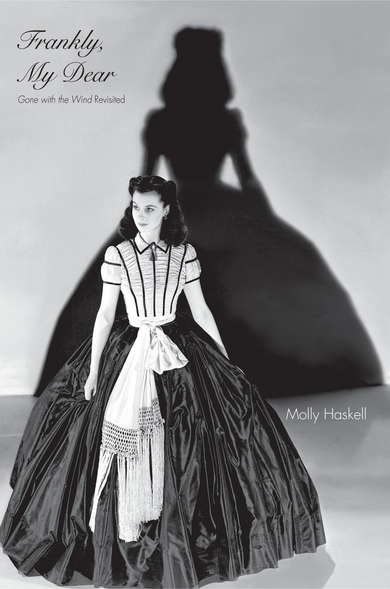
Frankly, My Dear (2009)

Molly Haskell grew up here in Richmond, and it’s here that she fell in love with movies. One of her most vivid childhood memories finds her standing before a magazine rack in the Broad Street station waiting for the train to Florida, and persuading her father to buy her a magazine devoted to the child star Margaret O’Brien.* The pleasure Molly Haskell took in reading that movie magazine is one she would later pass on to the readers of her own film reviews and books.” Those are some of the words that I spoke about Haskell Friday night when I introduced her as keynote speaker at the third annual VCU Southern Film Festival at the Virginia Museum of Fine Arts.

In her keynote address, Haskell discussed her most recent book, Frankly My Dear: Gone With the Wind Revisited (2009), which expolores Gone With the Wind as the product of three strong personalities: author Margaret Mitchell, film producer David O. Selznick, and actress Vivien Leigh. Published on the seventieth anniversary of the film’s release, Haskell’s book looks back more than eighty years to Mitchell’s drafting of the novel in the 1920s, while also considering the book and film in multiple cultural contexts and reflecting on its enduring presence in our collective memory and imagination.

Margaret Mitchell’s Gone With the Wind (2011)

Haskell‘s speech led into the screening of the recent documentaryMargaret Mitchell: American Rebel (2011), which features Haskell as well as John Wiley, Jr., who co-authored–along with Ellen F. BrownMargaret Mitchell’s Gone With the Wind: A Bestseller’s Odyssey from Atlanta to Hollywood (2011). Both Wiley, of Midlothian, and Brown, of Richmond, were in the audience Friday night as well, and after the film they joined Haskell on stage for a panel discussion moderated by me.

At the outset of the panel, I noted that the publication of Brown and Wiley‘s book marked an important contribution to Mitchell scholarship as well as studies of book publishing and copyright. Though I was prepared to offer more talking points  about their work and Haskell‘s, I didn’t need to. Their own observations about Mitchell, her novel, and the film prompted a nearly hour-long conversation with the audience, cut short only by the announcement that the museum would close at 9 p.m.

When one man sitting near the front of the auditorium expressed his ambivalence about calling himself a fan, I was reminded of the “Seven Stages of Gone With the Wind” that Haskell outlines in Frankly My Dear:

“For those of us who fell under its spell, the range of emotions attached to the film fluctuate over time with the predictable volatility of a love affair and its aftermath, in my own case what we might clinically designate as the Seven Stages of Gone With the Wind: Love, Identification, Dependency, Resentment, Embarrassment, Indifference, and then something like Half-Love again, a more grown-up affection informed by a film-lover’s appreciation of the small miracle by which a mere ‘woman’s film’ with a heroine who never quite outgrows adolescence was tansfigured into something much larger, something profoundly American, a canvas that contains, if not Walt Whitman’s multitudes, at least multiple perspectives” (xiii).

Along with those words of Haskell‘s about the Seven Stages of Gone With the Wind, I would’ve liked to address how fans of the novel and the film have formed online communities, particularly on Facebook. That’s something that Ellen Brown mentioned back stage when the four of us–Brown, Wiley, Haskell, and I–were clipping on our wireless microphones.

In their introduction to Margaret Mitchell’s Gone With the Wind, Brown and Wiley write: “We do not claim to have rewritten Gone With the Wind, but we have refocused the lens” (3). Similarly, Haskell‘s Frankly My Dear refocuses the lens, and the insights of the three authors inspired Friday’s night’s audience to see the book and film anew.

*The childhood memory of Haskell‘s that I mentioned in my introduction is one that she recounts in From Reverence to Rape: The Treatment of Women in the Movies (1974, Second Edition 1987).

Posted in Reading, Theatre, Writing

“One’s Whole Being Becomes Absorbed”

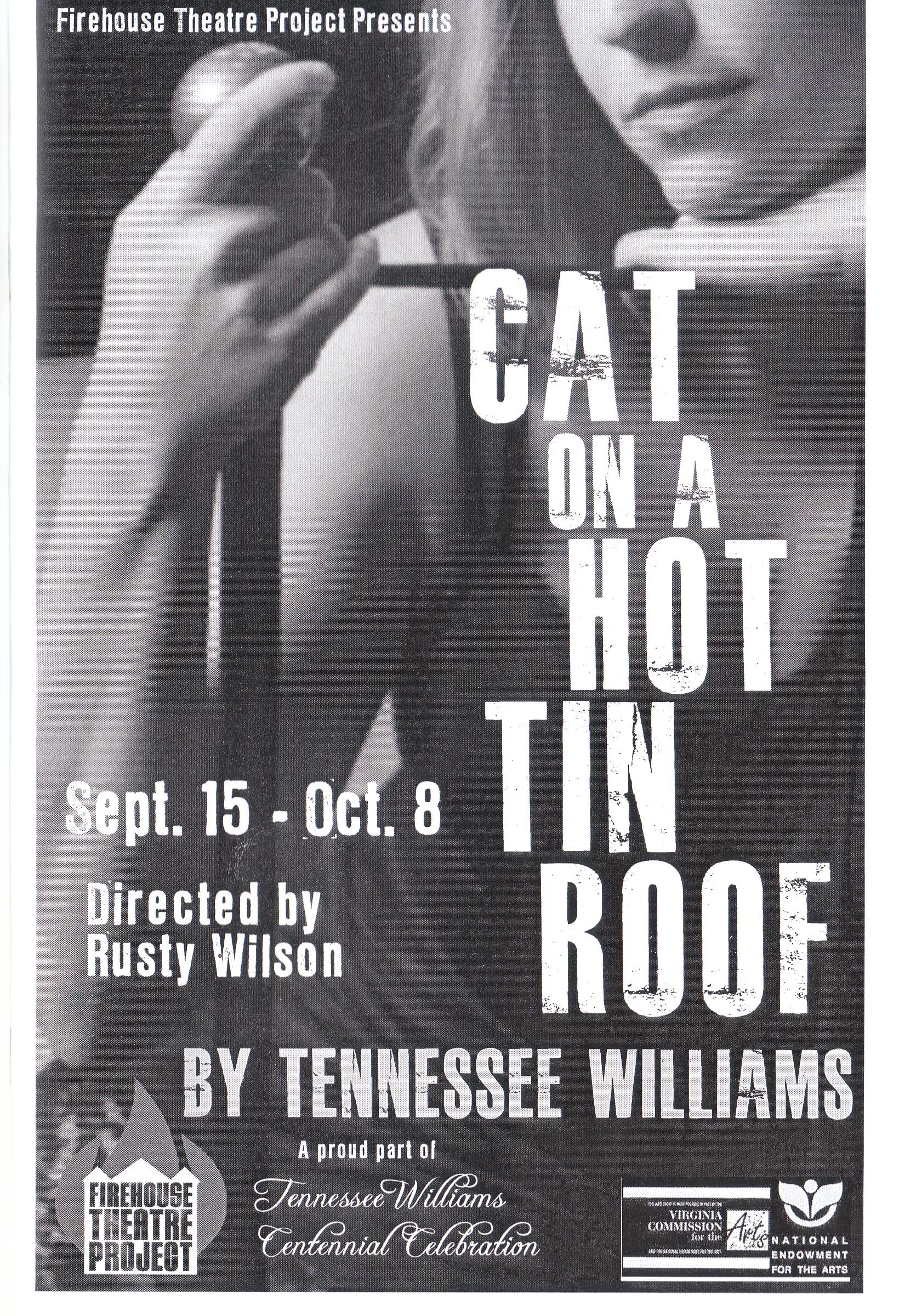
FTP’s Cat on a Hot Tin Roof, September 15 – October 8, 2011

The Firehouse Theatre’s September 19 staged reading of The Night of the Iguana and its current production of Cat on a Hot Tin Roof–both part of Richmond’s Centennial Celebration of Tennessee Williams–sent me back to the pages of Williams’ plays, which I’ve been rereading in the Library of America edition: Plays 1937-1955.

Williams’ Plays 1937 -1955 (2000)

I keep thinking of these words of Big Mama’s: “Time goes by so fast. Nothin’ can outrun it. Death commences too early–almost before you’re half-acquainted with life–you meet the other. . . .” In a recent Fresh Air interview, actress Margo Martindale told Terry Gross how saying those lines as a student differed from saying them decades later:

“I played Big Mama in Cat on a Hot Tin Roof when I was 20 years old at the University of Michigan. And then I played Big Mama on Broadway in 2004. The speech at the end of that play — ‘Time goes by so quickly …’ — boy did that have different weight from when I was 20 years old to when I was 50-something-odd years old. It’s all about what you’ve experienced. You can’t teach that to a younger actor. You have to have lived that.” In the current Firehouse production,
Jacqueline Jones
speaks Big Mama’s lines from experience as well, delivering one of the cast’s strongest performances.

In his introduction to Camino Real, Williams writes of the all-consuming nature of play writing: “It is amazing and frightening how completely one’s whole being becomes absorbed in the making of a play. It is almost as if you were frantically constructing another world while the world that you live in dissolves beneath your feet, and that your survival depends on completing this construction at least one second before the old habitation collapses.”

Today when I was completing an application for a grant, I thought of how it would enable my whole being to become absorbed–at least briefly–in the writing process in a way that it can’t when I’m teaching. Grants buy us time, which “goes by so fast. Nothin’ can outrun it.”

Posted in Reading, Social Media, Teaching, Theatre, Writing

On Readers’ Theatre, Blackboard, and Turning Away from the Screen

I planned to devote this blog entry—my first in two weeks—to the Virginia Blackboard User’s Group Conference, which I attended on Friday. But what lingers in my mind today isn’t the conference, it’s the personal narratives that my students presented in class after their draft workshop on Thursday.

To shift students’ focus away from “correcting” their classmates’ writing, I decided to devote the second half of class to Readers’ Theater. After students read and commented on their group members’ drafts, each group chose an essay to perform for the class, assigned parts, and assembled impromptu costumes and props.

To honor the students’ privacy, I won’t reveal any details about their personal narratives; I will simply say that their work left a lasting
impression on me. As readers they offered descriptive rather prescriptive comments, and as performers they gave their stories a life in the classroom that was separate and distinct from the words on the page.

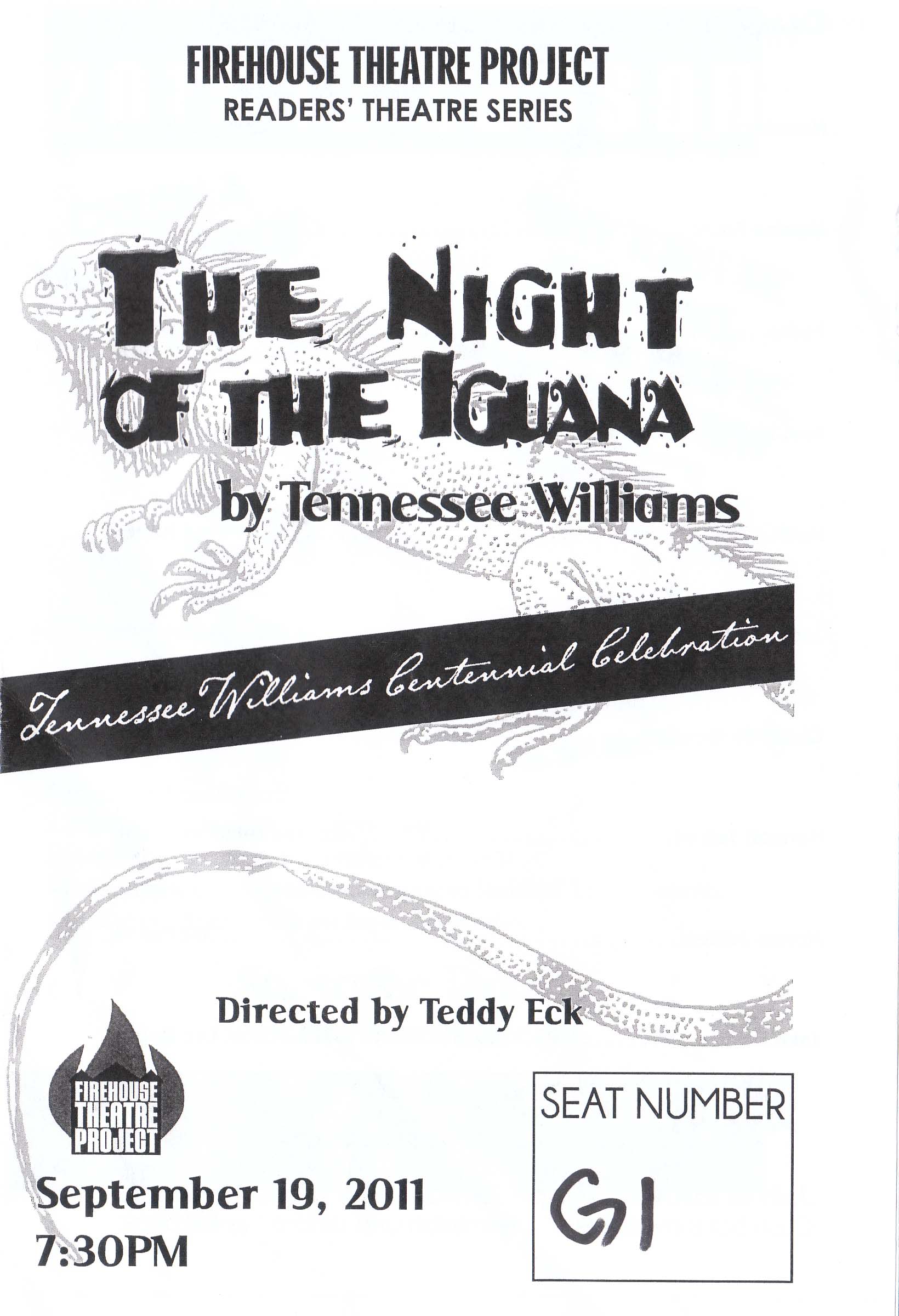
FTP’s The Night of the Iguana

The idea of combining a draft workshop with Readers’ Theater stems from my renewed interest in drama and my recent experiences at  Readers’ Theater performances staged at the Firehouse, including the September 19 reading of The Night of the Iguana, part of Richmond’s Centennial Celebration of Tennessee Williams.

The power of live theater and its influence on my teaching also speaks to my experience at yesterday’s Blackboard conference. Though I use Blackboard on a daily basis—and it’s usually projected on the screen in the classroom at least once during each of my Tuesday-Thursday classes—for me it’s simply a tool: a content management system for content that’s always changing.

During yesterday’s conference sessions, many in the audience divided their attention between the large screens at the front of the room and the small screens in their hands and their laps. In the 1:15 session, I overheard a man say his iPad was attached to his thigh.

More and more I see the need for opportunities to turn away from the screen and to face each other.  Though I don’t agree with many of David Mamet’s sentiments—in particular some of his pronouncements in his latest book, The Secret Knowledge: On the Dismantling of American Culture (2011)—I do concur with his notion that people go to the theater to see that real communication between human beings is still possible.  I know for me it’s true. My own return to the theater is in part a response to our increasingly digital lives.

Posted in Reading, Writing

The Writing Show’s Voldemort Panel

James River Writers’ Writing Show

At Thursday night’s Writing Show–Tall, Dark, and Creepy?: Writing a Believable Villain, author John Milliken Thompson thanked James River Writers for scheduling the event between natural disasters. Despite the pre-Irene showers, a crowd of about seventy-five gathered in the pavillion of the Richmond Childrens’ Museum to hear Thompson, author of The Reservoir,  Katherine Neville, author of The Eight, and Alma Katsu, author of The Taker, discuss villains–both their own and others.

The show’s host, writer Meriah Crawford, an Assistant Professor in VCU’s University College as well as a private investigator, referred to the authors assembled on stage as the “Voldemort Panel.” Along with Voldemort, the panelists discussed Hannibal Lechter, another villain known to more movie-goers than readers. Neville observed that what drives The Silence of the Lambs isn’t the search for Buffalo Bill but the character of Hannibal Lechter. Thompson noted his affinity for villains like Wickham of Jane Austen’s Pride and Prejudice, a character who isn’t evil incarnate but who is deeply flawed. Katsu bemoaned the tendency for some writers to provide motivation for every villian’s actions: It’s a zombie, come on, she said.

Though villains dominated the conversation, the panelists and the host also addressed the importance of the writing habit, of returning to the desk every day. That’s a challenge for all three panelists, who are currently promoting new books. In the words of Thompson, promoting a book is like a wedding ceremony: You want to share your love of the writing with everyone, but then you’re ready to go back to the part that you do in private.

Posted in Reading, Teaching

Discussing VCU’s Summer Reading

The Other Wes Moore (2010)

This morning I met with twenty-five first-year students to discuss  The Other Wes Moore, VCU’s 2011 Summer Reading Program selection, as part of Welcome Week. Though classes don’t begin until tomorrow, the students I met with today–and the other members of the freshman class who met with other faculty, administrators, and staff during  Welcome Week discussions–engaged in an academic conversation similar to the ones that they will  encounter in their Focused Inquiry classes.

I was impressed by the number of students who were willing to express their ideas both in small-group and large-group discussion. (Our one-hour session included both.) I attribute the high level of participation in part to the nature of the  Welcome Week Summer Reading sessions, giving students the opportunity to engage in an academic discussion that isn’t led by someone who will evaluate their performance and record it in a grade book. Instead, the sessions offer an introduction to and preparation for the academic conversations that they will encounter later  in the classroom.

Several of the students I met with today mentioned the lines that were repeatedly addressed in the session for discussion leaders that I attended on August 15: “The chilling truth is that his story could have been mine. The tragedy is that my story could have been his ” (xi).

Those lines from Moore’s introduction also appear on the jacket–part of the book that’s the work of the publisher, not the writer. Wes Moore mentioned that fact when he spoke with the Focused Inquiry Faculty yesterday in a meeting interrupted by the earthquake. After we evacuated the Hibbs building, Moore generously continued to speak with the faculty while we stood on Shafer Court, awaiting news. In his discussion–both both pre and post-earthquake–Moore focused not on the lines that lend themselves to book-jacket blurbs, but on the crucial roles of  the people in his life–relatives, role models, and mentors–who, in his words, “kept pushing me to see more than what was directly in front of me, to see the boundless possibilities of the wider world and the unexplored possibilities within myself” (179).

The earthquake prevented Wes Moore from addressing the freshmen at convocation yesterday, but his words have spoken to many of the students I met with today. And their willingness to consider differing opinions about his book shows that they, too, are willing to see beyond their own experiences to the wider world.

Posted in Reading, Writing

River City Reads: “Ashes to Water”

Ashes to Water (2010)

Last night at the office of Richmond’s Frontier Project, on the corner of East Franklin and 20th Street, writer and actress Irene Ziegler  met with readers to discuss her mystery novel Ashes to Water:  the July-August selection for Richmond’s city-wide book club co-sponsored by Chop Suey Books and River City Reads. Rather than reading a long passage from her work–as many authors do–Ziegler alternated short excerpts from Ashes to Water and Rules of the Lake, its prequel, with reflections on writing and anecdotes from her life growing up in Pre-Disney, Florida.

As an author who is also an actress, Ziegler possesses an awareness of audience that many writers lack. When an author reads an entire chapter, even the best listeners are likely to lose their way. One image captures our interest, we linger with it, and never catch up to the narrative that’s unfolding. Ziegler encouraged the audience to write about what scares us and recounted how Francine Prose offered the same advice to playwright David Lindsay-Abaire. Following her advice,  he wrote Rabbit Hole, which received the Pulitzer Prize for drama in 2007.

Read more about Ashes to Water in the blog post for August 9 and on Irene Ziegler’s website.