Posted in Reading, Social Media, Teaching, Writing

Storytelling and Simulated Worlds

Sunday’s New York Times Magazine featured an essay on narration that a friend mentioned on Facebook. I didn’t see her comment initially because I don’t frequent Facebook. My husband posts there several times a day though, so he passed the news along to me. Now that I’ve read the essay, I’m ready to enter the conversation–but not on Facebook, where it seems too late. My friend’s request–“I’d love to hear more thoughts on this”–now lies buried beneath four days of links and “likes” and photos.

The essay “Once Upon a Time, There was a Person Who Said, ‘Once Upon a Time‘” reminds me of Ray Bradbury’s story “‘The Veldt” (1950), which my students and I read and studied this week. The  story’s crystal-walled virtual-reality nursery leads the Hadley children away from creativity toward passivity. When the son, Peter, admonishes his father for removing the picture painter from the nursery, George Hadley replies: ‘. . . I wanted you to learn to   paint all by yourself, son” (76).

“I don’t want to do anything but look and listen and smell,” Peter replies. “What else is there to do?” (76).

Ray Bradbury’s short story collection The Illustrated Man (1950), which includes “The Veldt.”

In “Once Upon a Time. . . ,” writer Steven Almond addresses how visual media (Bradbury’s crystal-walled virtual-reality) has changed how we conceive of storytelling. “Traditionally,” Almond writes, “stories represented an active collaboration. Listeners and readers were called upon to create the world described by the artist. Film advanced a new model of collaboration. An array of artists (screenwriters, actors, cinematographers, set designers, etc.) worked together to invent an ultra-vivid artificial world. The audience’s role became increasingly passive–to absorb and react, not to imagine. Television shrunk the wonders of film and delivered them directly to our living rooms.”

The absence of narration in “the shrunken wonders of film”–now shrunken to fit our iPhone 5 screens–isn’t simply the loss of a literary device. It’s the atrophy of an essential skill: one that enables us to make sense of the world. It’s no surprise that Almond’s creative writing students produce short stories that lack coherence. Or that many of the freshman in my classes struggle to produce essays of more than 1,500 words. If I write any more, I’ll be repeating myself, they often say, not because they can’t write more, but because they can’t imagine writing more. To do so would require the sustained attention and reflection that our digital culture leaves behind.

Posting to Facebook about the decline of narration isn’t the equivalent of driving and texting about the dangers of driving and texting. But it does underscore a consistent contradiction in our lives. As a writer and a teacher, I attempt to reconcile that incongruity with blog posts–writing that my students and I can draft and revise before our words enter the sphere Almond describes as “the simulated world through which most of us flit from one context to the next, from Facebook post to Tumblr feed to YouTube clip, from ego moment to snarky rant to carnal wormhole.”

Posted in Social Media, Teaching, Writing

Social Media in the Classroom, Tommy’s Blog

For the past several years, I’ve explored various ways of incorporating social media into my UNIV 112, Focused Inquiry II classes, offering students the option of maintaining blogs and creating a Facebook page for the course, which students weren’t required to “like,” but were encouraged to post to as an alternative to blogging. I was still uncertain of how I would introduce social media next semester, when one of my former students, Tommy McPhail, sent me an email message, which I include below with his permission.

29 November 2012

Prof. Lucas,

I recently underwent a Cultural Discovery Project for my EDUS 476 class (the introductory course to being an RA at VCU). Afterwards, I wrote a blog post comprising my thoughts, and the response was incendiary. Within 24 hours, my post went viral received thousands of hits. To date, the post has received over 40,000 hits on Tumblr alone, and was one of the top posts on Reddit, in addition to being signal-boosted by various Facebook networks, Philadelphia Slutwalk, and my favorite author. I’ve received a plethora of encouragement, criticism, heartfelt praise, objection, and even a marriage proposal from a blogger in New Zealand. The very idea that my writing could reach so many people worldwide, let alone evoke such a response, has been both overwhelming and inspiring. It was only fitting that I forward this along to you. I would not have been able to accomplish something like this without you and your class. It really inspired me, particularly the social media components, to start using my blog for social advocacy purposes. Thank you so much for all that you do. I hope you enjoy the piece.

My essay and the accompanying appendix are attached for your convenience. Here is a link to my original post:

Tommy’s blog post on his Cultural Discovery Project and the overwhelming response it received attest to the value of social media as platforms on which students’ work in the classroom–in Tommy’s case, EDUS 476–can have a life outside of the classroom with an audience of thousands of readers. At last count, Tommy’s Tumblr post had prompted 46,935 notes.

Now I know how I’ll introduce social media next semester: I’ll begin with Tommy’s blog.

Posted in Reading, Social Media, Teaching, Theatre, Writing

On Readers’ Theatre, Blackboard, and Turning Away from the Screen

I planned to devote this blog entry—my first in two weeks—to the Virginia Blackboard User’s Group Conference, which I attended on Friday. But what lingers in my mind today isn’t the conference, it’s the personal narratives that my students presented in class after their draft workshop on Thursday.

To shift students’ focus away from “correcting” their classmates’ writing, I decided to devote the second half of class to Readers’ Theater. After students read and commented on their group members’ drafts, each group chose an essay to perform for the class, assigned parts, and assembled impromptu costumes and props.

To honor the students’ privacy, I won’t reveal any details about their personal narratives; I will simply say that their work left a lasting
impression on me. As readers they offered descriptive rather prescriptive comments, and as performers they gave their stories a life in the classroom that was separate and distinct from the words on the page.

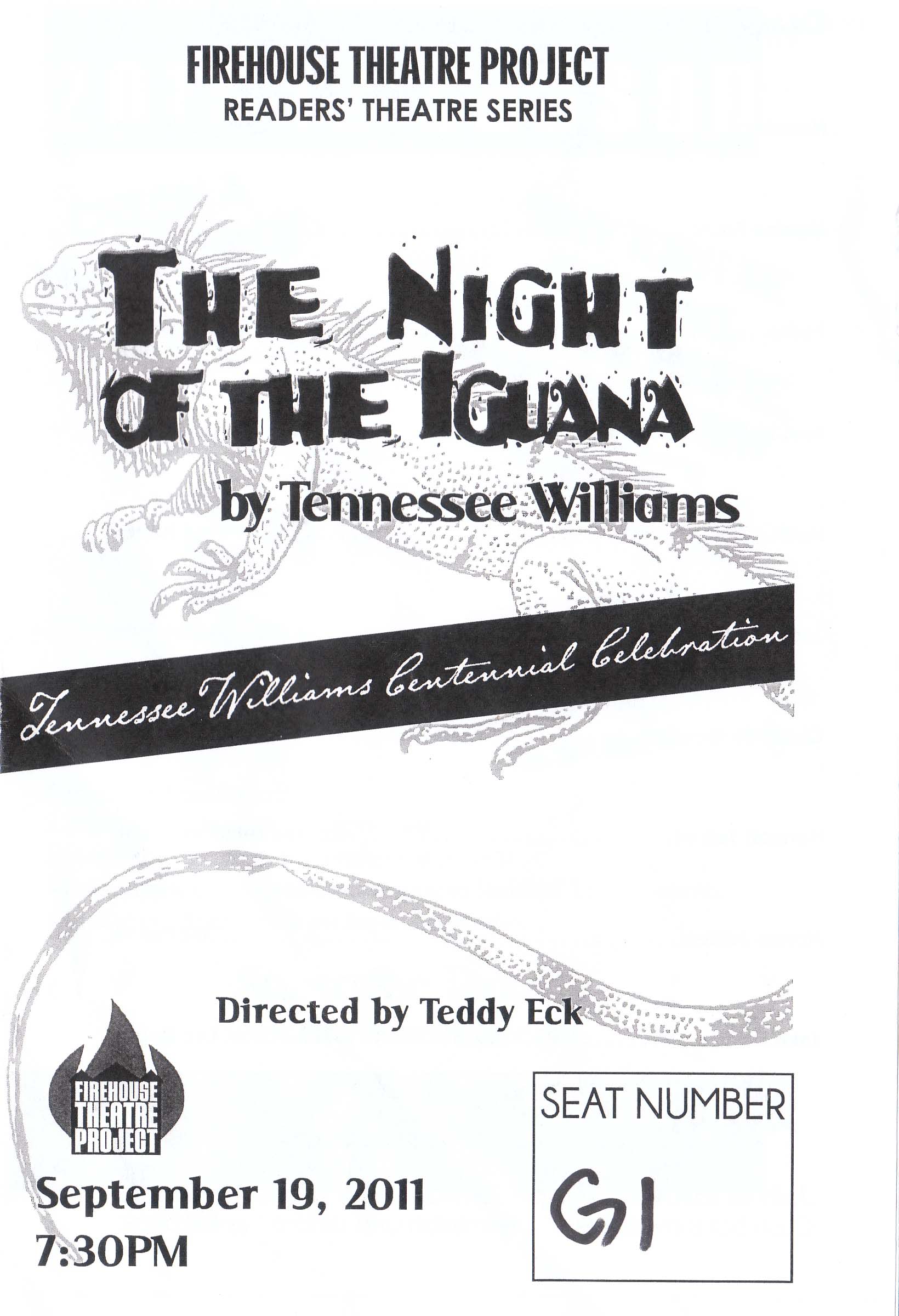
FTP’s The Night of the Iguana

The idea of combining a draft workshop with Readers’ Theater stems from my renewed interest in drama and my recent experiences at  Readers’ Theater performances staged at the Firehouse, including the September 19 reading of The Night of the Iguana, part of Richmond’s Centennial Celebration of Tennessee Williams.

The power of live theater and its influence on my teaching also speaks to my experience at yesterday’s Blackboard conference. Though I use Blackboard on a daily basis—and it’s usually projected on the screen in the classroom at least once during each of my Tuesday-Thursday classes—for me it’s simply a tool: a content management system for content that’s always changing.

During yesterday’s conference sessions, many in the audience divided their attention between the large screens at the front of the room and the small screens in their hands and their laps. In the 1:15 session, I overheard a man say his iPad was attached to his thigh.

More and more I see the need for opportunities to turn away from the screen and to face each other.  Though I don’t agree with many of David Mamet’s sentiments—in particular some of his pronouncements in his latest book, The Secret Knowledge: On the Dismantling of American Culture (2011)—I do concur with his notion that people go to the theater to see that real communication between human beings is still possible.  I know for me it’s true. My own return to the theater is in part a response to our increasingly digital lives.

Posted in Social Media, Theatre

An Online Dating Musical

FTP’s Hearts on Line, August 14 and 15, 2011.

If you saw Hearts on Line last Sunday or Monday, you were face to face with characters pursuing relationships that began without face-to-face contact. I’ve been thinking about that since I saw Monday night’s performance, which I almost didn’t see.  I was one of the last people ushered to the section of folding chairs set up for the overflow crowd.

Live theater has far less cultural impact than the Internet now, yet  the staged reading of Hearts on Line played to sold-out crowds on both nights of its run at the Firehouse, August 14-15.

Playwright Rebecca Jones, Marketing Program Coordinator for VCU’s School of Business, depicts online dating with humor and insight, and the successful run of her show at the Firehouse attests to the value of black box theater as a venue for reflecting on our increasingly digital lives–if we’re willing to unplug for an evening.