Today in class you will plan and compose a short midterm reflective essay that documents your work in the first half of the semester, focusing on two or three assignments or aspects of the course that have contributed to your development as a writer and a student. Since you have already written a reflection devoted solely to your literacy narrative, your midterm reflection should focus primarily on other assignments or aspects of the course, including the following:
Keeping a journal
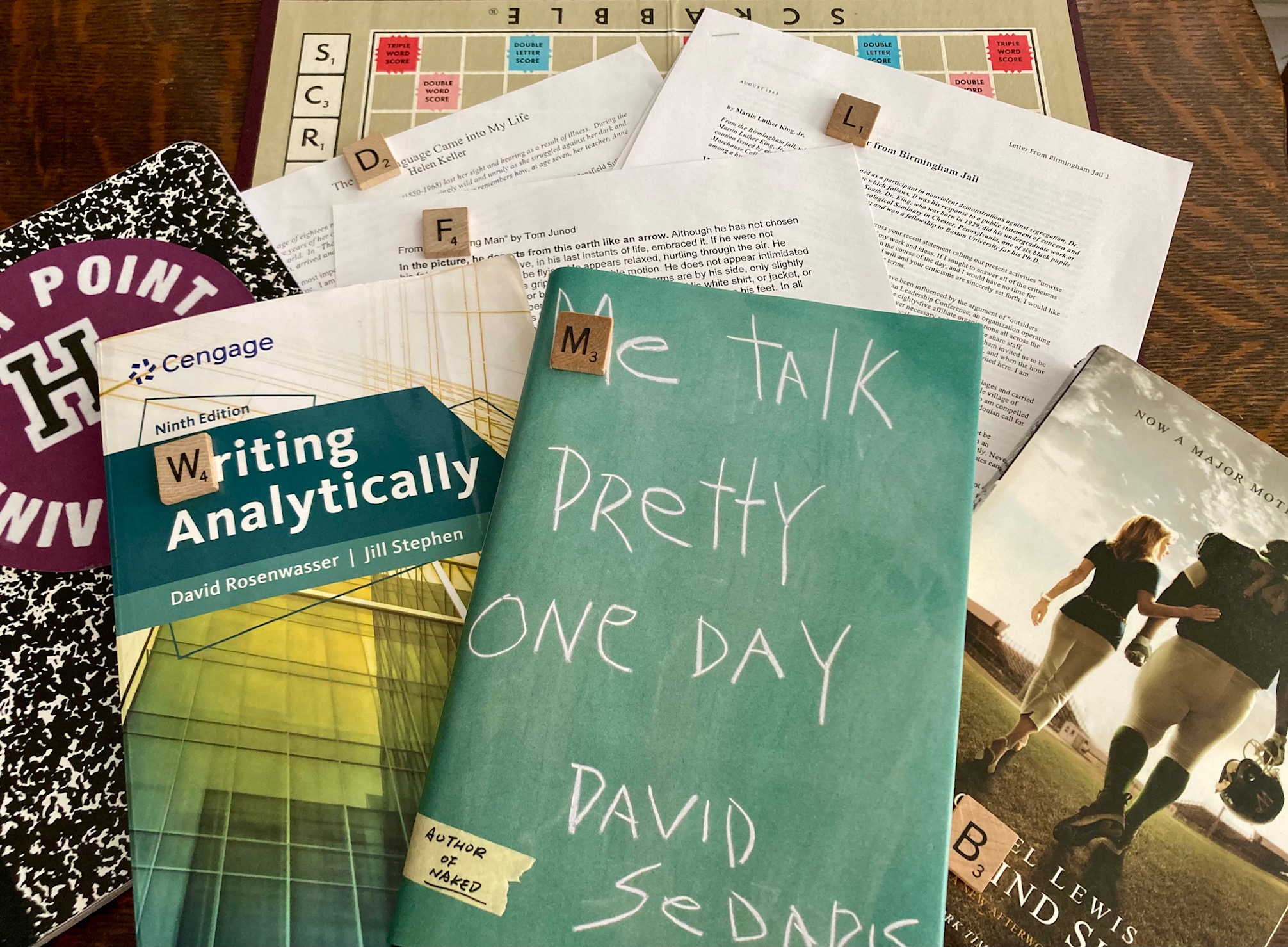
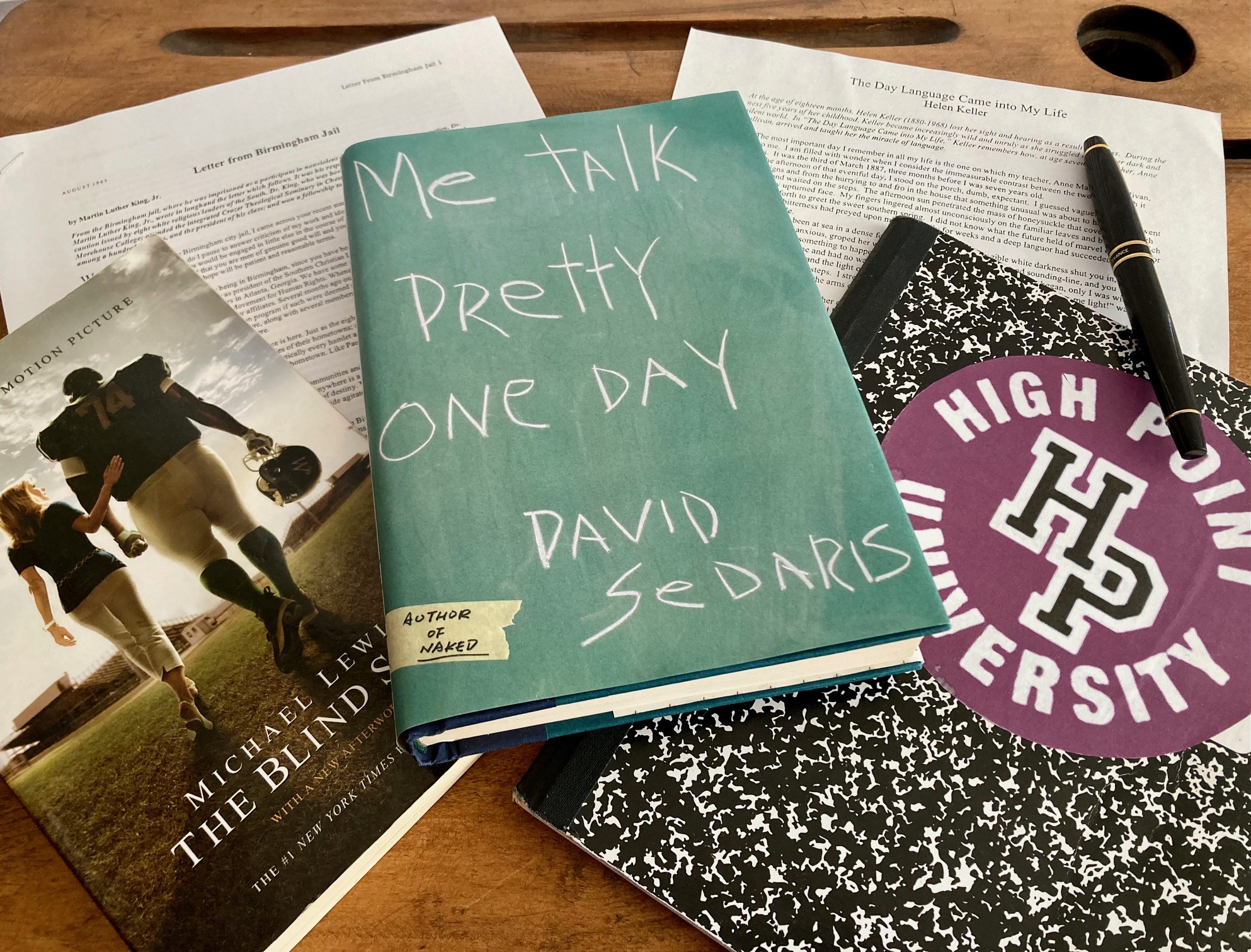
Studying one of the readings examined class, including “Me Talk Pretty One Day,” “The Day that Language Came into My Life,” “Letter from Birmingham Jail,” “Back Story,” or “The Falling Man”
Reading and editing samples of student writing
Writing for an online audience beyond the classroom/creating and maintaining a WordPress blog
Collaborating with your classmates on in-class writing assignments
Playing Scrabble/Collaborating with your teammates on Wordplay Day
Completing Check, Please! assignments
Writing longhand
Limiting screen time
Beginning your analysis
Include in your refelective essay the following elements:
A title that offers a window into your reflection
An opening paragraph that introduces your focus and presents your thesis
Body paragraphs that offer concrete details from your work to support your thesis
One relevant quotation from one of the essays or chapters that you have read or from Writing Analytically—see the accompanying handout for examples
A signal phrase and a parenthetical citation for the quotation
A conclusion that revisits the thesis without restating it verbatim
Rosenwasser, David and Jill Stephen. “Becoming Conversant with a Reading.” Writing Analytically, 9th edition. Wadsworth/Cengage, 2024. p. 46.
Rosenwasser, David and Jill Stephen. “Process and Product.” Writing Analytically, 9th edition. Wadsworth/Cengage, 2024. pp. 141-42.
Rosenwasser, David and Jill Stephen. “The Writer as Both Observer and Observed.” Writing Analytically, 9th edition. Wadsworth/Cengage, 2024. pp. 163.
Sedaris, David. “Me Talk Pretty One Day.” Me Talk Pretty One Day. Little, Brown, 2000. 166-73.
Note that unlike the works cited entries above, the one on your midterm reflection will have a hanging indent, as will all of the works cited entries in the Microsft Word files and PDFs that you post to Blackboard.
The complete midterm reflection assignment, along grade criteria, is included on the assignment handout that you will receive in class.
Next Up
At the beginning of class on Wednesday, I will collect your worksheets for the fourth Check, Please! lesson. Afterward, I will return your handwritten analyses drafts with my notes, and you will have the remainder of the class period to begin revising on your laptops and tablets.
Monday in class you will plan and compose a short midterm reflective essay that documents your work in the first half of the semester, focusing on two or three assignments or aspects of the course that have contributed to your development as a writer and a student. Since you have already written a reflection devoted solely to your literacy narrative, your midterm reflection should focus primarily on other assignments or aspects of the course. One of the requirements of the assignment is incorporating a relevant quotation from one of the essays or chapters you have read or from Writing Analytically. Before Monday’s class, determine what phrase, clause, or sentence you will quote, and draft a sentence in your journal that introduces the quotation with a signal phrase and follows it with a parenthetical citation.
One option for integrating a quotation into your essay is to include a line from one of your readings and explain what that passage has taught you about writing.
Examples
In the opening line of “Back Story,” Michael Lewis demonstrates that repetition can be an asset. With the words “[f]rom the snap of the ball to the snap of the first bone” (15), he repeats “snap” as a frame for the seconds leading up to Jo Theismannn’s career-ending injury. The first “snap,” the hike of the football, begins the sequence. The second “snap,” the fracture of Theismann’s tibia and fibula, ends it.
The opening line of “Back Story,” demonstrates that repetition can be an asset. The two prepositional phrases “[f]rom the snap of the ball to the snap of the first bone” (Lewis 15), repeat “snap” as a frame for the seconds leading up to Jo Theismannn’s career-ending injury. The first “snap,” the exchange of the football, begins the sequence. The second “snap,” the fracture of Theismann’s tibia and fibula, ends it.
The two examples above are very similar. The first one names the author, so only the page number appears in the parenthetical citation. The second does not name the author, so his last name precedes the page number in the parenthetical citation. Note that omitting the author’s name from the passage shifts the emphasis from the writer’s actions (“he repeats ‘snap’”) to the words themselves (“prepositional phrases . . . repeat ‘snap’”).
Another option for integrating a quotation into your essay is to include a line from Writing Analytically that presents a concept that figures in your own reading or writing process.
Examples
When I write a journal entry about an essay or chapter I have read for class, I sense that I have begun what Rosenwasser and Stephen term “a mental dialogue with it” (46).
When I write a journal entry about an essay or chapter I have read for class, I sense that I have begun “a mental dialogue with it” (Rosenwasser and Stephen 46).
A variation on the previous option is integrating a quotation that serves as an epigraph in Writing Analytically. If you quote an epigraph, which is a quote at the beginning of a book or book section, intended to suggest its theme, you are presenting an indirect quotation.
Examples
I realized that I needed to change the subject of my analysis when I began to feel like one of those writers who, in Vivian Gornick’s words, “are pulled around by motives they can neither identify accurately nor struggle to resolve” (qtd. in Rosenwasser and Stephen 163).
I realized that I needed to change the subject of my analysis when I began to feel like one of those writers who “are pulled around by motives they can neither identify accurately nor struggle to resolve” (Gornick qtd. in Rosenwasser and Stephen 163).
The first example names the writer, Vivian Gornick, so the parenthetical citation does not include her name as the author who is quoted. The second example omits her name, so her last name precedes “qtd. in” (quoted in) and the textbook’s authors’ last names.
Works Cited
Lewis, Michael. Chapter One: “Back Story.” The Blind Side. 2006. Norton, 2009. pp. 15-23.
Rosenwasser, David and Jill Stephen. “Becoming Conversant with a Reading.” Writing Analytically, 9th edition. Wadsworth/Cengage, 2024. p. 46.
—. “The Writer as Both Observer and Observed.” Writing Analytically, 9th edition. Wadsworth/Cengage, 2024. pp. 163.
Constant Consonants
Learning nth (an unspecified number) and other all-consonant words enables you to continue a Scrabble game when you’re faced with a rack without vowels.
brr: used to indicate that one is cold
crwth: an ancient stringed instrument (pl. -s)
cwm: a cirque (a deep, steepwalled basin on a mountain, pl. -s, prounounced to rhyme with “boom”)
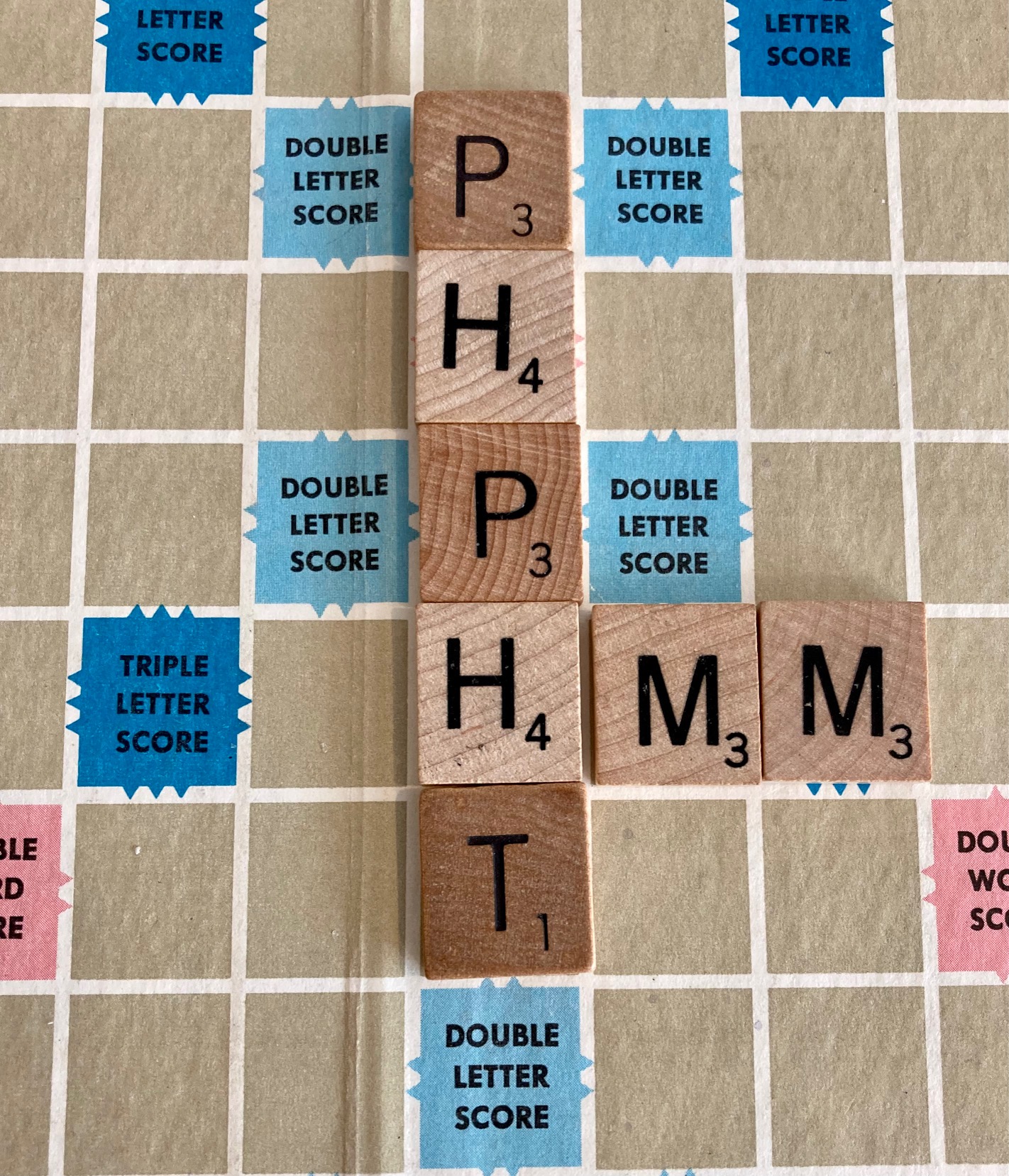
hm: used to express thoughtful consideration (also “hmm“)
mm: used to express assent or satisfaction
nth: describing an unspecified number in a series
phpht: used as an expression of mild anger or annoyance (also “pht“)
psst: used to attract someone’s attention
sh: used to urge silence (also “shh” and “sha“)
tsk: to utter an exclamation of annoyance (-ed, -ing, -s)
tsktsk: to “tsk” (-ed, -ing, -s)
Next Up
Wordplay Day! To prepare for class, revisit the Dictionary and World Builder pages on the Scrabble website. Also review the blog posts devoted to Scrabble tips, including this one.
Coming Soon
In class on Monday, you will write your midterm reflection.
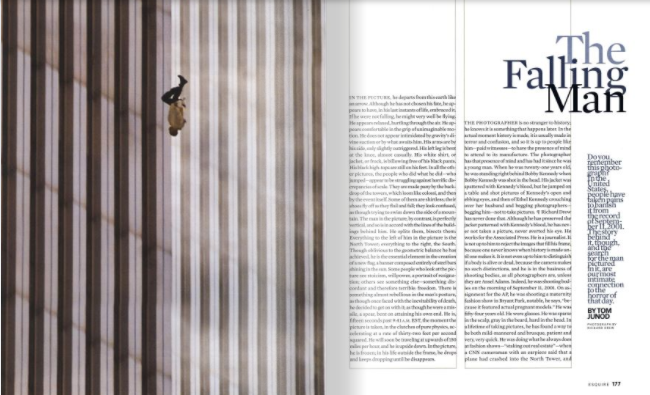
Yesterday in class, before you began planning and drafting your analyses, we examined the beginning of Tom Junod‘s essay “The Falling Man,” published in Esquire magazine two years after 9-11. If you choose that excerpt for the subject of your analysis, one element you might address is the unusually long first paragraph. Consider where Junod might have divided the paragraph and why he may have chosen not to divide it.
Junod might have started a second paragraph with the words “[i]n all the other pictures,” because there he shifts the focus from the Falling Man to the photographs of other people who jumped from the Twin Towers. An opportunity for a third paragraph comes with the words “[t]he man in the picture, by contrast,” where Junod turns his attention back to the Falling Man. And he might have begun a fourth paragraph with “[s]ome people who look at the picture,” because there he shifts to viewers’ perceptions of the Falling Man.
The first paragraph is over four-hundred words long, a length I advise you to avoid in your own paragraphs. Generally, one-hundred to one-hundred-and-fifty words is a suitable length. As a rule, you should begin a new paragraph whenyou present a new idea or point. If you have an extended idea that spans multiple paragraphs, each new point within that idea should have its own paragraph. But the first paragraph of “The Falling Man” is an exception. For Junod, choosing not to divide the first paragraph creates an unbroken movement that parallels the unbroken downward flight of his subject, the Falling Man. Outside of the photograph, “he drops and keeps dropping until he disappears.” With “disappears,” the last word of the paragraph,” the Falling Man disappears from the page, and Tom Junod turns to the photographer, whom we learn later in the essay is Richard Drew.
Unless you subscribe to Esquire, the magazine’s paywall will deny you access to the full text of “The Falling Man”; but if you’re interested in reading it in full, you can access it through the HPU Library site by following these steps:
The second half of this blog post features my version of the third Check, Please! assignment, which you submitted at the beginning of class on Wednesday. In preparation for submitting your worksheet for lesson four, review this post as well as the assignment notes that I posted on January 23.
Sample Assignment
In the third lesson of the Check, Please!, Starter Course, Mike Caulfield, author of the course and a research scientist at the University of Washington’s Center for an Informed Public, continues his instruction on the second step in four-step SIFT approach to determining the reliability of a source. Lesson three, “Further Investigation” covers these topics: (1) Just add Wikipedia for names and organizations, (2) Google Scholar searches for verifying expertise, (3) Google News searches for information about organizations and individuals, (4) the nature of state media and how to identify it, and (5) the difference between bias and agenda.
One of the most instructive parts of lesson three focuses on two news stories about MH17, Malyasia Airlines Flight 17, a passenger flight scheduled to land in Kuala Lumpur that was shot down over eastern Ukraine on July 17, 2014. While the second story, a television news segment, appears to present detailed investigative reporting challenging the conclusion of the Dutch Safety Board and Dutch-led joint investigation team–the conclusion that Russia was to blame–a quick just-add-Wikipedia check reveals that RT (formerly Russia Today) is a Russian state-controlled international TV network, a government propaganda tool rather than a source of fair and balanced news. The first video, the one produced by Business Insider, a financial and business news site, delivers accurate coverage of MH17.
Another notable segment of “Further Investigation” addresses the important distinction between “bias” and “agenda.” There, Caulfield observes that “[p]ersonal bias has real impacts. But bias isn’t agenda, and it’s agenda that should be your primary concern for quick checks,” adding that “[b]ias is about how people see things; agenda is about what a news or research organization is set up to do.”
Wordplay Day! To prepare for class, revisit the Dictionary and World Builder pages on the Scrabble website, and review the blog posts devoted to Scrabble tips.
This morning in class, after I collect your third Check, Please! worksheets, you will begin planning and drafting your analysis. You will receive a hard copy of the assignment in class, and I am including an additional copy below.
Directions for Planning and Drafting
Review the texts that you have read for class, and determine which one appeals to you most as a subject of analysis.
Identify one or more elements that contribute to its effectiveness.
Develop your analysis through a close examination of those elements.
Write in dark ink, preferably black. You are welcome to use both sides of the page.
Before you leave class today, staple this handout on top of your draft and submit it to me. Next week I will return your draft with notes, and you will have the class period to begin revising and editing on your laptop or tablet.
Directions for Revising
The revision of your analysis should include the following:
A title that offers a window into your analysis
An introduction that presents a summary of the essay, essay excerpt, or chapter
A thesis statement, or main claim, that presents your take on the essay, essay excerpt, or chapter based on your close study of it
Textual evidence that supports your claims
A minimum of one relevant quotation from the text, introduced with a signal phrase and followed by a parenthetical citation
A conclusion that revisits the thesis without restating it verbatim
Lewis, Michael. Chapter One: “Back Story.” The Blind Side. 2006. Norton, 2009, pp. 15-23.
Sedaris, David. “Me Talk Pretty One Day.” Me Talk Pretty One Day. Little Brown, 2000. pp. 166-73.
Think of your preliminary draft as your down draft; your aim in the early stage of the process is to get your ideas down on the page. You may need the process of drafting to discover what you think the essay, essay excerpt, or chapter means and how it makes its meaning.
Directions for Formatting and Posting Your Revision—See the Course Calendar for the Due Date and Hard Deadline
Save your revised essay as a Microsoft Word file or PDF and submit it to Blackboard in compliance with MLA manuscript guidelines.
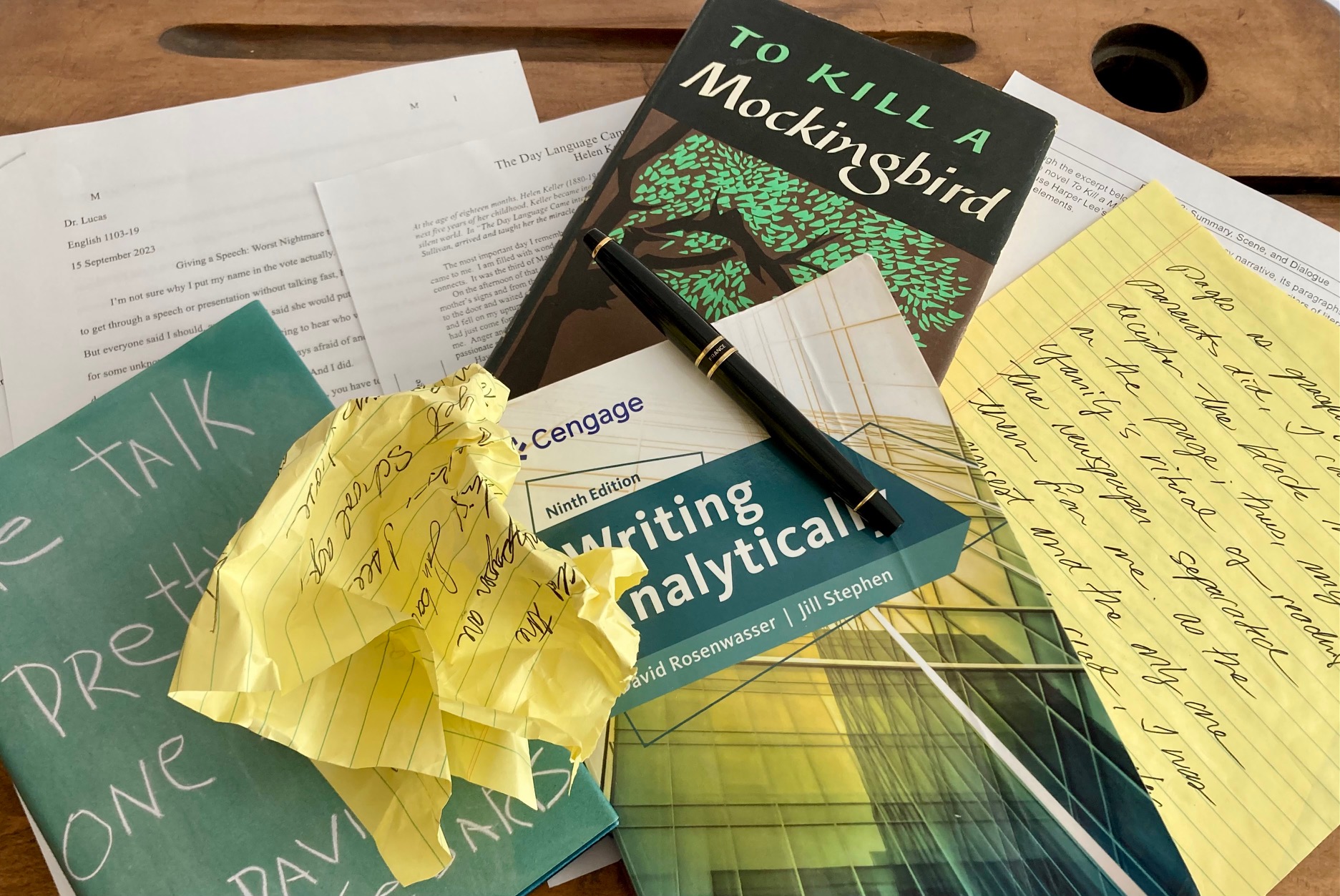
Publish your revision as a blog post. In your post, omit the first-page information included in your file submitted to Blackboard (your name, course, section, instructor’s name, and date). Add to your blog post an image that documents some part of your writing process away from the screen, such as a photo of your reading notes or a page of your draft. Also add to your blog post an embedded link to a relevant website.
Grade Criteria
An A analysis complies with all assignment guidelines, demonstrates a depth of understanding by using relevant and accurate detail, and is also well organized and relatively free of surface errors.
A B analysis complies with all assignment guidelines and presents an adequate analysis but examines little more than what was addressed in class. A B analysis is also well organized and relatively free of surface errors.
A C analysis complies with most but not all assignment guidelines and may also be flawed by issues of organization and/or surface errors, or more consequential factual errors.
A D analysis complies with only a few of the assignment guidelines and may also be flawed by issues of organization and/or surface errors, or more consequential factual errors.
An F analysis fails to comply with most or all assignment guidelines and may also be flawed by substantial issues of organization and/or surface errors, or more consequential factual errors.
MLA Style
Look to my sample assignments on Blackboard as models of MLA style. For more information on MLA style, see the MLA Style Center and OWL sites linked to my blog.
Next Up
Wordplay Day! To prepare for class, revisit the Dictionary and World Builder pages on the Scrabble website, and review the blog posts devoted to Scrabble tips.
Tomorrow in class, you will begin planning and drafting an analysis, your second major writing assignment for the course. Your subject may be any one of the following texts that we have studied.
“Me Talk Pretty One Day” by David Sedaris
“The Day Language Came into My Life” by Helen Keller
“Letter from Birmingham Jail” by Martin Luther King, Jr.
“Back Story” by Michael Lewis
As I noted in yesterday’s post, you should review your assigned readings, and determine which one appeals to you most as a subject for analysis. I asked you to consider this question: Which text are you most interested in examining in closer detail to determine what makes it an effective piece of writing? Your answer to that question is likely the best subject for you. That said, in the process of planning and drafting, your answer may change. Sometimes the writing process involves discovering that a subject you weren’t interested in–or were less interested in than others–deserves a closer look.
Rather than trying to begin the writing process with a thesis (or main claim, or controlling idea), jot down the words, phrases, and sentences from the text that have lingered in your mind the most. Ask yourself these questions:
What do some of these words, phrases, and sentences have in common?
How are they different?
What patterns can you identify among them?
After repeated readings, do any of them seem to take on additional meanings?
Answering those questions will lead you to identify patterns that will give you the framework for your analysis.
Elements to address in your analysis include these:
Scene
Summary
Figurative language
Sensory details
Structure
Theme
To determine one of the themes of your subject, think about the ideas that the writer conveys throughout the text. Humor in the face of adversity and antagonism (“Me Talk Pretty One Day”), language as illumination and liberation (“The Day Language Came into My Life”), social injustice and the urgency of nonviolent protest (“Letter from Birmingham Jail”), fear and the unseen (“Back Story”) are among the themes to consider.
Keep in mind that themes are abstractions that writers convey through concrete details. If you address a theme in your subject, be sure to refer to concrete details that convey that theme.
As you continue to work on your analysis, read these sections of Writing Analytically:
“Focus on Individual Words and Sentences” (49-50)
“Find the Analytical Potential: Locate an Area of Uncertainty” (120-21)
“Six Rules of Thumb for Responding to Assignments more Analytically” (121-23)
Next Up
At the beginning of class on Wednesday, you will submit your third Check, Please! worksheet, and you will have the rest of the class period to begin planning and drafting your analyses.
Today’s class will be devoted primarily to reading and responding to the blog post of one of your classmates’ literacy narratives. Elements you will consider in your response included these:
the title
vivid details
scene and summary (and dialogue, if present)
the conclusion
the image documenting part of the writing process away from the screen
the link to a relevant website
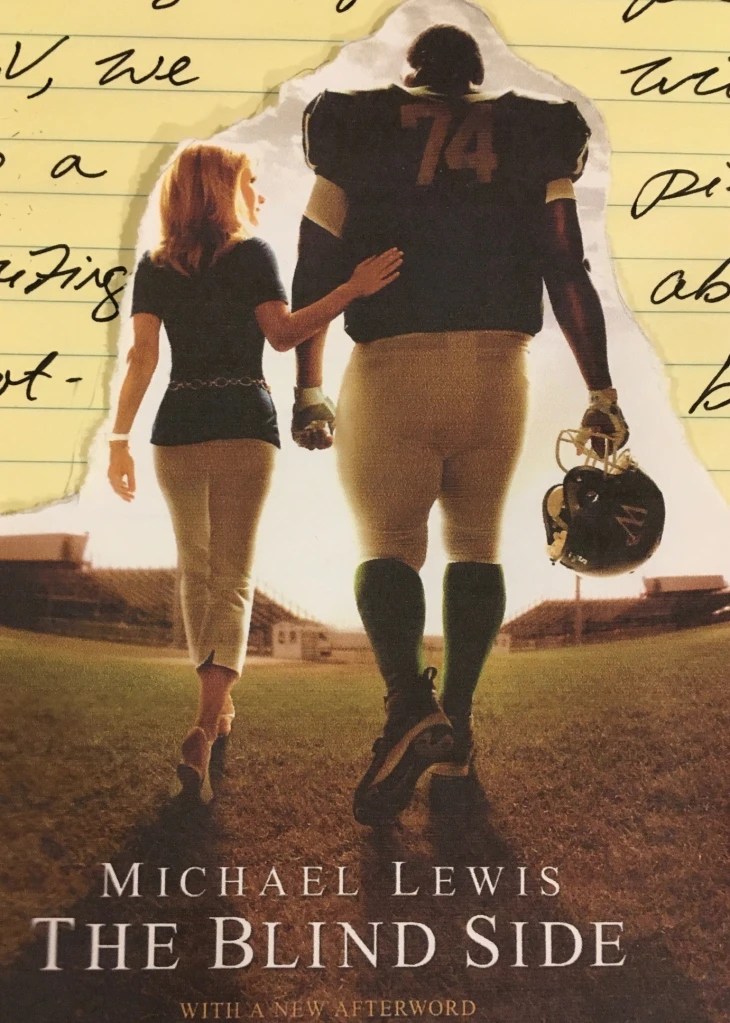
Before you begin that assignment, we will examine the opening pages of “Back Story,” the first chapter of Michael Lewis‘s The Blind Side, which dramatizes the moments in the November 1985 Redskins-Giants football game leading up to the injury that ended quarterback Joe Theismann’s career:
“From the snap of the ball to the snap of the first bone is closer to four seconds than to five. One Mississippi: The quarterback of the Washington Redskins, Joe Theismann, turns and hands the ball to running back John Riggins. He watches Riggins run two steps forward, turn, and flip the ball back to him. It’s what most people know as a ‘flea-flicker,’ but the Redskins call it a ‘throw-back special.’ Two Mississippi: Theismann searches for a receiver but instead sees Harry Carson coming straight at him. It’s a running down—the start of the second quarter, first and 10 at midfield, with the score tied 7–7—and the New York Giants’ linebacker has been so completely suckered by the fake that he’s deep in the Redskins’ backfield. Carson thinks he’s come to tackle Riggins but Riggins is long gone, so Carson just keeps running, toward Theismann. Three Mississippi: Carson now sees that Theismann has the ball. Theismann notices Carson coming straight at him, and so he has time to avoid him. He steps up and to the side and Carson flies right on by and out of the play. The play is now 3.5 seconds old. Until this moment it has been defined by what the quarterback can see. Now it–and he–is at the mercy of what he can’t see” (15).
What Theismann cannot see is Lawrence Taylor. A second later, as Taylor sacks Theismann, Taylor’s knee drives straight into Theismann’s lower right leg, leading to the “snap of the first bone” that Lewis mentions in the first line of the chapter. He hooks the reader by linking the beginning of the play, “the snap of the ball,” to the gruesome “snap of the first bone” that will follow (15). Lewis develops the opening paragraph using the common one-Mississippi, two-Mississippi method of marking seconds to present the events leading up to the compound fracture that ends Theisman’s career.
Lewis doesn’t dramatize the injury itself because his interest lies instead in the blind side that led to it and subsequently elevated the status and salary of the left tackle, the player who protects the quarterback’s blind side.
When you’re struggling to develop a piece of writing, reread the opening paragraph of The Blind Side. Observe how Lewis dramatizes 3.5 seconds–yes, only 3.5 seconds–with about two-hundred words.
Next Up
In class on Wednesday, after you submit your worksheets for the third lesson of Check, Please!, you will begin planning and drafting your analysis, your second major writing assignment for the course. To prepare for Wednesday’s class, review your assigned readings, and determine which one appeals to you most as a subject for analysis. Which text are you most interested in examining in closer detail to determine what makes it an effective piece of writing? Your answer to that question is likely the best subject for you.
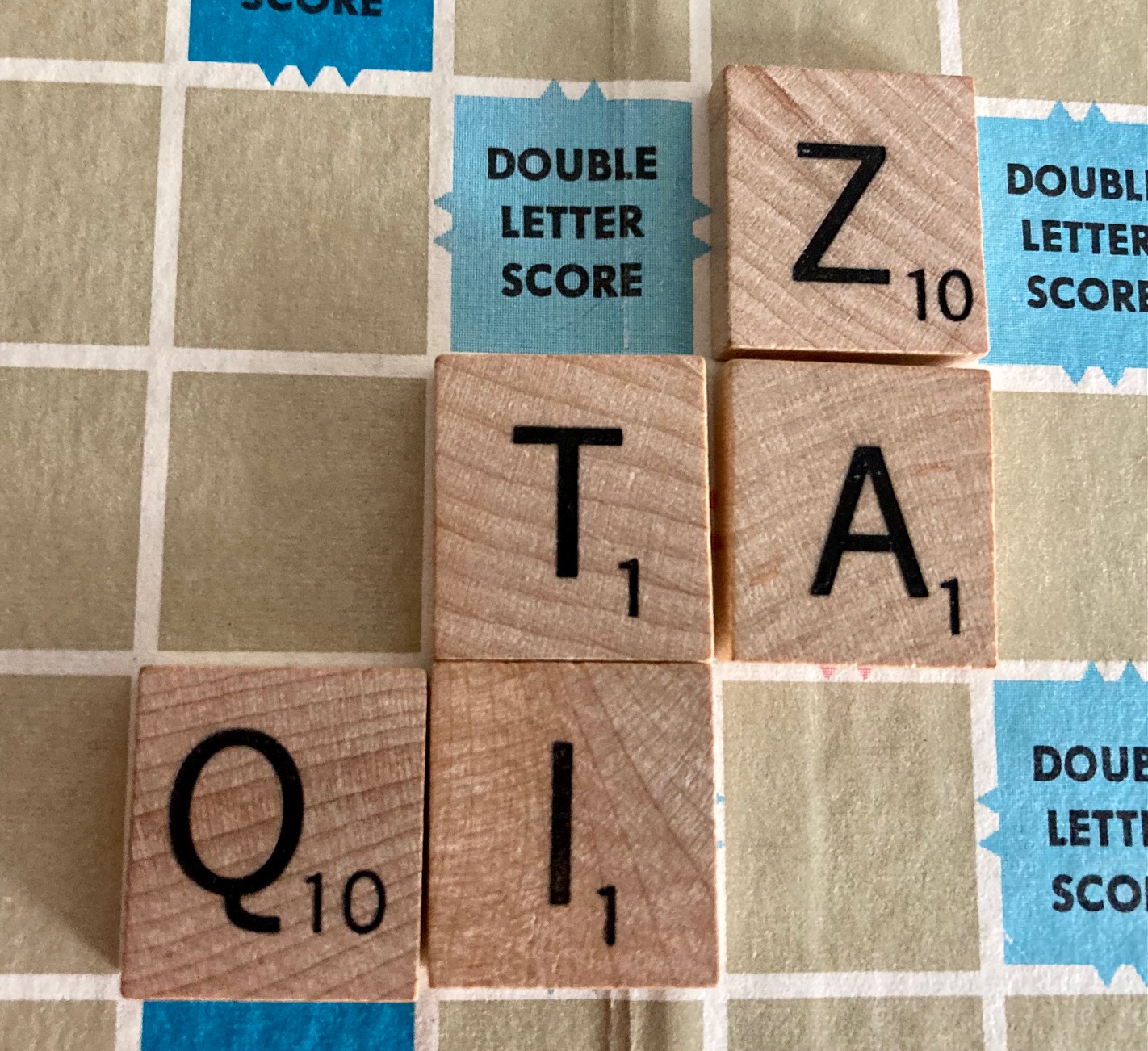
Today’s blog post is the final installment in the series of posts devoted to playable two-letter words. Learning these two-letter words, as well as the other two-letter words in the alphabet, will enable you to see more options for play and increase the number of points you earn in a single turn.
qi: the central life force in Chinese culture (also ki)
re: a tone of the diatonic scale
sh: used to encourage silence
si: a tone of the diatonic scale (also ti)
so: a tone of the diatonic scale (also sol)
ta: an expression of thanks
ti: a tone of the diatonic scale
to: in the direction of
uh: used to express hesitation
um: used to express hesitation
un: one
up: to raise (-s, -ped, -ping)
us: a plural pronoun
ut: the musical tone C in the French solmization system, now replaced by do
we: a first-person plural pronoun
wo: woe
xi: a Greek letter
xu: a former monetary unit of Vietnam equal to one-hundreth of a dong (also sau, pl. xu)
ya: you
ye: you
yo: an expression used to attract attention
za: pizza
Next Up
Wordplay Day! To prepare for class, revisit the Dictionary and World Builder pages on the Scrabble website. Also review the posts on my blog devoted to Scrabble tips, including this one.
Today marks the end of the first month of class, a point in the semester when you may look back and ask yourself whether the skills you have developed and the habits of mind you have practiced will benefit you in the real world. Yesterday’s reflective writing asked you to consider your literacy-narrative writing processes in particular; today’s blog post asks you to meditate on all aspects of English 1103.
Last week, High Point University’s president, Nido Qubein, emailed some members of the university community a link to an article that addresses employers’ dissatisfaction with Gen Z graduates. In his email, President Qubein quoted John Hardage, who emailed the article to Qubein. Hardage wrote:
“The Fortune article . . . prompted me to reflect on how grateful I am for the great work HPU does in shaping young people (my son included) to meet the challenges of a modern work environment. The value of learning life skills at HPU should not be underestimated.”
To earn bonus points for your next Check, Please! assignment, complete the exercise at the end of this blog post.
Work Cited
Qubein, Nido. Email: “Bosses are Firing Gen Z Grads Just Months after Hiring Them—Here’s What They Say Needs to Change.” 29 Jan. 2025.
Bonus Point Opportunity
Review the article and your journal entry, then compose a blog comment that addresses (1) one of the specific skills or habits that many Gen Z workers lack, and (2) one or more of the assignments you have completed or practices you have engaged in for English 1103 that has helped you develop that skill or habit.
Post your comment as a reply to this blog post by 9:00 a.m. on Monday, February 10.
To post your comment, click the title of the post, “ENG 1103: From the Classroom to the Office,” then scroll down to the bottom of the post. There you will see the image of an airmail envelope with a white rectangular box for your comment. Type your comment in the box and hit return. Voila! You have submitted your response. I will make the comments visible before class on Monday, February 10. Students who post comments by the deadline will earn five bonus points for their third Check, Please! worksheets.
Next Up
Wordplay Day! To prepare for class, revisit the Dictionary and World Builder pages on the Scrabble website, and review the blog posts devoted to Scrabble tips.
Today in class you will compose a short reflective essay that documents the processes of planning, drafting, and revising your literacy narrative. Questions to consider include the ones below. You don’t need to address all of the questions; focus on the ones whose answers reveal the most about your work.
Include in your reflection a minimum of one relevant quotation from the textbook, Writing Analytically. Introduce your quotation with a signal phrase and follow it with a parenthetical citation.
Examples:
The authors of Writing Analytically observe that “[o]ne goal of a writer’s notebook is to teach yourself through repeated practice that you are capable of finding things to write about” (Rosenwasser and Stephen 157).
In Writing Analytically, Rosenwasser and Stephen note, “to a significant extent, writing of all kinds tells a story—the story of how we have come to understand something” (162).
In the first example above, the authors’ last names appear in the parenthetical citation because they are not named in the signal phrase. In the second example, only the page number appears in the parenthetical citation because the authors are named in the signal phrase.
Sample Work Cited Entries:
Rosenwasser, David and Jill Stephen. “On Keeping a Writer’s Notebook.” Writing Analytically, 9th edition. Wadsworth/Cengage, 2024. pp. 157-58.
Rosenwasser, David and Jill Stephen. “Writing from Life: The Personal Essay.” Writing Analytically, 9th edition. Wadsworth/Cengage, 2024. pp. 161-68.
What aspect of the writing seemed the most challenging? Determining the focus of your narrative? Developing the story? Crafting the conclusion? Why did that aspect of the writing seem the most challenging?
Did you change the subject of your narrative? If so, what was the original subject? What did you change it to? Why?
Did you change the organization of the narrative? For example: Did you initially present the story chronologically, then begin in the present and move to flashback?
Did any of the sample essays we examined (“Me Talk Pretty One Day,” “The Day Language Came into My Life,” “A Bridge to Words”) prove helpful to you as a model? If so, how? (Offer one or more concrete details to support your claim.)
What do you consider the strongest element of your literacy narrative?
At what point in the process did you decide on a title? Did you change the title during the writing process? If so, what was the original title?
What photograph did you include in your blog that documents part of your writing process away from the screen? Why did you choose that particular image?
What relevant website did you link to your blog post. Why is that particular site relevant to your narrative?
In addition to metacognition, did any of the other habits of mind of successful college students play a significant role in your writing process? If so, which one? The other seven are curiosity, openness, engagement, creativity, persistence, responsibility, and flexibility.
Next Up
Wordplay Day! To prepare for class, revisit the Dictionary and World Builder pages on the Scrabble website, and review the blog posts devoted to Scrabble tips.
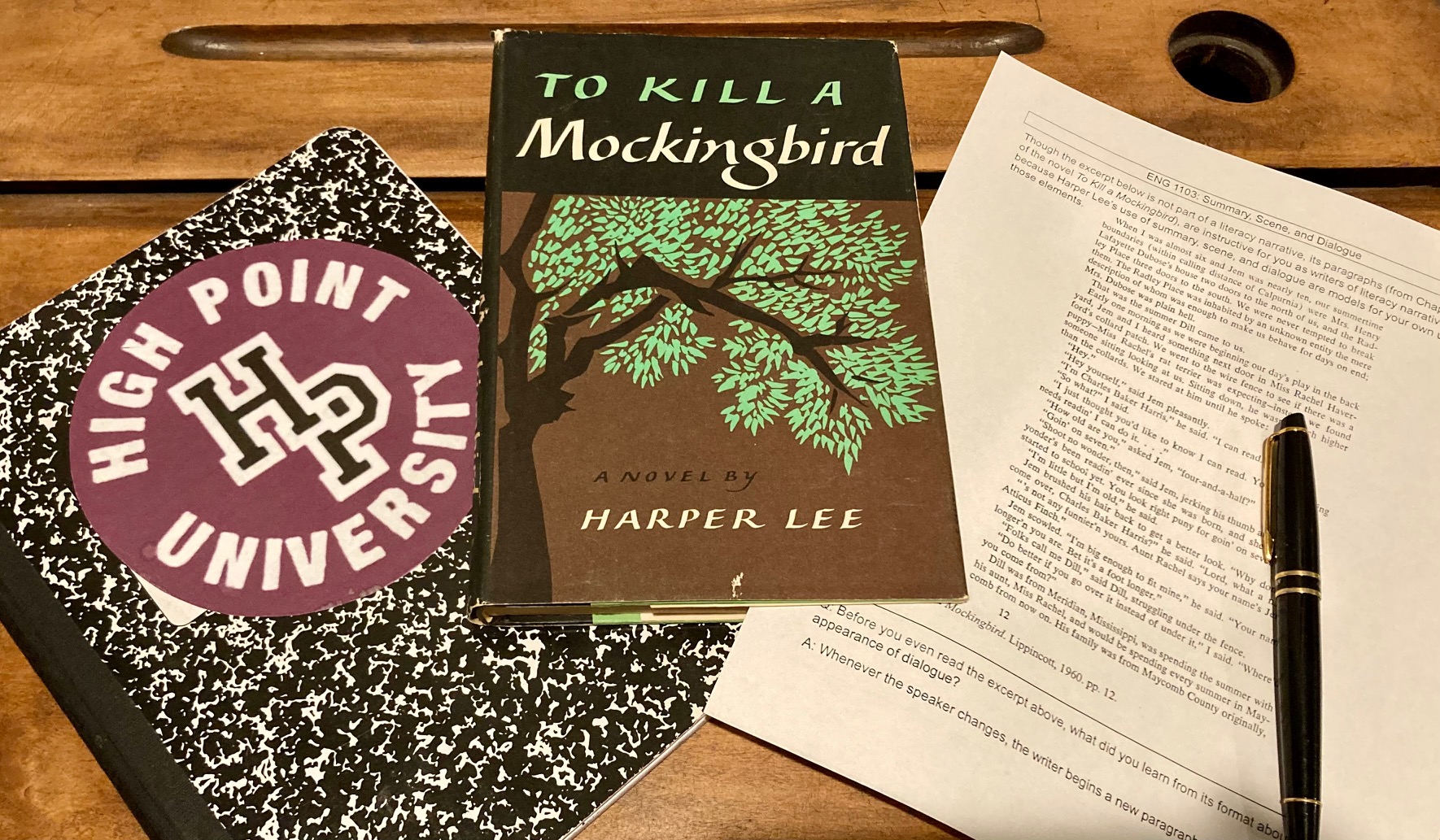
Yesterday before you and your group members assessed the literacy narratives that you read for class, we examined a page (pictured above) from Harper Lee’s novel To Kill a Mockingbird. That page from Chapter One serves as a useful model for three narrative elements: summary, scene, and dialogue–at least two of which will figure in your literacy narrative.
The first paragraph of the passage sets the scene with summary, designating the “summertime boundaries” within which the narrator, Jean Louise, “Scout,” Finch, and her older brother, Jem, may play outdoors (12). The short one-sentence paragraph that follows continues the summary, informing readers that the summer Scout has just summarized is the one in which Dill (Charles Baker Harris) first visits Maycomb, Alabama.
With the first words of the next paragraph, “[e]arly one morning,” Scout shifts from summary to scene (12). All of the remaining paragraphs except the final one continue the scene with dialogue. Scout returns to summary with the words “Dill was from Meridian” (12).
Note that Harper Lee begins a new paragraph whenever the speaker changes. Also note that every line of dialogue does not include a dialogue tag, such as “he said” or “she said.” If a passage of dialogue includes only two speakers, none of the paragraphs require dialogue tags after the speakers’ first lines because the start of a new paragraph signals to the reader that the other person is speaking. If a dialogue includes three or more speakers–such as Scout’s conversation with Jem and Dill–occasional tags are essential.
In my notes above, I have been careful to distinguish between the author, Harper Lee, and the narrator, the fictional character Scout. When you write about an autobiographical work, such as a literacy narrative, you may use the terms writer and narrator interchangeably. When you write about a work of fiction, it’s important to separate the narrative voice from the author. Reserve the term author for published writers. When you write about a piece of student writing, refer to the student as a writer, not an author.
Sample Student Literacy Narratives
The paragraphs that follow include detailed but not comprehensive notes on the two sample narratives that you assessed in class yesterday. Look to these notes as a guide for editing your own literacy narrative.
“Creativity is Key”
The writer changes the font of the body of the paper to Times New Roman but does not change the font of the running header, which should also be Times New Roman.
The writer incorrectly adds an extra space between the first-page course information (in the upper left) and between the title and the first line of the essay. MLA-style manuscripts are double-spaced. Note that later, the writer also incorrectly adds space between the paragraphs.
The title should be typed in twelve-point font, which is the font size that should be used throughout the document.
The title should not appear in boldface.
In MLA style, all major words in a title, including the final one, are capitalized (“key” should be “Key).
Form, which is the focus of the previous notes, is less important than content, but easily avoidable errors of form may prevent a reader from appreciating the content of your narrative. Creating a compelling story is hard work, proofreading isn’t. If you don’t get the easy part right, readers may stop reading.
The second “sentence” of the second paragraph is a fragment because the meaning of “one being my senior year . . .” is dependent upon the clause that ends the previous sentence. See Writing Analytically, page 426-29.
The comma between “all” and “matter” is a comma splice. See Writing Analytically, 429.
“[R]eal life” should be hyphenated (as real-life) when it functions as a compound modifier. Ditto for “open minded” and “four to five.”
Errors of letter case–upper rather than lower, or vice versa–are mistakes of mechanics, which are prevalent in the second paragraph “Track, “Field,” “Defensive,” “Back,” and “Athlete” should all began with a lower-case letter.
“[F]elt like” should be “felt as if.” In comparisons, use “like” before a noun and “as if” before a clause.
“I’m a writer that” should be “I’m a writer who.” The correct relative pronoun for a person is “who,” not “that.”
The essay is not a narrative. The writer mentions his experience writing a Southern gothic story, and he briefly recounts writing about his training for track and field and international football (soccer), but the writer offers very few details. Focusing on one of those experiences and recreating one or more moments from it would transform the essay into a narrative and develop it into one that meets the six hundred-word minimum requirement.
“Giving a Speech: Worst Nightmare to Best Feeling”
In the second line of the second paragraph, “Megan” is a parenthetical element that should be set off by commas. See Writing Analytically, 441.
The parenthetical element is the next line, “Mrs. Hron’s,” is correctly set off with commas, but the word that precedes “Mrs. Hron’s” should be possessive (“teacher’s,” not “teachers”).
Several other minor punctuation errors occur in the essay, but overall it’s a strong literacy narrative that’s notable for its vivid scenes and the writer’s self-deprecating humor.
Notes on Monday’s Quiz
Rather than posting the answers to the quiz, I am asking you to review the sample student literacy narratives, my annotations on your assignments, and the class notes for January 28 and February 3 and to find the answers on your own. Doing so will enable you to retain more of the course content from the past two weeks of class.
Keep in mind that one of the reasons we write is to remember. Taking notes on all of the blog entries that I publish and on all of your other reading assignments will both engage you in learning process and enable you to demonstrate your learning in the course.
Integrating Quotations
Writing your reflective essay on your literacy narrative tomorrow will include an exercise in integrating a quotation into your writing, a practice you will engage in more frequently as the semester progresses.
In your reflection, you are required include a minimum of one relevant quotation from the textbook, Writing Analytically, which you will introduce with a signal phrase and follow with a parenthetical citation.
Examples
The authors of Writing Analytically observe that “[o]ne goal of a writer’s notebook is to teach yourself through repeated practice that you are capable of finding things to write about” (Rosenwasser and Stephen 157).
In Writing Analytically, Rosenwasser and Stephen note, “to a significant extent, writing of all kinds tells a story—the story of how we have come to understand something” (162).
In the first example above, the authors’ last names appear in the parenthetical citation because they are not named in the signal phrase. In the second example, only the page number appears in the parenthetical citation because the authors are named in the signal phrase.
At the end of your essay, you will include a work cited entry for the section of the textbook that you quote.
Sample Work Cited Entries
Rosenwasser, David and Jill Stephen. “On Keeping a Writer’s Notebook.” Writing Analytically, 9th edition. Wadsworth/Cengage, 2024. pp. 157-58.
Rosenwasser, David and Jill Stephen. “Writing from Life: The Personal Essay.” Writing Analytically, 9th edition. Wadsworth/Cengage, 2024. pp. 161-63.
Next Up
In class tomorrow, you will compose a short essay that reflects on the processes of planning, drafting and composing your literacy narrative. If you do not post your essay to Blackboard and WordPress before class (you have until Friday morning to do so), you should refer to your work as ongoing. Be sure to bring your copy of Writing Analytically to class.



 Jane Lucas