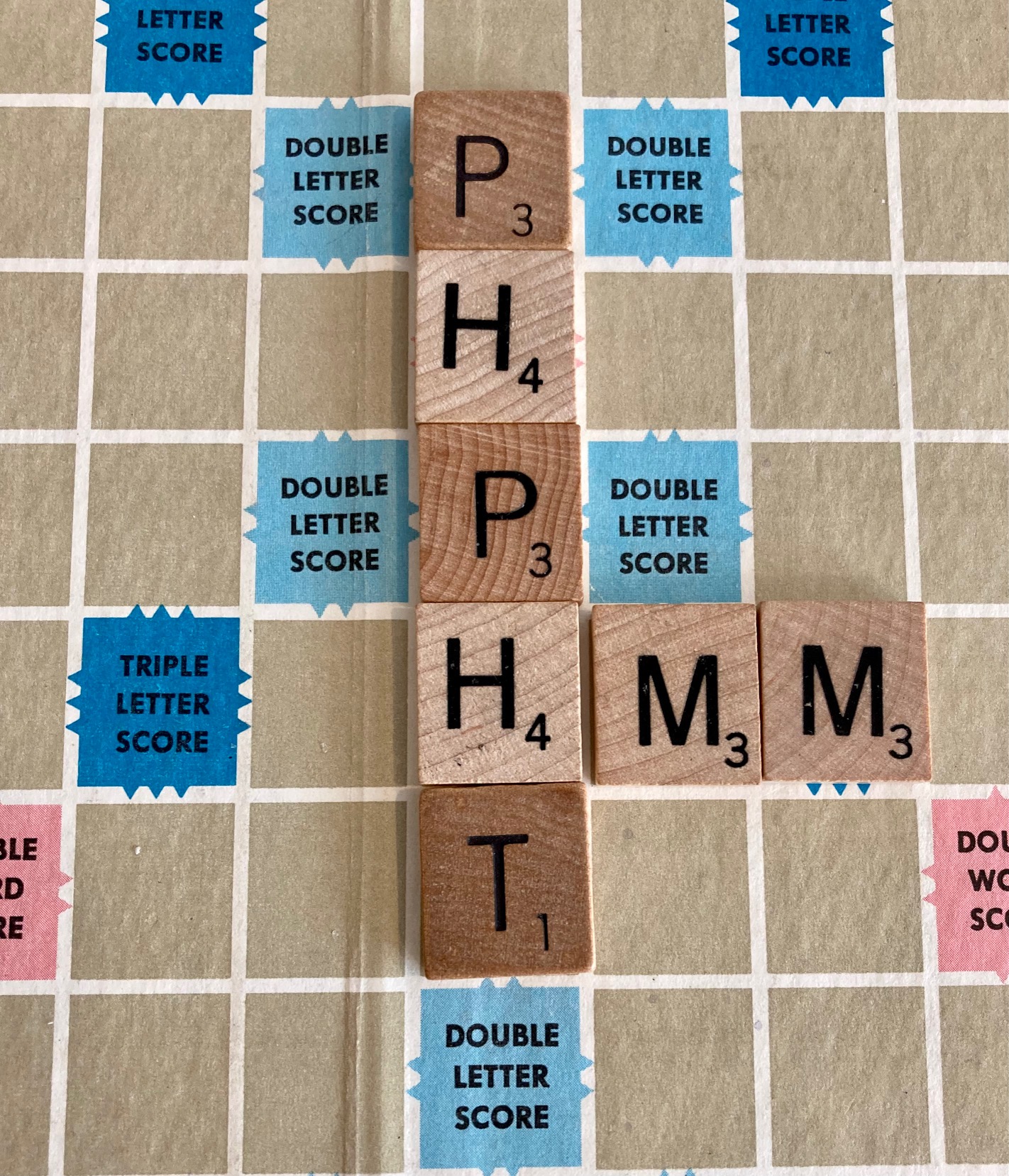
Learning nth (an unspecified number) and other all-consonant words can enable you to continue the game when you’re faced with a rack without vowels.
brr: used to indicate that one is cold
crwth: an ancient stringed instrument (pl. -s)
cwm: a cirque (a deep, steepwalled basin on a mountain, pl. -s, prounounced to rhyme with “boom”)
hm: used to express thoughtful consideration (also “hmm“)
mm: used to express assent or satisfaction
nth: describing an unspecified number in a series
phpht: used as an expression of mild anger or annoyance (also “pht“)
psst: used to attract someone’s attention
sh: used to urge silence (also “shh” and “sha“)
tsk: to utter an exclamation of annoyance (-ed, -ing, -s)
tsktsk: to “tsk” (-ed, -ing, -s)
Next Up
Wordplay Day! To prepare for class, revisit the Dictionary and World Builder pages on the Scrabble website. Also review the blog posts devoted to Scrabble tips, including this one.
Today in class, before you continue planning your group presentations, you will complete an exercise that offers you practice in some of the key moves of academic writing: (1) introducing a quotion with a signal phrase, (2) following it with a parenthetical citation, and (3) developing a paragraph by offering your own ideas on the subject of the quotation.
As model for you, I offer the sample paragraph below, which focuses on the Diego Velaszquez painting above and the Pablo Picasso painting below.
Sample Paragraph
The authors of Writing Analytically note, “There are provocative differences between Velásquez’s original and Picasso’s copy in size, spatial configuration, and palette” (Rosewasser and Stephen 268). Yet despite those differences, The Maids of Honor (Las Meninas, after Velásquez) features all of the figures in the same spirit Velásquez depicts them. Along with the painter’s canvas out of view, the artists’ foregrounding of elements ordinarily relegated to the perimeter—children, pets, servants, the artist, himself—invite a new way of seeing. Both Velásquez’s seventeenth-century baroque rendering of King Phillip IV’s court and Picasso’s cubist reassembling of it challenge viewers’ expectations of the subjects of art.
Picasso, Pablo. The Maids of Honor (Las Meninas, after Velazquez). 1957.
The paragraph that follows is the same as the one above, but the parenthetical citation includes only the page number because the authors are named in the signal phrase. In academic writing, whenever you quote more than one source, the authors’ names should appear either in a signal phrase or in the parenthetical citation, not both. Your analysis was an exception to this rule because your cited only one source, the text that served as your subject.
Sample Paragraph
David Rosenwasser and Jill Stephens, the authors of Writing Analytically, note, “There are provocative differences between Velásquez’s original and Picasso’s copy in size, spatial configuration, and palette” (268). Yet despite those differences, The Maids of Honor (Las Meninas, after Velásquez) features all of the figures in the same spirit Velásquez depicts them. Along with the painter’s canvas out of view, the artists’ foregrounding of elements ordinarily relegated to the perimeter—children, pets, servants, the artist, himself—invite a new way of seeing. Both Velásquez’s seventeenth-century baroque rendering of King Phillip IV’s court and Picasso’s cubist reassembling of it challenge viewers’ expectations of the subjects of art.
Directions
As practice in three of the key moves of academic writing, use the paragraphs above as models for your own paragraph focusing on Ian Falconer’s The Competition. (See page 108.)
Include in your paragraph a signal phrase that introduces one of the following two quotations:
“At its most serious, The New Yorker cover may speak to American history, in which New York has been a major point of entry for generations of immigrants, embracing diversity and nonconformity, while viewing the rest of the nation as more homogenous.”
“[T]he magazine is [. . .] admitting, yes America, we New Yorkers do think that we’re cooler and more individual than the rest of you, but we also know that we shouldn’t be so smug about it.”
Follow the quotation with a parenthetical citation. If you name the authors in the signal phrase, include only the page number, 112, in the parenthetical citation. If you do not name the authors in the signal phrase, include their last names before the page number.
Develop the paragraph with two or more sentences that offer your own reading of the magazine cover.
Follow your paragraph with a work cited entry:
Work Cited
Rosenwasser, David and Jill Stephen. “Arriving at an Interpretive Conclusion: Making Choices.” Writing Analytically. 9th edition, Wadsorth/Cengage, 2024. pp. 111-12.
Next Up
Wordplay Day! To prepare for class, revisit the Dictionary and World Builder pages on the Scrabble website. Also review the blog posts devoted to Scrabble tips.
As an exercise in reviewing one of the lessons in the Check, Please! course and also as an exercise in collaboration and oral communication, you and two or three of your classmates will deliver a short presentation that addresses the most significant points covered in one of the five lessons in the Check, Please! Course.
This morning in class, after you complete your Scrabble debriefing, you will receive your group assignments and begin planning for your presentation. You will receive a handout in class with directions for your presentation, and I am including the directions below as well.
Directions for Planning
Plan a presentation of five to ten minutes that addresses the most significant points covered in your group’s designated lesson in the Check, Please! course. (See pages 2-3 for the lists of groups and lesson assignments)
Include in your presentation (a) an opening in which you state each member’s first and last name, (b) a close examination of one segment of the lesson, and (c) a conclusion that provides closure and invites questions.
You are encouraged but not required to address how the lesson has been relevant to your other work in English 1103 and/or your other courses.
Directions for Rehearsing
In preparation for rehearsing, write your notes on an index card. If your initial notes are written in complete sentences, rewrite them to include only words and short phrases for your key points. If your notes are too detailed, you will risk relying too heavily on them and making minimal eye contact with the audience. Plan to make as much eye contact as possible and be sure to make eye contact with people throughout the room rather than fixing your eyes on one or two people.
Familiarize yourself with the presentation station. If you have not used the presentation station, I encourage you to devote part of today’s class period to familiarizing yourself with its setup.
Practice good posture. As you deliver your presentation, your ears should be directly above your shoulders. If you tend to shift your weight from one foot to the other—a distracting habit that’s sometimes called rocking the boat—stand with your feet perpendicular to each other. If you do so, you will not be able to shift your weight from one foot to the other.
Avoid filler words, such as uh, um, like, and you know. If you tend to use filler words, practice pausing at the points where you are likely to use fillers.
Take turns delivering your portions of the presentation, and offer feedback to your group members. Offer both suggestions for improvement and words of encouragement.
Check, Please! Lesson Three: Ava Gaudioso, Mason Hooey, Izzy O’Connor, Chaning Smith
Check, Please! Lesson Four: Santino Hall, Ella MacGlashan, Autumn Spaulding, Renae West
Check, Please! Lesson Five: Madison Harding, Brayden Krieser, Kenzie Van Cleef, Liz Wilburn
Grade Criteria
An A presentation includes all elements outlined in the directions for planning and demonstrates the group members’ poise and ability to avoid filler words.
A B presentation includes all elements outlined in the directions for planning but may be marred by group members’ lack of poise and/or inability to avoid filler words.
A C presentation includes most but not all elements outlined in the directions for planning and may also be marred by group members’ lack of poise and/or inability to avoid filler words.
A D presentation includes only some elements outlined in the directions for planning and may also be marred by group members’ lack of poise and/or inability to avoid filler words.
An F presentation includes few if any elements outlined in the directions for planning and may also be marred by group members’ lack of poise and/or inability to avoid filler words.
Next Up
In class on Wednesday, you will have additional time to prepare for your group presentations.
Your fifth and final Check, Please! assignment is due at the beginning of class next Wednesday, March 13. If you were absent on the day that I distributed the worksheet for the assignment, or you misplaced your copy, you should download and print a copy from Blackboard.
Although the assignment isn’t due until Wednesday, I encourage you to complete it before Monday’s class. In class on Monday, you will begin planning your group presentations on the Check, Please! lessons. Since you may be in the group that will deliver a presentation on lesson five, you will be able to devote more of your class time to planning if you have already completed the lesson.
Be sure to bring your worksheets for lessons one through four, so you will have the corresponding worksheet to refer to as you and your group members plan your presentation. Also, you may find it helpful to review the blog post that features my model assignment for the lesson:
Lesson One, January 23
Lesson Two, February 2
Lesson Three, February 16
Lesson Four, February 23
Next Friday, March 15, I will publish a blog post devoted to lesson five.
Next Up
In class on Monday, you and two or three of your classmates will begin planning for a short presentation on one of the five Check, Please! lessons. After your Scrabble debriefing at the beginning of class, you will receive your group assignments.
To mark the end of the first week of our windiest month, this Scrabble post features playable wind-related words. If your rack contains the right letters, spelling these words will be a breeze.
bayamo: a strong wind found in Cuba
bhut: a warm, dry wind in India (also bhoot)
bise: a cold, dry wind, found especially blowing from the northeast in Switzerland (also bize)
blaw: to blow
bleb: a blister (an extremely intense or severe wind)
bora: a cold wind in lowland regions
brr: used to indicate feeling cold (also brrr)
bura: a violent Eurasian windstorm (also buran)
chinook: a warm wind that flows off the east side of the Rockies; or a type of Pacific Northwest salmon named after the Chinook people)
fon: a warm dry wind that blows down off some mountains (also fohn and foehn)
Next Up
Wordplay Day! To prepare for class, revisit the Dictionary and World Builder pages on the Scrabble website. Also review the posts on my blog devoted to Scrabble tips, including this one.
This morning in class, you will plan and draft a short midterm reflective essay that documents your work in the first half of the semester, focusing on your analysis and one or two other assignments or aspects of the course that have contributed to your development as a writer and a student. In addition to your analysis, assignments and aspects of the course to consider include the following:
Keeping a journal
Completing Check, Please! assignments
Studying one of the readings examined class, including “Letter from Birmingham Jail,” “Me Talk Pretty One Day,” “The Day that Language Came into My Life,” “Back Story” (from The Blind Side), “The Falling Man,” “The School,” the sample literacy narrative (“A Bridge to Words”), or the sample analysis (“The Strange Fruit of Sosnowiec”)
Reading and editing samples of student writing
Writing for an online audience beyond the classroom/creating and maintaining a WordPress blog
Collaborating with your classmates on in-class writing assignments
Playing Scrabble/Collaborating with your teammates on Wordplay Day
Writing longhand
Limiting screen time
Include in your reflective essay the following elements:
A title that offers a window into your reflection
An opening paragraph that introduces your focus and presents your thesis
Body paragraphs that offer concrete details from your work to support your thesis.
A relevant quotation from Writing Analytically. Introduce your quotation with a signal phrase and follow it with a parenthetical citation. In addition to quoting a relevant passage from Writing Analytically, you may quote one of the texts that we have studied in class.
A conclusion that revisits the thesis without restating it verbatim
An MLA-style works cited entry for your source or sources
Sample MLA Style Works Cited Entries
Bartheleme, Donald. “The School.” The Best American Short Stories 1975, edited by Martha Foley, Houghton Mifflin, 1975. pp.8-11.
Rosenwasser, David and Jill Stephen. “Analysis and Argument.” Writing Analytically, 9th edition. Wadsworth/Cengage, 2019. pp. 7-8.
—. “Analysis and Everyday Life: More Than Breaking a Subject into Its Parts.” Writing Analytically, 9th edition. Wadsworth/Cengage, 2024. pp. 6-7.
—. “Integrating Quotations into Your Paper.” Writing Analytically, 9th edition. Wadsworth/Cengage, 2019. pp. 343-46.
—. “The Idea of the Paragraph.” Writing Analytically, 9th edition. Wadsworth/Cengage, 2019. pp. 307-313.
Sedaris, David. “Me Talk Pretty One Day.” Me Talk Pretty One Day. Little, Brown, 2000. 166-73.
Next Up
Wordplay Day! To prepare for class, revisit the Dictionary and World Builder pages on the Scrabble website. Also review the posts on my blog devoted to Scrabble tips.
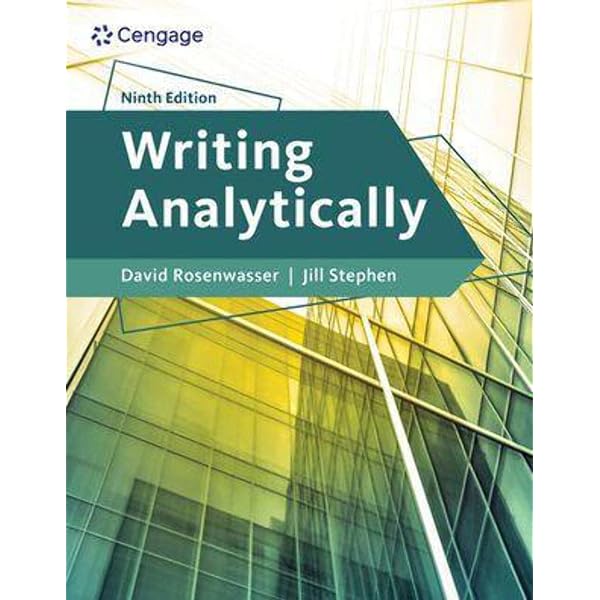
Rosenwasser, David and Jill Stephen. Writing Analytically, 9th edition. Wadsworth/Cengage, 2019.
Revising Your Analysis
As you continue to revise your analysis, review “The Strange Fruit of Sosnowiec” and consider the elements of the essay that we examined in class on Monday: the thesis, the examples of connections and separations that I offer as support for my thesis, and conclusion strategies that I employ in the final paragraph.
Additional Citations
You are not required to cite any text other than the essay, essay excerpt, or chapter excerpt that serves as your subject, but if you include any ideas from my class notes, you should name me in sentence and include a parenthetical citation and a work cited entry for the blog post in which the idea appears. In class on Monday, I distributed a handout with samples of additional citations and am including them here as well:
Example
Dr. Jane Lucas observes that “choosing not to divide the first paragraph creates an unbroken movement that parallels the unbroken downward flight of his [Junod’s] subject, the Falling Man” (par. 3).
In class on Wednesday, you will plan and compose a midterm reflection that documents your work in the first half of the semester, focusing on your analysis and one or two other assignments or aspects of the course that have contributed to your development as a writer and a student. In addition to reflecting on your analysis, you may reflect on one or two of the following:
Keeping a journal
Completing Check, Please! assignments
Studying one of the readings examined class, including “Letter from Birmingham Jail,” “Me Talk Pretty One Day,” “The Day that Language Came into My Life,” “Back Story” (from The Blind Side), “The Falling Man,” “The School,” the sample literacy narrative (“A Bridge to Words”), or the sample analysis “The Strange Fruit of Sosnowiec”
Writing for an online audience beyond the classroom/creating and maintaining a WordPress blog
Collaborating with your classmates on in-class writing assignments
Playing Scrabble/collaborating with your teammates on Wordplay Day
Writing longhand
Limiting screen time
You will be required to include a relevant quotation from Writing Analytically. To prepare for that element of the reflection, review the sections of the textbook listed below, and select a relevant sentence, clause, or phrase to quote.
Rosenwasser, David and Jill Stephen. “Analysis and Argument.” Writing Analytically, 9th edition. Wadsworth/Cengage, 2019. pp. 7-8.
—. “Analysis and Everyday Life: More Than Breaking a Subject into Its Parts.” Writing Analytically, 9th edition. Wadsworth/Cengage, 2024. pp. 6-7.
—. “Integrating Quotations into Your Paper.” Writing Analytically, 9th edition. Wadsworth/Cengage, 2019. pp. 343-46.
—. “The Idea of the Paragraph.” Writing Analytically, 9th edition. Wadsworth/Cengage, 2019. pp. 307-313.
Next Up
In class on Wednesday, you will compose your midterm reflection. (See the notes above.) Wednesday, March 6 (before class) is also the due date for your analysis; the hard deadline is Friday, March 8 (before class). Review the assignment submission requirements, and be sure to post your analysis both as a Word or PDF file to Blackboard and as a blog entry on your WordPress site.
The analysis that follows is one that I wrote as a model for my students in 2021. As you read it, note how I turn from summary to thesis (in bold) in the first paragraph. Also note how the paragraphs that follow offer support for the thesis with concrete details from the comic’s panels.
Since concluding paragraphs can be particularly difficult to write without repeating the introduction, today’s group work will include a close look at strategies for conclusions.
The Strange Fruit of Sosnowiec
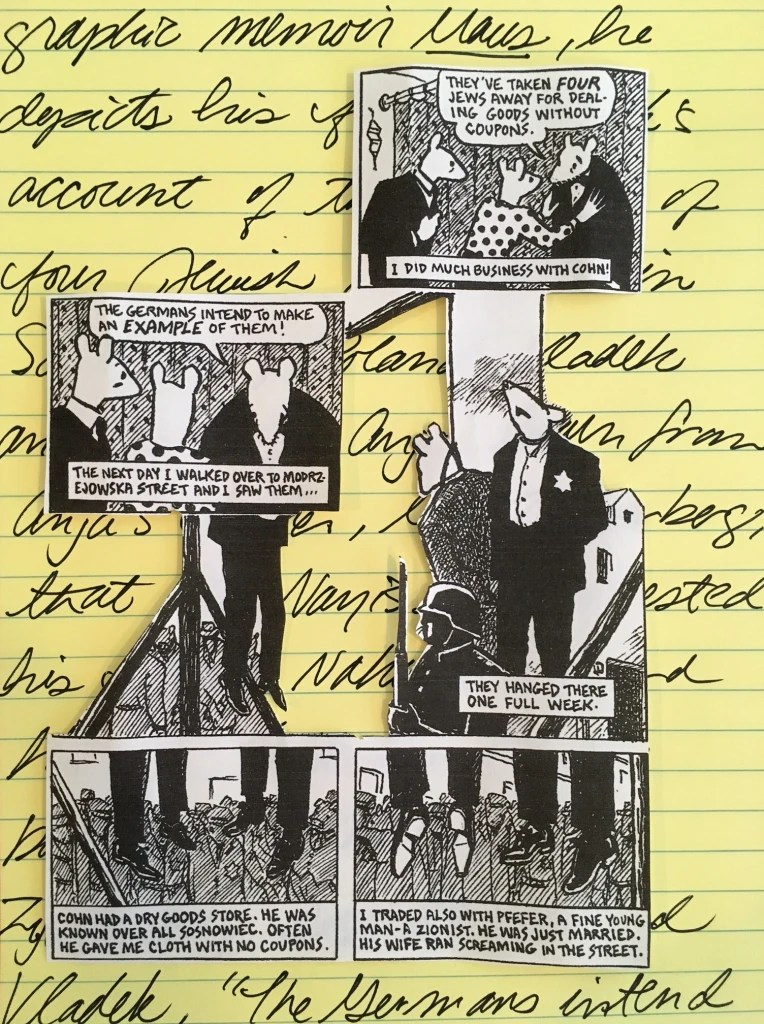
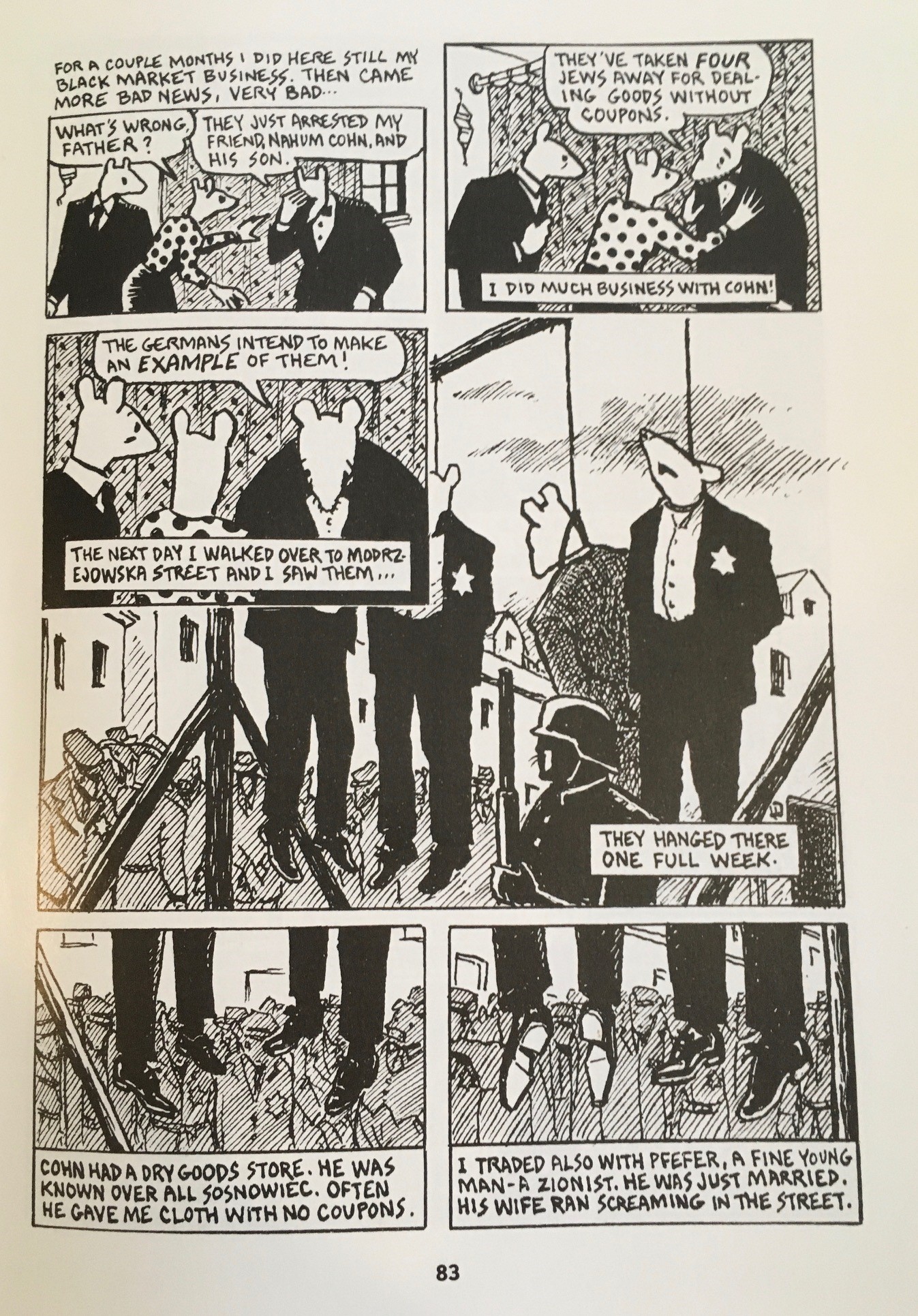
In Chapter 4 of Art Spiegelman’s graphic memoir Maus, he depicts his father Vladek’s account of the hangings of four Jewish merchants in Sosnowiec, Poland. Vladek and his wife, Anja, learn from Anja’s father, Mr. Zylberberg, that the Nazis have arrested his friend Nahum Cohn and his son. With his head bowed in sorrow, Mr. Zylberberg says to Anja and Vladek, “The Germans intend to make an example of them!” (83). That image of Mr. Zylberberg speaking with Vladek and Anja overlays the larger panel that dominates the page, one that depicts the horror that Mr. Zylberberg anticipates: the murder of his friend Nahum Cohn, Cohn’s son, and two other Jewish merchants. That haunting panel and the smaller ones that frame it illustrate the complexity of Spiegelman’s seemingly simple composition. His rendering of the panels of the living in conjunction with the fragmented panels of the hanged merchants simultaneously conveys connection and separation: both the grieving survivors’ ties to the dead and the hanged men’s objectification at the hands of the Nazis.
The placement of the overlaying panel not only hides part of the horror behind it, but it also connects Vladek’s father-in-law to one of the victims. Mr. Zylberberg’s head and torso appear directly above the suspended legs and feet of one of the hanged men, creating an image that merges the two.
Spiegelman further emphasizes the mourners’ identification with the hanged men by extending two of the nooses’ ropes upward to the smaller panel above them, linking the living to the dead. Additionally, Spiegelman underscores the link with Vladek’s line of narration at the bottom of the smaller panel: “I did much business with Cohn!” (83). The word “with” appears directly above the rope, punctuating the connection between both Nahum Cohn and his friend Mr. Zylberberg and Zylberberg’s son-in-law, Vladek.
While the panels of the hangings yoke the living to the dead, Spiegelman’s presentation of the hanged men in fragments also objectifies them. The final panels on the page depict only their shoes and part of their pant legs suspended above the onlookers, images that may evoke in some readers thoughts of the last remnants of the Jews who stepped barefoot into the gas chambers of Auschwitz.
Whether the hanged men’s shoes call to mind those mountains of leather left behind by the Jews, the separation of their lower legs and feet from the rest of their bodies turns them into something less than human—not people, but mere parts. Thus, Spiegelman creates a picture of the hangings that illustrates both the mourners’ identification with the victims and the Nazis’ perception of the Jews as less than human: the malignant ideology that the artist has pinpointed “at the very heart of the killing project.”
Spiegelman, Art. Maus 1. Pantheon, 1986, p. 83.
Spiegelman’s transformation of the Nazi propaganda portrayals of Jews as rats remains an astounding achievement thirty-five years after the publication of the first volume of Maus. But seeing the hanged merchants in Modrzejowska Street in the midst of the George Floyd murder trial in Minneapolis and less than three months after the January 6 Capitol riot reminds readers that the panels of Spiegelman’s memoir have grown more prescient. The nooses evoke images of Officer Derek Chauvin’s knee on George Floyd’s neck, the January 6 chants to hang the Vice President, and a T-shirt glimpsed in the Capitol crowd, one with a Nazi eagle below the acronym “6MWE” (Six Million Wasn’t Enough), a reference to the numbers of Jews slaughtered in the Holocaust. Our heads are bowed in sorrow with Mr. Zylberberg’s. The strange fruit of our past, both distant and recent, should seem far stranger.
After we examine “The Strange Fruit of Sosnowiec,” you and two or three of your classmates will collaborate on an exercise that asks you to consider an example of the connections and separations that I address in my thesis. The exercise will also ask you to explore the conclusion strategies that I employ in the final paragraph.
Next Up
In class on Wednesday, you will compose a reflective essay that focuses on your work over the first half of the semester. In your reflection, you will be required address your analysis and one or two other assignments or aspects of the course that have contributed to your development as a writer and a student. You will also be required to include at least one relevant quotation from a section of Writing Analytically devoted to analysis.
This blog post features my version of the fourth Check, Please! assignment, which you submitted at the beginning of class on Wednesday. In preparation for submitting your worksheet for lesson five, review this post as well as the assignment notes that I posted on January 30.
Check, Please! Lesson Four
In the fourth lesson of the Check, Please!, Starter Course, Mike Caulfield, author of the course and a research scientist at the University of Washington’s Center for an Informed Public, focuses his instruction on the third step in the four-step SIFT approach to determining the reliability of a source. Lesson four, “Find Trusted Coverage,” addresses these topics: (1) scanning Google News for relevant stories, (2) using known fact-checking sites, and (3) conducting a reverse-image search to find a relevant source for an image.
One of the concepts Caulfield introduces in lesson four is click restraint, which was given its name by Sam Wineberg, Professor of History and Education at Stanford, and Sarah McGrew, Assistant Professor of Education at the University of Maryland. Click Restraint is an activity that fact checkers practice regularly, but average people do not. Fact checkers resist the impulse to click on the first result, opting instead to scan multiple results to find one that combines trustworthiness and relevance.
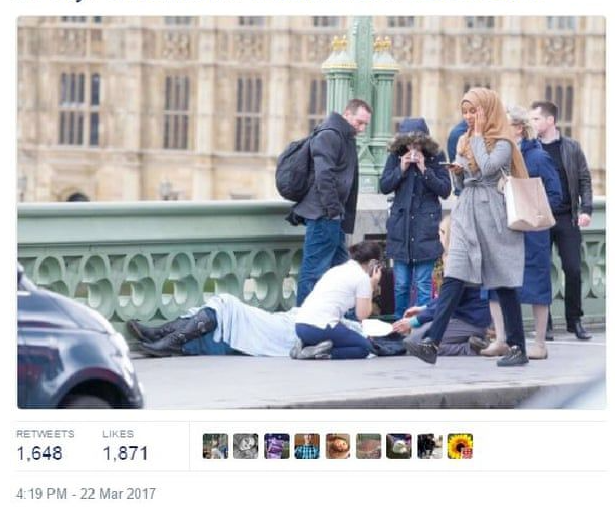
Caulfield also considers the issue of false frames and offers as an example the miscaptioned photo of a young woman that circulated widely after the 2017 London Bridge attack. In the photo, the woman, who is wearing a hijab, is looking down at her phone as she walks past one of the victims lying by the side of the road, surrounded by members of the rescue team. Because the woman’s face is blurred, viewers of the miscaptioned picture cannot see the look of shock that is visible in her face in another image taken by the same photographer. Subsequently, her apparent lack of concern for the victim seems to confirm the caption in the infamous tweet.
Choosing a general search term over a specific one is a useful and unexpected tip Caulfield includes in his discussion of image searches. He explains that the benefit of such a bland term as “letter” or “photo” will prevent the confirmation bias that can lead to the proliferation of disinformation through false frames.
After spring break, on Monday, March 4, we will examine a model analysis, and you will begin planning your midterm reflection, which you will compose in class on Wednesday, March 6.
Last week I published a blog post that listed the first twenty-two playable four-letter words with three vowels. Knowing those words, and others with multiple vowels, proves useful when you’re faced with a rack of mostly, or all, vowels. Here’s a list of the remaining fourteen playable four-letter words with three vowels:
naoi: ancient temples (pl. of naos)
obia: form of sorcery practiced in the Caribbean (also obeah)
odea: concert halls (pl. of odeum)
ogee: an S-shaped molding
ohia: a Polynesian tree with bright flowers (also lehua)
olea: corrosive solutions (pl. of oleum)
olio: a miscellaneous collection
ouzo: a Turkish anise-flavored liquor
raia: a non-Muslim Turk (also rayah)
roue: a lecherous old man
toea: a currency in Papua, New Guinea
unai: a two-toed sloth (pl. unai; an ai is a three-toed sloth)
zoea: the larvae of some crustaceans
Next Up
When class resumes on March 4, we will examine a model literacy narrative, and you will begin planning the midterm reflection that you will compose in class on Wednesday, March 6.





 Jane Lucas