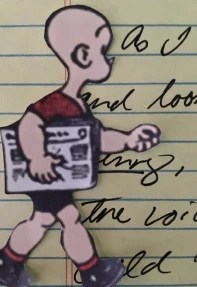
Carl Thomas Anderson’s comic strip character Henry
Yesterday in class we examined the model literacy narrative “A Bridge to Words,” and you and two or three of your classmates collaboratively composed a piece of writing that addressed one of these elements in the essay:
concrete details
figurative language
scene (see paragraphs two through five)
the adult retrospective narrator
the writer as a child
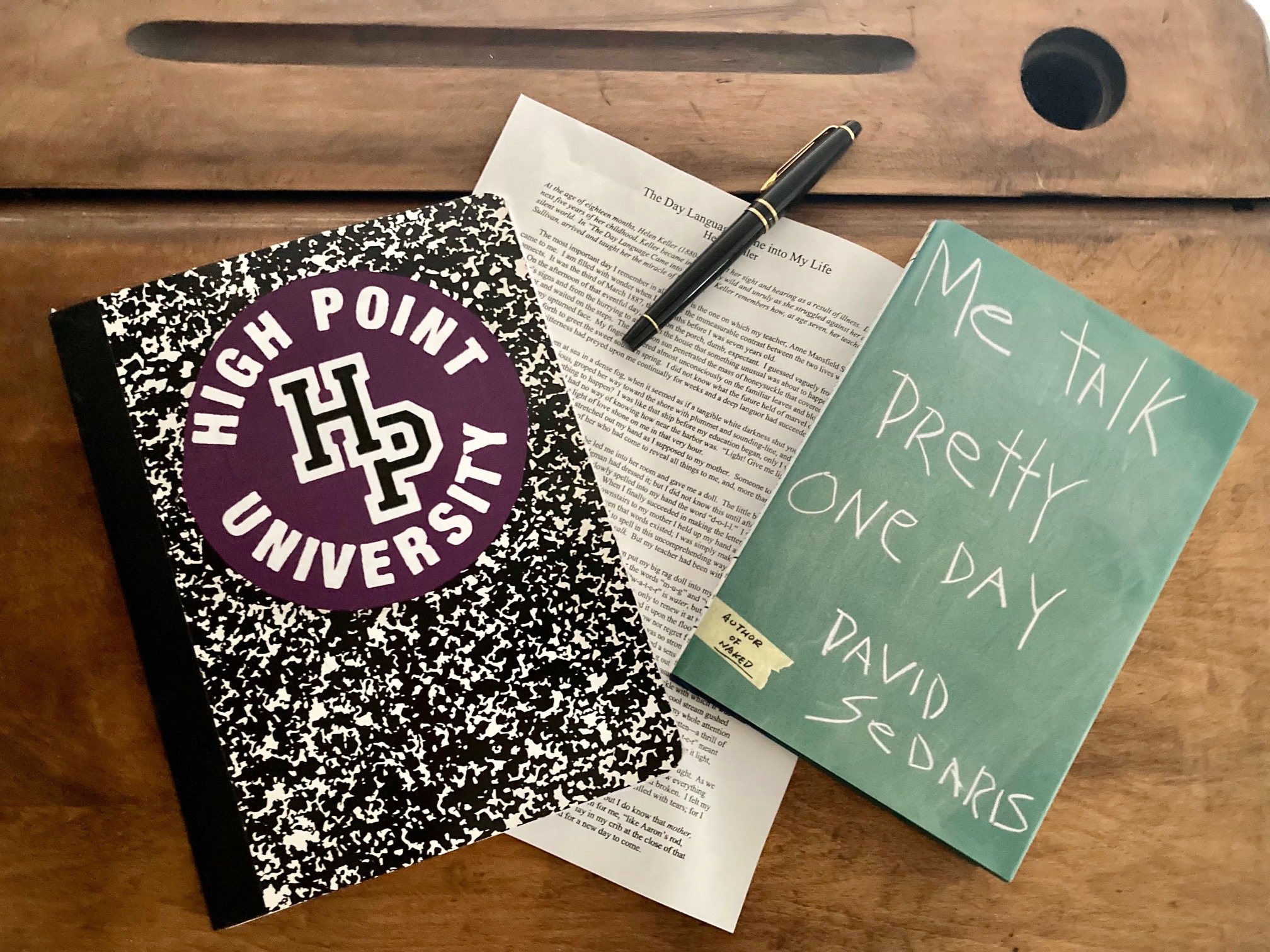
As you continue to revise your own literacy narrative, review David Sedaris’s “Me Talk Pretty One Day,” Helen Keller’s “The Day Language Came into My Life,” and “A Bridge to Words.” Note the use of concrete details, figurative language, and scene in all three. As you review Keller’s essay and mine, examine the dual roles of the central figure: the adult retrospective narrator and the child that she recollects.
Consider how your study of the narrative elements listed above can enhance those story components in your own essay.
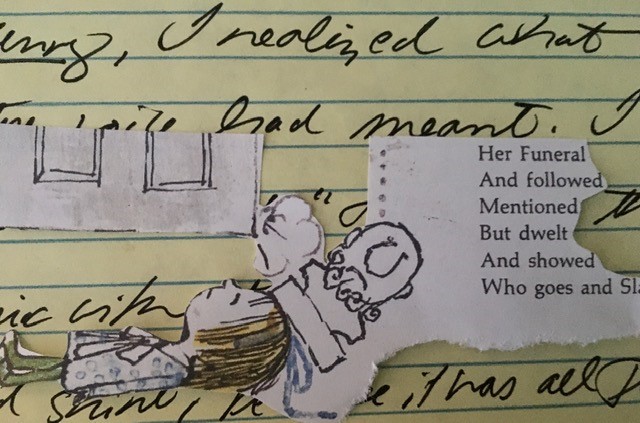
Hilaire Belloc’s “Rebecca,” illustrated by Alice and Martin Provensen
Narrative Don’ts
I also asked you to consider what the narrative doesn’t do (because it shouldn’t). Here are the two narrative don’ts that I covered in class:
Don’t write, “It made me the reader I am today,” “It made me the writer I am today,” “It made me the person I am today,” or any variation on those. Such statements are common in speeches, but they are trite and should be avoided in writing because they tell readers nothing about your particular experience. Rather than writing, “It made me the reader/writer/person . . . ,” show the readers that person.
Don’t write, “I became a better reader (or writer, or person) because I persevered, and that’s what you should do.” Don’t tell readers what they should do. Instead, let them see your experience and draw their own conclusions.
Next Up
In class on Wednesday you will compose a short reflective essay that chronicles the process of planning, drafting, and revising your literacy narrative.
Hilaire Belloc’s “Rebecca,” illustrated by Alice and Martin Provensen
Today in class we will examine the model literacy narrative “A Bridge to Words,” which appears below, and you and two or three of your classmates will collaboratively compose a piece of writing that addresses one of these elements of the essay:
concrete details
figurative language
scene (see paragraphs two through five)
the adult retrospective narrator
the writer as a child
As you continue to revise, consider the role of those elements your own literacy narrative, and ask yourself what changes may enhance them.
A Bridge to Words
To a small child, the pages of a newspaper are enormous. Looking far back through the years, I see myself, not yet school age, trying to hold up those long, thin sheets of newsprint, only to find myself draped in them, as if covered by a shroud. But of course, back then, my inability to hold a newspaper properly was of little consequence. Even if I could have turned the pages as gracefully as my parents did, I couldn’t decipher the black marks on the page; thus, my family’s ritual reading of the newspaper separated them from me. As the youngest and the only one who couldn’t read, I was left alone on the perimeter to observe. My family’s world of written words was impenetrable; I could only look over their shoulders and try to imagine the places where all those black marks on the page had carried them—these people, my kin, who had clearly forgotten that I was in the room.
My sister, who was three years older, had her very own news source: The Mini Page, a four-page miniature paper that arrived at our house as an insert in the Sunday edition. While our parents sat in their easy chairs poring over the state and local news, my sister, Jo, perched at the drop-front desk and occupied herself with articles, puzzles, and connect-the-dots.
Finally, one Sunday, someone noticed me on the margin and led me into our family’s reading circle. Whether it was one of my parents or my sister, I don’t know. I remember only the gesture and the words: someone handing me the Sunday comics and saying, “You can read part of the funny pages, too. You can read Henry.”
I took the giant page and laid it flat in the middle of the oval, braided rug on the floor of the den. Once I situated the page, I lay on top of it with my eyes just inches above the panels of the comic strip. To my parents, my prone position was a source of amusement, but for me it was simply a practical solution. How else was someone so small supposed to manage such a large piece of paper?
As I lay on the floor and looked at the comic strip’s panels, I realized what the voice had meant. I could “read” Henry, the comic with the bald boy in a red shirt, because it consisted entirely of pictures. In between panels of Henry walking, there were panels of him standing still, scratching his hairless head. I didn’t find Henry funny at all. I wondered how that pale forerunner of Charlie Brown had earned a prime spot in the funnies. Still, I was glad he was there. He was the bridge that led me to the written word.
Reading the wordless comic strip Henry for the first time was the beginning of a years-long habit of stretching out on the floor with newspapers and large books—not thick ones but ones that were tall and wide, among them one of my childhood favorites: The Golden Book of Fun and Nonsense. My sister and I spent hours lying on our bedroom floor, the pink shag carpet tickling our legs as we delighted in the antics of Rebecca, the mischievous title character of one of the poems.
Carl Thomas Anderson’s comic strip character Henry
“Rebecca”—which my sister read to me before I could read it myself—introduced me to the word “abhors,” the very sound of which appealed to me. Sometimes before Jo had finished reading the opening lines, my uncontrollable giggles collided with her perfect mock-serious delivery. As the last word in the first line, “abhors” serves as a lead-in to an enjambment: the continuation of a sentence or clause in a line break. It would be years before I learned the term “enjambment,” but I was immediately swept away by its effect in the opening lines: “A trick that everyone abhors/ In Little Girls is Slamming Doors” (Belloc 61). The first line lured me into the second one, and so on and so on. I was drawn both to the individual word “abhors”—with its side-by-side “b” and “h,” rare in English—and the way the words joined, like links in a chain, to yank me giggling through Rebecca’s cautionary tale:
It happened that a marble bust Of Abraham was standing just Above the door this little lamb Had carefully prepared to slam, And down it came! It knocked her flat! It laid her out! She looked like that.
Her funeral sermon (which was long And followed by a sacred song) Mentioned her virtues, it is true, But dwelt upon her vices too, And showed the dreadful end of one Who goes and slams the door for fun. (61)
Why these particular early memories visit me now, I don’t know. Perhaps rereading Art Spiegelman’s graphic memoir Maus with my students has roused the wordless Henry and the word-filled Golden Book of Fun and Nonsense from the corner of my brain where they’ve slumbered. The former wakes and stretches out in my mind as a bridge to the latter: a spot in the world of words I’ve inhabited ever since.
At the beginning of class on Wednesday, you will submit your worksheet for the second lesson in the Check, Please! course. After that, I will return your handwritten drafts, and you will have the remainder of the period to begin typing your revisions on your laptops. You will have an additional week to continue revising before you submit your literacy narrative to Blackboard and WordPress. The due date is Wednesday, February 7; the hard deadline is Friday, February 9.
This blog post features my version of the second Check, Please! assignment, which you submitted at the beginning of class on Wednesday. In preparation for submitting your worksheet for lesson three, review this post as well as the assignment notes that I posted on January 30.
Check, Please! Lesson Two
In the second lesson of the Check, Please! Starter Course, Mike Caulfield, author of the course and a research scientist at the University of Washington’s Center for an Informed Public, focuses on investigating a source, the second step in the SIFT approach, which he introduces in lesson one.
One of the most useful practices presented in lesson two is Caulfield’s follow-up to the Wikipedia strategy, which he outlined in the previous lesson. After he reviews that strategy, Caulfield explains how to use the control-f keyboard shortcut (command-f on a Mac). Typing control-f (or command-f) will open a small textbox in the upper right of the screen. Typing a word you are searching for will highlight the first appearance of the word in the text. Hitting return will highlight each subsequent appearance of the word.
Lesson two introduced me to fauxtire, a term for websites such as World News Daily Report, based in Tel Aviv, that present themselves as satirical but in fact serve primarily to perpetuate disinformation.
Perhaps the most memorable portion of lesson two was the side-by-side comparison of the websites for the American Academy of Pediatrics and the American College of Pediatricians. Though at first glance the two appear comparable, using the Wikipedia strategy reveals their profound differences. While AAP is the premiere authority on children’s health and well-being, ACP was founded to protest the adoption of children by single-sex couples and is widely viewed as a single-issue hate organization.
In class on Monday, we will examine the model literacy narrative “A Bridge to Words,” and you and two or three of your classmates will collaboratively compose a piece of writing that addresses one of these elements of the essay:
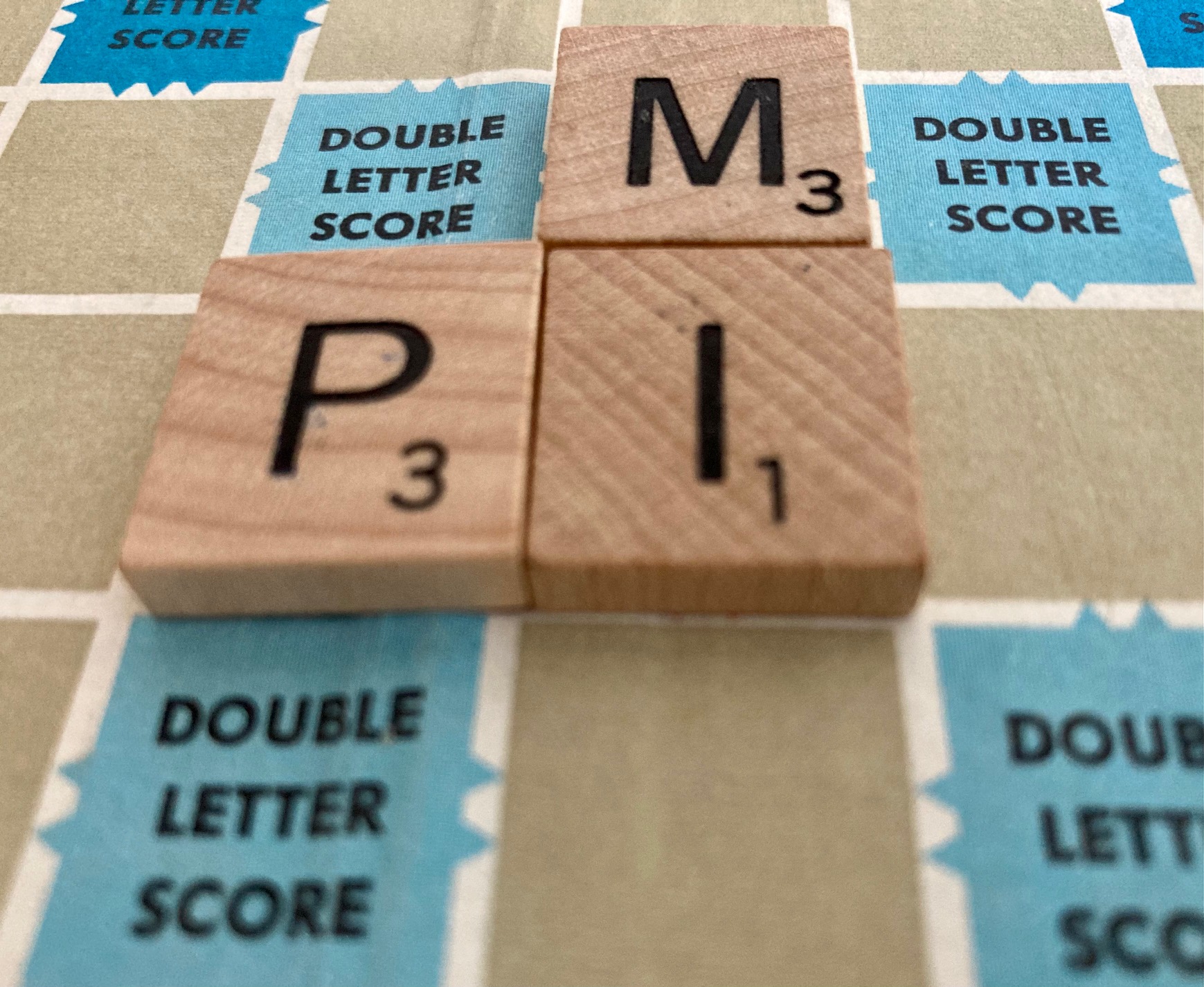
In the previous weeks, I published blog posts featuring the playable two-letter words that begin with a, b, d, e, f, g, h, i, j, k, and l. Today’s post features the playable two-letter words beginning with m, n, o, and p. Learning these two-letter words, as well as the other two-letter words in the alphabet, will enable you to see more options for play and increase the number of points you earn in a single turn.
M, by the way, is the most versatile consonant. In the first position, m pairs with every vowel: ma, me, mi, mo, mu, and also my. In the second position, m pairs with every vowel except i: am, em, om, um.
ma: a mother
me: a singular objective pronoun
mi: a tone of the diatonic scale
mm: an expression of assent
mo: a moment
mu: a Greek letter
my: a first-person possessive adjective
na: no, not
ne: born with the name of (also nee)
no: a negative answer
nu: a Greek letter
od: a hypothetical force
oe: a whirlwind off the Faero Islands
of: originating from
oh: an exclamation of surprise
oi: an expression of dismay (also oy)
om: a sound used as a mantra
on: the batsman’s side in cricket
op: a style of abstract art dealing with optics
or: the heraldic color gold
os: a bone
ow: used to express pain
ox: a clumsy person
oy: an expression of dismay (also oi)
pa: a father
pe: a Hebrew letter
pi: a Greek letter
Next Up
Wordplay Day! To prepare for class, revisit the Dictionary and World Builder pages on the Scrabble website, and review this post.
This morning, after I collect your Check, Please! worksheets for lesson two, I will return your drafts, and you will have the remainder of the class period to begin revising your literacy narratives on your laptops. You will have an additional week to continue your revision work before you submit the assignment to Blackboard and publish it as a WordPress blog entry. The due date is next Wednesday, February 7 (before class). The hard deadline is Friday, February 9 (before class). Directions for submitting your literacy narrative are included on your assignment sheet and on the Blackboard submission site.
As you continue to revise your literacy narrative, consider visiting The Writing Center. If you do so, you will earn five bonus points for the assignment.
To schedule an appointment, visit https://highpoint.mywconline.com, email the Writing Center’s director, Professor Justin Cook, at jcook3@highpoint.edu, or scan the QR code below. To earn bonus points for your literacy narrative, consult with a Writing Center tutor no later than Thursday, February 8.
Next Up
Wordplay Day! To prepare for class, revisit the Dictionary and World Builder pages on the Scrabble website and review the blog posts devoted to Scrabble.
Tomorrow, at the beginning of class, I will collect your worksheets for the second Check, Please! lesson. If you were absent on the day that I distributed copies of the worksheet or you have misplaced your copy, download the file from Blackboard and print it.
In preparation for submitting your assignment, review the notes below.
A summary is a third-person objective synopsis. In the first paragraph of your assignment, your summary, you should not use first- or second-person pronouns, singular or plural. In other words, “I,” “me,” “we,” “us,” and “you” should not appear in your summary. Your summary should also be free of commentary. If you use such words as “effective,” “useful,” and “instructive,” you have shifted from summary to commentary. Turn to commentary in your second paragraph.
Check, Please! is a nonprint source, which means that you do not include parenthetical citations with page or paragraph numbers (because, after all, there are no paragraphs or page numbers). Think of citing a website such as Check, Please! the way you would cite a film. Any lines that you include verbatim are enclosed in quotation marks, and the reader knows from the context that the lines are spoken in the film. The works cited entry at the bottom of the text provides the reader with the necessary source details.
Not all lists require a colon. Use one only if the clause (a group of words containing a verb) that precedes the colon makes sense on its own.
Consider the difference between these two sentences with lists:
In lesson two, Mike Caulfield continues his instruction in the four-step approach to determining the reliability of a source, which he terms SIFT: (1) “Stop,” (2) “Investigate,” (3) “Find better coverage,” and (4) “Trace claims, quotes, and media to the original context.”
The steps of SIFT include (1) “Stop,” (2) “Investigate,” (3) “Find better coverage,” and (4) “Trace claims, quotes, and media to the original context.”
The second example above does not include a colon because the clause before the list does not make sense on its own.
A work cited entry has a hanging indent, which means its appearance is the opposite of a paragraph’s. The first line of a paragraph is indented five spaces or one-half inch, and the remaining lines of the paragraph are flush left. In a works cited entry, the first line is flush left, and the remaining lines are indented.
Include concrete details. Specificity not only enables the reader to see your subject, it also demonstrates to the reader that you have examined your subject carefully.
Consider the difference between the two passages below.
Lesson two includes two websites that show how similar two can be even though one is propaganda.
Perhaps the most memorable portion of lesson two is the side-by-side comparison of the websites for the American Academy of Pediatrics and the American College of Pediatricians. Though at first glance the two appear comparable, using the Wikipedia strategy reveals their profound differences. While AAP is the premiere authority on children’s health and well-being, ACP was founded to protest the adoption of children by single-sex couples and is widely viewed as a single-issue hate organization.
The two passages above address the same websites featured in lesson two, but the first example provides the reader with no specifics.
Next Up
At the beginning of class on Wednesday, I will collect your worksheets for the second Check, Please! lesson and return the drafts of your literacy narratives. You will have the class period to begin revising on your laptops, and you will have an additional week to continue your revisions. The due date for posting your revision to Blackboard and to your WordPress blog is Wednesday, February 7 (before class); the hard deadline is Friday, February 9 (before class).
Today in class we will examine two literacy narratives written last semester. After you read and annotate the essays, you and two or three of your classmates will collaboratively compose a short assessment of each narrative.
In each assessement, consider whether the essay focuses on one of the following options for topics:
a memory of a reading or writing assignment that you recall vividly
someone who helped you learn to read or write
a writing-related school event that you found humorous or embarrassing
a particular type of writing that you found (or still find) especially difficult or challenging
a memento that represents an important moment in your development as a reader or writer
Also determine whether each essay fulfills the requirements listed below.
a well-told story
vivid detail
some indication of the narrative’s significance
a minimum of 600 words
After you have composed your assessment, you will review the grade criteria listed below, and assign a letter grade to each narrative.
An A literacy narrative complies with all of the assignment guidelines: it presents a well-told story, includes vivid details, and conveys the story’s significance in a way that demonstrates a depth of understanding. An A literacy narrative is also well organized and relatively free of surface errors.
A B literacy narrative complies with all of the assignment guidelines but may convey the significance of the story in a superficial way, may have issues with organization, or may be flawed by surface errors.
A C literacy narrative complies with most but not all of the assignment guidelines and may also be flawed by issues of organization and/or surface errors.
A D literacy narrative complies with only a few of the assignment guidelines and may also be flawed by issues of organization and/or surface errors.
An F literacy narrative fails to comply with most or all of the assignment guidelines and may also be flawed by substantial issues of organization and/or surface errors.
Next Up
At the beginning of class on Wednesday, I will collect your workshseets for the second Check, Please! lesson and return the drafts of your literacy narrative. You will have the class period to begin revising on your laptops, and you will have an additional week to continue your revisions. The due date for posting your revision to Blackboard and to your WordPress blog is Wednesday, February 7 (before class); the hard deadline is Friday, February 9 (before class).
In the previous weeks, I published one blog post featuring playable two-letter words beginning with a and a second blog post featuring playable two-letter words beginning with b, d, and e. Today’ s blog post features playable two-letter words beginning with f, g, h, i, j, k, and l. Learning these two-letter words, as well as the other two-letter words in the alphabet, will enable you to see more options for play and increase the number of points you earn in a single turn.
fa: a tone on the diatonic scale
fe: a Hebrew letter
gi: a white garment worn in martial arts
go: a Japanese board game
ha: used to express surprise
he: a pronoun signifying a male
hi: an expression of greeting
hm: used to express consideration
ho: used to express surprise
id: the least censored part of the three-part psyche
if: a possibility
in: to harvest (a verb, takes -s, -ed, -ing)
is: the third-person singular present form of “to be”
it: a neuter pronoun
jo: a sweetheart
ka: the spiritual self in ancient Egyptian spirituality
ki: the vital life force in Chinese spirituality (also qi)
la: a tone of the diatonic scale
li: a Chinese unit of distance
lo: an expression of surprise
Next Up
Wordplay Day! To prepare for class, revisit the Dictionary and World Builder pages on the Scrabble website. Also review this post.
Today is class you will begin planning and drafting your first essay assignment, a literacy narrative, which is an account of a learning experience involving reading, writing, or learning to speak a language.
Begin by asking yourself some of these questions: How have you come to think about yourself as a reader or writer? What were some of your most formative experiences as a reader or writer? What are some of the do’s and don’ts you have learned about writing? How has what you have learned about reading or writing enhanced your confidence and skill in that role? You don’t need to respond to all of those questions. Try picking one or two as a starting point, then begin bringing one of those experiences to life.
Your aim is to recreate your experience on the page and then to reflect on its significance. Your focus may be any one of the following:
a memory of a reading or writing assignment that you recall vividly
someone who helped you learn to read or write
a writing-related school event that you found humorous or embarrassing
a particular type of writing that you found (or still find) especially difficult or challenging
a memento that represents an important moment in your development as a reader or writer
Detailed instructions are included in the assignment handout that you will receive in class today. An additional copy of the handout is posted on Blackboard in the essay assignments folder.
Next Up
Wordplay Day! To prepare for class, review the Dictionary and World Builder pages on the Scrabble website. Also review tomorrow’s Scrabble post.
Tomorrow, at the beginning of class, I will collect your worksheets for the first Check, Please! lesson. If you were absent on the day that I distributed copies of the worksheet or you have misplaced your copy, download the file from Blackboard and print it.
My sample assignment for lesson one appears below, as well as on the worksheet, itself.
Check, Please! Lesson One
In the first lesson of the Check, Please!, Starter Course, Mike Caulfield, author of the course and a research scientist at Washington State University’s Center for an Informed Public, introduces the four-step SIFT approach to determining the reliability of a source: (1) “Stop,” (2) “Investigate,” (3) “Find better coverage,” and (4) “Trace claims, quotes, and media to the original context.”
One of the most useful practices presented in lesson one is what the author terms the “Wikipedia Trick.” Deleting everything that follows a website’s URL (including the slash), adding a space, typing “Wikipedia,” and hitting “enter” will yield the site’s Wikipedia page. The Wikipedia entry that appears at the top of the screen may indicate the source’s reliability or lack thereof.
The most memorable segment of lesson one is the short, riveting video “The Miseducation of Dylann Roof,” which begins with the narrator asking the question, “How does a child become a killer?” Produced by the Southern Poverty Law Center, it documents how algorithms can lead unskilled web searchers down paths of disinformation. In the worst cases, such as Roof’s, algorithms can lead searchers to the extremist propaganda of radical conspiracy theorists.
Check, Please! worksheets are designed to be handwritten, and I prefer for you to complete them by putting pen to paper. If, however, you wish to type them, you are required to follow MLA style manuscript guidelines. See the sample file posted in the Check, Please! folder on Blackboard.
Next Up
Tomorrow’s class will be devoted to planning and drafting your literacy narratives. Next Wednesday, January 31, I will return your handwritten drafts with my notes, and you will have the class period to begin revising your narratives on your laptops and tablets. After that class, you will have an additional week to continue your revision work. The due date for posting your revisions to Blackboard and to your WordPress blog is Wednesday, February 7 (before class); the hard deadline is Friday, February 9 (before class).



 Jane Lucas