This final Scrabble post of the semester features the names of authors and characters that are playable words. Learning these will not only increase your word power (and up your game), it will also broaden your knowledge of literature. If you haven’t read some of classics listed here, I encourage you to check them out.
eyre: a long journey (the last name of of the title character in Charlotte Bronte’s Jane Eyre, 1847)
dickens: a devil (Charles Dickens, 1812-1870)
fagin: a person, usually an adult, who instructs others, usually children, in crime (from a character of that type in Dickens’ Oliver Twist, 1838)
holden: the past participle of hold (Holden Caulfield, the protagonist in J.D. Salinger’s The Catcher in the Rye, 1951)
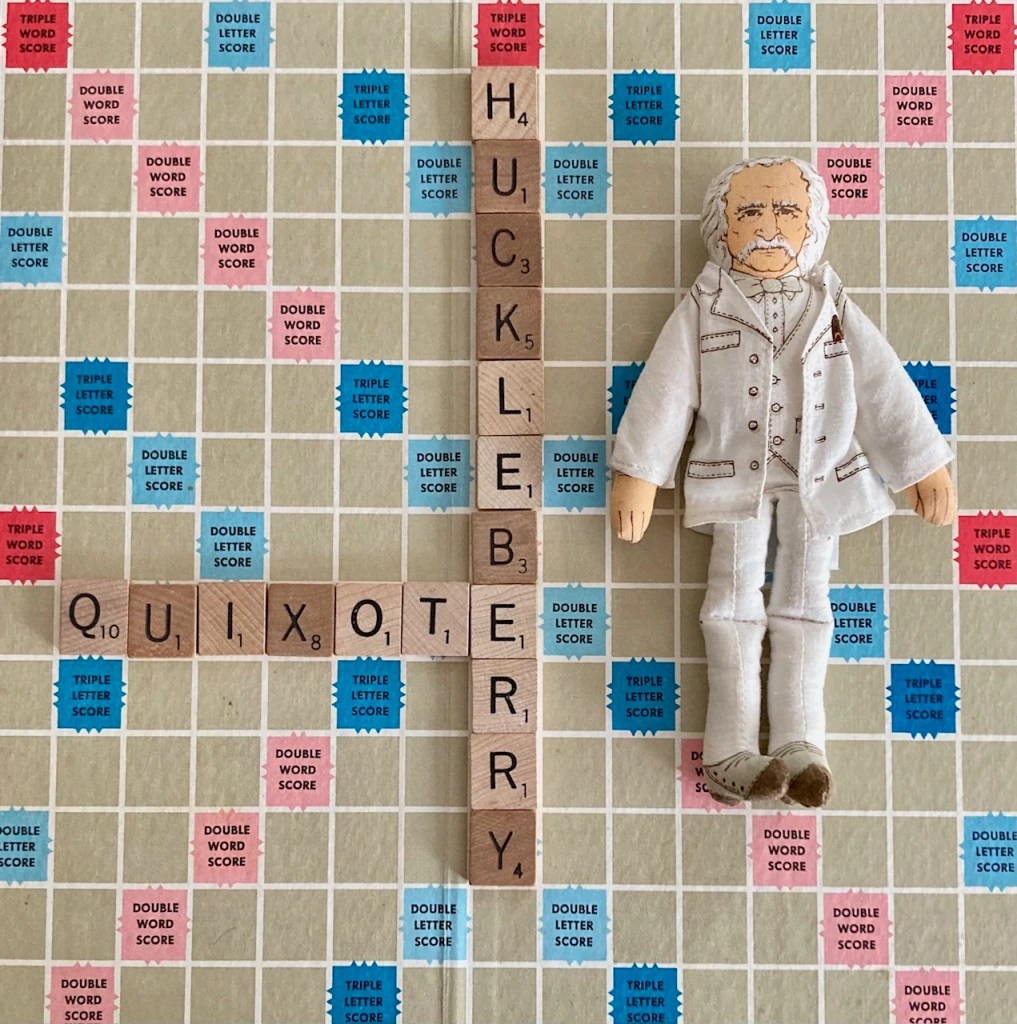
huckleberry: a berry like a blueberry (the first name of the title character in Mark Twain’s Adventures of Hucklebery Finn, 1884)
oedipal: describing libidinal feelings of a child toward the parent of the opposite sex (from the title character in Sophocles’ Oedipus Rex, c. 429 B.C.)
quixote: a quixotic, or extremely idealistic person; also quixotry, a quixotic action or thought (the title character in Michael de Cervantes’ Don Quixote, Part I: 1605, Part II: 1615)
Next Up
Your final assignment for the course will be your individual oral presentation, which you will deliver during the exam period. See my December 4 blog post, and the handout I distributed that day, for detailed instructions.
Today’s class period will be devoted to planning and preparation for your individual oral presentations, which you will deliver during the final exam period: 8 a.m., Saturday, December 9, for section 20 students; 8 a.m., Wednesday, December 13, for section 19 students.
As a finalist for a much-sought-after internship in your field, you are required to deliver a concise and engaging presentation that highlights your achievements in English 1103 and demonstrates your ability to effectively assume the responsibilities that the internship requires of you. Among the aspects of the course that you should address are one or more of your major writing assignments and the development of your critical thinking and collaboration skills. You are encouraged but not required to address additional aspects of the course.
Directions for Planning
Plan a brief presentation of five minutes or fewer that highlights your achievements in English 1103 and demonstrates your ability to effectively assume the responsibilities that the internship in your field requires of you.
Address one or more of your major writing assignments and the development of your critical thinking and collaboration skills. You are encouraged but not required to address additional aspects of the course.
Include the following in your presentation:
an opening in which you state your first and last names and your major,
concrete details in your blog that illustrate the development of your writing, your critical thinking, and your collaboration skills.
a close examination of one pertinent passage in your blog, and
a conclusion that provides closure and invites questions from the interview committee.
Directions for Rehearsing
In preparation for rehearsing, write your notes on index cards. If your notes are in complete sentences, rewrite them to include only words and short phrases for your key points. If your notes are too detailed, you will risk relying heavily on them and making minimal eye contact with the interview committee. Make as much eye contact as possible and be sure to make eye contact with committee members throughout the room rather than fixing your eyes on one or two people.
Familiarize yourself with the presentation station. Demonstrating that you are not adept at using the technology required for your presentation may jeopardize your chances for obtaining the internship. If you have not used the presentation station, I encourage you to devote part of today’s class period to familiarizing yourself with its setup.
Practice good posture. As you deliver your presentation, your ears should be directly above your shoulders. If you tend to shift your weight from one foot to the other—a distracting habit that’s sometimes called rocking the boat—stand with your feet perpendicular to each other. If you do, you will not be able to shift your weight from one foot to the other.
Avoid filler words, such as um, like, and you know. If you tend to use filler words, practice pausing at the points where you are likely to use fillers.
Rehearse with a classmate. Take turns delivering your presentations and offering feedback. Offer both suggestions for improvement and words of encouragement.
Next Up
Wordplay Day! To prepare for class, revisit the Dictionary and World Builder pages on the Scrabble website, and review the posts on my blog devoted to Scrabble tips.
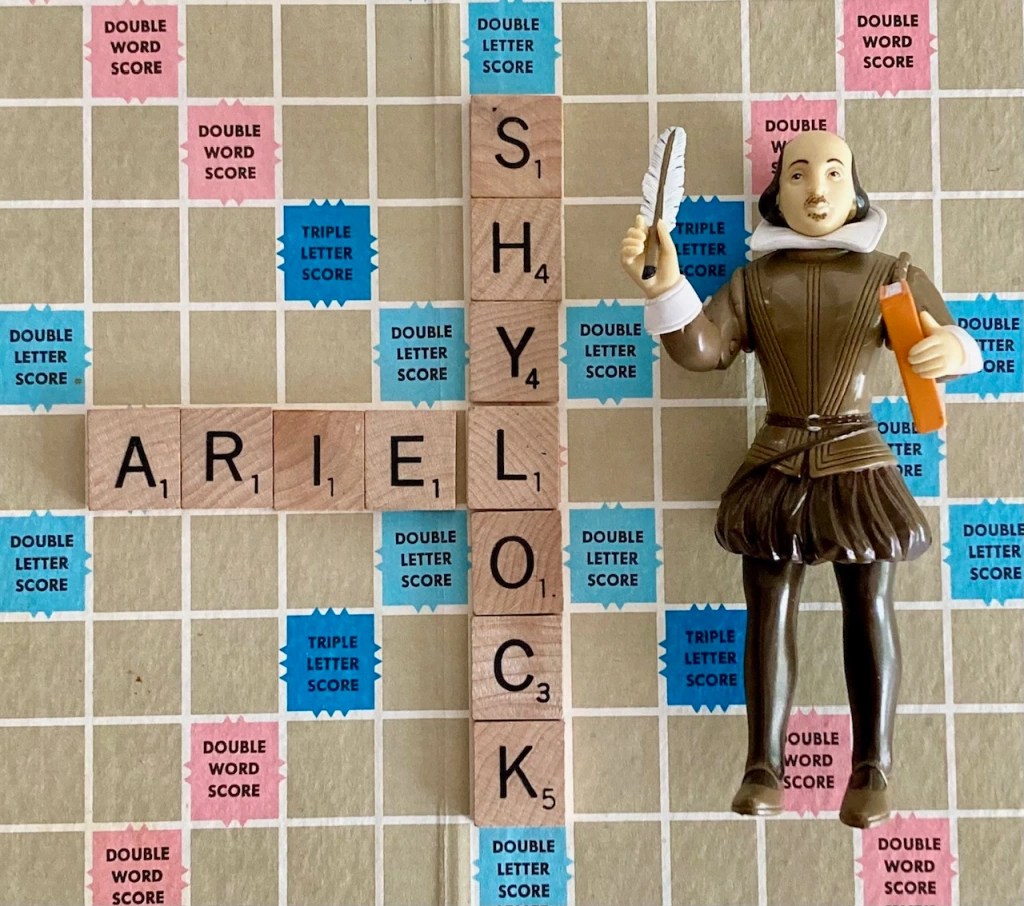
Today’s Scrabble post features Shakespeare characters whose names are also playable common nouns.
ariel: a gazelle found in Africa (Ariel, The Tempest, 1611-12)
dogberry: the fruit of a dogwood tree (Dogberry, Much Ado about Nothing, 1598-1599)
hamlet: a village (the title character of Hamlet, 1600-1601)
lear: learning (the title character of King Lear, 1605-1606)
puck: a disk used in ice hockey and other games (Puck, A Midsummer Night’s Dream, 1595-1596)
romeo: a seductive lover, a male lover (one of the title characters in Romeo and Juliet, 1594-1595)
shylock: to lend money with a high interest rate (Shylock, The Merchant of Venice, 1596-1597)
Next Up
Wordplay Day! To prepare for class, revisit the Dictionary and World Builder pages on the Scrabble website, and review the posts on my blog devoted to Scrabble tips, including this one.
Today in class you will plan and draft a short final reflective essay that documents your work in the second half of the semester, focusing on what you consider your most significant work and the feature or features of the course that have proven most beneficial to your development as a writer and a student. Features to consider include the following:
Planning, drafting, and revising your final essay and annotated bibliography. Since you recently composed a reflection on this assignment, it should not be the main focus of your final reflection.
Keeping a journal
Delivering your group presentation on one of the lessons in the Check, Please! course
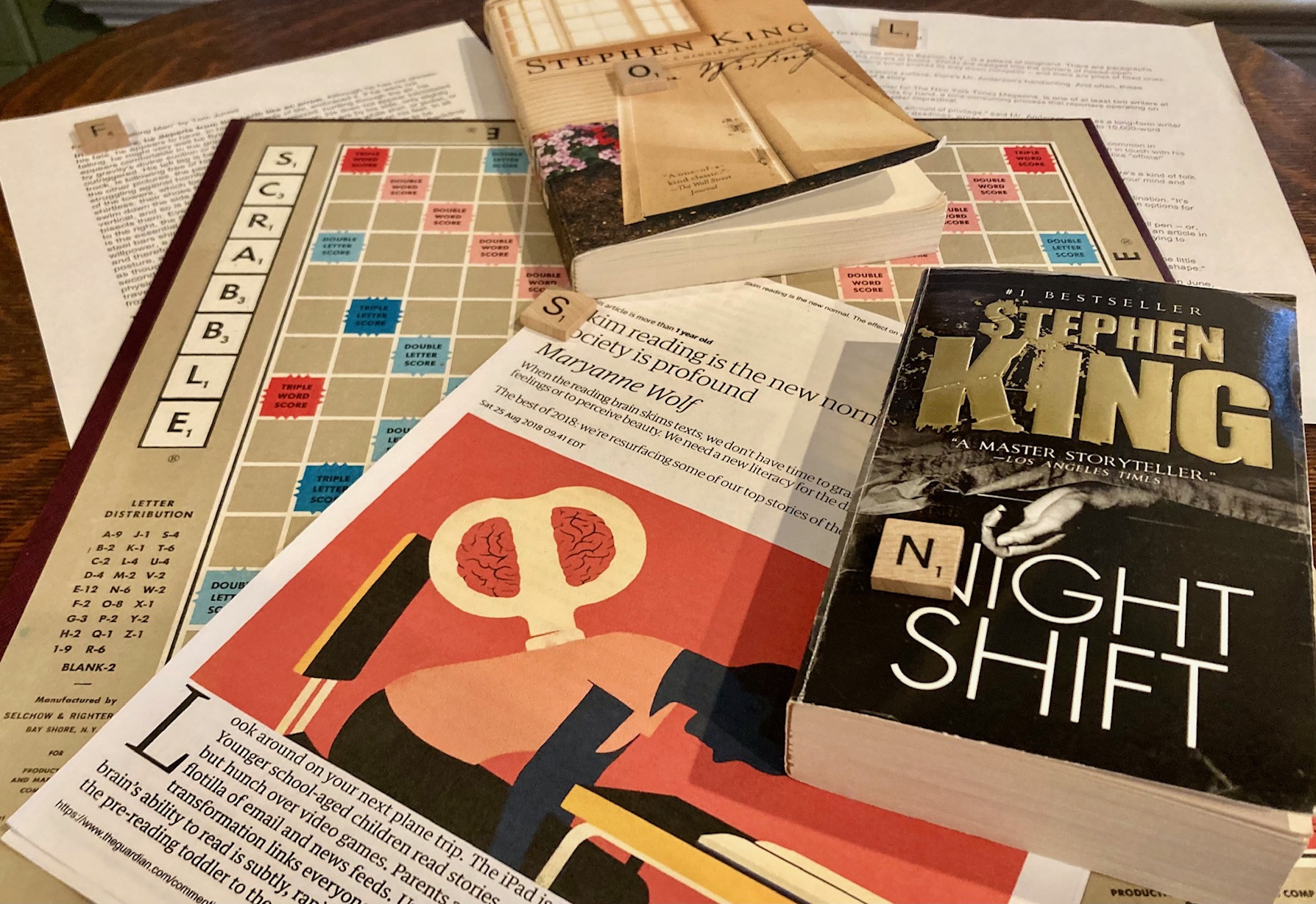
Studying one of the readings examined in the second half of the semester, including “The Case for Writing Longhand,” “Skim Reading is the New Normal,” “Strawberry Spring,” the excerpt from On Writing, or the sample final essay and annotated bibliography.
Writing for an online audience beyond the classroom/creating and maintaining a WordPress blog
Collaborating with your classmates on in-class writing assignments
Playing Scrabble/Collaborating with your teammates on Wordplay Day
Writing longhand
Limiting screen time
Include in Your Reflective Essay the Following Elements:
A title that offers a window into your reflection
An opening paragraph that introduces your focus and presents your thesis
Body paragraphs that offer concrete details from your work to support your thesis.
A relevant quotation from Writing Analytically or a relevant quotation from one of the texts that we have studied in class. Introduce your quotation with a signal phrase and follow it with a parenthetical citation.
A conclusion that revisits the thesis without restating it verbatim
Wordplay Day! To prepare for class, revisit the Dictionary and World Builder pages on the Scrabble website, and review the blog posts devoted to Scrabble tips,
Rosenwasser, David and Jill Stephen. “Integrating Quotations into Your Writing.” Writing Analytically, 8th edition. Wadsworth/Cengage, 2019. p. 231.
Yesterday in class, before you began your blog review, you revised two passages of student writing that integrated quotations from Writing Analytically. The original passages and my revised versions appear below. Return to these sample revisions as you continue to plan your final reflection. Note how I have integrated the quotations more gracefully, omitted unnecessary words, and eliminated passive voice and weak diction. Also note where I have corrected spelling and punctuation errors.
Original
The article “Integrating Quotes into your Paper” from Writing Analytically was the most helpful source that we were given. In the first paragraph of this article, it discusses, “An enormous amount of writers lose authority and readability because they have never learned how to correctly integrate quotations into their own writing.” (Rosenwasser/Stephen, 231)
Revision
In “Integrating Quotations Into Your Paper,” the most helpful section of the textbook, the authors note that “[a]n enormous amount of writers lose authority and readability because they have never learned how to correctly integrate quotations into their own writing” (Rosenwasser and Stephen 231).
Original
In Writing Analytically by David Rosenwasser and Jill Stephen in chapter eight the section on “Integrating Quotations Into Your Paper” helped me better understand how to do citations. In the reading Rosenwasser and Stephen addressed “always attach a quotation to some of your own language; never let it stand as its own sentence in you text” (Rosenwasser, Stephen 231).
Revision
“Integrating Quotations Into Your Paper” helped me better understand how to compose citations. In that section of the textbook, Rosenwasser and Stephen advise students to “[a]lways attach a quotation to some of your own language; never let it stand as its own sentence in your text” (Rosenwasser and Stephen 231).
Next Up
Tomorrow in class you will compose a short reflective essay focusing on the aspects of the course that have benefited you most in the second half of the semester.
Today’s class will be devoted to updating your blog, reviewing your classmates’ sites, and planning for the final reflection that you will compose in class on Wednesday. Devote the first half of class to updating your blog and reviewing your classmates’ sites. In the second half of the class, you will not be permitted to use your laptops, tablets, or phones. That time will be devoted to planning for your final reflection.
To update your blog, complete the check list below and make any necessary changes to your site.
All three of my major essay assignments (my literacy narrative, my analysis, and my final essay and annotated bibliography) are published on my blog.
My final essay and annotated bibliography assignment is the top post on my blog (followed by my analysis and my literacy narrative).
All three of the blog posts for my major essay assignments include an image that documents part of my writing process away from the screen.
All three of the blog posts for my major essay assignments include an embedded link to a relevant website.
I have corrected any errors of spelling, punctuation, grammar, mechanics, and style in my blog posts.
After you have updated your blog, devote the remainder of the first half of class to reviewing your classmates’ sites. You are encouraged, but not required, to type brief comments and/or like your classmates’ posts.
Directions for Planning Your Reflection
Review your class handouts and journal entries and determine what you consider your most significant work and the feature or features of the course that have benefited your development as a writer and a student. Features to consider include the following:
Planning, drafting, and revising your final essay and annotated bibliography. Since you recently composed a reflection on this assignment, it should not be the main focus of your final reflection.
Keeping a journal
Delivering your group presentation on one of the lessons in the Check, Please! course
Studying one of the readings examined in the second half of the semester, including “The Case for Writing Longhand,” “Skim Reading is the New Normal,” “Strawberry Spring,” the excerpt from On Writing, or the sample final essay and annotated bibliography.
Writing for an online audience beyond the classroom/creating and maintaining a WordPress blog
Collaborating with your classmates on in-class writing assignments
Playing Scrabble/Collaborating with your teammates on Wordplay Day
Writing longhand
Limiting screen time
You may focus on two, three, or four features of the course (but no more than four).
After you determine what features of the course you will address, select a minimum of one relevant quotation to integrate into your reflection. The quotation you include may be one from Writing Analytically or a relevant quotation from one of the texts that we have studied in the second half of the semester.
Next Up
In class on Wednesday, you will compose your final refelection for the course.
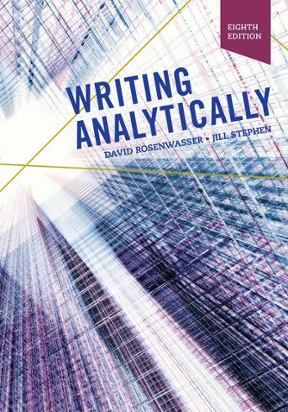
Rosenwasser, David and Jill Stephen. Writing Analytically, 8th edition. Wadsworth/Cengage, 2019.
Today in class you will read a classmate’s final essay and annotated bibliography and compose a response to it.
Directions
Go to the class blog page, https://janelucas.com/english-at-high-point/, and click on the link for the blog of the classmate whose name precedes yours on the roster. If you are first on the list, go to the blog of the student whose name is last on the list.
If the student’s blog is not accessible, email the student and ask that he/she/they email you a copy of his/her/their final essay and annotated bibliography. If the student does not respond, choose another classmate’s blog for review.
Read the classmate’s final essay and annotated bibliography and compose a response (75 words, minimum). If the essay or bibliography includes one of the nine basic writing errors (Rosenwasser and Stephen 341-68), include the specific error and identify it by name and number in your response. If the final essay and bibliography does not contain one of the nine basic writing errors, quote a line that you find particularly effective.
Does the blog post include an image that documents part of the blogger’s writing process away from the screen? ___ (yes or no)
Does the post include a relevant embedded link? ___ (yes or no)
Write your response on the handout provided in class.
After you have composed your handwritten response, type your response as a comment for the blogger. You should see a leave comment/reply option at the top or bottom of the post. If you do not see that option, click on the title of the blog post, and scroll down. You should then see leave comment/reply.
Submit the handwritten copy of your response at the end of class today. You will submit that handwritten copy because the blogger may not choose to make your comment visible. You will receive credit for this assignment only if you submit your handwritten copy at the end of class today.
Next Up
Next Monday’s class will be devoted to reviewing and updating your own blog and to planning for your final reflection, which you will compose in class on Wednesday, November 29.
Last week’s Scrabble post featured a list of toponyms (place names) in the first half of the alphabet. This post includes a list of toponyms in the second half. Learning these playable place names will broaden your vocabulary and up your game.
oxford: a type of shoe, also known as a bal or balmoral
panama: a type of wide-brimmed hat
paris: a type of plant found in Europe and Asia that produces a lone, poisonous berry
roman: a romance written in meter
scot: an assessed tax
scotch: to put an end to; or to etch or scratch (as in hopscotch)
sherpa: a soft fabric used for linings
siamese: a water pipe providing a connection for two hoses
swiss: a sheer, cotton fabric
texas: a tall structure on a steamboat containing the pilothouse
toledo: a type of sword known for its fine craftsmanship, originally from Toledo
wale: to injure, to create welts on the skin
warsaw: a type of grouper fish
waterloo: a definitive defeat
zaire: a currency of Zaire
Next Up
Monday marks our last class before Thanksgiving Break. Class activities TBA.
Today in class you will plan and draft a short reflective essay that documents your writing process and includes at least one relevant quotation from Writing Analytically or On Writing. Introduce your quotation with a signal phrase and follow your essay with a work cited entry for Writing Analytically or On Writing.
Sample Works Cited Entries
King, Stephen. “Toolbox.” On Writing. 2000. Pocket Books, 2001. pp. 123-24.
Rosenwasser, David and Jill Stephen. “Integrating Quotations into Your Paper.” Writing Analytically, 8th edition. Wadsworth/Cengage, 2019. pp. 231-33.
—. “Writing on Computers vs. Writing on Paper.” Writing Analytically, 8th edition. Wadsworth/Cengage, 2019. pp. 124-25.
Questions to Consider in Your Reflection
What aspect of the writing seemed the most challenging? Choosing your subject? Composing your annotations? Developing the final essay? Why did that aspect seem the most challenging?
Did your subject change? If so, what was your original subject, and why did you change it?
What do you consider the strongest element of your final essay and annotated bibliography?
At what point in the process did you decide on a title? Did you change the title during the writing process? If so, what was the original title?
What image that documents part of your writing process away from the screen did you include in your blog post? Why did you choose that particular image?
To which relevant website did you include an embedded link in your blog post?
Next Up
Wordplay Day! To prepare for class, revisit the Dictionary and World Builder pages on the Scrabble website, and review the posts on my blog devoted to Scrabble tips, including this one.
In October, when you were working on your analyses, I distributed a handout on quotations and parenthetical citations. As you continue to work on your final essays and annotated bibliographies, review that handout as well as the notes that follow.
If your source is an unpaginated text, your parenthetical citation will include the abbreviation par. for paragraph, followed by the paragraph number. If your source is a paginated text, your parenthetical citation will include the page number. Include the author’s last name before par. or the page number only if you do not name the author in the sentence.
Sample Quotations and Parenthetical Citations
The author of “The Falling Man” depicts the other victims who jumped from the Twin Towers as “look[ing] confused, as though trying to swim down the side of a mountain” (Junod par. 1).
In “The Falling Man,” Tom Junod depicts the other victims who jumped from the Twin Towers as “look[ing] confused, as though trying to swim down the side of a mountain” (par. 1).
The author of “Scrabble is a Lousy Game” claims that the game “treats language the way computers do–as arbitrarily ordered codes stored in a computer chip” (Kay par. 7).
In “Scrabble is a Lousy Game,” Jonathan Kay argues that the game “treats language the way computers do–as arbitrarily ordered codes stored in a computer chip” (par. 7).
“The Case for Writing Longhand” offers one journalist’s observation that “[t]he quality of the thinking and the writing feels higher to me when revising by hand” (Anderson qtd. in Bahr par. 13).
“The Case for Writing Longhand” offers Sam Anderson’s insight on the benefits of writing longhand as part of the revision process: “The quality of the thinking and the writing feels higher to me” (qtd. in Bahr par. 13).
In the samples above, brackets indicate an alteration. If you change the case of a letter or the tense of a verb, look to the sample quotations above with brackets as models.
The last two sample parenthetical citations in the list above include qtd. in because the words quoted are Sam Anderson’s, but the author of the article is Sarah Bahr.
If you omit words within a quotation, include an ellipsis. For example:
In “Skim Reading is the New Normal,” Maryanne Wolf asserts that “[w]e need to cultivate a . . . ‘bi-literate’ reading brain capable of the deepest forms of thought in either digital or traditional mediums” (par. 12).
Do not include an ellipsis at the beginning or end of a quotation to indicate an omission. When you are quoting a text, it’s understood that additional lines of text usually precede and follow the words you are quoting.
If you are quoting a text by two authors and do not include their names in the signal phrase, include their last last names in the parenthetical citation, followed by the page number or par. plus the paragraph number, for example: (Jones and Smith 3) or (Jones and Smith par. 5).
If you are quoting a text by three or more authors and do not include their names in the signal phrase, include the first author’s last name followed by et al. (Latin for “and the rest “) in the parenthetical citation, followed by the page number or par. plus the paragraph number, for example: (Lucas et. al 7) or (Lucas et al. par. 9).




 Jane Lucas