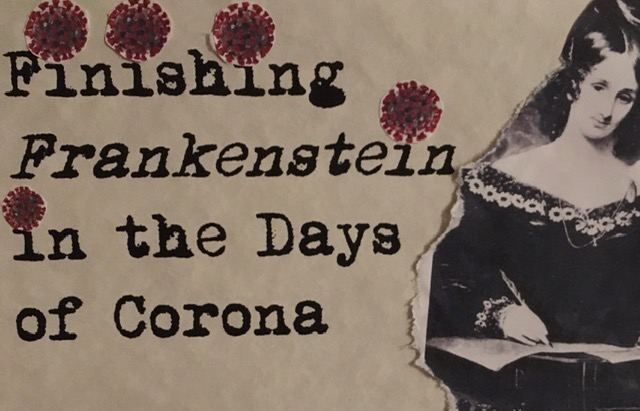
 Dear Readers,
Oscar-winning director Gillermo Del Toro first read Frankenstein when he was a fourteen-year-old growing up in Mexico. Mary Shelley’s novel transformed him. As we conclude our study of Frankenstein, consider these words of his:
I saved my Sunday allowance for a couple of weeks and bought it [the paperback]. I read it in one sitting, and by the end of it, I was weeping. It was my Road to Damascus. It illuminated the reason I love monsters, my kinship with them, and showed me how deep, how life-changing, a monster parable could be–how it could function as art and how it could reach across distance and time to become a palliative to solitude and pain.
And here we are, two centuries later, faithfully depositing flowers to this most exquisite storyteller, this extraordinary Galatea who refused to be shaped by her circumstances and gave us all life. And we try, in return, to help her creature stay alive. We strive to turn a curse into a blessing.
We hope that in some way, somehow, our gratitude, our love, can reach him like a whispered prayer, like a distant song. And we dream that perhaps he can stop–amid that frozen tundra and the screaming wind–and can turn his head and look back. At us.
And we hope that then he might recognize in our eyes his own yearning. And perchance we can walk toward each other and find meager warmth in our embrace.
And then, if only for a moment, we will not feel alone in the world. (xiv-xv)
Although Mary Shelley’s novel may not have transformed you as it did Del Toro, you are reading, or rereading, its final chapters as the COVID-19 pandemic transforms all of our daily lives.
- Have the unprecedented circumstances of the past two weeks altered your perceptions of Shelley’s novel? If so, how?
- If you’d rather not write about finishing Frankenstein in the days of coronavirus, write about one of the novel’s themes or one of the moments in the narrative that lingers in your mind.
- Or respond to Del Toro’s remarks.
Post your response of twenty-five words or more as a reply. If you address a point that one of your classmates has written in a previous reply, mention that classmate by name in your own reply. In the coming weeks we may turn back to some of your replies/comments as we study Dickens, Carroll, Stevenson, and Doyle.
Remember to check your CVCC email and Blackboard regularly for updates and assignments.
Sincerely Sequestered,
Dr. Lucas
Work Cited
Del Toro, Guillermo. Introduction. “Mary Shelley, or the Modern Galatea.” The New Annotated Frankenstein. By Mary Shelley, edited by Leslie S. Klinger, W. W. Norton, 2017, pp xi-xvii.
Postscript
 And the early-bird bonus points go to these CVCC Red Hawks: Grey Sacona, Caeley Arney, Madison St. Clair, Gabe Carswell, Chandler Danner, Lauren Setzer, Jenna Ramsey, Joshua West, Ruben Castillo, and Joe Van Story! Well Done!
 Chapter 22, “What We Whispered and What We Screamed,” marks a change in
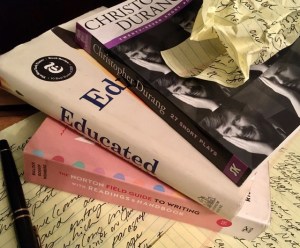
 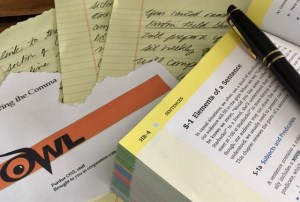 Your revised readings in The Norton Field Guide to Writing will prepare you for the six quizzes that you will complete during the remaining weeks of the semester. I selected the six subjects for the quizzes (words often confused, punctuation, precise words, active and passive voice, main points and support, and MLA documentation) based on patterns that I have identified in your essays. Most of the readings that will prepare you for the quizzes are in the yellow-edged Handbook section of Norton.
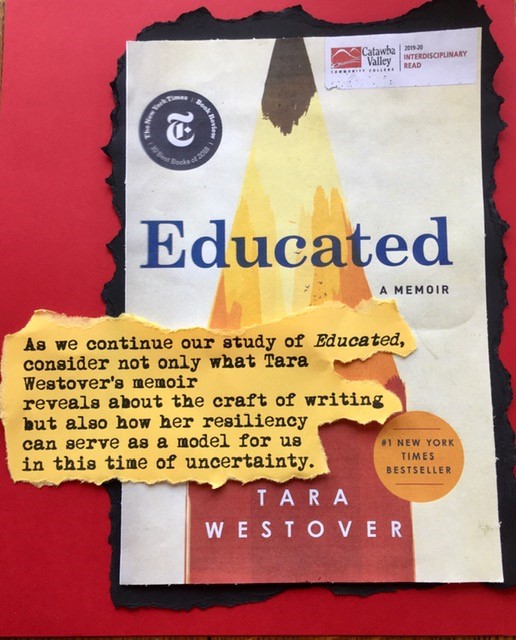 Wherever you are in your reading of Educated, I encourage you to look back at the pages where Tara Westover recounts her first days on campus at Brigham Young University (155-58). Stepping into the unfamiliar–as she was then and we are now–is always difficult.
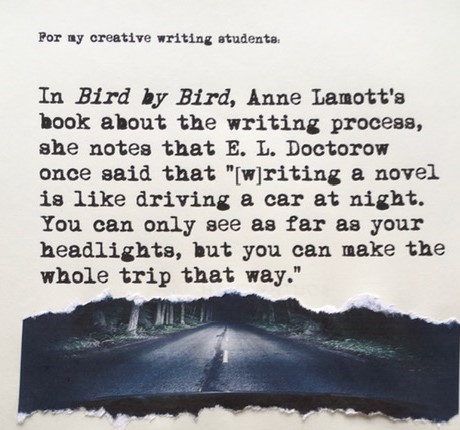 This post serves as both a welcome back note and a blog entry on the writer’s craft, the second one I’ve written with you. (I posted the first one on
  Another dovetail discovery occurred when my composition students were studying Chapter 11 of Tara Westover’s memoir, Educated. The latter half of that chapter, “Instinct,” depicts Westover’s brother Shawn reining in the frightened gelding, Bud, preventing him from throwing Tara.
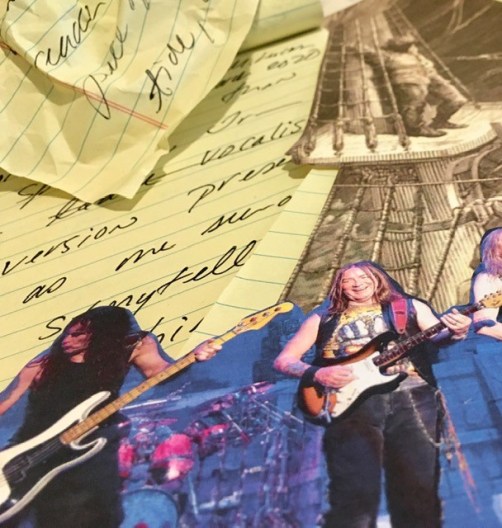 A sailor kills a bird of good omen, his destructive act dooms his shipmates and curses him with retelling the tale over and over: So the story of the Ancient Mariner goes. Yet those plot details convey neither the epic nature of Samuel Taylor Coleridge’s poem nor its influence on later writers. Only the poem itself places readers fully in the imaginative realm of the tale, but its late eighteenth-century diction creates a gulf between the poem and contemporary readers. Consequently, one of the challenges of introducing “The Rime of the Ancient Mariner” to millennial students is bridging that gulf. Iron Maiden’s adaptation offers one solution. By eliminating the shifts in the narrative voice and updating the story with contemporary language, their heavy-metal version draws listeners into the story with emphatic rhythms that capture the spirit of the original lines.
 Iron Maiden’s adaptation eliminates those issues with updated diction and a consistent narrative voice. Rather than shifting speakers, Iron Maiden’s version presents the tale sung by a single storyteller, not the sailor himself, but a narrator who tells listeners to “[h]ear the rime of the ancient mariner” (1). Those first words of the song, penned by lead singer Bruce Dickinson, form an imperative sentence: a command with the understood subject “you”—“[You] hear the rime . . . ” (1). I am master and commander of this story, Dickinson seems to say, and you will hear it now. Such is the power of the imperative. Rather than leaving the reader questioning, as Coleridge’s first stanzas may, Iron Maiden’s song speaks directly to listeners, taking hold of them with the pull of a powerful tide, drawing them out to sea to witness the Mariner as he kills the albatross and seals his fate.
 A flannel shoe bag, a pile of mini craft sticks, and a repurposed Q-Tip travel box: These items are in my hands most days. They’re often in the hands of my students as well. Any of them who walk into the classroom early—before the beginning of the hour—and spot the bag and the box of sticks on the front desk know that they’ll be working in groups that day, at least for part of the class period. Their job, if they choose to volunteer, is to make random groups by drawing sticks, which are labeled with the students’ names.
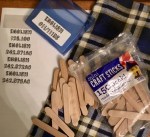 To me, all of these noises are sounds of collaboration and community building, of students not sitting passively but instead taking an active role in preparing for class. A flannel shoe bag, a pile of mini craft sticks, and a repurposed Q-Tip travel box: In the classroom these are small, good things.
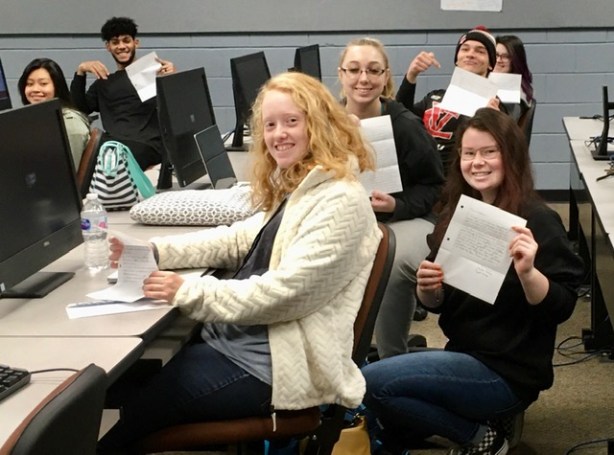 More than twenty years ago, in August of 1997, National Public Radio’s Morning Edition featured a story about Nancy Johnson, a second- and third-grade teacher who gave her students the assignment of writing letters to themselves, letters that covered such details as “their favorite toys, what makes them different from other kids and what they want to do in the future” (Morning par. 1). Johnson collected the letters and mailed them back to her pupils at the end of their senior year of high school. As I pictured Nancy Johnson’s eighteen-year-old students reading the words written by their seven- and eight-year-old selves, I began wondering how I might create a similar letter-writing experience for my college students. Following Johnson’s model wouldn’t be practical. My students’ addresses would change repeatedly throughout their twenties; I doubted that many of their letters would find their way back to them. Rather than requiring pieces of writing that might end up at the dead letter office, I crafted an alternate assignment. I required my students to write to themselves at the beginning of the semester, and I returned their letters to them on the last day of class.
 I was thinking about that last spring—how few of my students receive snail mail and how I wished more of them received replies—when it occurred to me that retirement communities offered potential pen pals—people who might not only welcome snail mail from college students but who might also write them back. Margaret Shepherd, author of The Art of the Handwritten Note, recommends that if you don’t know whom to write snail mail to, “reach out to deserving strangers” (qtd. in
  When the students composed their letters in class, some asked when they would receive a reply. I could only tell them, I don’t know when you will, or if you will. After a month passed and I hadn’t heard from Abernethy Laurels, it occurred to me that the activities director may have been overwhelmed by the number of letters she received, forty-one in all. And what if the residents didn’t want to write back? Or what if some wanted to reply, but couldn’t? I imagined the activities director transcribing letter after letter for residents with arthritic hands. If I had given her a formidable task, I didn’t want her to feel compelled to complete it. If I phoned or emailed to request an update, I might put her in an awkward position. So I waited until the first week of November to email her. She replied that the residents had responded to thirty-five of the letters and would soon complete responses to the remaining six.
 Jane Lucas