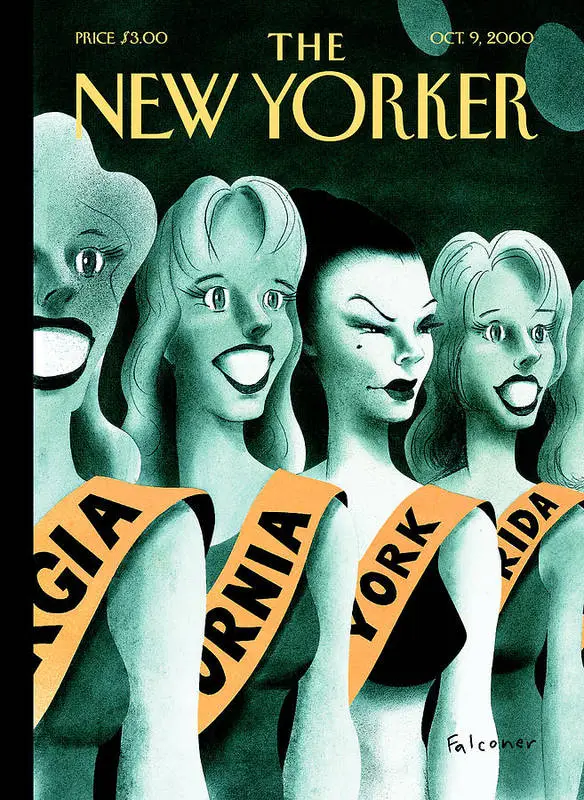
Monday in class, after you examined Ian Falconer’s New Yorker cover The Competition, you studied Tetsuya Ishida’s painting Seedlings (1998) and chose one of those two visual texts as the subject of a writing exercise: a paragraph of summary followed by a paragraph of analysis. That exercise served both as a departure from your study of written texts and as additional writing practice. The summary and analysis of Seedlings that I wrote as samples for you appear below.
Summary
Tetsuya Ishida’s painting Seedlings depicts a classroom of uniformed teenagers, all males, whose teacher, seen only from the shoulders down, holds a textbook in one hand. The teacher drapes his other hand on the head of one of the pupils, one of two students presented as microscopes with human faces.
Analysis
Although the subject at hand is biology, the study of living organisms, the student seedlings barely seem alive themselves as they stare blankly into the distance. The uniformity Ishida depicts, with their haircuts, crested blazers, striped neckties, and rows of desks, takes a surrealistic twist with the images of the two pupils who have transformed into microscopes. By placing the teacher’s hand on one of the students-turned-microscope, Ishida indicates that the instructor—himself objectified by the absence of his head—approves of the metamorphosis. For him, the goal of education seems to be that transformation: for the individual to be consumed by the device of study itself, to become a cold, metallic instrument.
As I noted in class yesterday, you will have the opportunity to revisit The Competition or Seedlings, or both, in the final reflection that you will compose next Monday.
This morning in class, you will plan and compose a reflective essay that documents your writing process and includes at least one relevant quotation from Writing Analytically or one of the articles included in your bibliography. You will introduce your quotation with a signal phrase and follow your essay with a works cited entry.
Questions to Consider in Your Reflection
What aspect of the writing seemed the most challenging? Locating relevant sources? Composing your annotations? Developing the final essay? Why did that aspect seem the most challenging?
Did your subject change? If so, what was your original subject, and why did you change it?
What do you consider the strongest element of your final essay and annotated bibliography?
At what point in the process did you decide on a title? Did you change the title during the writing process? If so, what was the original title?
What image that documents part of your writing process away from the screen did you include in your blog post? Why did you choose that particular image?
To which relevant website did you include an embedded link in your blog post?
Sample Quotations with Signal Phrases
The authors of Writing Analytically advise writers to “frame material with a phrase such as ‘according to Sprayberry’ or ‘as Gruen argues'” (Rosenwasser and Stephen 344).
Rosenwasser and Stephen advise writers to “frame material with a phrase such as ‘according to Sprayberry’ or ‘as Gruen argues'” (344).
The parenthetical citation in the first sample above includes the authors’ last names because they are not named in the sentence. The parethetical citation in the second sample above does not include the authors’ last names because they are named in the sentence.
Sample Works Cited Entries
Rosenwasser, David and Jill Stephen. “Integrating Quotations into Your Paper.” Writing Analytically, 9th edition. Wadsworth/Cengage, 2024. pp. 343-46.
—. “Two Methods for Conversing with Sources.” Writing Analytically, 9th edition. Wadsworth/Cengage, 2024. p. 325.
—. “Ways to use a Source as a Point of Departure.” Writing Analytically, 9th edition. Wadsworth/Cengage, 2024. p. 326.
Note that your work cited entry in your reflection–and all of the work cited entries and bibliographic entries except for the ones on your blog–should have a hanging indent.
Journal Exercise
Time permitting, you will have the opportunity to begin an exercise that you should complete in your journal no later than Monday, November 24, before class.
Falconer, Ian. “The Competition.” Writing Analytically by David Rosenwaser and Jill Stephen, 9th edition, Wadsworth/Cengage, 2024. p. 108.
Yesterday in class, you and two or three of your classmates collaboratively examined Ian Falconer’s The Competition and Kazuo Ishiguro’s Seedlings. Afterward, you chose one of the two as the subject for an individual two-paragraph exercise in composing summary and analysis.
Below are three sample paragraphs that I wrote as models for you. The first is a summary of Falconer’s cover. The second and third offer close readings of the magazine cover. Each integrates one of the two interpretations that the authors of Writing Analytically offer. You were not required to address the textbook authors’ interpretations in your own analysis. I included them in the samples below because they serve as models for integrating a source’s commentary into your analysis, models you may want to follow if you choose to write about The Competition in your final reflection for the course.
Summary
Ian Falconer’s mostly black-and-white New Yorker cover The Competition depicts four beauty pageant contestants, three of whom stand in stark contrast to Miss New York. Her dark hair, angular body, narrowed eyes, tightly pursed lips, and two-piece bathing suit set her apart from the nearly identical blondes–Miss Georgia, Miss California, and Miss Florida–whose wide-open eyes and mouths and one-piece bathing suits are typical of pageant contestants.
Analyses
The contrast between the raven hair and eyes of Miss New York and the platinum-blonde and pale-eyed contestants from Georgia, California, and Florida suggests what the authors of Writing Analytically present as the first of two possible interpretations: The cover “speak[s] to American history, in which New York has been a major point of entry for generations of immigrants, embracing diversity and conformity, while viewing the rest of the nation as more homogenous” (Rosenwasser and Stephen 112).
The self-satisfied expression of Miss New York suggests what the authors of Writing Analytically present as the second of two possible interpretations: “[T]he magazine is . . . admitting, yes America, we New Yorkers do think that we’re cooler and more individual and less plastic than the rest of you, but we also know that we shouldn’t be so smug about it” (Rosenwasser and Stephen 112).
Work Cited
Rosenwasser, David and Jill Stephen. “Making an Interpretation: The Example of a New Yorker Cover.” Writing Analytically, 9th edition. Wadsworth/Cengage, 2024. pp. 107-112.
As you continue to work on your final essay and annotated bibliography, review these samples as models for your own summaries and close readings of your sources.
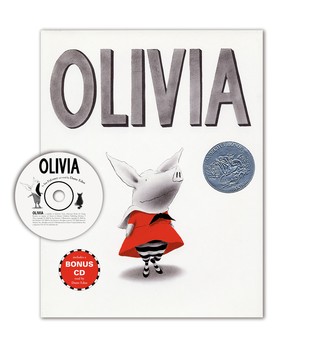
If the style of Ian Falconer’s New Yorker cover seems familiar to you, it may be because you encountered his work when you were a child. His book Olivia, published in 2000, received the 2001 Caldecott Medal, an award the Association for Library Service bestows upon the book they deem the best children’s picture book of the year. Falconer followed Olivia with several sequels, including Olivia Saves the Circus and Olivia Helps with Christmas.
Thursday’s blog post will offer a second look at the other visual text we examined yesterday: Tetsua Ishida’s painting Seedlings.
. . . Continuing Your Revisions
As you continue to revise, refer to the checklist I distributed in class, and have included below, to ensure that your essay and bibliography comply with all assignment requirements.
Final Essay
Presents the subject of the bibliography and the purpose for compiling it; in other words, what drives the research, and what question do you seek to answer?
Addresses all your sources at least briefly and quotes a minimum of two of them.
Introduces quotations with signal phrases and follows them with parenthetical citations. The only exception to the parenthetical citation rule is any quotation from the peer interview.
Concludes with a paragraph that mentions a larger project that might develop from it, in what discipline that project might be produced, and what would serve as its theoretical framework.
Annotated Bibliography
Each entry begins with a complete MLA-style bibliographic citation.
Each bibliographic citation is followed by three paragraphs: one of summary, a second of commentary, and a third that includes the author’s credentials.
The commentary paragraphs do not simply restate the information in the summaries but instead demonstrate the usefulness of the sources to researchers and make some connections among them. You are not required to mention another source in each commentary, but you should aim to do so at least once.
The sources in the bibliography are alphabetized by the authors’ last names.
MLA Style
The file’s font is twelve-point Times New Roman, including the running header.
The running header, which includes your last name and the page number, appears one-half inch from the top of the page, on the right side.
All required first-page information is included in the upper left.
The file is double-spaced, with no extra space between any sections.
All paragraphs are indented five spaces, or one-half inch.
All bibliographic citations have hanging idents; in other words, their formatting is the opposite of a conventional paragraph. (The first line is flush left, and any subsequent lines are indented.)
Next Up
Tomorrow in class, you will compose a reflective essay that focuses on the processes of planning, drafting, and revising your final essay and annotated bibliography. The due date for your revision is tomorrow, before class, but you have until the hard deadline, Friday, November 21, before class, to post your revision to Blackboard and publish it on your WordPress blog.
If you are still revising your essay and bibliography tomorrow, in your reflection, you will refer to your writing as ongoing.
In your reflection, you will include a minimum of one relevant quotation from Writing Analytically or from one of the sources included in your bibliography. Before class, identify the passage you plan to quote, and draft a sentence with it in your journal. Also, be sure to write in your journal a complete MLA-style work cited entry for the source you plan to quote. That preparation will ensure that you have ample time to integrate the quotation into your reflection and compose your work cited entry before the end of Wednesday’s class period. You will not have the option to refer to your essay online, so a handwritten version of the information you’ll need is essential.
This morning in class, after your Scrabble debriefing, we will examine the model final essay and annotated bibliography, “Scrabble as a Game Changer in the College Classroom,” which appears below.
Scrabble as a Game Changer in the College Classroom
Earlier this month, when I reread Jonathan Kay’s Wall Street Journal op-ed feature “Scrabble is a Lousy Game,” I once again meditated on his criticism of Scrabble as a word game that deemphasizes semantics. In Kay’s words, “Scrabble treats language the way computers do—as arbitrarily ordered codes stored in a memory chip” (par. 7). I asked myself, If I want my students to play a board game that cultivates word power, collaboration, and critical thinking skills, is Scrabble the game to choose? Thus, Kay’s review became the starting point for my research on the benefits of Scrabble play. As I scrolled through search results, I found not only articles that specifically addressed Scrabble in the college classroom but also many that focused on the value of the game itself for sharpening the mind.
The bibliography that follows includes Kay’s review, the starting point for my research, four refereed research articles, and two interviews with former students of mine. Three of the four refereed articles offer windows into the classrooms of professors who have incorporated Scrabble play into their curricula: an English professor at California State University-Monterey Bay, a professor of Christian education at MidAmerica Nazarene University, and a professor of engineering at Tomsk Polytechnic University in Russia. The fourth article addresses cognitive evaluations of competitive Scrabble players and what they reveal about how experience shapes word recognition.
Though Kay’s criticism of Scrabble warrants reconsidering the inclusion of Scrabble in my first-year writing classes, his disapproval of the game stems from the practices of tournament-level players, not people for whom the game is a pastime—or from students, like mine, who play Scrabble as a classroom exercise. It’s also notable that collaboration, which is an essential component of team Scrabble, does not factor in Kay’s review.
In “Tabletop Games and 21st Century Skills Practice in the Undergraduate Classroom,” Mark Hayse and his colleagues who participated in the study report “that tabletop gameplay helped students move from classroom passivity to classroom ‘engagement’” (298). My own students did not address engagement in their interviews with me—though their engagement is evident during Scrabble play—but instead focused on vocabulary building and the relationship of the game to the composing process. Jesse Brewer noted that the game has “introduced [him] to new words,” and Ava Salvant observed that the game has “[p]robably influenced [her] ability to write.”
How much does Scrabble play cultivate our word power? The answer to that question remains unclear, but the research of psychologists and educators points to the merits of team Scrabble for improving not only our language skills but also our facility with critical thinking, team-building, and spatial skills.
As I review the research on Scrabble that I have outlined here, I envision it as groundwork for a larger project, one in which I would use the theoretical framework of composition studies to examine the benefits of incorporating Scrabble play into the first-year writing curriculum. Such a project could be an interdisciplinary one since some of the skills the game promotes, such as collaboration and problem solving, are key to a variety of disciplines. Whether I undertake that project, the knowledge that I have gained will inform my teaching as I continue to seek ways to improve my students’ quality of learning through opportunities for wordplay in the classroom.
Annotated Bibliography
Brewer, Jesse. Interview. Conducted by Jane Lucas. 20 Oct. 2023.
English 1103 student Jesse Brewer recounts how he has played Scrabble for most of his life. Ever since he was a young child, he has played the game with his grandparents whenever he visited their home in Pennsylvania. Brewer will continue to play Scrabble after the end of the semester because the game remains a tradition in his family. In his words, “[M]y grandmother is still going to want to play it every summer.” Brewer also notes how the game has expanded his vocabulary, saying it has “introduced me to new words, which allows me to read and write more capably in everyday life.”
Brewer’s remarks on vocabulary building highlight the game’s verbal benefits, and his observations on Scrabble as a family tradition serve as a point of contrast to that of some other students’—such as Ava Salvant’s—who had not played Scrabble before playing it as a weekly exercise in English 1103.
Brewer is a junior computer science major at High Point University, where he was enrolled in English 1103, section 20, in 2023.
“Critical Habits of Mind” addresses the teaching practices of a group of college math and writing faculty who collaborated to develop lessons to foster intellectual capacities, such as motivation and self-efficacy. Developmental educational instructors from three California colleges, Cabrillo College, California State University-Monterey Bay, and Hartnell College, partnered to pilot classroom activities, including clicker technology, peer writing review, improvisation, metacognitive writing activities, and Scrabble Fridays. Reflecting on their collaboration, Fletcher observes that foregrounding procedural knowledge, as their pilot activities did, enabled them to couple their teaching of discipline-specific content with the set of behaviors essential to teaching and learning. Fletcher notes that Hetty Yelland, who devotes her Friday classes to Scrabble play, observes “the extra effort students have to make to overcome the boredom—and their passive word knowledge . . . eventually leads to more active and internalized language practices” (54).
Fletcher’s account of Hartnell writing instructor Hetty Yelland’s Scrabble Fridays is of particular value to education researchers and teachers considering Scrabble play as a classroom activity that dovetails with discipline-specific content and also fosters foundational learning skills.
Jennifer Fletcher is a professor of English at California State University, Monterey Bay. Her books include Teaching Arguments, Teaching Literature Rhetorically, and Writing Rhetorically.
“How a Hobby Can Shape Cognition” presents the findings of Canadian researchers inthe Departments of Psychology and Medicine at Calgary University who investigated how the word recognition skills of competitive Scrabble players differed from those of age-matched nonexperts. The researchers’ cognitive evaluations revealed differences only in Scrabble-specific skills, such as anagramming. Also, the researchers observed that Scrabble expertise was associated with two specific effects: vertical fluency and semantic deemphasis. The study’s results indicate that experience shapes visual word recognition.
The research of Hargreaves and his former colleagues at Cardiff is pertinent to educators who seek to understand the cognitive benefits of frequent Scrabble play. Notably, the semantic deemphasis that the study identifies—and that Jonathan Kay addresses in his commentary—contrasts the gains in language skills that Hetty Yelland observes in her students.
Ian Hargreaves is professor emeritus of journalism, media, and culture at Cardiff University and one of the contributors to A Manifesto for the Creative Economy, a ten-point plan for bolstering creative industries.
Hayse, Mark. “Tabletop Games and 21st Century Skill Practice in the UndergraduateClassroom.” Teaching Theology & Religion, vol. 21, no. 4, 2018, pp. 288–302., https://onlinelibrary-wiley-com.libproxy.highpoint.edu /doi/epdf/10.1111/teth.12456.
“In Tabletop Games and 21st Century Skill Practice in the UndergraduateClassroom,” the research of Mark Hayse and his colleagues is guided by the primary research question, “Does tabletop gameplay require the practice of 21st century skills?” (290), and their secondary question, “What initial links might be drawn between tabletop gameplay, 21st century skill practice, and undergraduate learning?” (290). All three professors reported “that tabletop gameplay helped students move from classroom passivity to classroom ‘engagement’” (298) and that “[e]ven though tabletop gameplay technically was coursework . . . the nontraditional nature of it seemed to render it as play more than work” (298).
Hayes’s findings are useful for researchers interested in how incorporating table-top game play into college curricula fosters such twentieth-first century skills as critical thinking and problem solving, creativity and innovation, communication, and collaboration. His findings are also of particular value to educators considering adding table-top game play to their secondary- or post-secondary courses.
Mark Hayse is Director of the Honors Program and Mabee Library Professor at MidAmerica Nazarene University. His other publications include an essay on the World of Warcraft, a study of the video game featured in the collection Don’t Stop Believin’: Pop Culture and Religion from Ben Hur to Zombies, edited by Robert K. Johnston, Craig Detweiler, and Barry Taylor.
Kay, Jonathan. Review. “Scrabble is a Lousy Game.” The Wall Street Journal, 4 Oct. 2018. ProQuest, https://libproxy.highpoint.edu/login?url=https://www.proquest.com /newspapers/scrabble-is-lousy-game-why-would-anyone- play/docview/2116081665/se- 2?accountid=11411.
In “Scrabble is a Lousy Game,” writer and editor Jonathan Kay criticizes Scrabble for its lack of emphasis on semantics. In Kay’s words, the game “is like a math contest in which you are rewarded for reciting pi to the 1,000th decimal place but not knowing that it expresses the ratio of a circle’s circumference to its diameter” (par. 5). Kay asserts that the best board games for casual players involve a mix of luck and skill and recommends two other board games, Codenames and Paperback, as better options for wordplay.
While Kay’s review focuses on the competitive player’s approach to Scrabble, the concerns he raises about the game’s deemphasis of word meaning and the frustration that novice players can experience warrant the attention of educators who are researching the potential drawbacks of introducing Scrabble play into their classrooms.
Jonathan Kay is senior editor of the journal Quillette and the author of Your Move: What Board Games Teach Us About Life.
Kobzeva, Nadezda. “Scrabble as a Tool for Engineering Students’ Critical Thinking Skills and Development.” Procedia: Social and Behavioral Sciences, no. 182, 2015, pp. 369-74. ScienceDirect, https://www.sciencedirect.com/ science/article/pii/S1877042815030669.
“Scrabble as a Tool for Engineering Students’ Critical Thinking Skills and Development” presents research involving second-year engineering students and teachers of EFL (English as a Foreign Language) at Tomsk Polytechnic University in Tomsk, Russia. The students, all non- native speakers of English, played Scrabble as an in-class and out-of-class-activity for oneacademic year. At the end of the year, the best six student players competed in teams in a tournament against two teams of the six EFL teachers. Throughout the tournament—which was conducted outside of the classroom to relieve students of the pressure to obtain a high score—the researcher, Nadezda Kobzeva, observed the contrast in the students’ and teachers’ practices as players. While the EFL instructors possessed an advanced knowledge of English language, they were newcomers to Scrabble. On the other hand, the engineering students with limited knowledge of English relied on the skills they developed throughout their year-long Scrabble program. In the feedback the students provided after the tournament, which they won, the majority rated the skills they developed as Scrabble players as excellent in all five fields assessed, including team building, thinking, spatial skills, vocabulary, and spelling.
Kobzeva focuses her research on engineering students, but her findings are also valuable to researchers and teachers in other fields who seek answers to the questions of how Scrabble can be used effectively as a learning tool, and what specific skills students may develop through frequent play. Unlike Mark Hayse’s findings, which focus exclusively on the twenty-first century skills, known as the 4Cs, Kobzeva’s research highlights other skills that students develop—in particular the Russian engineering students’ (non-native speakers of English) greater facility with the English language.
Nadezda Kobzeva is a professor of engineering at Tomsk Polytechnic University. Her other research articles include “Ontology of Key Metasigns in Translatology,” published in V Mire Nauchnykh Otkrytii (In the World of Scientific Discoveries).
Salvant, Ava. Interview. Conducted by Jane Lucas. 23 Oct. 2023.
English 1103 student Ava Salvant reveals that she had never played a game of Scrabble before playing it as a weekly exercise in English 1103. She also notes that the game has “[p]robably influenced [her] ability to write because not always when you sit down to write do you know the exact words that you want to say. You kind of have to go with the flow and put down as many words as you can on the board in Scrabble or on the paper in writing.”
Salvant’s observations as a novice Scrabble player underscore the similarities between game play and the writing process, and they also serve as a point of contrast to that of some other students’—such as Jesse Brewer’s—who bring years of Scrabble experience to their first-year writing class.
Ava Salvant is a junior neuroscience major at High Point University, where she was enrolled in English 1103, section 19, in 2023.
“The Competition” and “Seedlings”
After we examine “Scrabble as a Game Changer in the College Classroom,” you and your classmates will collaboratively examine Ian Falconer’s The Competition and Kazuo Ishiguro’s Seedlings. Afterward, you will individually compose a one-paragraph summary followed by a second paragraph of commentary on one of the two (The Competition or Seedlings, not both).
Your study of Falconer’s magazine cover and Ishiguro’s painting serves as both a departure from your focus on written texts and as additional practice in summary and analysis.
Next Up
In class on Wednesday, you will compose a reflective essay that focuses on the processes of planning, drafting, and revising your final essay and annotated bibliography. The due date for your revision is Wednesday, November 19, before class, but you have until the hard deadline, Friday, November 21, before class, to post your revision to Blackboard and publish it on your WordPress blog.
If you are still revising on Wednesday, in your reflection, you will refer to your writing as ongoing.
In your reflection, you will include a minimum of one relevant quotation from Writing Analytically or from one of the sources included in your bibliography. Before Wednesday’s class, identify the passage you plan to quote, and draft a sentence with it in your journal. Also, be sure to write in your journal a complete MLA-style work cited entry for the source you plan to quote. That preparation will ensure that you have ample time to integrate the quotation into your reflection and compose your work cited entry before the end of Wednesday’s class period. You will not have the option to refer to your essay online, so a handwritten version of the information you’ll need is essential.
The last Scrabble post featured a list of toponyms (place names and words derived from places) in the first half of the alphabet. Today’s post includes a list of toponyms in the second half. These proper nouns are playable in Scrabble because they’re also common nouns. Studying them offers you additional opportunities to broaden your vocabulary and up your game.
oxford: a type of shoe, also known as a bal or balmoral
panama: a type of wide-brimmed hat
paris: a type of plant found in Europe and Asia that produces a lone, poisonous berry
roman: a romance written in meter
scot: an assessed tax
scotch: to put an end to; or to etch or scratch (as in hopscotch)
sherpa: a soft fabric used for linings
siamese: a water pipe providing a connection for two hoses
swiss: a sheer, cotton fabric
texas: a tall structure on a steamboat containing the pilothouse
toledo: a type of sword known for its fine craftsmanship, originally from Toledo
On Monday, after your Scrabble debriefing, we will examine my model essay and bibliography, “Scrabble as a Game Changer in the College Classroom,” which you should read and annotate before class. Also, be sure to bring your copy of Writing Analytically to class. You will need your textbook for both the collaborative and individual exercises that you will complete.
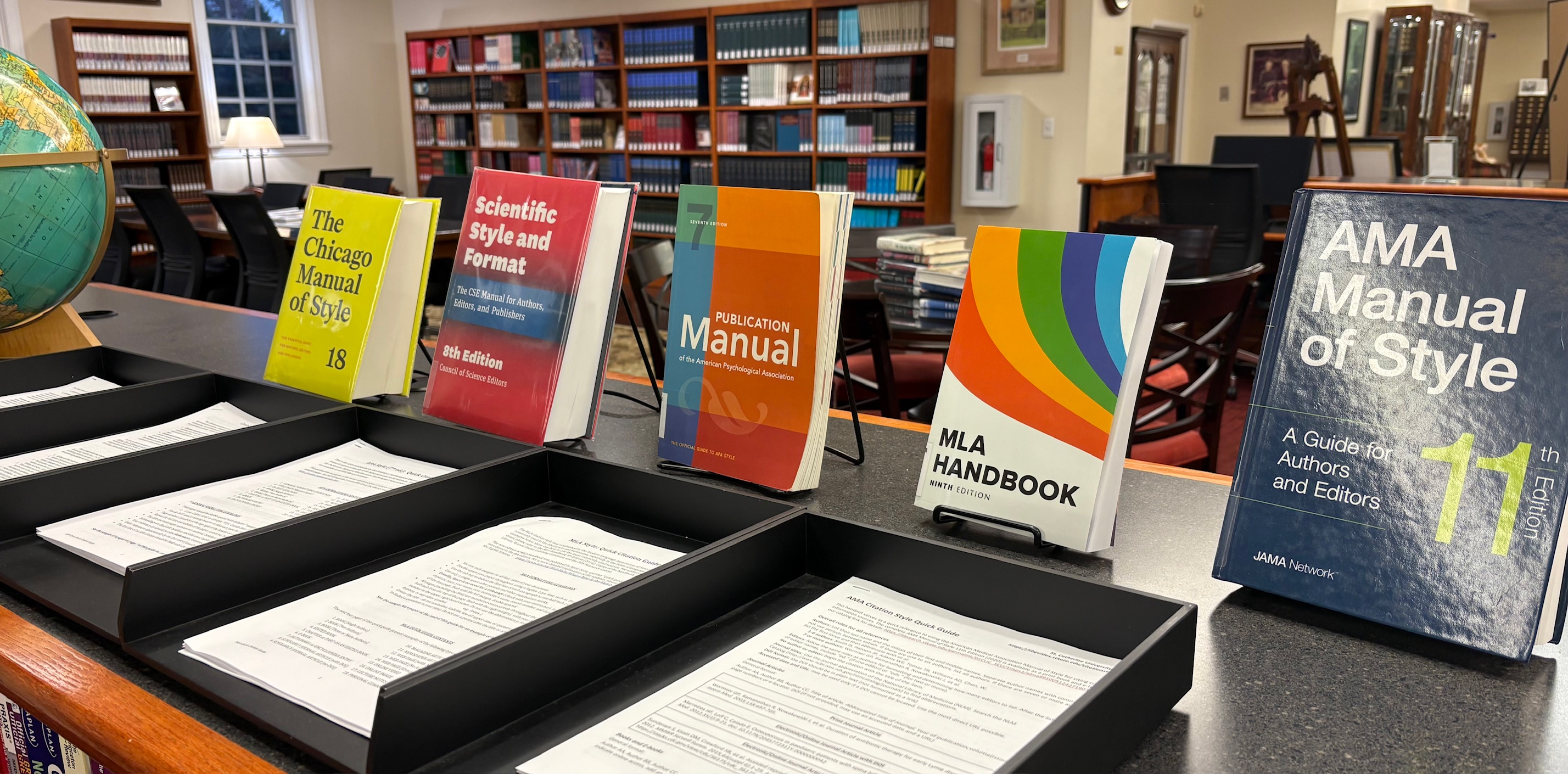
(L-R): The Chicago Manual of Style; Scientific Style and Format: The CSE Manual for Authors, Editors, and Publishers; Publication Manual of the American Psychological Association (APA); MLA (Modern Language Association)Handbook; AMA (American Medical Association)Manual of Style
As you continue to revise your final essay and annotated bibliography, pay careful attention to matters of style.
Keep in mind that if you use a citation generator–either one available through the HPU Libraries databases or elsewhere online–the citations may include errors. Compare them with the models at the MLA Style Center, on OWL, or in the MLA Handbook, ninth edition.
The list of links on my blog includes the websites for both the MLA Style Center and OWL (Purdue University’s Online Writing Lab). At the library’s reference desk (pictured above), you can pick up a handout on MLA style and consult a physical copy of the MLA Handbook, ninth edition.
If you do not know how to change a file’s font or create a running header, this YouTube video on MLA page setup will show you how.
Documentation Styles
The library’s reference desk also houses handbooks and handouts for other documentation styles, including APA (the American Psychological Association), CSE (the Council of Science Editors), and Chicago Style. Those are styles you will be required to use for projects in art, history, religion, sciences, and social sciences. For more information on some of the styles you will use in your other college courses, see “The Four Documentation Styles: Similarities and Differences” in Writing Analytically (367-75).
Today you have the class period to conduct additional research and compose additional portions of your final essay and annotated bibliography. Tasks to undertake include these:
Using the HPU Libraries databases to locate an additional source and reading that article or a portion of that book.
Composing annotations for one or more of your sources.
Reviewing the sources you have gathered and noting what similarities and differences you can identify among them. Those similarities and differences may serve as additional material for your essay or your commentaries.
Revising portions of your final essay and/or your annotated bibliography.
You will devote your time in the first half of class today to completing one or more of the tasks listed above. In the second half of class, you will compose a one- or two-paragraph summary of the work you completed, a minimum of seventy-five words. If you finish your summary before the end of the class period, resume work on your essay and bibliography in progress.
Writing Center
As you continue to revise your final essay and annotated bibliography, consider visiting the Writing Center. If you do so, you will earn five bonus points for the assignment.
To schedule an appointment, sign up online or scan the QR code below. To earn bonus points for your final essay and annotated bibliography, consult with a Writing Center tutor no later than Thursday, November 20. The due date for posting the assignment to Blackboard and to your WordPress blog is Wednesday, November 19 (before class); the hard deadline is Friday, November 21 (before class).
Writing Center Statistics
Literacy Narrative
Section 8: 8 of 19, 42%
Section 18: 10 of 18, 55%
Analysis
Section 8: 6 of 19, 31%
Section 18: 5 of 18, 27%
If you are one of the students who has not taken advantage of the opportunity to earn bonus points for meeting with a Writing Center consultant, please don’t miss your last opportunity to do so.
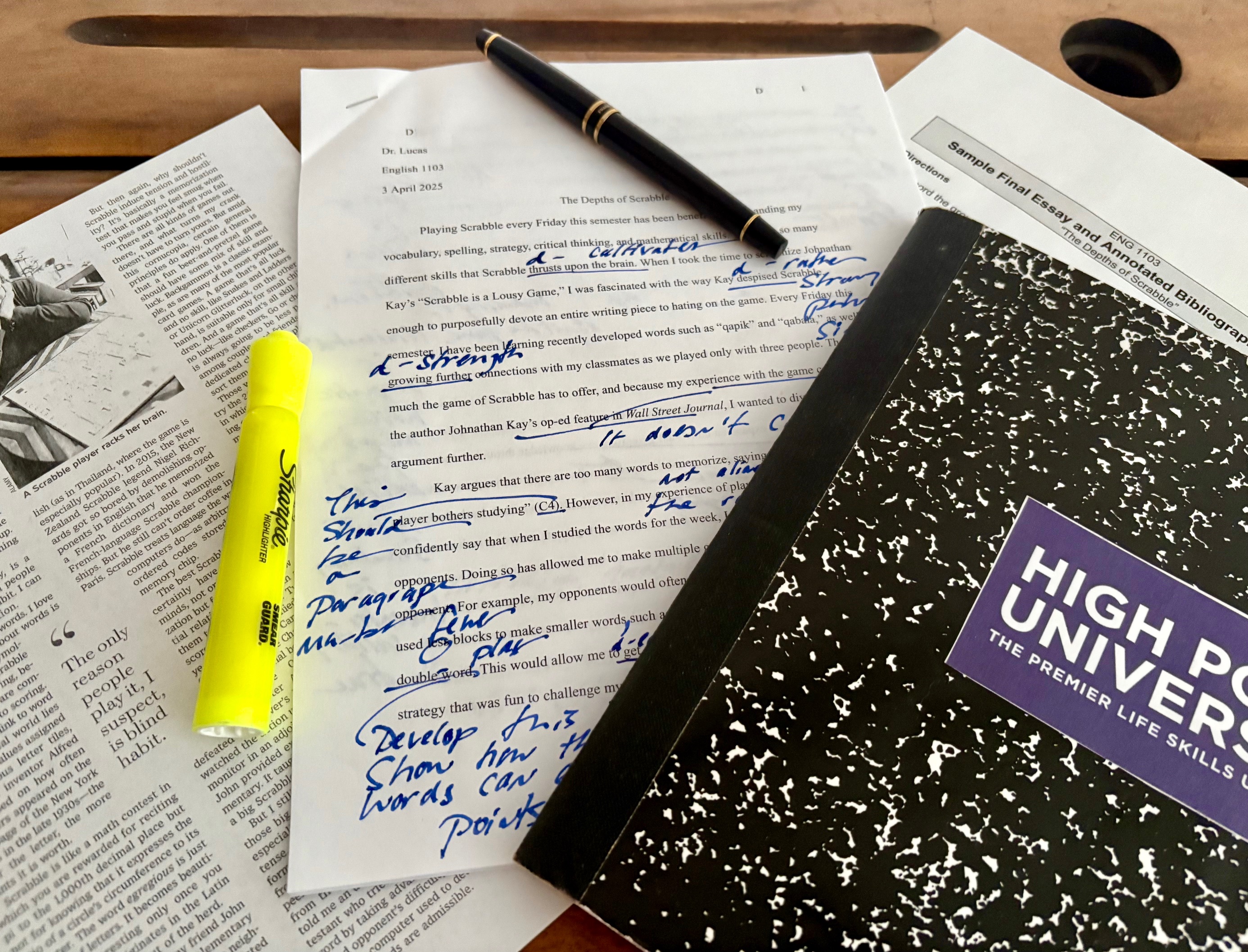
Yesterday’s class focused on a review of the sample student essay and annotated bibliography “The Depths of Scrabble,” an exercise that should continue to serve as a guide for you as you develop and revise your own essay and bibliography.
The notes that follow address points of content and form, some that we addressed in class, others that we didn’t. As you continue your own research and writing, revisit these notes.
Content
In his introduction, the writer addresses his subject and his reason for researching it. Still, his final essay lacks two key components: (1) it does not quote two of his sources, and (2) the conclusion does not address the larger project that might develop from the research and the theoretical framework for that project.
The writer’s mention of specific, uncommon words that he has learned for Scrabble play is admirable, but he does not define the words. Also, in his discussion of “qi” and “xi” (par. 2), he does not clarify that the primary reason for playing those words is the high point value of “q” and “x.”
The words “no real Scrabble player bothers studying” (par. 2) are presented as a line from Jonathan Kay’s “Scrabble is a Lousy Game,” but that line does not appear in Kay’s opinion piece. It’s an inaccurate paraphrase.
The writer incorrectly uses the words “less” (par. 2), “opinionated” (par. 3), and “commutative” (par. 3). He also misspells the last name of Ian Hargreaves, the one of one of his sources, as Hargraves (par. 3). Additionally, such inaccurate statements as “Scrabble thrusts upon the brain” (par. 1) indicate that the writer has not revised his prose.
While Jonathan Kay is a Scrabble detractor, writing that he “devotes[s] an entire piece to hating on the game” (par. 1) is a statement with diction appropriate for casual conversation but not for formal academic prose.
The commentaries in the writer’s annotations do not adequately demonstrate the sources’ usefulness to other researchers studying Scrabble. In his commentary on Stefan Fatsis’s article “The Case of the Stolen Blanks,” he misses the opportunity to create a connection between the cheating reported by Fatsis and the instances of cheating recounted by Kay.
Form
The manuscript does include the required Times New Roman font, the running header with the last name and page number, and the first page information (student’s name, professor’s name, etc.), but the bibliographic entries do not have hanging indents, and the first lines of the paragraphs of the summaries, commentaries, and credentials are not indented five spaces or one-half inch.
The sources in the annotated bibliography are not alphabetized by last name.
The presence of the capital “K” in one of his interviews with a classmate demonstrates that he has referred to the student by first name rather than last, which begins with “D.” In formal writing, people are referred to by first and last name when they are first mentioned. On subsequent references, they are referred to by last name. Fictional characters are an exception to that rule.
Two parenthetical citations, one in the essay and one in the bibliography, are presented incorrectly, and the writer omits the first portion of the bibliographic entry for Ian Hargreaves’s article.
Next Up
On Wednesday, you will have the class period to devote to additional research and writing for your final essay and annotated bibliography, and at the end of class, you will submit a summary of the work that you completed.
Also, I will distribute a checklist for you to refer to as you finalize your revisions over the next week.
This morning in class, after your Scrabble debriefing, you and two or three of your classmates will discuss your individual notes on “Scrabble is a Lousy Game” and “The Depths of Scrabble,” then collaboratively compose answers to a series of questions about the final essay and the annotated bibliography.
Among the questions to consider are these: How and where might the writer of “The Depths of Scrabble” have incorporated additional points from the opinion piece, “Scrabble is a Lousy Game,” into his essay or his commentaries in his bibliography?
Tomorrow’s blog post will serve as a follow-up to our examination of “The Depths of Scrabble” and provide more details about its content and form.
Next Up
On Wednesday, you will have the class period to devote to additional research and writing for your final essay and annotated bibliography, and at the end of class, you will submit a summary of the work that you completed.
Also, I will distribute a checklist for you to refer to as you finalize your revisions over the next week.
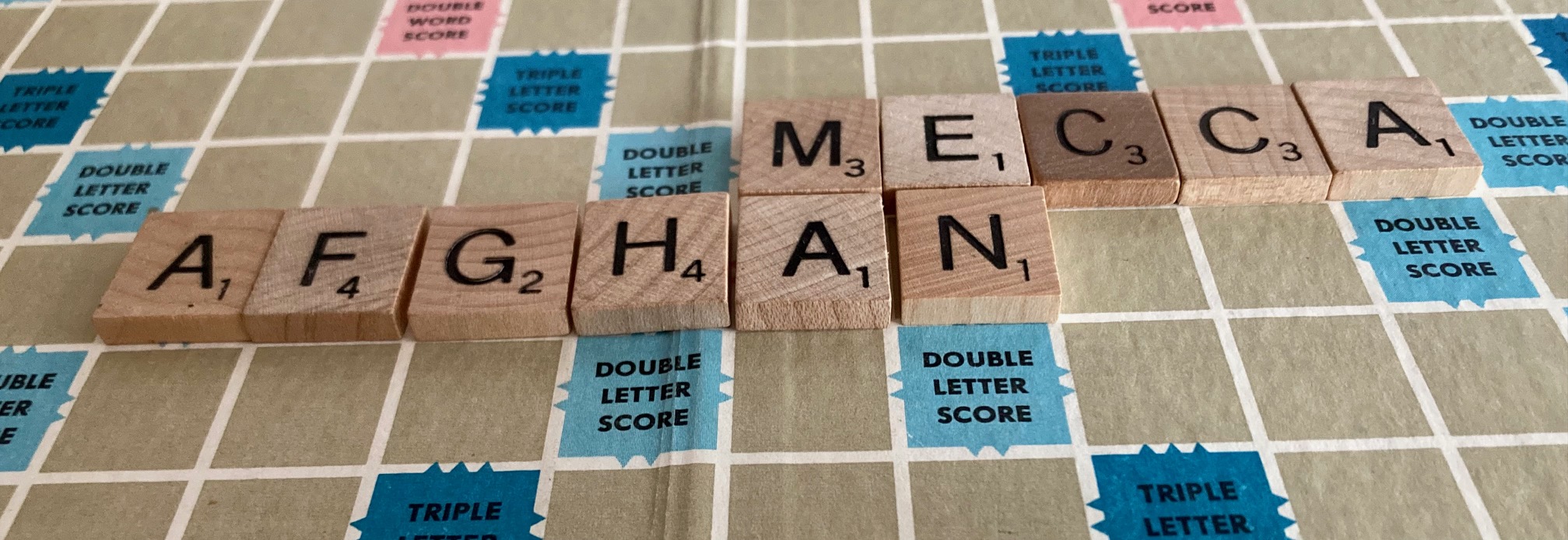
The first Scrabble post of the semester featured first names that are also common nouns, making them playable in Scrabble. Today’s post includes place names and words derived from places, or toponyms–more proper nouns that are playable in Scrabble because they’re also common nouns. Studying these words offers you additional opportunities to broaden your vocabulary and up your game.
afghan: a wool blanket
alamo: a cottonwood poplar tree
alaska: a heavy fabric
berlin: a type of carriage
bermudas: a variety of knee-length, wide-legged shorts
bohemia: a community of unconventional, usually artistic, people
bolivia: a soft fabric
bordeaux: a wine from the Bordeaux region
boston: a card game similar to whist
brazil: a type of tree found in Brazil used to make instrument bows (also brasil)
brit: a non-adult herring
cayman: a type of crocodile, also known as a spectacled crocodile (also caiman)
celt: a type of axe used during the New Stone Age
chile: a spicy pepper (also chili)
colorado: used to describe cigars of medium strength and color
congo: an eellike amphibian
cyprus: a thin fabric
dutch: referring to each person paying for him or herself
egyptian: a sans serif typeface
english: to cause a ball to spin
french: to slice food thinly
gambia: a flowering plant known as cat’s claw (also gambier, which is a small town in Ohio)
geneva: gin, or a liquor like gin
genoa: a type of jib (a triangular sail), also known as a jenny, first used by a Swedish sailor in Genoa
german: also known as the german cotillon, an elaborate nineteenth-century dance
greek: something not understood
guinea: a type of British coin minted from 1663 to 1813
holland: a linen fabric
japan: to gloss with black lacquer
java: coffee
jordan: a chamber pot
kashmir: cashmere
mecca: a destination for many people
Reading for Monday
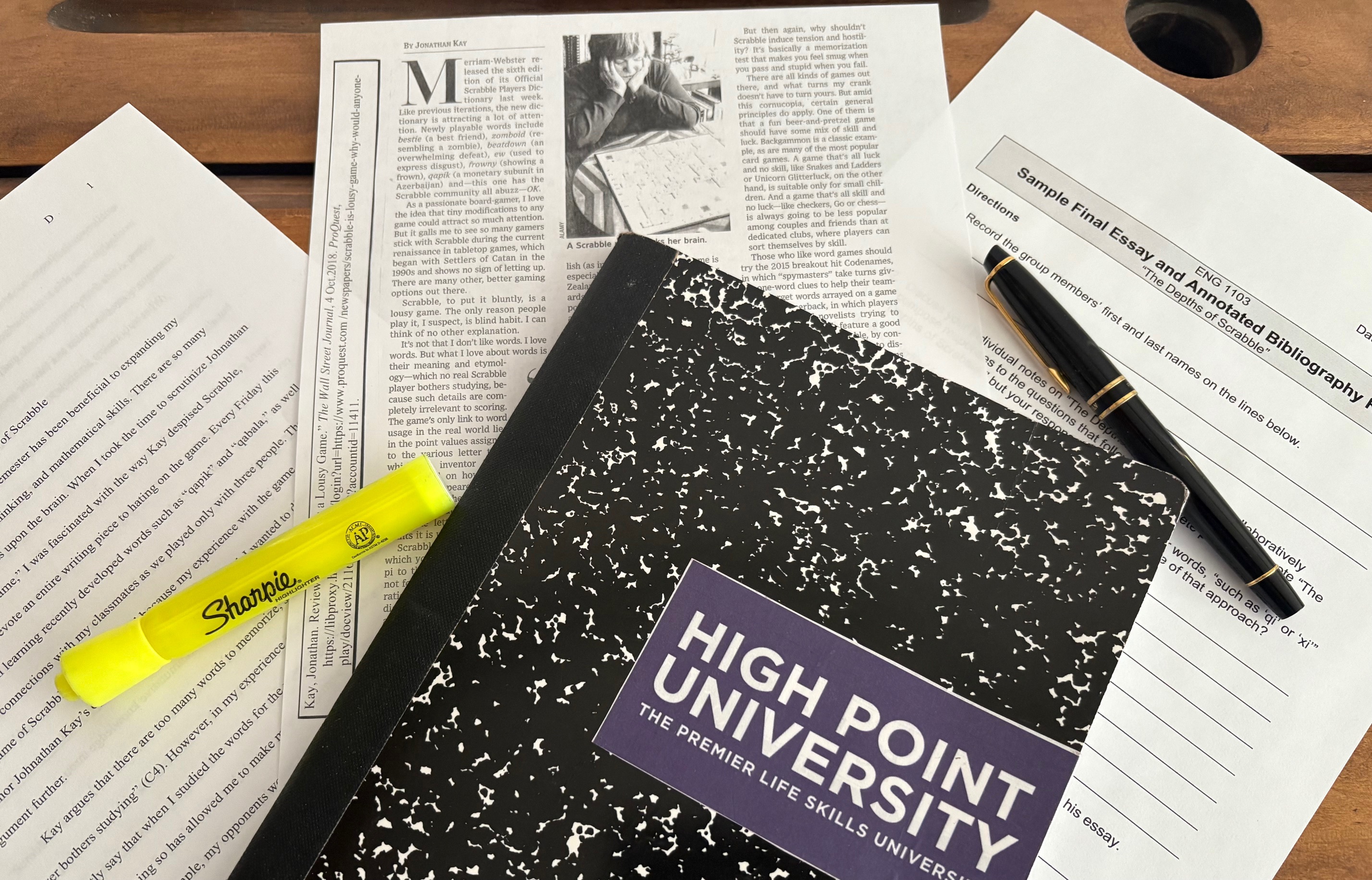
At the beginning of class today, I will distribute copies of an opinion piece on Scrabble and a student’s final essay and annotated bibliography devoted to the game. Before Monday’s class, read and annotate both–not simply by underlining and circling words but by writing questions and observations in the margins or between the lines. As you compose your annotations, consider how and where the student might have incorporated any additional details from the opinion piece, “Scrabble is a Lousy Game,” into his essay or his commentaries in his bibliography.
On Monday, during your Scrabble debriefing, I will check your annotations for the sample student essay “The Depths of Scrabble” and the opinion piece “Scrabble is a Lousy Game.” Afterward, you and two or three of your classmates will collaboratively complete an exercise on the readings, and we will conclude class with a discussion of the two.



 Jane Lucas