The two books that I need to read before the beginning of the semester didn’t go into the suitcase. I almost packed them, but then I stopped myself. It was our vacation, after all. So I chose, instead, a couple from the stack on the nightstand: The Best American Non-Required Reading 2011—more on that beach-appropriate reading in another blog entry to come—and Tina Fey’s Bossypants.
Bossypants (2011)
Even though I read Bossypants purely for pleasure, I found myself making notes on a passage that I’ll refer to when I teach oral communication in my Focused Inquiry classes this fall. In a section of the book titled “The Rules of Improvisation that will Change Your Life and Reduce Belly Fat,*” Tina Fey discusses the importance of speaking in statements “instead of apologetic questions”:
No one wants to go to a doctor who says, ‘I’m going to be your surgeon? I’m here to talk to you about your procedure? I was first in my class at Johns Hopkins, so?’ Make statements with your actions and your voice (85).
That’s valuable advice for all of us who strive to improve our public speaking, and Fey’s laugh-out-loud example teaches us more succinctly and effectively than volumes of oral communication theory.
On November 8, as an exercise in ethical reasoning, students in my Focused Inquiry classes formulated responses to questions submitted to Randy Cohen during his tenure as the writer of TheNew York Times column “The Ethicist.” Students worked collaboratively in four groups, with each of the four responding to a different question regarding campus ethics. One question addressed the market-style dining system, another dealt with course evaluations, and the other two, unsurprisingly, concerned cheating and plagiarism. The four questions–which appear at the end of this blog entry–prompted considerable discussion, enough to insure that I’ll repeat the exercise again next fall as an introduction to applying ethical frameworks.
Students in my Focused Inquiry classes considered those questions of ethics only a day before the announcement of the firing of legendary Nittany Lions coach Joe Paterno and Penn State President Graham Spanier following the arrest of Paterno’s former assistant coach, defensive coordinator Jerry Sandusky, on charges related to the sexual abuse of minors.
Sexual abuse—in Sandusky’s case, of eight young boys over a fifteen-year period—doesn’t present us with an ethical question. Its atrocity isn’t an arguable point. But what we would have done if we were Mike McCreary—if we had seen what he saw in the locker-room shower—is another matter altogether.
In his November 14 column in The New York Times, “Let’s All Feel Superior,” David Brooks addresses the vanity that followed the news of the atrocity: “The vanity is the outraged reaction of a zillion commentators over the past week, whose indignation is based on the assumption that if they had been in Joe Paterno’s shoes, or assistant coach Mike McQueary’s shoes, they would have behaved better. They would have taken action and stopped any sexual assaults.”
Though we may believe that we “would have behaved better,” historically we haven’t. Brooks cites complicity in the face of the Holocaust and the Rwandan genocide as examples of the normalcy bias that prevents people from “process[ing] the horror in front of them.” Brooks also notes people’s motivated blindness–“they don’t see what is not in their interest to see.”
On the November 18 broadcast of NPR’s Tell Me More, ethicist Jack Marshall, founder of ProEthics, observed how the events at Penn State exemplify the dark side of loyalty: “And the dark side, in this case, is that people were so focused on the football program, and so focused on the university, that their loyalty blotted out all other considerations, including a prime directive, which is loyalty to the human race, to our children, to the innocent.”
When we return to questions of ethics next semester, it’s likely that students will raise the subject of the Penn State scandal. If they do, it will present an opportunity to consider how acting ethically isn’t synonymous with following the law.
Along with demonstrating the difference between ethics and law, and the power of the normalcy bias and motivated blindness, the recent events at Penn State underscore how even our greatest ethical values, such as loyalty, can lead us to act unethically.
The ethical questions that follow are the ones that my students addressed in class on November 8. The first three are collected in Randy Cohen’s book The Good, the Bad & the Difference (2002). The fourth question appeared in Cohen’s column on January 20, 2008.
The mandatory meal plan at my college allows you to eat as much as you want but prohibits taking food out of the dining hall. However, I think it’s okay to slip a sandwich in my backpack because I am only a little freshman, and the college needs to budget for lacrosse players. My sister, Shayna, believes this is tantamount to bringing an extra-large purse to a Holiday Inn buffet? What do you think? –Erin and Shayna Silverman, Boiceville, New York
I attend an Ivy League university where students are graded on a curve. During the midterm exam, the student next to me was copying answers from my paper. Because a higher score would mean a lower grade for me, I intentionally wrote some incorrect answers, waited until she handed in her test booklet, and then changed my answers to the correct ones. Was this wrong? –Brenna Tinkel, Philadelphia
A college student called last week to say his ‘friend’ had visited my Web page, lifted something I wrote, and turned it in as her own work. Suspicious, her professor plans to search the Web; if he finds the paper was plagiarized, he’ll recommend expulsion. The student implored me to take the paper off my site, lest his ‘friend’s’ academic career, and possibly her life, be ruined. What do I do? –Anonymous
Our university requires us students to write anonymous evaluations of our professors. On one evaluation, a student made derogatory comments about a professor’s sexual orientation. The university hired a handwriting expert to confirm the identity of the culprit so punishment could be administered. The university claims the student broke the code of conduct, but if anonymity was promised, is this investigation ethical?” –S.C., Georgia
I planned to devote this blog entry—my first in two weeks—to the Virginia Blackboard User’s Group Conference, which I attended on Friday. But what lingers in my mind today isn’t the conference, it’s the personal narratives that my students presented in class after their draft workshop on Thursday.
To shift students’ focus away from “correcting” their classmates’ writing, I decided to devote the second half of class to Readers’ Theater. After students read and commented on their group members’ drafts, each group chose an essay to perform for the class, assigned parts, and assembled impromptu costumes and props.
To honor the students’ privacy, I won’t reveal any details about their personal narratives; I will simply say that their work left a lasting
impression on me. As readers they offered descriptive rather prescriptive comments, and as performers they gave their stories a life in the classroom that was separate and distinct from the words on the page.
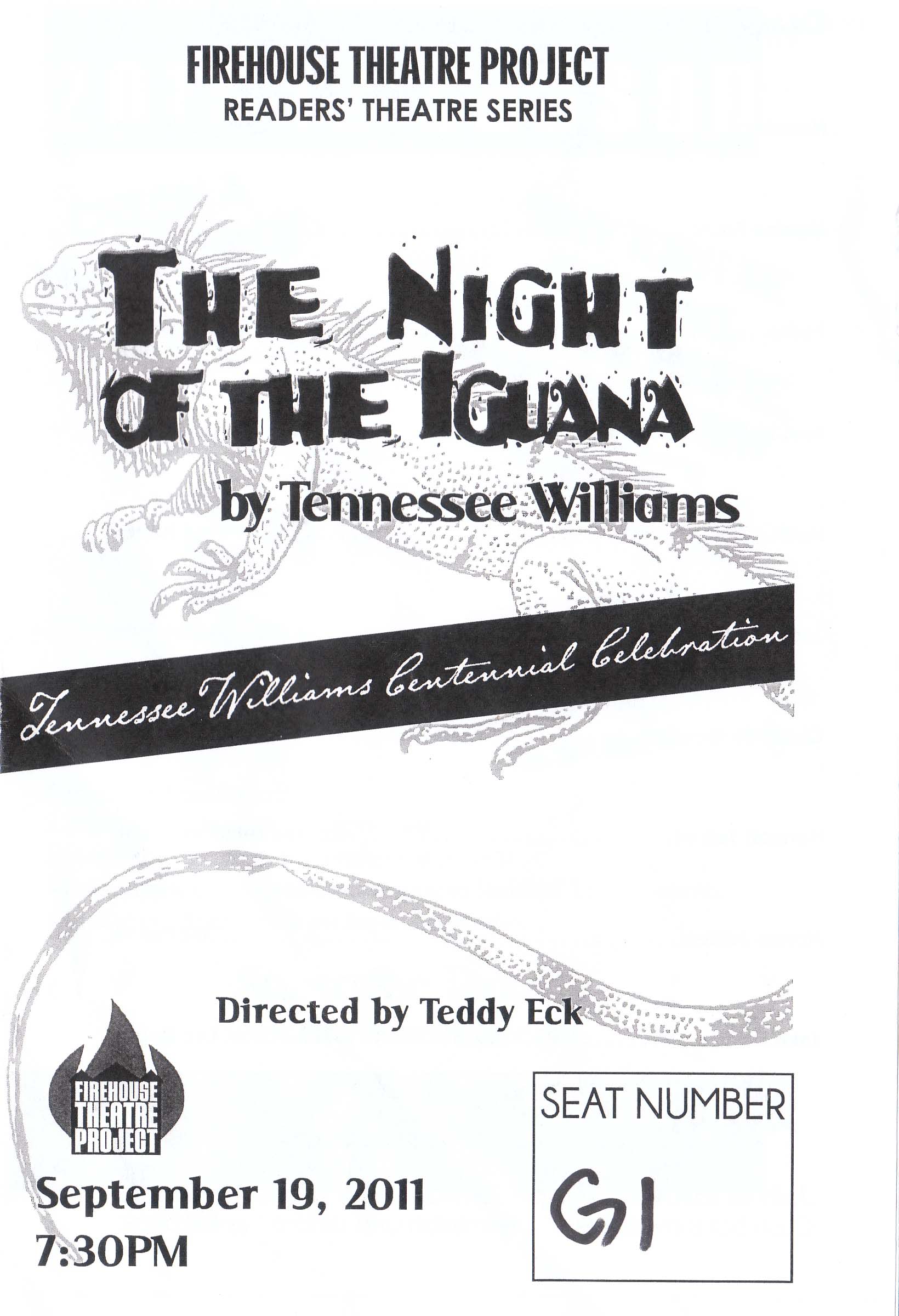
FTP’s The Night of the Iguana
The idea of combining a draft workshop with Readers’ Theater stems from my renewed interest in drama and my recent experiences at Readers’ Theater performances staged at the Firehouse, including the September 19 reading of TheNight of the Iguana, part of Richmond’s Centennial Celebration of Tennessee Williams.
The power of live theater and its influence on my teaching also speaks to my experience at yesterday’s Blackboard conference. Though I use Blackboard on a daily basis—and it’s usually projected on the screen in the classroom at least once during each of my Tuesday-Thursday classes—for me it’s simply a tool: a content management system for content that’s always changing.
During yesterday’s conference sessions, many in the audience divided their attention between the large screens at the front of the room and the small screens in their hands and their laps. In the 1:15 session, I overheard a man say his iPad was attached to his thigh.
More and more I see the need for opportunities to turn away from the screen and to face each other. Though I don’t agree with many of David Mamet’s sentiments—in particular some of his pronouncements in his latest book, The Secret Knowledge: On the Dismantling of American Culture (2011)—I do concur with his notion that people go to the theater to see that real communication between human beings is still possible. I know for me it’s true. My own return to the theater is in part a response to our increasingly digital lives.
I wish I could have read Acting Lessons for Teachers(1994, 2007) in 1990 when I was teaching my first college classes. Robert T. Tauber and Cathy Sargent Mester‘s book would have shown me that my teaching act wasn’t a gimmick but a pedagogical necessity–not simply because I was a twenty-two-year-old who could have passed for seventeen but because all of us who teach are performers.
Despite its title, Acting Lessons for Teachersdoesn’t offer tutorials on craft but instead describes the acting strategies that enhance teaching: physical and vocal animation, teacher role-playing, strategic entrances and exits, humor, props, suspense and surprise, and creative use of space. It also presents anecdotes from teachers, both K-12 and college professors, who have successfully employed those strategies in the classroom. Raymond J. Clough, Professor Emeritus of Modern Languages at Canisius College, recalls an evening in the mid-1960s when he saw Vincent Price perform a dramatic reading of Edgar Allan Poe’s “The Tell-Tale Heart.” For Clough, then a young college teacher, Price’s mesmerizing performance served as an epiphany, illustrating the importance of “training the voice” and of “knowing materials cold” (192).
Scott Richardson, Professor of Classics at St. John’s University, recounts how he presents a Viewer Mail segment in his classes to address the relevance of studying a dead language and broader questions regarding the value of higher education (202). To introduce the Greek god Dionysus, he invokes The Rocky Horror Picture Show(203).
While some teachers readily draw on the tools of actors in the classroom, others would rather not identify themselves as performers, believing that focusing on performance emphasizes entertainment over instruction. But all of us who teach–whether we call ourselves performers or not–share the aim of instructing our students, which requires their attention. Acting Lessons for Teachersshows us how we can capture that attention as an actor would.
This morning I met with twenty-five first-year students to discuss The Other Wes Moore, VCU’s 2011 Summer Reading Program selection, as part of Welcome Week. Though classes don’t begin until tomorrow, the students I met with today–and the other members of the freshman class who met with other faculty, administrators, and staff during Welcome Week discussions–engaged in an academic conversation similar to the ones that they will encounter in their Focused Inquiry classes.
I was impressed by the number of students who were willing to express their ideas both in small-group and large-group discussion. (Our one-hour session included both.) I attribute the high level of participation in part to the nature of the Welcome Week Summer Reading sessions, giving students the opportunity to engage in an academic discussion that isn’t led by someone who will evaluate their performance and record it in a grade book. Instead, the sessions offer an introduction to and preparation for the academic conversations that they will encounter later in the classroom.
Several of the students I met with today mentioned the lines that were repeatedly addressed in the session for discussion leaders that I attended on August 15: “The chilling truth is that his story could have been mine. The tragedy is that my story could have been his ” (xi).
Those lines from Moore’s introduction also appear on the jacket–part of the book that’s the work of the publisher, not the writer. Wes Moore mentioned that fact when he spoke with the Focused Inquiry Faculty yesterday in a meeting interrupted by the earthquake. After we evacuated the Hibbs building, Moore generously continued to speak with the faculty while we stood on Shafer Court, awaiting news. In his discussion–both both pre and post-earthquake–Moore focused not on the lines that lend themselves to book-jacket blurbs, but on the crucial roles of the people in his life–relatives, role models, and mentors–who, in his words, “kept pushing me to see more than what was directly in front of me, to see the boundless possibilities of the wider world and the unexplored possibilities within myself” (179).
The earthquake prevented Wes Moore from addressing the freshmen at convocation yesterday, but his words have spoken to many of the students I met with today. And their willingness to consider differing opinions about his book shows that they, too, are willing to see beyond their own experiences to the wider world.
I have taught In the Shadow of No Towers in the spring semester for the past two years but thought it would be worthwhile to consider Spiegelman‘s graphic memoir of the days that followed 9/11 on the days that follow the tenth anniversary.
On page 7, Spiegelman writes: “My ‘leaders’ are reading the book of Revelations. . . . I’m reading the paranoid science fiction of Phillip K. Dick.” Why does Spiegelman want us to know what he was reading–and what our leaders were reading–in the days following 9/11? What does he want to tell us? Those are a couple of the questions I may pose in class on September 13 or 15–and perhaps again in January when we study “the paranoid science fiction of Phillip K. Dick.”
Do Androids Dream of Electric Sheep?is new to me–I have just begun reading it–so I don’t know yet how I will approach it in class. My tentative plans include incorporating a study of excerpts from the graphic novel adaptation from Boom Studios and concluding the semester with a study of Blade Runner, Ridley Scott‘s film adaptation–or perhaps, more accurately, his re-imagining–of the novel.
This morning I attended a meeting that brought together some of the VCU faculty, staff, and administrators who will lead discussions of The Other Wes Moore—VCU’s 2011 Summer Reading Program selection–during Welcome Week, August 21 – 28. Each of us will meet with a group of first-year students and their Resident Assistant to discuss Moore’s book, which chronicles the lives of two young men from Baltimore, born within a year of each other and bearing the same name, one of whom, the author, became Johns Hopkins‘ first African-American Rhodes Scholar; the other of whom will spend the rest of his life as an inmate at the Jessup Correctional Institution in Maryland. In his introduction, Moore writes: “The chilling truth is that his story could have been mine. The tragedy is that my story could have been his ” (xi). Several of the meeting’s attendees referred to those lines, including the woman sitting next to me, who turned to me before we began and asked: “Do you think it’s true?” I didn’t have time to respond–much less formulate a response–before the meeting began in earnest.
Though I haven’t finalized my plans for the discussion that I will lead on August 24, I know that I will ask the students to consider those lines from the introduction, the “moments of decision” (xi), when they could have chosen different paths, and the impact of mentors in their lives.
In Chapter Seven, Wes Moore recounts how his mother “sensing [his] apathy toward reading” (130), bought the teenage Wes a copy of Mitch Albom’s The Fab Five: “I was riveted by that book. The characters jumped off the page, and I felt myself as engulfed in their destiny as I was in my own. I finished The Fab Five in two days. The book itself wasn’t what was important–in retrospect I can see that it was a great read but hardly a great work of literature–but my mother used it as a hook into a deeper lesson: that the written word isn’t necessarily a chore but can be a window into new worlds” (130-131).
In today’s story reporting Philip Levine’s appointment as Poet Laureate, NPR excerpted a 2005 interview in which Levine said that the Detroit of his youth “was probably half-Southern. And every Sunday morning you could turn on these guys [preachers on the radio]—both white and black—and they would belt out language like I never heard. I loved it.”
Along with the announcement of our new Poet Laureate from half-Southern Detroit, today brought the release of the film adaption of Kathryn Stockett’s best-seller The Help. Between thoughts of a half-Southern Detroit, I tried to imagine what I will say to students in my Southern Literature class when they ask why Stockett’s novel, or an excerpt from it, isn’t on the syllabus. I agree with Janet Maslin’s assertion that “[i]t’s a story that purports to value the maids’ lives while subordinating them to Skeeter and her writing ambitions.”
But the cultural impact of the novel, and now the film as well, tells me that The Help needs to be part of our classroom conversation, even though it won’t be on the syllabus. In David Edelstein’s review of the film on Fresh Airtoday, he observed that “[s]ome of Stockett’s critics have gone so far as to say she actually romanticizes domestic servitude by depicting black nannies’ genuine love for the white children in their care. They also say the novel is full of stock characters that reinforce classic African-American stereotypes like the ‘sassy’ maid and the shiftless, abusive husband.”
And what is Edelstein’s take on it all? He said: “My view of this controversy is easily stated: ‘I don’t know, I don’t know, I don’t know.’”
I don’t know either, but I do know that The Help will be part of our classroom conversation—perhaps along with half-Southern Detroit.
Elisabeth “Betsy” Muhlenfeld, president emerita of Sweet Briar College (1996 – 2009) and Mary Boykin Chesnut scholar, joined the class for our final Tuesday-morning meeting on May 24. Her remarks on Chesnut brought to life a woman whose incisive diary, Mary Chesnut’s Civil War, offers not only one of the most important historical accounts of the Civil War years but also a document of considerable literary merit.
Muhlenfeld’s biography of Chesnut sustained me while I was icing a sprained ankle back in March and renewed my interest in the diarist, so I added Muhlenfeld’s edition of Chesnut’s novel manuscripts (UVA Press, 2002) to my summer reading list. Chesnut’s unfinished apprentice novels, The Captain and the Colonel and Two Years—or The Way We Lived Then, don’t place you in her world the way her diary so beautifully does, but they reveal how she fictionalized her life as she taught herself to write, and in her developing voice you can hear a hint of what’s to come.
Other notable summer reads include the first chapter of colleague Mary Lou Hall’s Dogs and Heroes, whichreceived the third annual Best Unpublished Novel prize, sponsored by James River Writers and Richmond Magazine. Mary Lou read the opening of the novel at the Focused Inquiry Faculty symposium on Friday, November 12, and I enjoyed reacquainting myself with the first chapter–in the pages of the July issue of RM–which introduces a boy named Clarence and his new friend Mona, the albino Great Dane “all white with the baby blue eyes” (66). Congratulations, Mary Lou!
Still lingering in my mind is the closing image of the writer learning to dance in the personal essay “Lady Lessons” by Lee Smith in the June/July issue of Garden and Gun. Studying with Smith in 1989 filled me with the love that Bobbie’s dancing lesson gives the young Lee. And her writing continues to delight and instruct me.







 Jane Lucas