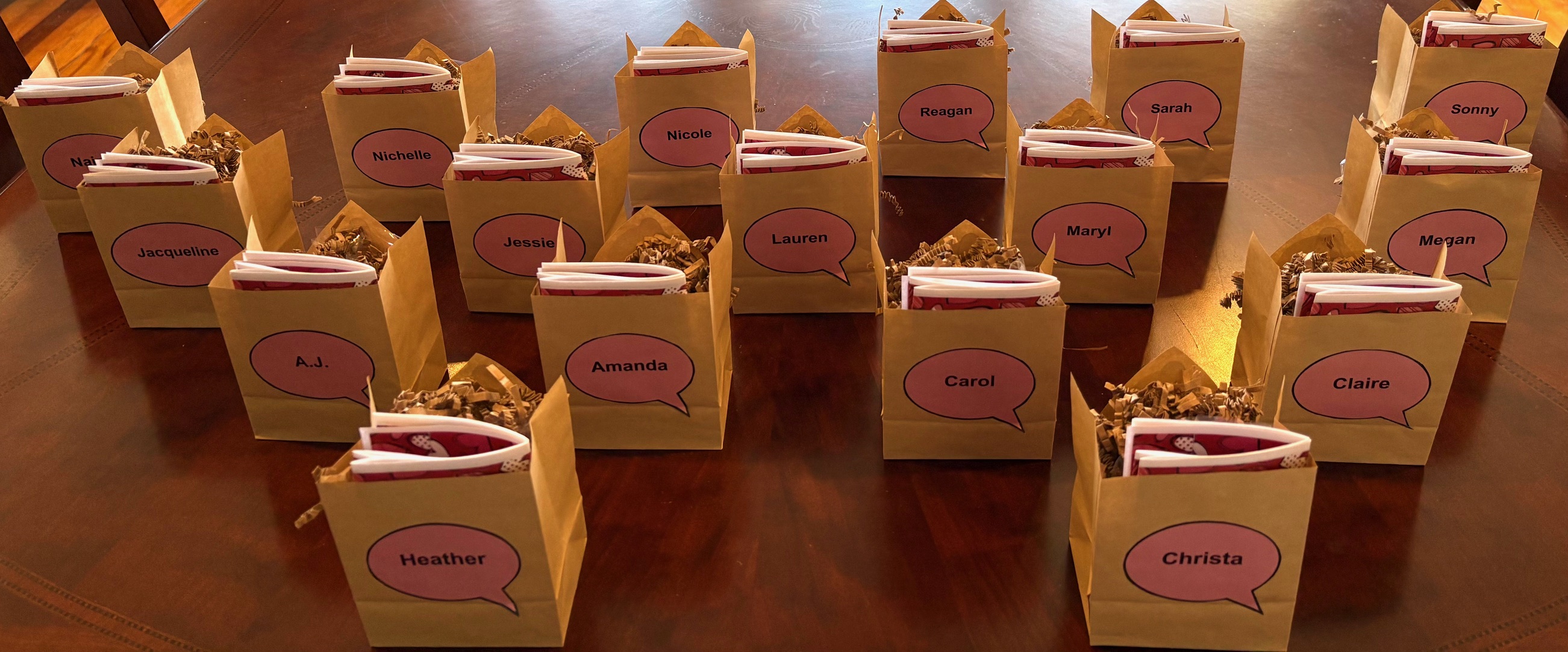
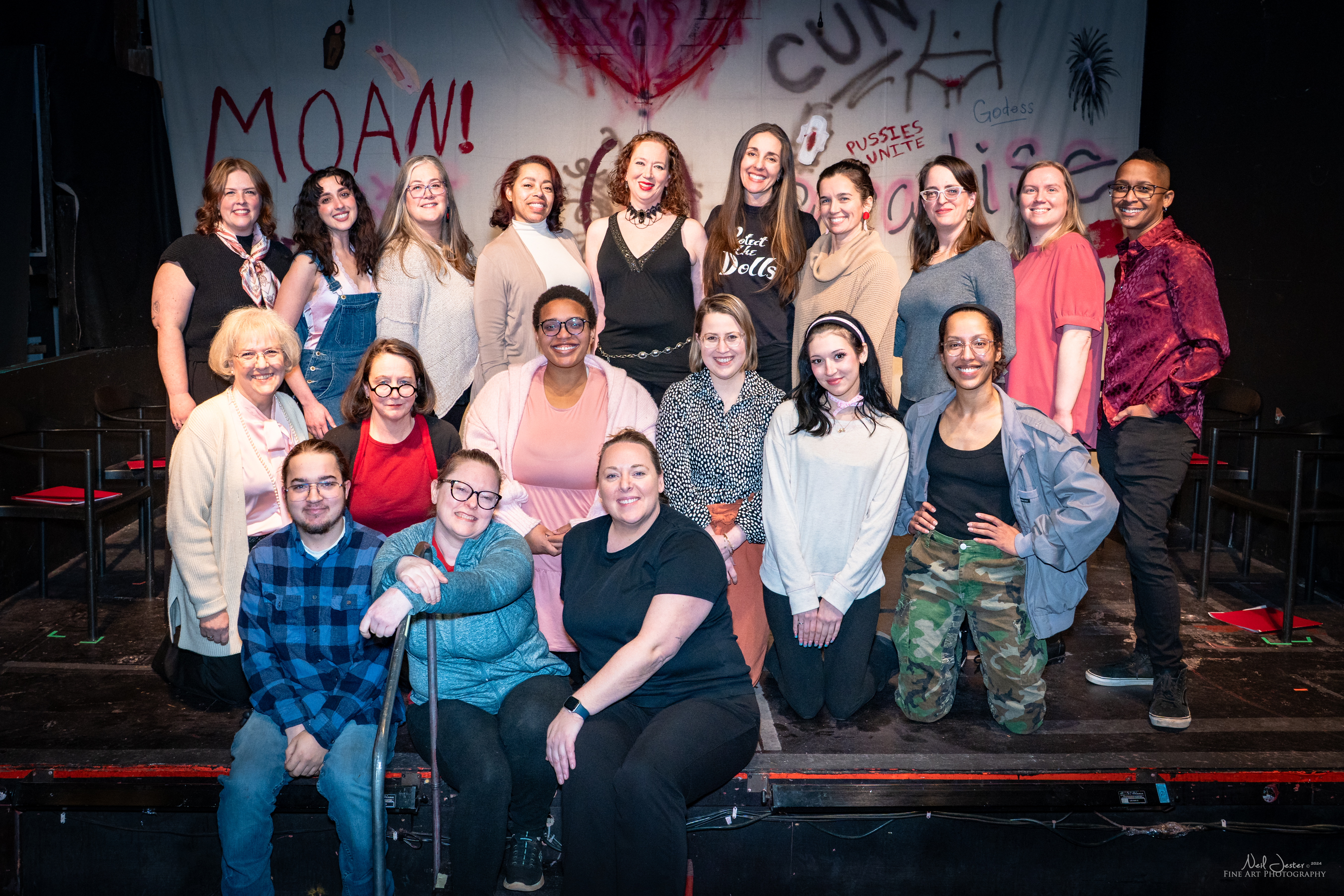
For the Women of The Vagina Monologues, Camel City Playhouse 2026
Finding myself rehearsing again for The Vagina Monologues carried me back to the last time I performed in it, only weeks before the pandemic shutdown. As I stood on stage, saying, “I was there in the room,” I had no idea that our lives were about to be confined to rooms—for maddening months on end.
While we sheltered in place—on the edge of the apocalypse, it seemed—the playwright V, formerly known as Eve Ensler, spoke with writer Jemimah Steinfeld about a new version of her play Chamomile Tea, which depicts two women living behind masks as the result of nuclear fallout. V said to Steinfeld:
“‘Will you go out and risk getting ill? Will you live with freedom and potentially die [going outside] or will you live inside a gas mask where you can no longer eat, talk, or feel? What is it like living without touch, without connection to people, without community?’” (par. 6).
Although she was speaking of the imagined nuclear fallout of her Reagan-era play, V could have been referring to her own experience then, in 2020, or to ours. (Though we weren’t wearing gas masks, we were masked.)]
Minus the masks, we returned to that isolation in late January and early February when back-to-back stormageddons froze us in our tracks.
For many of us, driving to rehearsal meant long stretches on dark roads where we didn’t know what hazards might lie ahead. Those long stretches became less difficult when I reminded myself that those journeys were a metaphor. Such fear of the unknown is a daily part of the lives of the women V has honored with her monologues.
As I write these words, I can hear running water: the sound of the last remnants of the storms we have weathered. Women weather storms. V has documented them. And now we bring them to the stage.*
In sisterhood, Jane Lucas
Pussycat Narrator
I am grateful for the opportunity to perform by your side, and I hope we’ll have the chance to work together again.
Steinfeld Jemimah. “Masking the Truth: The Writer of the Vagina Monologues (Formerly Known as Eve Ensler) Speaks to Index About Attacks on the Truth. Plus a New Version of Her Play About Living in a Nuclear Wasteland.” Index on Censorship, vol. 49, no. 2, 2020, pp. 76–81, https://doi.org/10.1177/ 0306422020935356.
*And, fortunately, we won’t have to perform as an Ice Capades troupe.
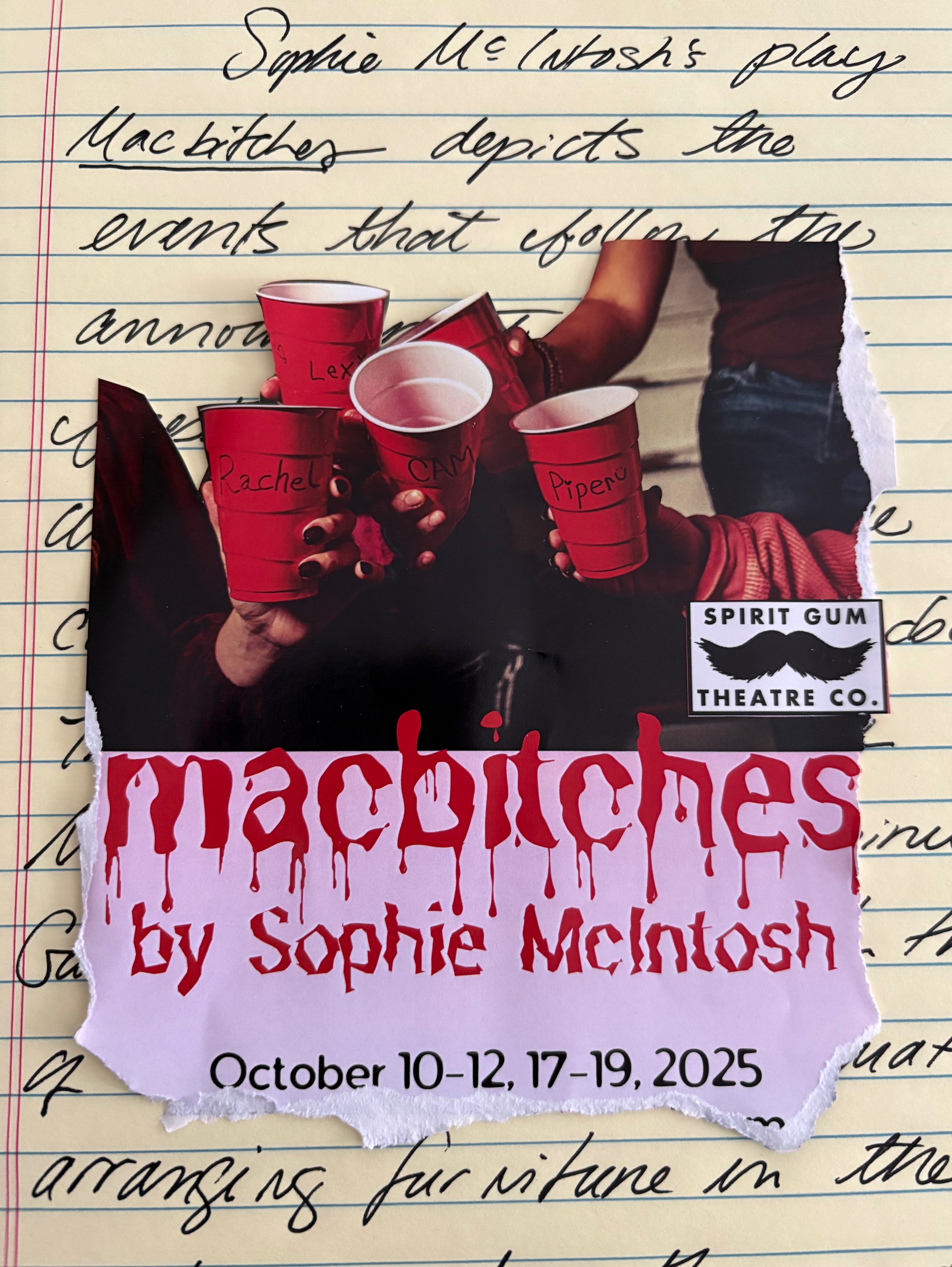
Sophie McIntosh’s play Macbitchesdepicts the events that follow the announcement that a college freshman has unexpectedly been cast in the coveted role of Lady Macbeth. The recent production of McIntosh’s play by Spirit Gum Theatre begins with two of the older undergraduates arranging furniture in the apartment where they and their frenemies in the theatre department will supposedly celebrate the casting announcement—but in fact will subject the novice Hailey (Katie Pelikan) to a series of mind and drinking games. Fireball and Svedka are their witches’ brew; red Solo cups are their cauldrons.
At the outset, as the young women set the stage with the apartment’s furniture, it isn’t clear whether the audience is witnessing the characters in their first moments. That blurring of the real world and the realm of the play continues throughout the eighty-five-minute performance as audience members often feel more like eavesdroppers at a real-life thespian gripe fest than theatregoers, so convincing were the portrayals of Hailey (Pelikan), Rachel (Elise Kimpel), Lexi (Ireland Barile), Cam (Hunter Harrell), and Piper (Ally Shelton).
The frenemies ply Hailey with so much Fireball and Svedka, I convinced myself—and wrongly so—that she has not simply passed out on the couch but in fact has died of alcohol poisoning. What would follow, I told myself, is an argument among Rachel, Lexi, Cam, and Piper regarding what to do next: Should they leave Hailey on the couch and phone 911, or should they sneak Hailey’s body back to her dorm?
What actually unfolds is much darker, and the showdown isn’t between the ringleader, Rachel, and Hailey but between Rachel and Lexi. The audience watches aghast as “[w]hat’s done cannot be undone” (Shakespeare 5.1). It’s not the ending we expect, which is another of the play’s merits. As the lights dim, we feel surprised but not misled and find ourselves meditating on the intersections of life and art, both the beauty and the horror.
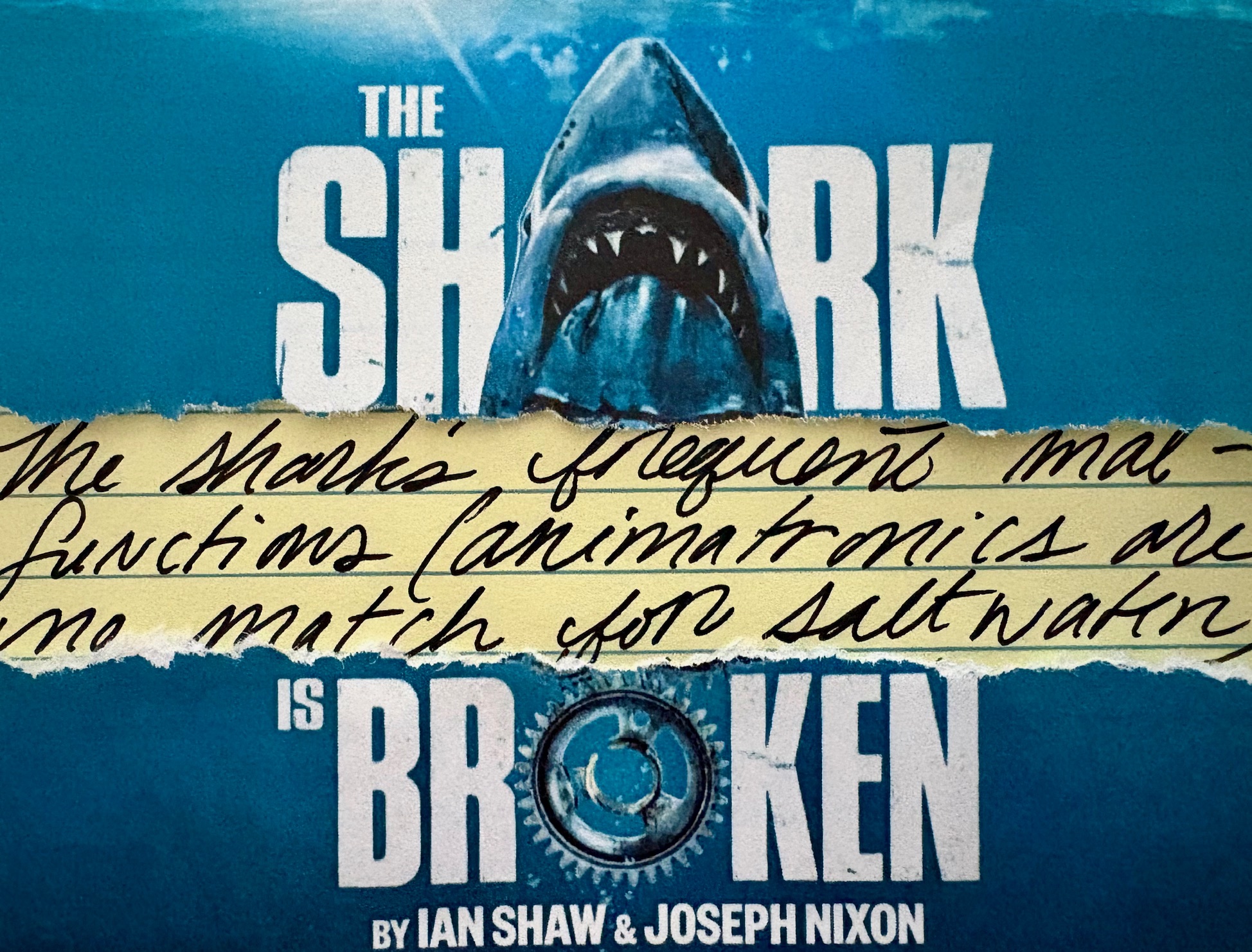
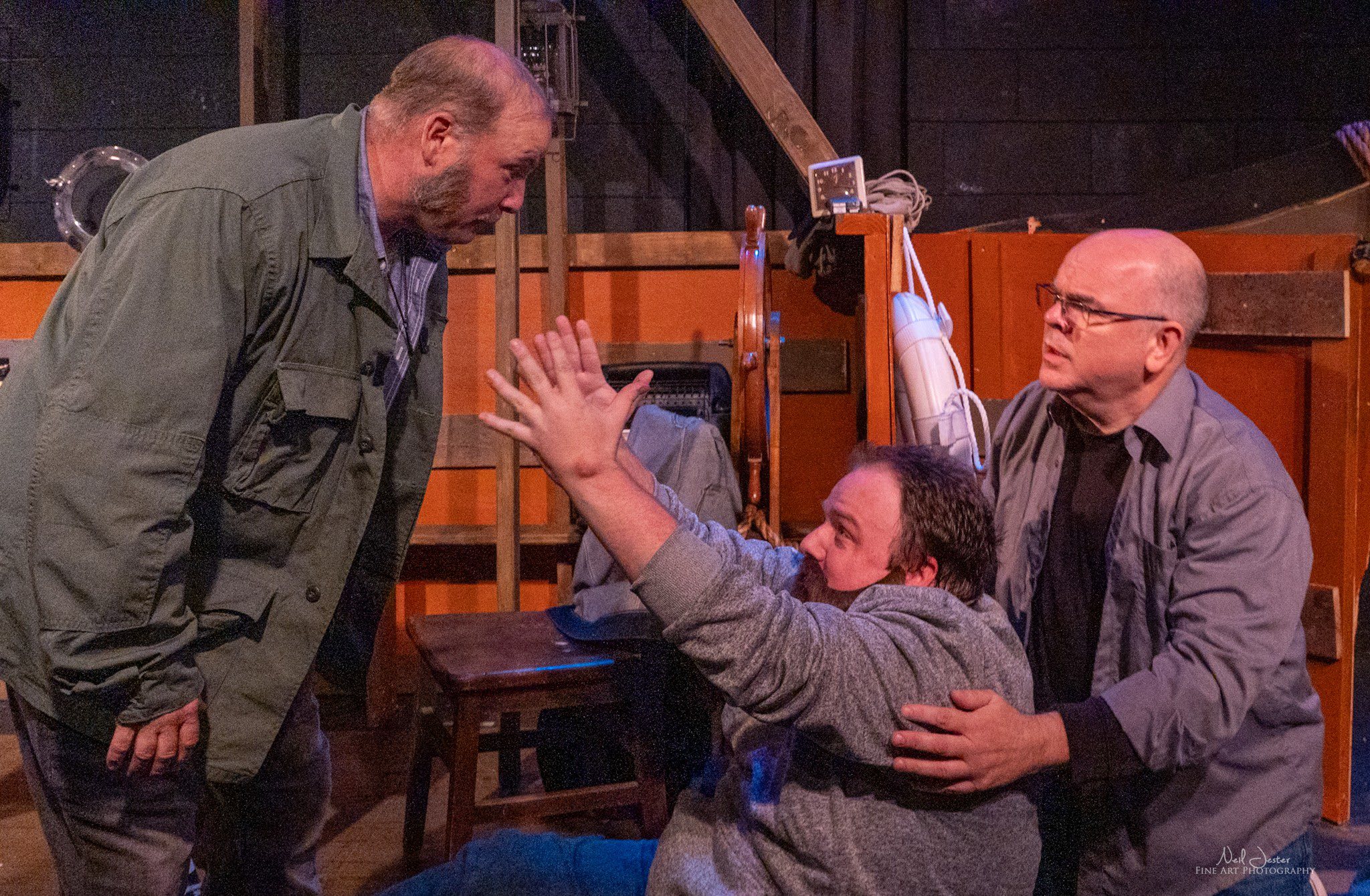
On August 16, 17, and 23, audiences at the Winston-Salem Theatre Alliance’s Beall black box theatre found themselves aboard the Orca with Robert Shaw (Patrick Daley), Richard Dreyfuss (Kenan Stewart), and Roy Scheider (Robert Evans), waiting for the tech crew to repair the mechanical shark for the umpteenth time. The shark’s frequent malfunctions (animatronics are no match for saltwater)—a staple of behind-the-scenes accounts of Jaws—try the actors’ patience, none more so than Shaw’s. Like his character in the film, the eccentric shark hunter, Quint, Shaw is a quick-tempered alcoholic. His similarities to his character prompt Dreyfuss to remark that he isn’t sure where Shaw ends and Quint begins. Shaw exploits that blurred line, needling the neurotic Dreyfuss who hops about the Orca’s deck like a nervous rabbit, confessing his desire to meet the renowned playwright Harold Pinter.
Shaw, a masterful interpreter of Pinter’s work, cruelly misleads the naïve Dreyfuss, telling him that Pinter would love for Dreyfuss to call him in the morning and tell the playwright his own interpretations of his plays. When Shaw and Dreyfuss almost come to blows—as they do more than once—it’s Scheider who serves as mediator, his primary function in the play. Like his Jaws character, Police Chief Brody, he’s there to keep the peace. Neither Brody nor Dreyfuss is as deftly drawn as Shaw, undoubtedly because one of the play’s coauthors, Ian Shaw, began the project that became The Shark is Broken as a way of exploring the life of his father, who died three years after he brought Quint to life on screen. Ian was only nine years old.
Like his father, Ian became an actor, and like his father, he turned to writing, but the two pursuits do not compete for the younger Shaw’s attention as they did for his father’s. In The Shark isBroken, Shaw—recipient of the Hawthornden Prize for his second novel—laments that he has neglected his writing in favor of a Hollywood career, a choice he makes not for stardom but to support a family of (then) nine children. When Shaw recites Shakespeare’s Sonnet 29, his utterance of the desire for “this man’s art and that man’s scope” (7) speaks to his longing to write. Notably, he recites the sonnet as an antidote to Dreyfuss’ panic attack. Though Shaw has bullied the younger actor throughout the play, when Dreyfuss finds himself in crisis, Shaw speaks the words that calm him.
Photo by Neil Jester Photography https://neiljesterphotography.shootproof.com/ (L-R): Patrick Daley (Shaw), Kenan Stewart (Dreyfuss), and Robert Evans (Scheider) in the Winston-Salem Theatre Alliance production of The Shark is Broken.
Shaw’s own writing comes to the fore in two scenes that depict his signature monologue, the speech that recounts the horrific aftermath of the torpedoing of the U.S.S. Indianapolis after it delivered the atomic bomb to the island of Tinian. Many of the sailors who survived the ship’s attack by the Japanese were later ripped to pieces by sharks. In the film, the monologue traces Quint’s deep-seated hatred of sharks to its depths in the Western Pacific, where hundreds of his shipmates perished in a sea of blood. In the play, the monologue foregrounds Shaw’s own writing. Rehearsing the scene, Shaw balks at the screenwriters’ shoddy speech. Then, in frustration, he pens his own version, the one we have watched over and over as Hooper and Brody listen in awe.
The final scene of the play returns to the monologue, giving the audience a live performance of the lines they have watched Shaw utter countless times on screen, and the ones they have now watched the actor put on paper. I can hardly fathom the mega-meta quality of watching Ian Shaw in the first productions of The Shark is Broken—the younger Shaw performing the role of his father in a play that he, the son, cowrote, with Joseph Nixon, to depict his father portraying Quint . . . At a community theatre, the effect isn’t mega-meta, but it’s multi-layered, nevertheless. Audiences at Winston-Salem Theatre Alliance watched Triad actors Patrick Daley (Shaw), Kenan Stewart (Dreyfuss), and Robert Evans (Scheider) portraying Hollywood actors performing—or mostly waiting to perform—now-iconic roles. Call it a Chinese box or a hall of funhouse mirrors. Maybe we’re going to need a bigger metaphor.
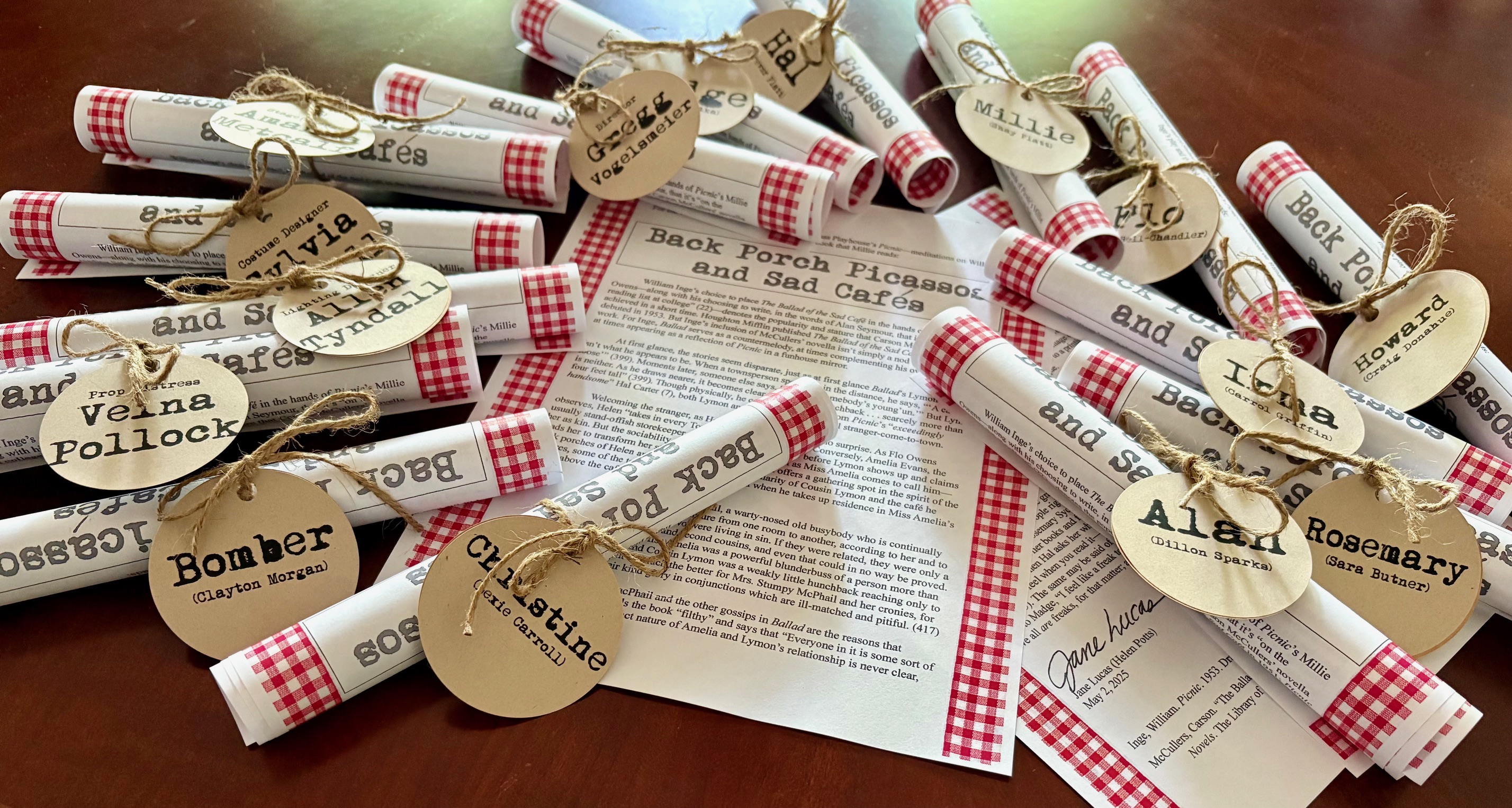
For the cast and production staff of Stained Glass Playhouse‘s Picnic–meditations on William Inge’s play and the book that Millie reads:
William Inge’s choice to place The Ballad of the SadCafé in the hands of Picnic’s Millie Owens—along with his choosing to write, in the words of Alan Seymour, that it’s “on the reading list at college” (22)—denotes the popularity and stature that Carson McCullers’ novella achieved in a short time. Houghton Mifflin published The Ballad of the Sad Café in 1951; Picnic debuted in 1953. But Inge’s inclusion of McCullers’ novella isn’t simply a nod to a then-recent work. For Inge, Ballad serves as a countermelody, at times complementing his own themes and at times appearing as a reflection of Picnic in a funhouse mirror.
At first glance, the stories seem disparate, just as at first glance Ballad’s Lymon Willis isn’t what he appears to be. When a townsperson spots him in the distance, he says, “‘A calf got loose’” (399). Moments later, someone else says, “‘No, it’s somebody’s young’un.’” But Lymon is neither. As he draws nearer, it becomes clear that he is “a hunchback . . . scarcely more than four feet tall” (399). Though physically, he couldn’t be further from Picnic’s “exceedingly handsome” Hal Carter (7), both Lymon and Hal are the archetypal stranger-come-to-town.
Welcoming the stranger, as Helen Potts does, comes as no surprise. As Flo Owens observes, Helen “takes in every Tom, Dick, and Harry” (11). Conversely, Amelia Evans, the usually stand-offish storekeeper, has never taken in anyone before Lymon shows up and claims her as kin. But the sociability of Lymon—Cousin Lymon as Miss Amelia comes to call him—leads her to transform her store into a nightly café that offers a gathering spot in the spirit of the back porches of Helen and Flo. Yet despite the popularity of Cousin Lymon and the café he inspires, some of the townspeople are scandalized when he takes up residence in Miss Amelia’s rooms above the café:
[A]ccording to Mrs. MacPhail, a warty-nosed old busybody who is continually moving her sticks of furniture from one room to another, according to her and to certain others, these two were living in sin. If they were related, they were only a cross between first and second cousins, and even that could in no way be proved. Now, of course Miss Amelia was a powerful blunderbuss of a person more than six feet tall—and Cousin Lymon was a weakly little hunchback reaching only to her waist. But so much the better for Mrs. Stumpy McPhail and her cronies, for they and their kind glory in conjunctions which are ill-matched and pitiful. (417)
The notions of Mrs. MacPhail and the other gossips in Ballad are the reasons that Picnic’s Rosemary Sydney labels the book “filthy” and says that “Everyone in it is some sort of degenerate” (22). Though the exact nature of Amelia and Lymon’s relationship is never clear, they are judged not only for their apparent transgressions but also for their unconventional appearances—a testament to the belief that good looks, themselves, are a virtue, a tenet that Picnic’s beauty, Madge Owens, calls into question when she asks, “What good is it to be pretty?” (16).
For all of Madge’s and Hal’s natural good looks, it’s clear that what we behold as beauty is also partly artifice. When Hal tells his friend Alan Seymour about his stint in Hollywood, he says, “[Y]ou gotta have a certain kind of teeth or they can’t use you . . . they’d have to pull all my teeth and give me new ones” (26). When Madge delays getting ready for the picnic, Alan prods her, saying, “Go on upstairs and get beautiful for us” (49). Still, unlike, the cross-eyed, six-foot Amelia and the hunchback Lymon, Madge, with or without powder and lipstick, finds the image in the mirror affirming. As she says to her mother, Flo, “It just seems that when I’m looking in the mirror that’s the only way that I can prove to myself that I’m alive” (42). Yet Madge is as much a misfit as McCullers’ oddballs, a truth signified in the image of her as Miss Neewollah published in The Kansas City Star’s Sunday magazine. Due to a printing error, her mouth appears in the middle of her forehead, rendering her grotesque.
That image of Madge with her mouth in the middle of her forehead is like the woman in the Picasso prints that hang over her sister Millie’s bed, a woman that Madge sums up sarcastically as one “with seven eyes. Very Pretty” (23). Millie knows that works of art “don’t have to be pretty” (23), that the woman with her seven eyes speaks a truth that photographic realism doesn’t. Similarly, The Kansas City Star’s unrealistic photograph doesn’t lie. Objectifying Madge distorts her.
Millie vows that after she graduates from college that she’s “going to New York, and . . . write novels that’ll shock people right out of their senses” (87). Some people, like Ballad’s Mrs. McPhail and Picnic’s Rosemary Sydney, may be shocked. Others, ones with Millie’s own sensibility, will read her books and feel the way Millie herself feels when she reads The Ballad of the Sad Café. When Hal asks her what it’s about, she says, “[I]t’s kind of hard to explain, it’s just the way you feel when you read it—kind of warm inside and sad and amused—all at the same time” (53). The same may be said of Picnic. Near the play’s end, before Hal jumps the train, he says to Madge, “I feel like a freak to say this, but—I love you” (85). We all feel like freaks, Hal. We all are freaks, for that matter; and we love, for better or worse—and all at the same time.
Works Cited
Inge, William. Picnic. 1953. Dramatists Play Service Inc., n.d.
McCullers, Carson. “The Ballad of the Sad Café.” 1951. Carson McCullers: The Complete Novels. The Library of America, 2001. pp. 395-458.
Rockwell, Norman. “Girl at Mirror.” The Saturday Evening Post. 6 March 1954.
Seven years ago, when my students at Lenoir-Rhyne University were studying Thorton Wilder’s Our Town, I wrote this essay as a model for their own analyses. Before we opened tonight, I gave copies of it to my castmates and the production team. In the letter that accompanied the essay, I noted, “When I wrote ‘Through a Glass Darkly: Girl at Mirror and Grover’s Corners,’ I was an adjunct professor writing about Mrs. Webb, among other characters, with no inkling that seven years later I’d find myself playing Professor Willard and Mrs. Webb. As George says, ‘What do you know!'”
Through a Glass Darkly: Girl at Mirror and Grover’s Corners
In Norman Rockwell’s painting Girl at Mirror, the face that viewers see is the girl’s reflection—not her face itself, but the one she sees in the glass. What does she see in herself, and what do the painting’s observers see, as we witness this private moment? Does her lace-trimmed petticoat evoke in her, or in us, thoughts of the wedding gown that she may wear one day? For Rockwell’s detractors—and for those who consider him a guilty pleasure—Girl at the Mirror and his other covers for The Saturday Evening Post present a sentimentalized depiction of American life, the same picket-fenced cliché that many who find fault with Our Town perceive as the prevailing image of the play. As theatre scholar Donald Margulies writes in his foreword to Our Town, many people who dislike it have “dismissed [it] as a corny relic of Americana and relegated Thornton Wilder to the kitsch bin along with Norman Rockwell and Frank Capra” (xi). Yet a close look at Our Town and Girl at Mirror reveals portraits of American life that are far from idyllic.
As she gazes pensively in the mirror, the girl in Rockwell’s painting might be asking herself the same question that Emily Webb asks her mother: “[A]m I pretty?” (31). Though Mrs. Webb tries to reassure her daughter, Emily seeks an answer that her mother’s words fail to provide.
Both Emily and the subject of Girl at Mirror occupy that awkward space between childhood and adulthood—a notion that Rockwell emphasizes with the composition of his painting, placing the girl between her childhood toy, the doll that she has cast aside, and her new grown-up object of interest, movie star Jane Russell, who gazes up at her from the page of a magazine. Will I ever be beautiful and desirable, the way you are? the girl might be asking of Russell. Or, as Emily asks her mother: “Am I pretty enough . . . to get anybody . . . to get people interested in me? (32). Though Mrs. Webb answers Emily, she doesn’t provide the answer that her daughter seeks. Telling Emily, instead, that she has “a nice pretty young face” (31) and that she’s “pretty enough for all normal purposes” (32), she avoids the subject of adult desire that underlies Emily’s questions.
Though the audience feels the frustration in Emily’s voice as she says, “Oh, Mama, you’re no help at all” (32), only later in the play do we feel the full weight of those words when Mrs. Webb confesses in the wedding scene that she has never talked to Emily about sex: “It’s cruel, I know, but I couldn’t bring myself to say anything” (76). Mrs. Webb’s monologue turns the scene of her daughter’s wedding into a reminder of the vulnerability and pain that will come as a consequence. That same darkness at the edge of a seemingly quaint picture appears in Girl at Mirror. Consider the doll, just beyond the mirror—and the viewer’s focus—innocently cast aside, perhaps, but backed up to the edge of the mirror’s frame. To the adult eye, the doll’s posture is one of sexual submissiveness.
Both Wilder’s and Rockwell’s visions are more complex than what many of their critics give them credit for—or more accurately deny them—rendering the trouble that lurks below the surfaces of our daily encounters. And while the sexual innocence of Emily Webb and Rockwell’s Girl at Mirror may seem distant to us, the silence that endangers their innocence pervades our lives. Now as revelations of celebrities’ and politicians’ transgressions saturate our news streams, the silences of Wilder’s characters seem eerily prescient. Can anyone now hear Mrs. Webb say, “I couldn’t bring myself to say anything” (76), without thinking of our own culture of silence—and of Roy Moore and Louis C.K. and Kevin Spacey and Harvey Weinstein—and of all the predators in our own towns, places supposedly so far removed Grover’s Corners?
Meanwhile, back in Our Town, Mrs. Gibbs says of Simon Stimson’s alcoholism that “the only thing the rest of us can do is just not to notice it” (40). And Constable Warren says, “‘Twant much” (104), of a Polish immigrant nearly freezing to death, another way of saying that some lives don’t matter as much as others, a prejudice that we know all too well as no mere relic of the past. Those moments in Our Town not only belie the notion of Grover’s Corners as a saccharine portrait of America but also demonstrate that the play critiques the very parochialism that its detractors denounce as its stock-in-trade.
In his reassessment of Rockwell’s paintings, Richard Halpern observes that “[a] false belief in our own sophistication or knowingness is just another form of innocence” (par. 17). The same innocence may prevent us from seeing Our Town with real clarity, the way that Emily only truly sees her twelfth birthday when she revisits it after death. As she says to the Stage Manager, “I can’t look at everything hard enough” (105). Perhaps in our own innocence, neither can we.
Margulies, Donald. Foreword. Our Town by Thornton Wilder. 1938. Harper Perennial, 2003, xi-xx.
Rockwell, Norman. “Girl at Mirror.” The Saturday Evening Post, 6 Mar. 1954. Norman Rockwell Museum, 2016, http://www.nrm.org/MT/text/GirlMirror.html, Accessed 16 Nov. 2017.
(L-R): Helga (Jane Lucas) and Jozephina (Cass Weston) in the Creative Greensboro production of The Wolves of Ravensbruk (2022)
The following essay is one that I wrote as a sample literacy narrtive for my students last semester.
Another Way with Words
What do a Nazi prison guard, a medieval abbess, a Mexican maid, and a seventy-two-year-old bag lady have in common? They’re all character roles that I’ve played on stage. Though acting is one of my favorite pastimes, each new role is a source of anxiety. I am comfortable on stage, but backstage, as I prepare to enter, is another story. Preparing for my entrances as María, the Mexican maid, in Glorious! were some of the most nerve-wracking moments of my stage career. I remember vividly standing backstage holding a large tray with a tea pot, two teacups, a slice of cake, napkins, and silverware. As I held the tray, my hands began to sweat, and I worried not only that the tray might slip out of my hands but also that the words I was supposed to speak might slip from my mind.
Robert (David Ingle) and Berthe (Jane Lucas) in The Green Room Community Theare production of Boeing, Boeing (2017) / Ken Burns
Though the fear of forgetting my lines is always with me backstage, that fear was heightened when I played María because her lines were all in Spanish. The challenge inherent in learning lines was compounded by the cognitive shift required of learning them as a non-native speaker. When I say kitchen, in my mind I see a kitchen, but when I say cocina, I do not. As María, for the first time, I wasn’t visualizing my lines. Instead, I was memorizing a series of unfamiliar sounds. I knew their English translation, but I couldn’t link the signs to the signifiers, not the way I could in English.
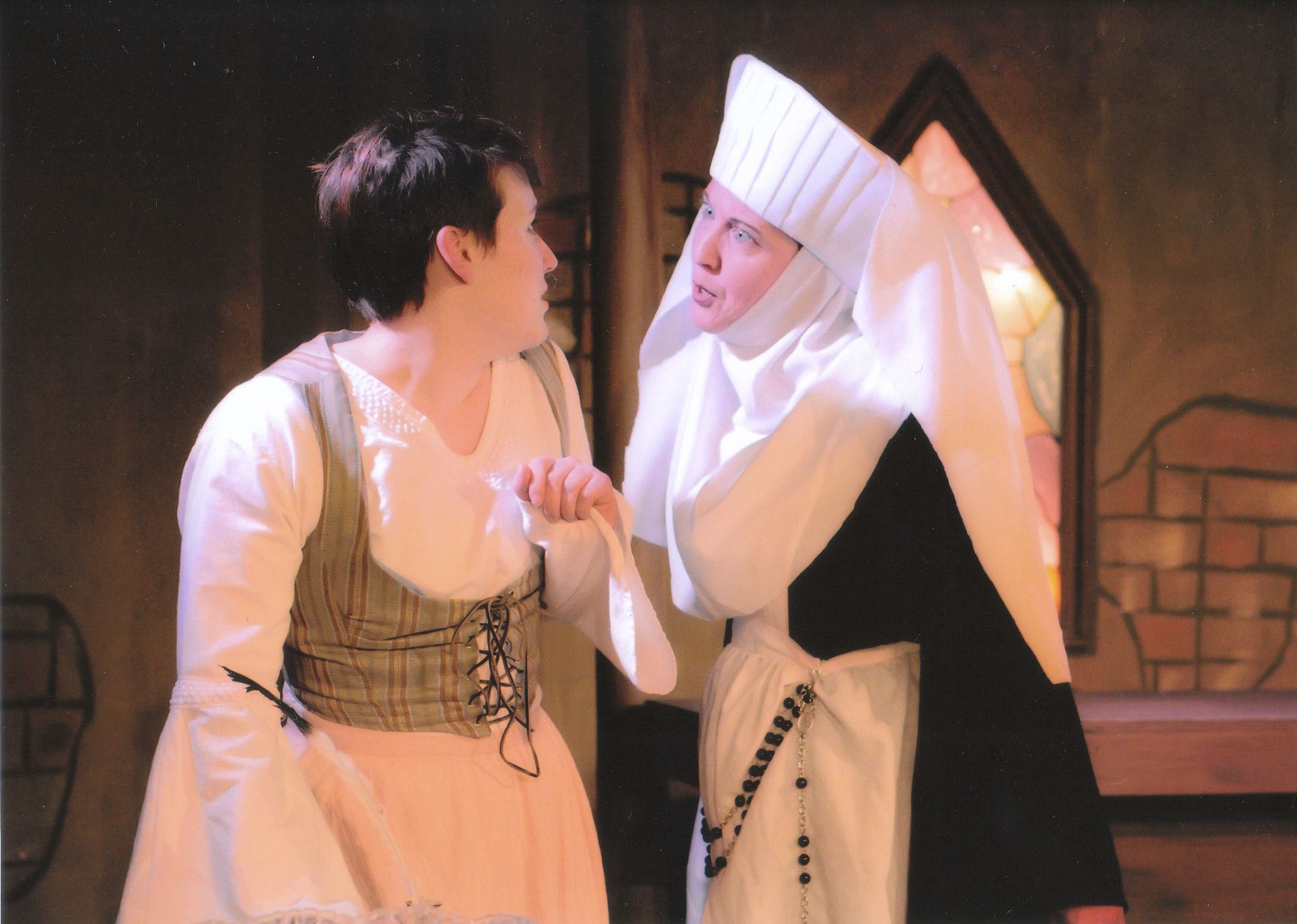
Marie (Nikkita Gibson) and Abbess Agatha (Jane Lucas) in the Hickory Community Theatre prouction of Incorruptible (2016) / Ken Burns
Preparing to play María meant increasing the hours I devote to my lines, including the practices of writing my lines on note cards, recording my lines and their cues, and writing my lines over and over in my theatre journal. As one of my first steps in the line-learning process, I type my lines and paste them onto three-by-five note cards. On the back of each note card, I write my cues in pencil. I start by memorizing the lines on the first card, usually four or five. And once I’ve learned those, I memorize the ones on the second card, and so on. Learning my cues as well my lines enables me to follow my partner’s words on stage even if he or she jumps ahead by dropping a line.
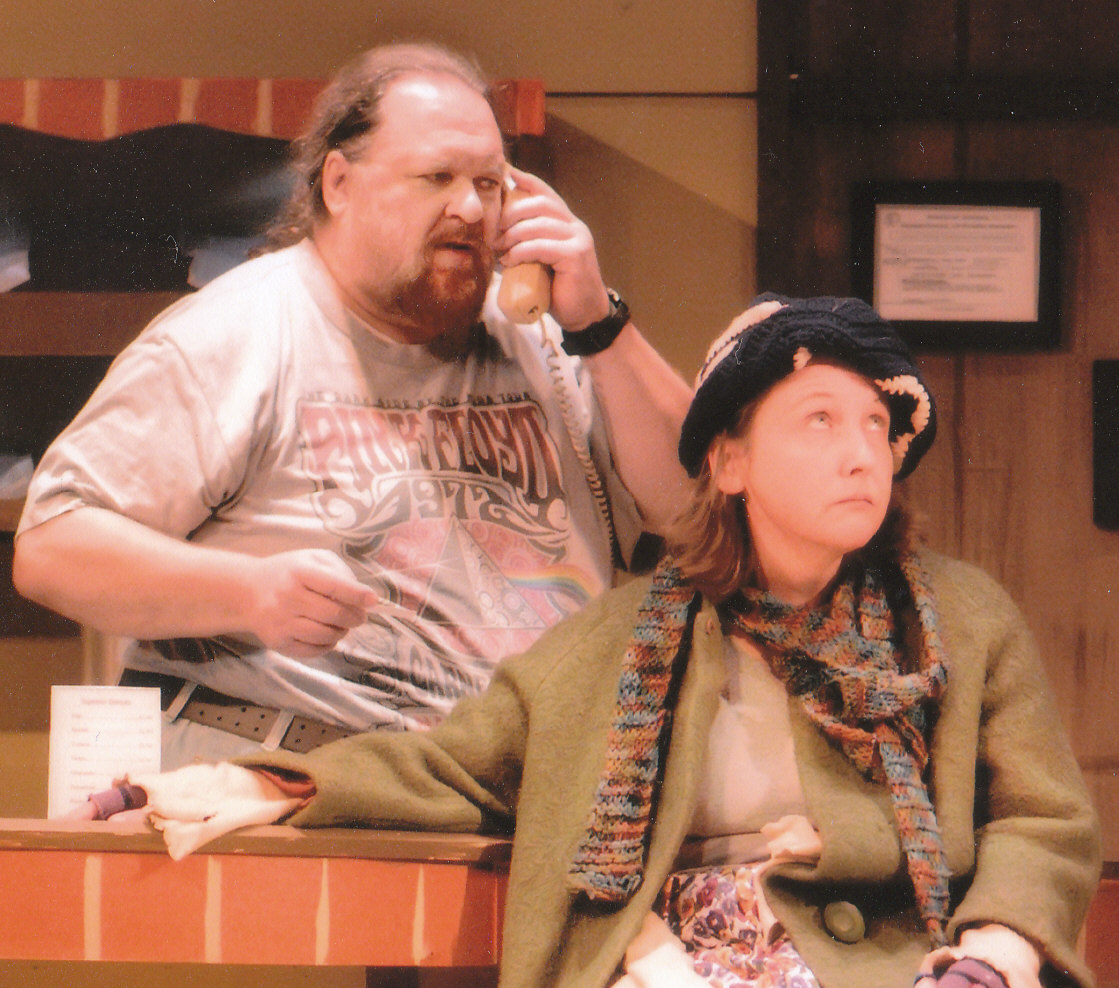
Arthur Przybyszewski (Peter Bost) and Lady Boyle (Jane Lucas) in the Hickory Community Theater production of Superior Donuts (2016) / Ken Burns
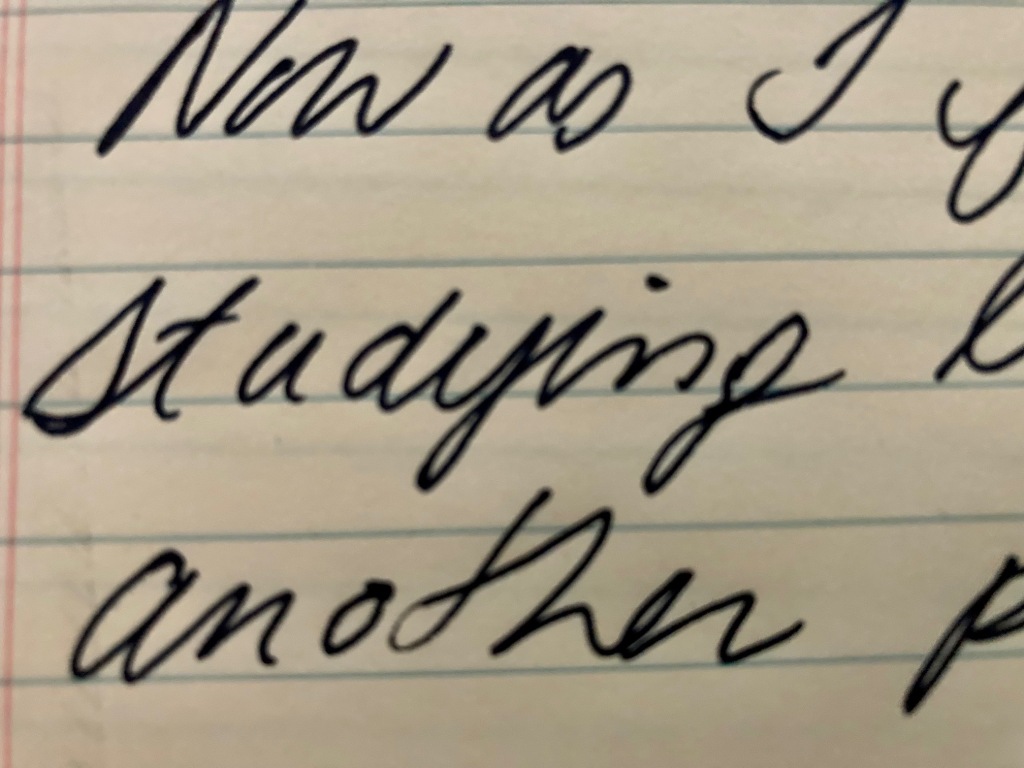
In addition to putting my lines and cues on notecards, I record them with a voice recorder app on my phone. Listening to myself as I drive to rehearsal further helps me to learn the words. Along with studying my notecards and listening to my recorded lines, I write my lines over and over in my theatre notebook, the same way that as a student I would recopy my class notes as a way of studying for a test.
Now as I find myself studying lines for yet another play, one staged by Goodly Frame theatre company, I am reminded of the importance of trusting the process. I will not learn my lines as quickly as I would like to, and waiting backstage to say them will always be nerve-wracking, but becoming another person on stage remains pure joy. For me as a writer, acting is another way of working with words, a process of transporting them from the page to the stage and transforming the language into the utterances of a living, breathing character—someone who isn’t me but in whom I can “live truthfully,” as the acting teacher Sanford Meisner would say, “under the given imaginary circumstances.”
Helga (Jane Lucas) and Jozephina (Cass Weston) in the Creative Greensboro production of The Wolves of Ravensbruk (2022).
The essay that follows is the literacy narrative that I wrote as a model for you.
Another Way with Words
What do a Nazi prison guard, a medieval abbess, a Mexican maid, and a seventy-two-year-old bag lady have in common? They’re all character roles that I’ve played on stage. Though acting is one of my favorite pastimes, each new role is a source of anxiety. I am comfortable on stage, but backstage, as I prepare to enter, is another story. Preparing for my entrances as María, the Mexican maid, in Glorious! were some of the most nerve-wracking moments of my stage career. I remember vividly standing backstage holding a large tray with a tea pot, two teacups, a slice of cake, napkins, and silverware. As I held the tray, my hands began to sweat, and I worried not only that the tray might slip out of my hands but also that the words I was supposed to speak might slip from my mind.
Robert (David Ingle) and Berthe (Jane Lucas) in The Green Room’s production of Boeing Boeing (2017). / Ken Burns
Though the fear of forgetting my lines is always with me backstage, that fear was heightened when I played María because her lines were all in Spanish. The challenge inherent in learning lines was compounded by the cognitive shift required of learning them as a non-native speaker. When I say kitchen, in my mind I see a kitchen, but when I say cocina, I do not. As María, for the first time, I wasn’t visualizing my lines. Instead, I was memorizing a series of unfamiliar sounds. I knew their English translation, but I couldn’t link the signs to the signifiers, not the way I could in English.
Marie (Nikkita Gibson) and Abbess Agatha (Jane Lucas) in Hickory Community Theatre’s production of Incorruptible (2016) / Ken Burns
Preparing to play María meant increasing the hours I devote to my lines, including the practices of writing my lines on note cards, recording my lines and their cues, and writing my lines over and over in my theatre journal. As one of my first steps in the line-learning process, I type my lines and paste them onto three-by-five note cards. On the back of each note card, I write my cues in pencil. I start by memorizing the lines on the first card, usually four or five. And once I’ve learned those, I memorize the ones on the second card, and so on. Learning my cues as well my lines enables me to follow my partner’s words on stage even if he or she jumps ahead by dropping a line.
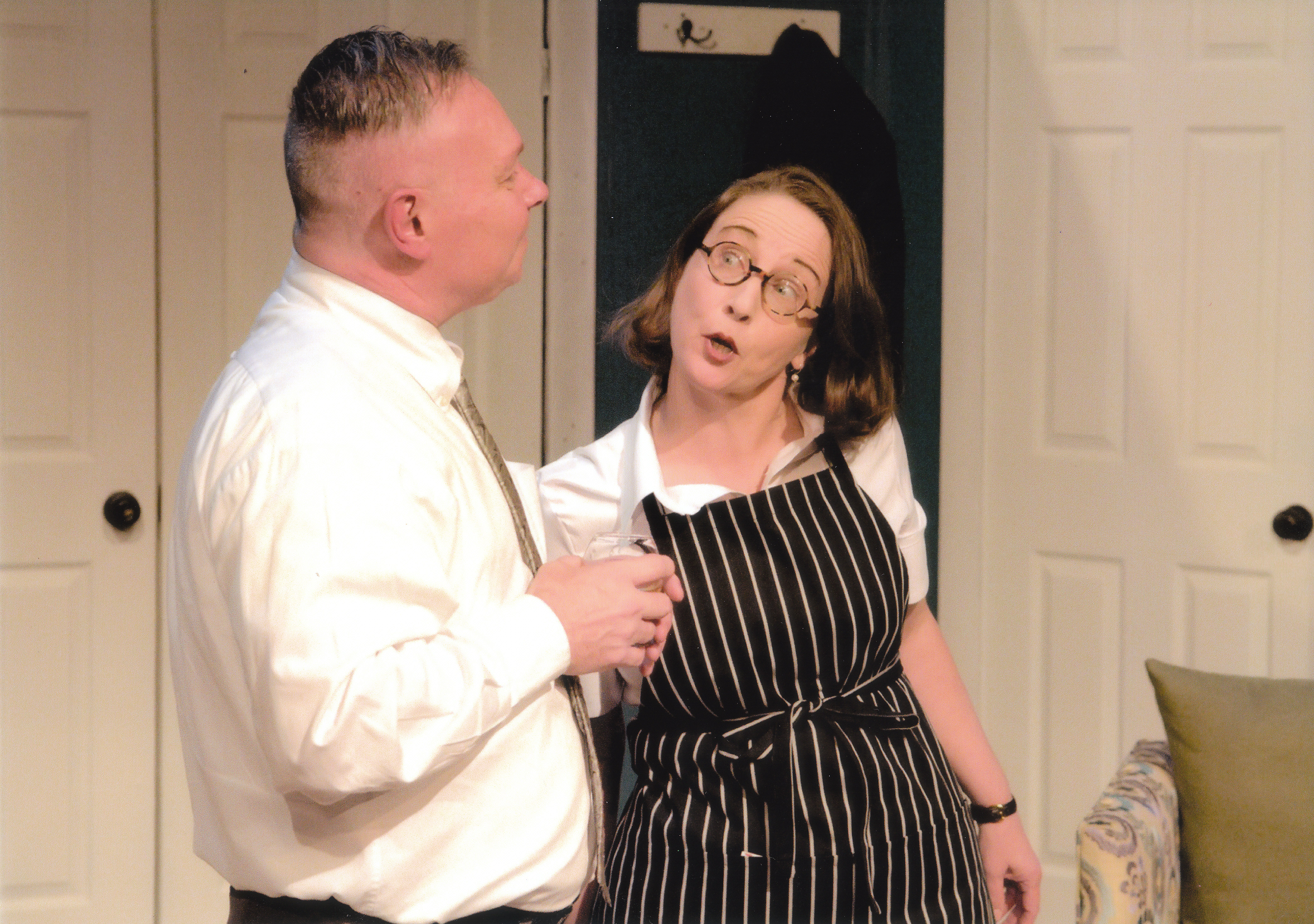
Arthur (Peter Bost) and Lady Boyle (Jane Lucas) in Hickory Community Theatre’s production of Superior Donuts (2016) / Ken Burns
In addition to putting my lines and cues on notecards, I record them with a voice recorder app on my phone. Listening to myself as I drive to rehearsal further helps me to learn the words. Along with studying my notecards and listening to my recorded lines, I write my lines over and over in my theatre notebook, the same way that as a student I would recopy my class notes as a way of studying for a test.
Now as I find myself studying lines for yet another play, one staged by Goodly Frame theatre company, I am reminded of the importance of trusting the process. I will not learn my lines as quickly as I would like to, and waiting backstage to say them will always be nerve-wracking, but becoming another person on stage remains pure joy. For me as a writer, acting is another way of working with words, a process of transporting them from the page to the stage and transforming the language into the utterances of a living, breathing character—someone who isn’t me but in whom I can “live truthfully,” as the acting teacher Sanford Meisner would say, “under the given imaginary circumstances.”
Helga (Jane Lucas) in Creative Greensboro’s production of The Wolves of Ravensbruk (2021) / Sam McClenaghan
I wrote the blog post that follows as a sample for your own introductory post. You are required to write only one-hundred words and feature one relevant photograph, but I encourage you to write more than the minimum and include additional pictures.
Though I began performing in community theatre as a teenager in the 1980s, I was away from it—focusing on my teaching and writing—for more than twenty-five years. Becoming an acting student in my forties—enrolling in classes in Richmond, Virginia, in 2011 and 2012—rekindled my passion for the craft. I fell in love with acting all over again, and I found myself wondering how I’d ever left it.
(L-R): Rosa (Beth Strader), Gizela (Nicole Weintraub), Zofia (Mary Quagliano), Helga (Jane Lucas), Ilse (Camille Wright), and Gertja (Rebecca Stanifer) / Sam McClenaghan
(L-R): Helga (Jane Lucas) and Jozefina (Cass Weston) / Sam McClenaghan
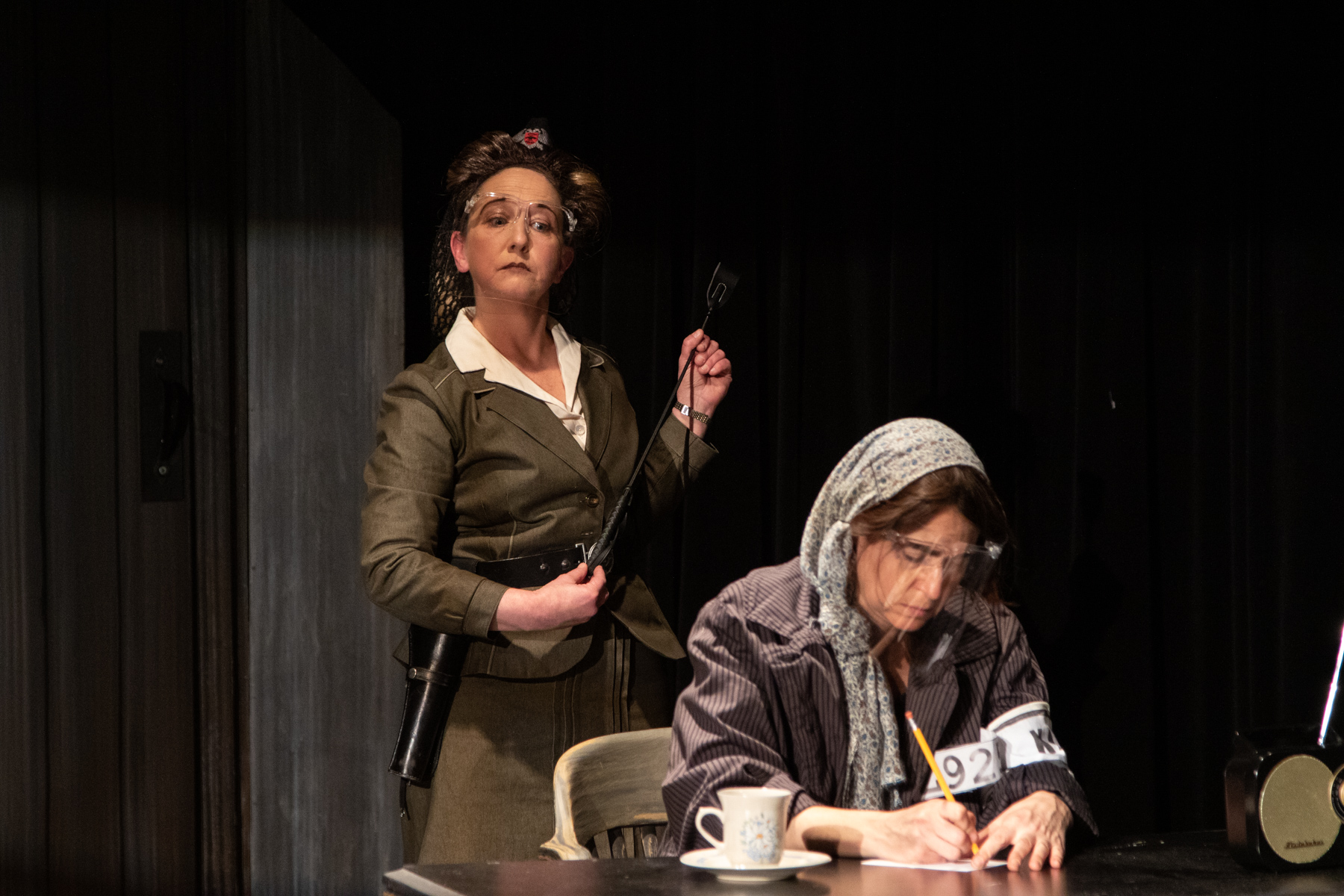
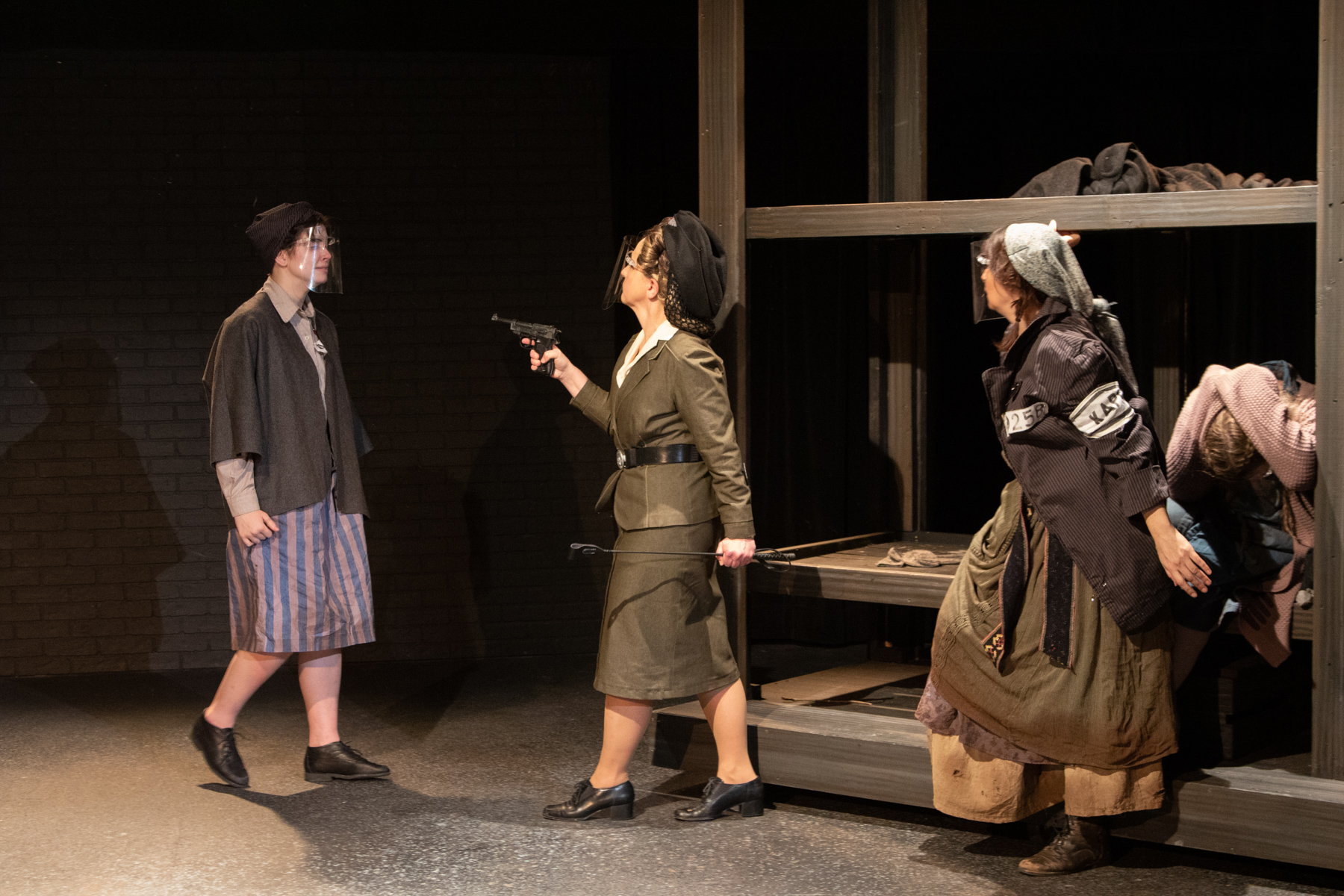
Most recently, I appeared on stage as Helga, the Nazi prison guard in the premiere production of The Wolves of Ravensbuk by Sally Kinka, which was received the New Play Project Prize awarded annually by the Creative Greensboro’s Playwright’s Forum.
(L-R): Zofia (Mary Quagliano), Helga (Jane Lucas), Jozefina (Cass Weston), and Gizela (Nicole Weintraub) / Sam McClenaghan
Performing the role of Helga proved to be one of my most challenging roles. Along with the difficulty of playing a despicable character who commits barbarous acts and barks mean-spirited words, the work of playing Helga was rigorous because of the length of her monologues and alterations in my voice required for me to convey some semblance of a German accent. Though Helga did not speak more lines than any other character I’ve played, she spoke more words in each speech, or monologue, than any other character I’ve played. That volume of words coupled with the difficulty of speaking in a foreign voice–one in which my “th” sounds morphed into “z”’s–made me more vocally tired than I’d ever been.
Though the role was tiring, I am grateful that I had the opportunity to play it. For me as a writer, acting is another way of working with words, a process of transporting them from the page to the stage and transforming the language into the utterances of a living, breathing character—someone who isn’t me but in whom I can live truthfully, as the acting teacher Sanford Meisner said, under the given imaginary circumstances.
Next Up
At the beginning of class on Wednesday, January 26, you will turn in your completed work sheet for the first lesson in the Check, Please! course. You may handwrite your assignment on the back of the worksheet, or staple a typed copy to it. If you did not receive a copy because you were absent today, you can download the worksheet below or from Blackboard.
Also, in class on Wednesday, you will begin your preliminary work on your first paper assignment, your analysis. You will receive a copy of that assignment at the beginning of the class period.
When I am not teaching, you may find me at the theatre preparing for another role. Though I have played an English teacher twice, I am often someone quite different from myself: a seventy-two-year-old bag lady, a medieval abbess, or a Spanish-speaking maid.
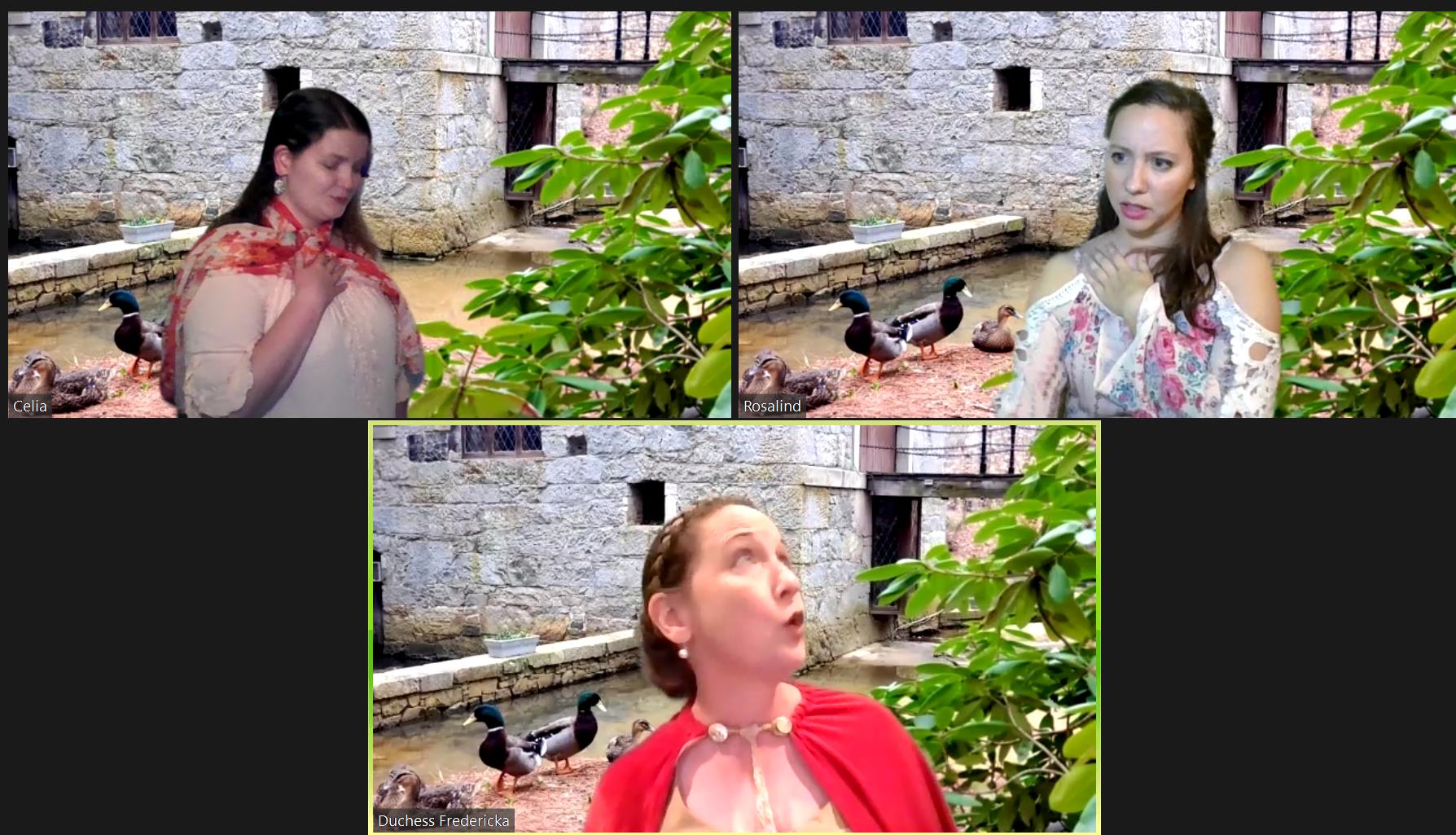
Clockwise from right: Rosalind (Stephanie Nussbaum), Duchess Fredericka (Jane Lucas), and Celia (Maggie Swaim) in dress rehearsal for the Shared Radiance Zoom production of As You Like It.
When the pandemic shut down live theatre, I found myself performing on a virtual stage, playing the role of Duchess Fredricka in the Shared Radiance Zoom production of Shakespeare’s As You Like It. Though I missed the face-to-face experience of live theatre, playing the duchess introduced me to performing on camera with a green screen and learning how to carry on conversations convincingly with actors who were invisible to me.
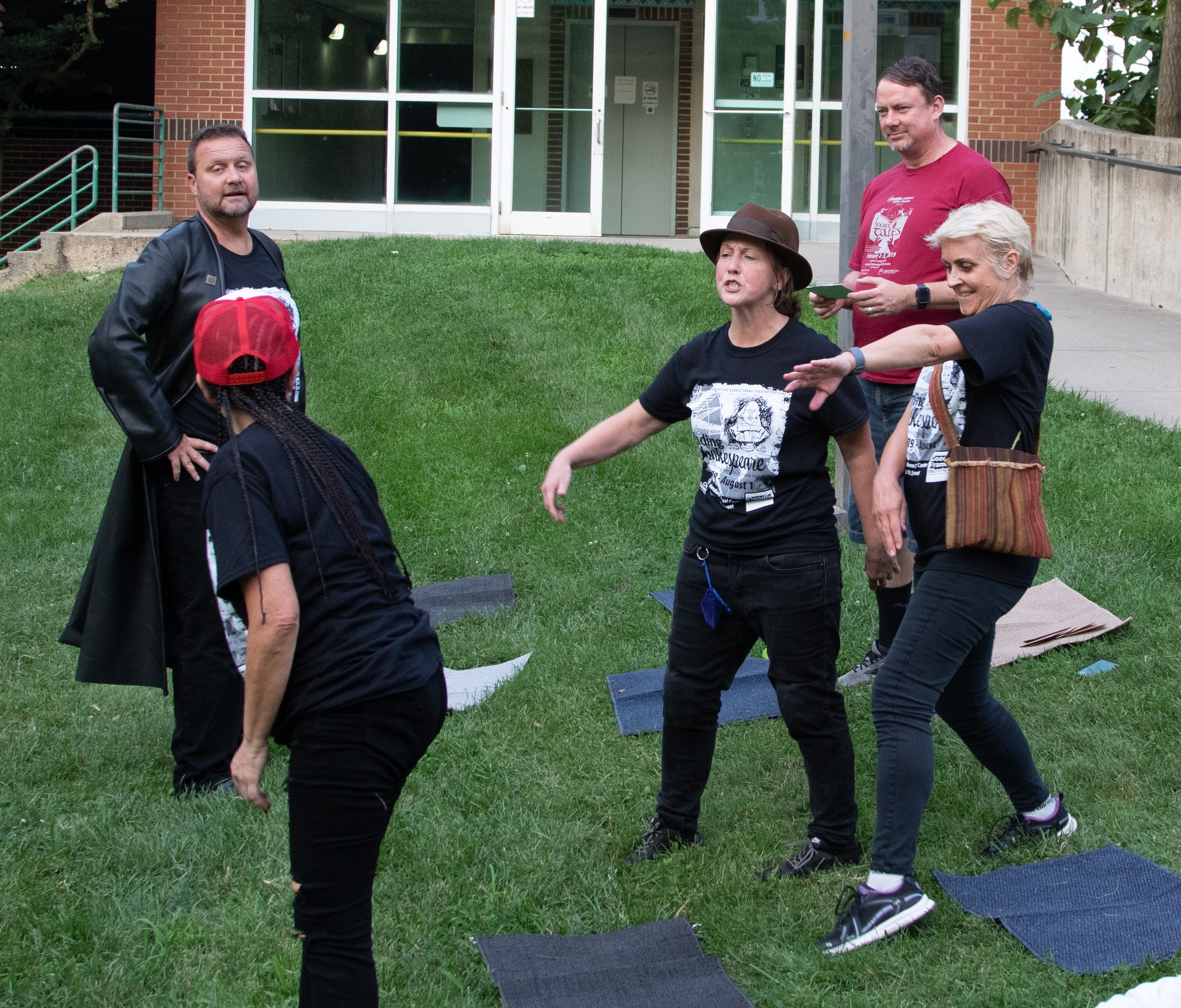
After the pandemic restrictions relaxed temporarily, I found myself performing live again but in a way that was new to me. Goodly Frame’s Finding Shakespeare required me to play three different characters in a fifteen-minute outdoor production of Shakespeare’s A Midsummer Night’s Dream.
Rehearsal for Goodly Frame’s Finding Shakespeare: A Midsummer Night’s Dream, (L-R): Theseus (Axel Tolksdorf), Lysander (Tabitha Stillwell Wilkins), Egeus (Jane Lucas), Creative Greensboro’s Todd Fisher, and Hermia (Sally Kinka) / Sam McClenaghan
Now actors find themselves in rehearsals akin to–but not the same as–the ones of our pre-pandemic nights at the theatre. They don literal masks until they step on stage to wear their figurative ones. I look forward to the days when I will not have to pull off a mask before I step into the light, but for now I am simply grateful for the innovative pandemic-era theatre opportunities I’ve had.
Arthur Przybyszewski (Peter Bost) and Lady Boyle (Jane Lucas) / Ken Burns
When I decided to audition for Superior Donuts, Lady Boyle was not on my radar. What had drawn me to the play was its writer, Tracy Letts. A few years earlier, I had seen a production of Letts’ Pulitzer Prize-winning tragicomedy August, Osage County and had left the theatre hoping that I would someday have the chance to perform a role he had written.
Then came Superior Donuts. As soon as I read the character list in the audition notice, I knew I wanted to read for the role of Randy Osteen, a woman Letts described as a forty-nine-year-old Irish American cop. (As a fair-skinned forty-eight-year-old, I seemed like a good fit.) After I auditioned for Randy, the director asked me to read for the other female role, Lady Boyle. I didn’t give her much thought until the cast announcement arrived in my inbox. When I read the director’s email, I was elated to discover that I had been cast but surprised that I wasn’t Randy. Instead, I was Lady Boyle, the seventy-two-year-old bag lady.
The role of Lady Boyle was appealing but daunting. An alcoholic living in her own alternate reality, she was a woman whose foul-mouthed nonsense unexpectedly gave way to moments of clarity and wisdom. Often when I think of her, I am reminded of Letts’ decision to name her Boyle even though her name is never spoken in the play; the other characters simply call her “Lady.” For Letts, the name Boyle granted Lady her humanity, which is what I aimed for as I worked to become her. As I learned her lines and developed the mannerisms that would accompany them, I hoped the audience would see her as more than a type.
That’s how the other characters saw her, with the exception of the donut shop’s owner, Arthur Przybyszewski. In the second act, when Arthur asks about her children, he inquires not as a shop owner making small talk but as a parent struggling to reconcile with his daughter.As Lady Boyle and Arthur sit together at a table in his shop, she tells him that she has outlived three of her four children, and recounts their deaths:
LADY: One of ‘em got shot by the coppers in a gasoline station stick-up. One of ‘em had a grabber, mowin’ the yard. And one of them died in the crib with that disease. Where the spinal cord gets a mind of its own and decides it don’t want to live trapped inside those little bones no more. You know what I’m talkin’ about?
ARTHUR: I don’t think so.
LADY: Your spinal cord gets it in its head to go free and slitherin’ out into the world. That’s what killed my little Venus. Her spinal cord got its own notions. (44)
Delivering those lines of Lady Boyle’s—and finding myself speaking some of them through tears—sustained me during a difficult time. (As Lady Boyle would say, it “happens to all of us.”) My husband had been laid off from his job in Richmond two years earlier. We had landed on our feet in North Carolina, where he was working again as an editor, but I was an invisible adjunct longing for the full-time teaching job and the community of colleagues I had left behind.
Becoming Lady Boyle made me feel whole again.
Letts, Tracy. Superior Donuts. Dramatists Play Service, 2010.



 Jane Lucas