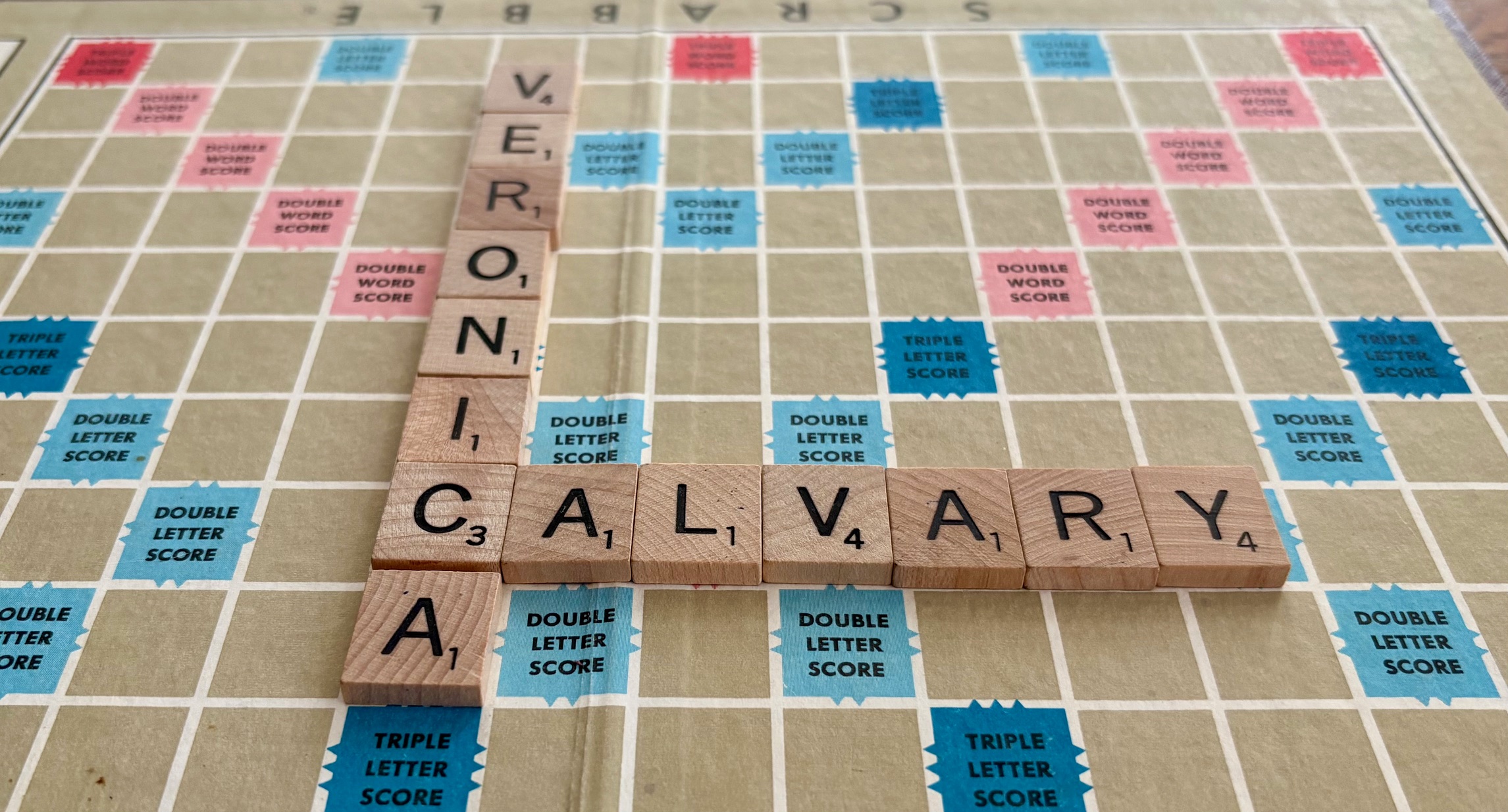
This morning, after your Scrabble debriefing, you will compose a short reflective essay focusing on the process of planning, drafting, and revising your literacy narrative. If you are still in the process of completing your essay (since you have until Friday morning’s hard deadline to post it), your reflection will address your work in progress. Instructions for your reflective essay are included below.
Directions: Compose a short reflective essay that documents the processes of planning, drafting, and revising your literacy narrative. Questions to consider include the ones listed below. You do not need to address all the questions. Focus on the ones whose answers reveal the most about your work.
When you began transferring the words from your handwritten draft onto the screen of your laptop or tablet, what did you observe about the process?
What aspect of the writing seemed the most challenging? Determining the focus of your narrative? Developing the story? Beginning a scene? Introducing dialogue? Crafting the conclusion? Why did that aspect of the writing seem the most challenging?
Did you change the subject of your narrative? If so, what was the original subject? What did you change it to? Why?
Did you change the organization of the narrative? For example, did you initially present the story chronologically, then begin in the present and move to flashback?
Did any of the sample essays or the chapter excerpt that we examined (“Me Talk Pretty One Day,” “The Day Language Came into My Life,” the excerpt from To Kill a Mockingbird, “A Bridge to Words,” “Creativity is Key,” “The Journey of the Greatest Story”) prove helpful as a model? If so, how?
What do you consider the strongest element of your literacy narrative?
What is the title, and at what point in the process did you decide on it? Did you change the title during the writing process? If so, what was the original title?
What image did you include in your blog that documents part of your writing process away from the screen? Why did you choose that particular image?
What relevant website did you link to your blog post? Why is that particular site relevant to your narrative?
Include in your reflection a minimum of one relevant quotation from the textbook, Writing Analytically, from the section “On Keeping a Writer’s Notebook” or from “Writing from Life: The Personal Essay.” Introduce your quotation with a signal phrase and follow it with a parenthetical citation. At the end of your essay, include the heading Work Cited, followed by your work cited entry. (See the models below.)
Remember that the writing that follows the quotation should demonstrate its relevance. Although you are required to include a quotation, its presence in your writing shouldn’t seem obligatory. In other words, the quotation shouldn’t appear to be there simply because you were required to include it.
Example: When I began planning my literacy narrative, I was skeptical of the assertion that “the more you write, the more you’ll find yourself noticing, and thus the more you’ll have to say” (Rosenwasser and Stephen 157). However, as I wrote in my notebook about the difficulty of holding a page of newspaper when I was a preschooler, I once again saw how those long, thin sheets of newsprint would drape over me. Then I saw my parents holding their pages of newspaper with ease, and I was back in the den with them—where I was more than fifty years ago—marveling at their ability to read.
A variation on the previous option is integrating a quotation that serves as an epigraph in Writing Analytically. If you quote an epigraph, which is a quote at the beginning of a book or book section, intended to suggest its theme, you are presenting an indirect quotation.
Example: In The Situation and the Story, memoirist Vivian Gornick observes: “What happened to the writer is not what matters; what matters is the large sense that the writer is able to make of what happened” (qtd. in Rosenwasser and Stephen). That notion of what matters became apparent to me as I drafted the conclusion of my essay. The story itself is not dramatic but the bridge it delineates—the one that connects my preliterate self to my reading self—signifies a vital crossing point in my life.
The words that I quote are Vivian Gornick’s, but the source is the textbook Writing Analytically. That is why the parenthetical citation begins with qtd. in, to indicate that the words are quoted in David Rosenwasser and Jill Stephen’s book.
The paragraphs that follow include detailed but not comprehensive notes on the two sample narratives that you read and evaluated yesterday. Look to these notes as a guide for editing your own literacy narrative.
“Creativity is Key”: Notes on Content
The essay is not a narrative. The writer mentions his experience writing a Southern gothic story, and he briefly recounts writing about his training for track and field and international football (soccer), but the writer offers very few details. Focusing on one of those experiences and recreating one or more moments from it would transform the essay into a narrative and develop it into one that meets the six hundred-word minimum requirement.
“Creativity is Key”: Notes on Form
Form is less important than content, but easily avoidable errors of form may prevent readers from appreciating the content of your narrative. Creating a compelling story is hard work; proofreading isn’t. If you don’t get the easy part right, readers may stop reading.
The writer changes the font of the body of the paper to Times New Roman but does not change the font of the running header, which should also be Times New Roman.
The writer incorrectly adds an extra space between the first-page course information (in the upper left) and between the title and the first line of the essay. MLA-style manuscripts are double-spaced. Note that later, the writer also incorrectly adds space between the paragraphs.
The title should be typed in twelve-point font, which is the font size that should be used throughout the document.
The title should not appear in boldface.
The title should be centered.
In MLA style, all major words in a title, including the final one, are capitalized (“key” should be “Key).
The second “sentence” of the second paragraph is a fragment because the meaning of “one being my senior year . . .” is dependent upon the clause that ends the previous sentence. See Writing Analytically, page 426-29.
The comma between “all” and “matter” is a comma splice. See Writing Analytically, 429.
“[R]eal life” should be hyphenated (as real-life) when it functions as a compound modifier. Ditto for “open minded” and “four to five.”
Errors of letter case–upper rather than lower, or vice versa–are mistakes of mechanics that are prevalent in the second paragraph. Track, Field, defensive back, and Athlete should all begin with a lowercase letter.
“[F]elt like” should be “felt as if.” In comparisons, use “like” before a noun and “as if” before a clause.
“I’m a writer that” should be “I’m a writer who.” The correct relative pronoun for a person is “who,” not “that.”
“The Journey of the Greatest Story”: Notes on Content
“The Journey of the Greatest Story” is a well-told narrative, but one with a glaring omission: Kate Chopin’s words. The writer claims that the last sentence of The Awakening affected her profoundly, but the absence of those words may lead readers to question the writer’s reliability. If Chopin’s words were so memorable, why aren’t they on the page? Near the end of the narrative, the writer states that she “can still recall key details from the story” (par. 4), but provides no examples. The only detail the writer mentions is Edna Pontelier’s suicide by drowning, which is a well-known fact about the novel.
The writer may have chosen to withhold Chopin’s last sentence from her introductory paragraph because she wanted to focus instead on what followed: the “loud slam of the book as he [the teacher] shut it” (par.1). Still, the writer could have included it later. For example, when she writes about the feelings the novel evokes, she might have included a sentence such as this:
I kept thinking about the last sentence: “There was a hum of bees, and the musky odor of pinks filled the air” (Chopin, ch. 39).
Quoting The Awakening doesn’t require having a copy of the novel at hand. The complete text is available on Project Gutenberg. The parenthetical citation in the example above follows the format for an unpaginated online book (author’s last name, chapter abbreviation, and chapter number). The MLA work cited entry for the book appears below. Note that in a manuscript, the entry would have a hanging indent, which means the first line would be flush left and any subsequent lines would be indented five spaces or one-half inch.
“The Journey of the Greatest Story”: Notes on Form
The Awakening (pars. 2, 4) should be italicized rather than underlined. In the process of composing her draft longhand, the writer learned that titles of book-length works are underlined in handwritten documents, and she mistakenly applied that rule to her typed revision.
The word as should not precede “the final sentence” (par. 1), because it is used improperly there. As offers comparison, shows reason, or introduces a clause. Here are two ways the writer could revise the sentence:
I still remember the moment the final sentence of the story slipped from my teacher’s mouth, and the loud slam of the book as he shut it.
I still remember the final sentence of the story slipping from my teacher’s mouth, and the loud slamming of the book as he shut it.
The second example above is more direct because the writer doesn’t tell the reader it’s a moment. Instead, she lets the moment happen. The strike-throughs indicate that “of the story” (par. 1) is an unnecessary phrase. The writer has already established that The Awakening is her subject. Also, if specifying the book is necessary at any point, it should be referred to as a novel, not a story.
The writer describes Edna Pontelier as “submerging as death grew upon her” (par. 2), but growing indicates a rise, while submersion indicates a lowering. Grew should be replaced with engulfed.
The writer incorrectly uses hyphens to set off the appositive “-the author-” (par. 2). Here are two ways the writer could correct the presentation of the appositive and edit the passage for brevity:
I yearned for more pages to materialize to clarify the ending, or to have a chat with Kate Chopin–the author–so she could relieve my frustration by explaining the conclusion. Instead, I just sat and pondered those aggravating feelings.
I yearned for more pages to materialize to clarify the ending, or to have a chat with Kate Chopin, the author, so she could relieve my frustration by explaining the conclusion. Instead, I just sat and pondered those aggravating feelings.
An appositive can be set off by em dashes or commas, but commas are preferable for short appostives, so the second correction above is recommended.
The line “having me read this class” (par. 3) is not what the writer intended. The words shoud be having me enroll in the course or having me read Chopin’s novel.
When the writer responds to her teacher, she should begin a new paragraph because the speaker changes from him to her, with her words, “Have a nice day” (par. 3).
Years are an exception to MLA’s numbers rule regarding words and figures. 2025 should be written as 2025, not “twenty-twenty-five” (par. 4).
Posting to Blackboard
Log in to Blackboard and select the course site for ENG 1108.03, then scroll down to Literacy Narrative Submission Site.
Click LiteracyNarrative Submission Site. On the next page, click the black rectangle on the lower right, labeled View instructions.
The next page is where you will submit your literacy narrative file as an MS Word document or PDF. Click on the paperclip icon, and attach your file as you would an email attachment.
An important posting note: Be sure to click the gray rectangle labeled Submit, on the lower right. If you click Save and Close, your file will be saved to Blackboard, but it will not be submitted and will not be accessible to me. To submit your file, you must click Submit.
If you follow the steps above, voila! You have submitted your literacy narrative to Blackboard.
Posting to WordPress
Log in to WordPress, and you will see a home page similar to the one below. Hover over +New in the upper left of the screen, and click Post. You can also add a post by scrolling down the left menu to Posts (beside the pushpin icon) and selecting Add Post.
On the next page, type your literacy narrative title in the Add title line and hit return. Then copy and paste the text of your narrative from your MS Word file into the space below the title. On a PC, copy and paste with control + c, control + v; on a Mac, copy and paste with command + c, command + v.
After you have pasted the text, it will appear as single-spaced, block-style paragraphs. Do not indent. Your file posted to Blackboard should follow MLA formatting guidelines, including paragraph indentations, but WordPress posts are easier to manage if you keep the default paragraph settings. To add your required image between the title and the first paragraph, hover below the title, and a + will appear.
Click the +, and a menu will pop up with various options for add-ins. If Image is not among them, click Browse all.
Scroll down, and under the heading Media, click Image.
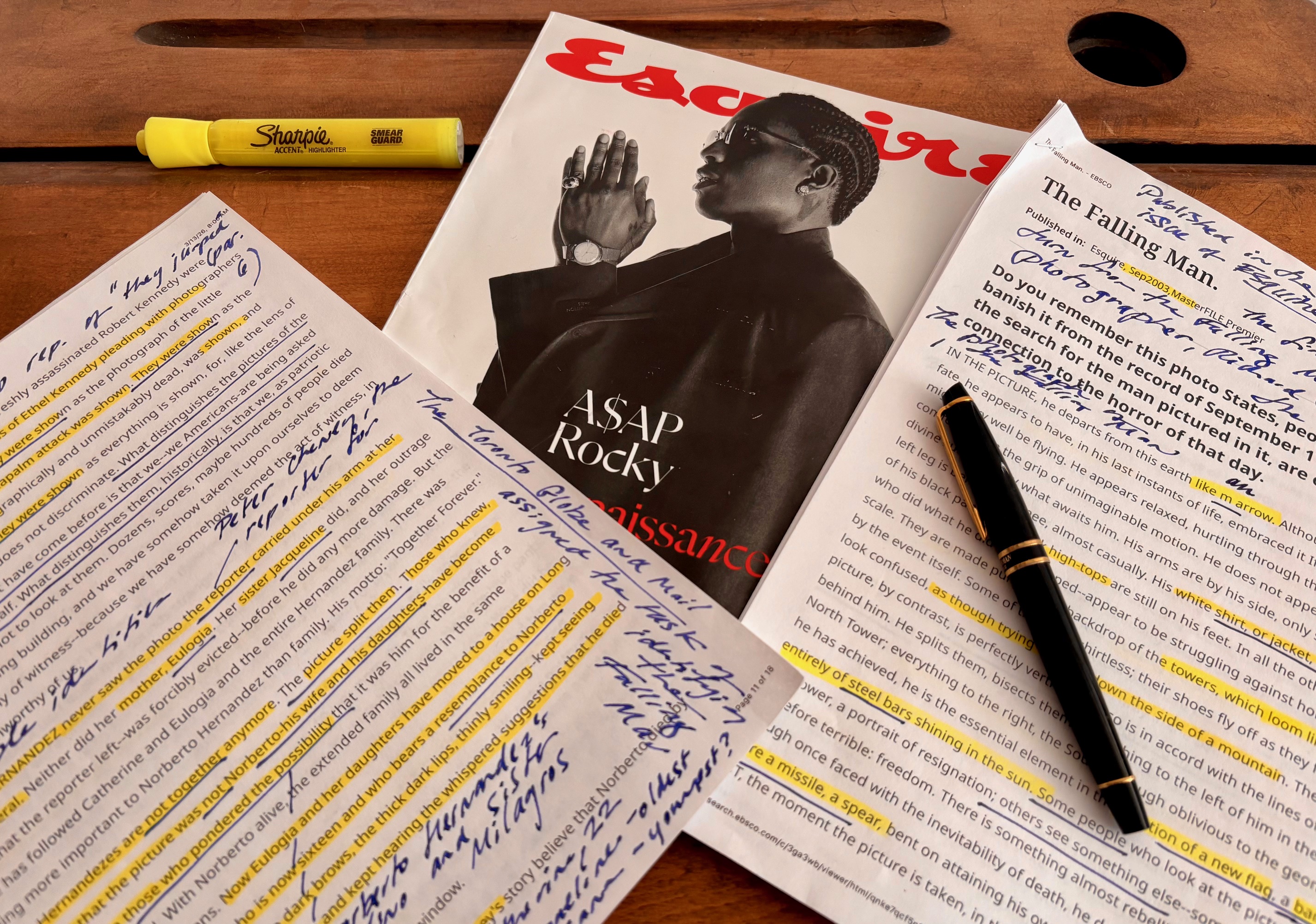
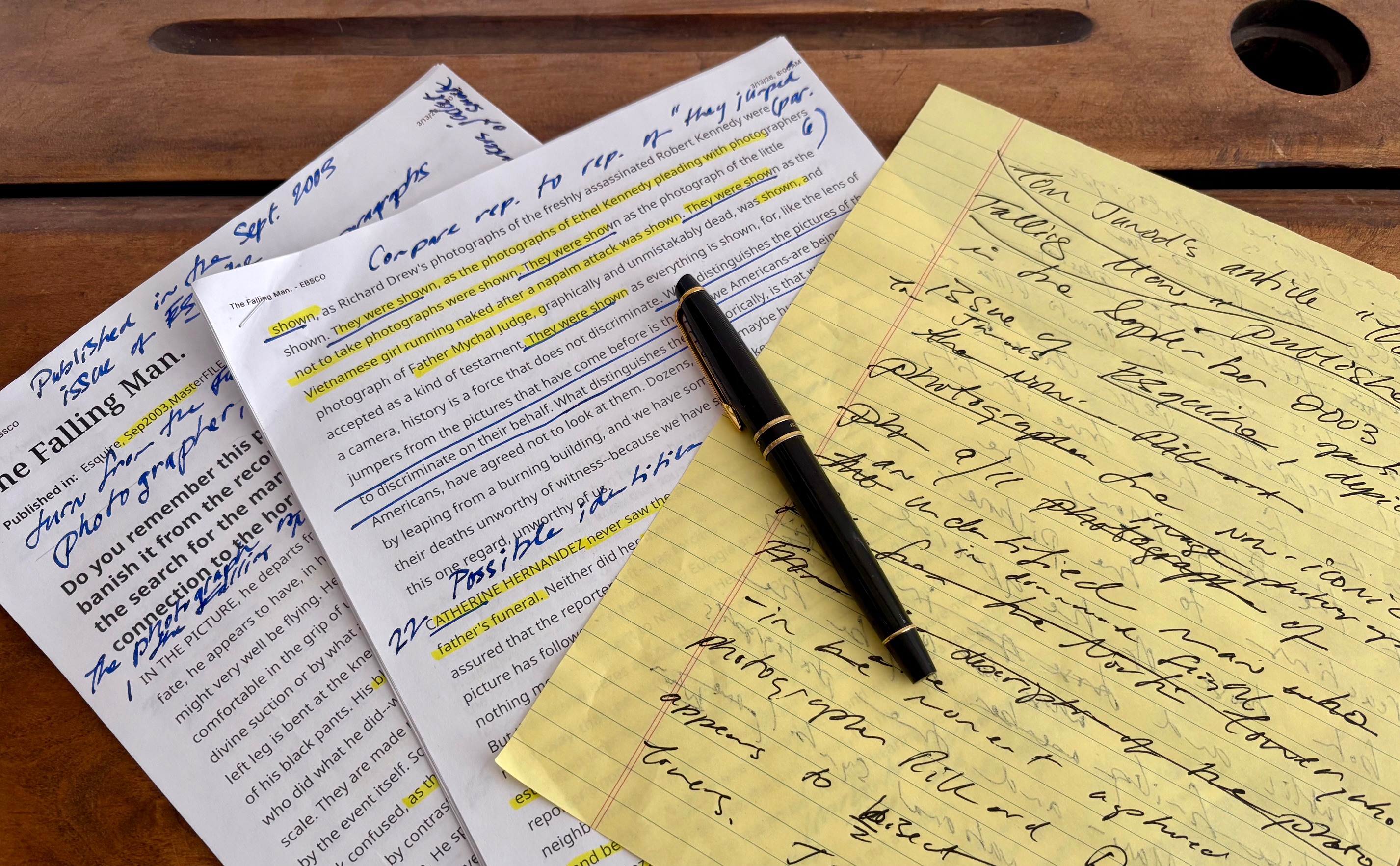
After you select Image, click Upload to add your picture. Do not post an AI-generated image or a stock photo from the Web. The image in your blog post should be a picture you took yourself that documents part of your writing process away from the screen. Note that the blog image you see below, and in Monday’s post, is a collage that includes snippets of my handwritten draft. Your image may be of your writing alone, or it may include other elements, as mine does.
Your image should now be centered on the page. If it isn’t, you can use the Align feature (shown above) to center it. If you would like the picture to be rounded, click on the picture, then click the half-black, half-white circle on the right (shown below). Then select the Rounded option.
Optional: To make the first letter of the first word of your literacy narrative a drop cap (or monogram), place the cursor on the first paragraph, and click Topography in the menu on the right (see the image below).
In the pull-down menu, click Drop cap, and a toggle switch will appear (see below). Click the toggle switch, and you will have a drop cap at the beginning of your narrative.
To add the required embedded link, open a new tab and go to the page you want to link to your post. Copy the address and return to the draft of your blog post. Highlight the word or phrase where you want to embed the link, and a link option will appear (see below).
Click the link icon, and a box will appear (see below).
Paste the address into the box, hit enter, or return, and the link will be embedded.
Save your draft (by clicking Save draft in blue in the upper right). Once you have finalized your post, click Publish. After you have published a post, you can still make changes. To do that, simply return to your dashboard, scroll down to Posts, click All Posts, then click edit under the post you want to edit (see below).
Next Up
In class on Wednesday, you will compose a short reflective essay focusing on the process of planning, drafting, and revising your literacy narrative. If you are still in the process of completing your essay on Wednesday (since you have until Friday morning’s hard deadline to post it), your reflection will address your work in progress.
Before class, read “On Keeping a Writer’s Notebook” (157-58) and “Writing from Life: The Personal Essay” (161-64). Those sections of the textbook, Writing Analytically, serve as companion pieces to your writing thus far in English 1103, and reading and taking notes on those sections will prepare you to compose the reflective essay you will write in class on Wednesday.
After you have read and taken notes on “On Keeping a Writer’s Notebook” and “Writing from Life: The Personal Essay,” choose a phrase, clause, or sentence relevant to your writing process and draft in your journal a short passage that connects that quotation to your writing. That passage will serve as part of your reflection. Detailed instructions for composing your reflection and including your chosen quotation will be included on the assignment handout that I distribute on Wednesday. Remember to bring your textbook to class.
Yesterday before you you began your revision work, we examined a page (pictured above) from Harper Lee’s novel To Kill a Mockingbird. That page from the first chapter serves as a valuable model for three narrative elements: summary, scene, and dialogue–at least two of which will figure in your literacy narrative.
The first paragraph of the passage summarizes the characters’ circumstances, designating the “summertime boundaries” (12) within which the narrator, Jean Louise, “Scout,” Finch, and her older brother, Jem, may play outdoors. The short one-sentence paragraph that follows continues the summary, informing readers that the summer Scout has just summarized is the one in which Dill (Charles Baker Harris) first visits Maycomb, Alabama.
With the first words of the next paragraph, “[e]arly one morning,” Scout shifts from summary to scene (12). All of the remaining paragraphs except the final one continue the scene with dialogue. Scout returns to summary with the words “Dill was from Meridian” (12).
Note that Harper Lee begins a new paragraph whenever the speaker changes. Also note that every line of dialogue does not include a dialogue tag, such as “he said” or “she said.” If a passage of dialogue includes only two speakers, none of the paragraphs require dialogue tags after the speakers’ first lines because the start of a new paragraph signals to the reader that the other person is speaking. If a dialogue includes three or more speakers–such as Scout’s conversation with Jem and Dill–occasional tags are essential.
Lessons in Punctuation
The excerpt from To Kill a Mockingbird also demonstrates how to use a variety of punctuation marks, including em dashes, hyphens, and commas.
Harper Lee uses em dashes to set off “Miss Rachel’s rat terrier was expecting” (12) from the rest of the sentence because it is nonessential. It adds details, but the sentence can function without them. An em dash is used before and after phrases that are nonessential. Note that there is no space before or after the dash, which is made with two strikes of the hyphen key.
Jem asks if Dill is “four-and-a-half”? Hyphens appear between those words because multiple-word numbers are hyphenated.
Near the end of the excerpt, “Mississippi” and “Miss Rachel” (12) are both set off by commas because those details are nonessential. Commas are used to set off single words and short phrases of nonessentials the way that em dashes are used to set off longer units of words.
Work Cited
Lee, Harper. To Kill a Mockingbird. Lippincott, 1960. p. 12.
Congratulations to Davis Smith for winning a copy of Helen Keller’s autobiography, The Story of My Life, in yesterday’s raffle.
Today’s class will be devoted primarily to revision work. After your Scrabble debriefing and our examination of “Letter from Birmingham Jail,” I will return the drafts of your literacy narratives, and you will have the remainder of the class period to begin revising on your laptops. You will have an additional week to continue revising before posting to Blackboard and WordPress. The due date for your literacy narrative is Wednesday, January 28, before class; the hard deadline is Friday, January 30, before class. Next Monday, January 26, I will guide you through the submission processes step by step.
As you continue to revise your literacy narrative, consider visiting the Writing Center. If you do so, you will earn five bonus points for the assignment.
To schedule an appointment, visit the Writing Center’s sign-up page, email the Writing Center’s director, Professor Justin Cook, at jcook3@highpoint.edu, or scan the QR code above. To earn bonus points for your literacy narrative, consult with a Writing Center tutor no later than Thursday, January 29.
I have attached a writing notes handout to your drafts. Keep it in your portfolio and refer to it when composing assignments. I have included an additional copy of that list below.
Writing Notes
&: Do not use an ampersand (&) in place of the word and in formal writing.
Abbreviations should often be avoided in formal writing. Do not write vocab for vocabulary. On first reference, spell out Advanced Placement in the name of a course. In subsequent references, AP is acceptable.
A lot: Don’t use a lot a lot. There are a lot of better ways to express that idea, such as many, often, considerable, etc. If you use a lot in your writing, I will mark it with a d, which denotes diction or word choice.
Compound modifiers are linked with a hyphen. Write twelve-page paper, not twelve page paper.
Do: What specifically did you do? (There is almost always a stronger verb than do.) Drafted, revised, edited, reviewed, studied, and memorized are all verbs that denote a particular action. Use action verbs whenever possible.
English and the names of other languages are always capitalized. If you write English with a lower-case e, I will underscore the letter with three vertical lines. Those three lines are the proofreader’s mark that denotes the need for a capital letter.
Modifiers: Place modifiers and modifying phrases as close as possible to the words they are meant to describe. Consider this sentence: As a four-year-old, my grandmother taught me to print the letters of the alphabet. In it, the person who is four is the grandmother, which makes no sense. (She cannot be a grandmother at four.) The sentence should be revised to read something like this: As a four-year-old, I learned from my grandmother how to print the letters of the alphabet.
Numbers that can be expressed as one or two words are written as words, not figures, in MLA style, which is the style used in English courses as well as some other courses in the humanities. Write twenty-five, not 25.
Paragraphs: Business writing calls for block paragraphs, but English 1103 and many of your other classes will require you to indent the first lines of each paragraph five spaces or one-half inch.
Passive voice should often be avoided in formal writing. The subject should perform the action. Write, we read several nineteenth-century novels, not several nineteenth-century novels were read.
Separate: an easy way to remember the spelling of this often-misspelled word is to tell yourself, there’s a rat in separate.
That/Who: The relative pronoun who, not that, refers to people. (That refers to things.) Do not write He is the teacher that taught me how to develop my writing. Instead, write He is the teacher who taught me how to develop my writing.
That/This: The relative pronoun this refers to something at hand or occurring now. That class is the one you’re writing about in your literacy narrative. This class is English 1103.
Then/Than: Than is used in comparisons; then refers to a point in time.
Titles: In MLA style, the titles of book-length works are italicized. If you are writing longhand, the titles of book-length works are underlined. The titles of shorter works—such as essays, short stories, and poems—are enclosed in quotation marks.
Whether/If: Whether introduces alternatives or a choice. If introduces a condition. Write, I don’t know whether my mother or my father read to me first, and If my pen runs out of ink, I will write in pencil instead.
Occasionally, I will post additional writing notes on my blog and will include notes on diction, mechanics, and style—as well as other writing elements—in my feedback on your major writing assignments.
As you prepare to revise your literacy narrative, look back at Helen Keller’s “The Day Language Came into My Life,” the fourth chapter of her autobiography, The Story of My Life, and consider how you can employ some of the same elements in your revision.
Keller draws on her sense of touch to render her world to us because she cannot see or hear. She writes of the warmth of the sun “on her upturned face” (par. 2) as she depicts herself waiting for the arrival of her teacher, Anne Mansfield Sullivan. Aim to use relevant sensory details in your own literacy narrative.
In the conclusion, Keller writes, “I learned a great many words that day. I do not remember what they all were; but I do know that mother, father, sister, teacher were among them” (par. 9). In writing those words, Keller makes both what she doesn’t remember and what she does remember part of her story. You may not remember all the details of a memory from your childhood, but the details you do remember will render your narrative more vividly. And if there’s something you don’t remember, that uncertainty–as Keller demonstrates–can be on the page, too.
She spells out the words that her teacher spells for her by forming each letter one at a time in Keller’s hand. If you are writing about learning to spell words, let the reader see that on the page as Keller lets her reader see: “‘w-a-t-e-r’ is water” (par. 6).
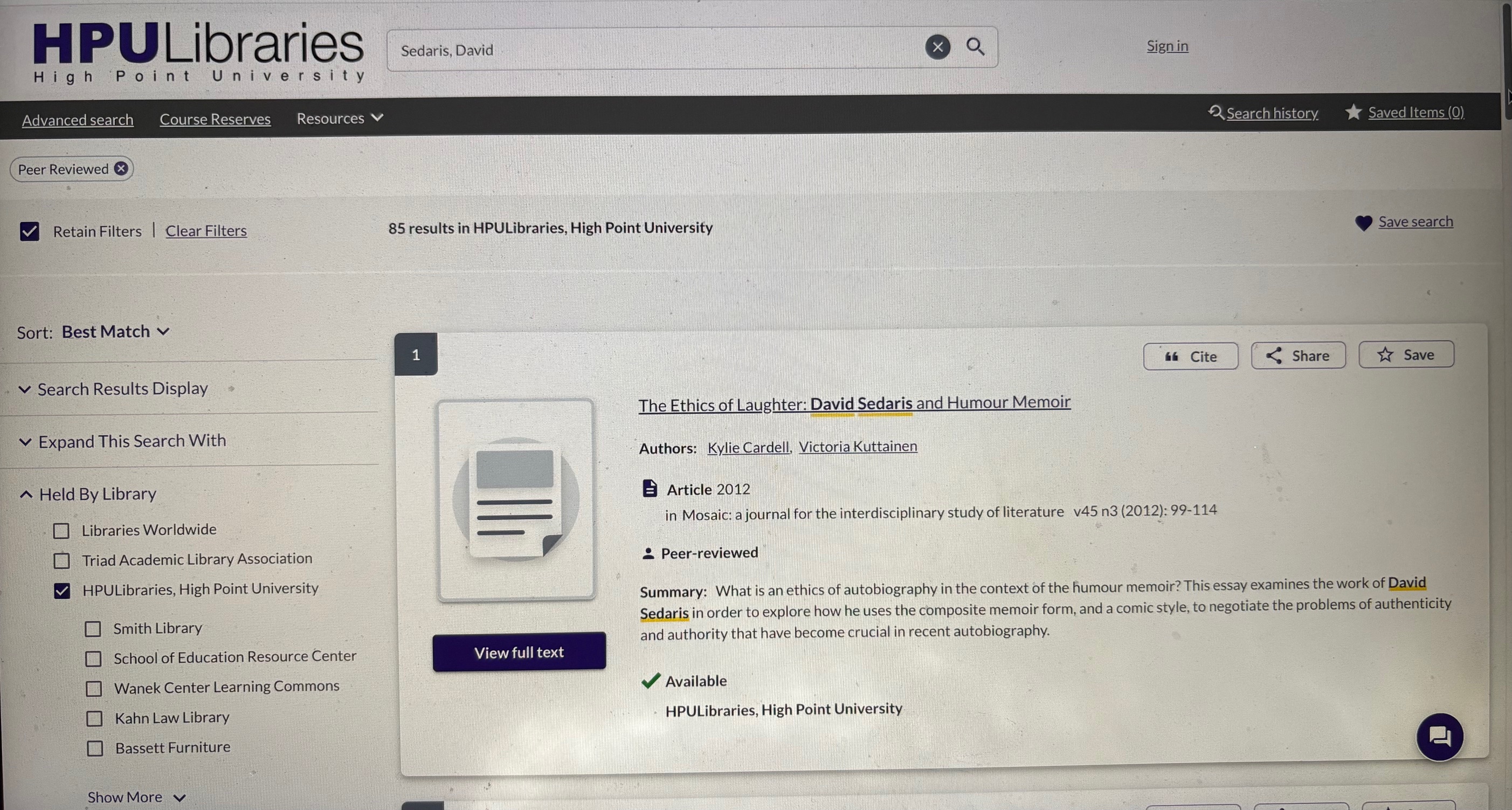
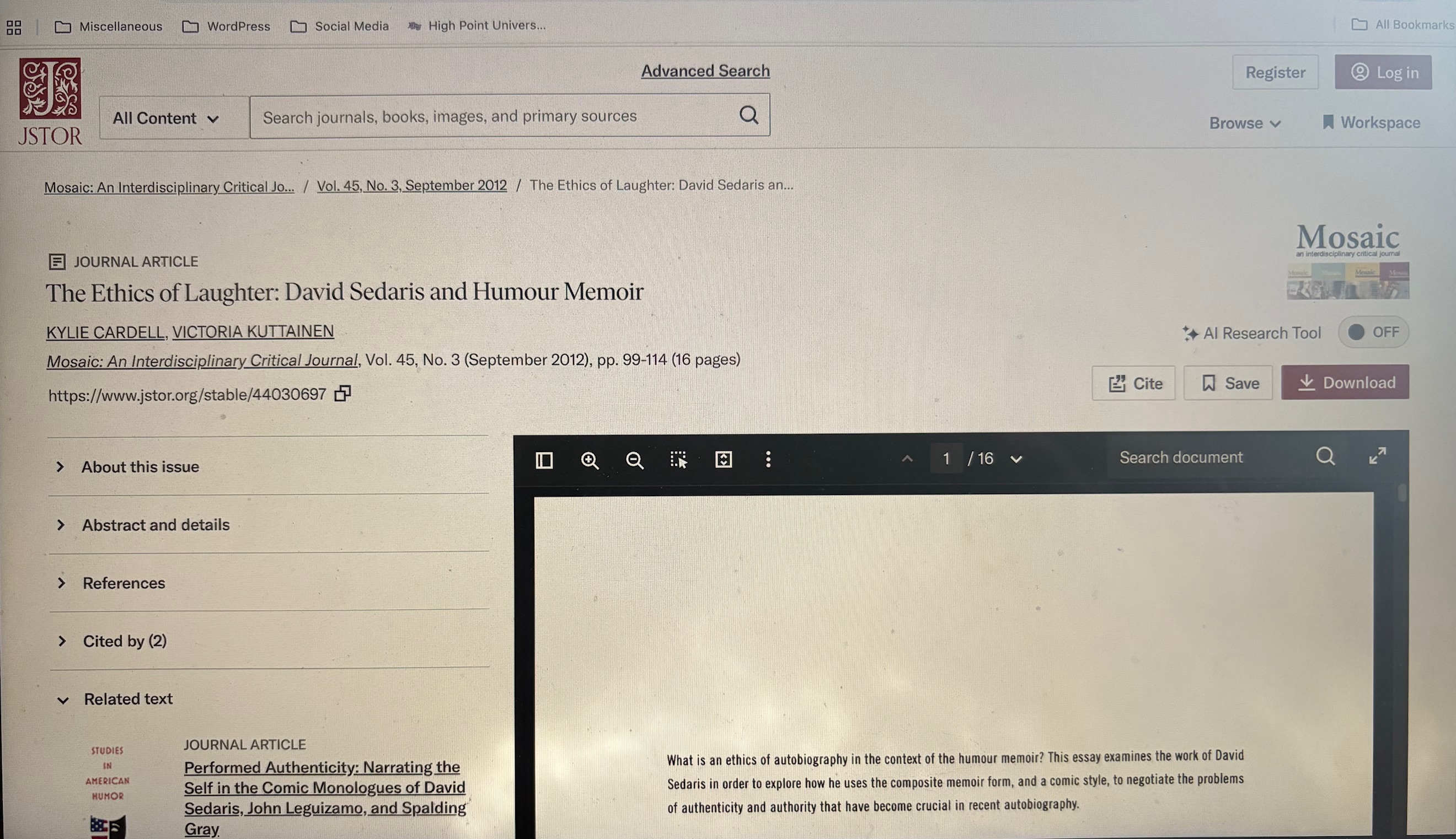
In “Me Talk Pretty One Day,” David Sedaris does not spell out the French words he is learning to speak, but he does include nonsense words, such as “meimslsxp” (167), to convey his lack of understanding. If you are writing about learning a second language, consider following Sedaris’ lead and using nonsense words–not his but ones of your own making–to convey your initial confusion. Also, try including one or more words of the language itself. Remember that words you write that are not English words–nonsense words included–are italicized. For more details on Sedaris’s essay, see the January 13 class notes.
Work Cited
Keller, Helen. “The Day Language Came Into My Life.” https://janelucasdotcom. files.wordpress.com/2025/08/a0461-3.thedaylanguagecameintomylife_keller.pdf.
Sedaris, David. “Me Talk Pretty One Day.” Me Talk Pretty One Day. Little Brown, 2000. pp. 166-73.
Pop Quiz
Rather than listing the answers to the questions on last Friday’s quiz, I have followed each question below with a note regarding where to find the answer. By finding the answers yourself, you will learn more than you would from simply reading them in a list.
In “The Day Language Came into My Life,” Helen Keller recounts what happened on that day, three months before she turned seven. Name one detail from that day that is notable for Keller’s rendering of it. See your copy of “The Day Language Came into My Life.”
How is a dead metaphor different from a cliché? (Briefly explain the two.) See the class notes for January 13.
What is the style used for formatting files and documenting sources in papers for courses in English and many other courses in the humanities (philosophy, classics, religious studies, art history, and foreign languages)? See the January 15 class notes.
Name one of the formatting requirements for the style you will use for your papers in English 1103. See the class notes for January 15.
What have you learned about writing from the annotations on your introductory reflection or on one of your Monday or Wednesday group exercises? Briefly note the rule or guideline. See your introductory reflection and your Monday and Wednesday group exercises.
Your quiz also included a bonus opportunity. Possible answers for that bonus are found in the class notes for January 8, January 9, and January 16.
Be sure to write notes in your journal on all of your readings, including the notes posted on my blog. Before each class begins, take out your journal and review your notes. That will increase your knowledge of what you read and ensure that you will earn high grades on your pop quizzes.
Next Up
Tomorrow, you will continue working on your own literacy narratives. After the Scrabble debriefing and our discussion of “Letter from Birmingham Jail,” I will return your rough drafts with my notes, and you will have the remainder of the class period to revise on your laptops. You will have an additional week to continue revising before posting your literacy narrative to Blackboard and to your WordPress blog. The due date is Wednesday, January 28, before class; the hard deadline is Friday, January 30, before class.
To honor Martin Luther King, Jr., today, I am asking you to you engage in a close study of his epistolary essay “Letter from Birmingham Jail.” Although I could ask you to listen to a recording of it, I ask that you to read it instead. King’s gift for oratory is well known, but for students of writing, closely examining his words on the page is a more pertinent exercise than listening to his voice.
What makes King’s letter an effective piece of writing? With that question in mind, consider these words: “Perhaps it is easy for those who have never felt the stinging darts of segregation to say, ‘Wait” (par. 11). Here King is addressing his initial audience, the eight white Birmingham-area clergymen who criticized his protest as “unwise and untimely” (par. 1). He suggests to those men that waiting to act isn’t difficult when you yourself aren’t the victim of injustice, when you haven’t, in King’s words, “felt the stinging darts of segregation” (par. 11). The sentence is notable not only for the contrast it illustrates between King’s reality and the lives of his readers but also for the words that King uses to show that contrast.
Consider King’s sentence and the paraphrase that follows:
Perhaps it is easy for those who have never felt the stinging darts of segregation to say, “Wait.”
Maybe it is simple for people who have not experienced segregation to say, “Wait.”
King’s sentence is stronger than the paraphrase that follows it because of the “stinging darts.” Writing that someone has not “experienced segregation” is abstract. Readers do not feel the general experience in the second sentence, but they feel King’s “stinging darts.” Sensory details strengthen sentences by appealing to readers’ senses, and figurative language invigorates writing by making the unfamiliar familiar. King’s white readers have not been the victims of segregation, but his choice of words makes them feel the sting.
While King’s “stinging darts” sentence—a relatively short one—is laudable, the long, winding sentence that follows is nothing short of staggering.
It starts with these words: “But when you have seen vicious mobs lynch your mothers and fathers at will and drown your sisters and brothers at whim.” King presents those atrocities in an introductory dependent clause, one whose full meaning depends on an independent clause that follows. But rather than immediately turning to an independent clause to complete the thought, King expands the sentence with this series of dependent clauses:
when you have seen hate filled policemen curse, kick and even kill your black brothers and sisters;
when you see the vast majority of your twenty million Negro brothers smothering in an airtight cage of poverty in the midst of an affluent society;
when you suddenly find your tongue twisted and your speech stammering as you seek to explain to your six-year-old daughter why she can’t go to the public amusement park that has just been advertised on television, and see tears welling up in her eyes when she is told that Funtown is closed to colored children, and see ominous clouds of inferiority beginning to form in her little mental sky, and see her beginning to distort her personality by developing an unconscious bitterness toward white people;
when you take a cross-county drive and find it necessary to sleep night after night in the uncomfortable corners of your automobile because no motel will accept you;
when you are humiliated day in and day out by nagging signs reading “white” and “colored”;
when your first name becomes “n—,” your middle name becomes “boy” (however old you are) and your last name becomes “John,” and your wife and mother are never given the respected title “Mrs.”;
when you are harried by day and haunted by night by the fact that you are a Negro, living constantly at tiptoe stance, never quite knowing what to expect next, and are plagued with inner fears and outer resentments;
when you are forever fighting a degenerating sense of “nobodiness”–(par. 11).
The independent clause that readers have been waiting for, the statement that completes the thought is this: “then you will understand why we find it difficult to wait” (par. 11). Those words could have immediately followed the first dependent clause, but instead King offers nine more dependent clauses, ten darts that sting his readers.
Ten dependent clauses connected by semicolons followed by a dash and an independent clause, a total of 316 words: That is not a structure I recommend for the sentences you write in English 1103, but it’s a valuable model, nevertheless.
I hope that you, as citizens, will continue to study the words of his letter. As your writing teacher, I hope that you will return to the sentence that I have examined in detail here. Along with showing his readers why his nonviolent protests could not wait, that sentence of King’s demonstrates how to develop a piece of writing through the accumulation of detail—not just the when, but the when and when and when . . . .
In class on Wednesday, we will examine a passage from “Letter from Birmingham Jail” and another prose excerpt before you begin planning and drafting your literacy narrative.
Postscript
This morning, I wrote letters of thanks to the twenty-six local men and women who participated in the 1960 High Point Sit-ins. What a pleasure it was to discover that one of the other volunteer letter writers was former student Annika Brown, now a junior accounting major!
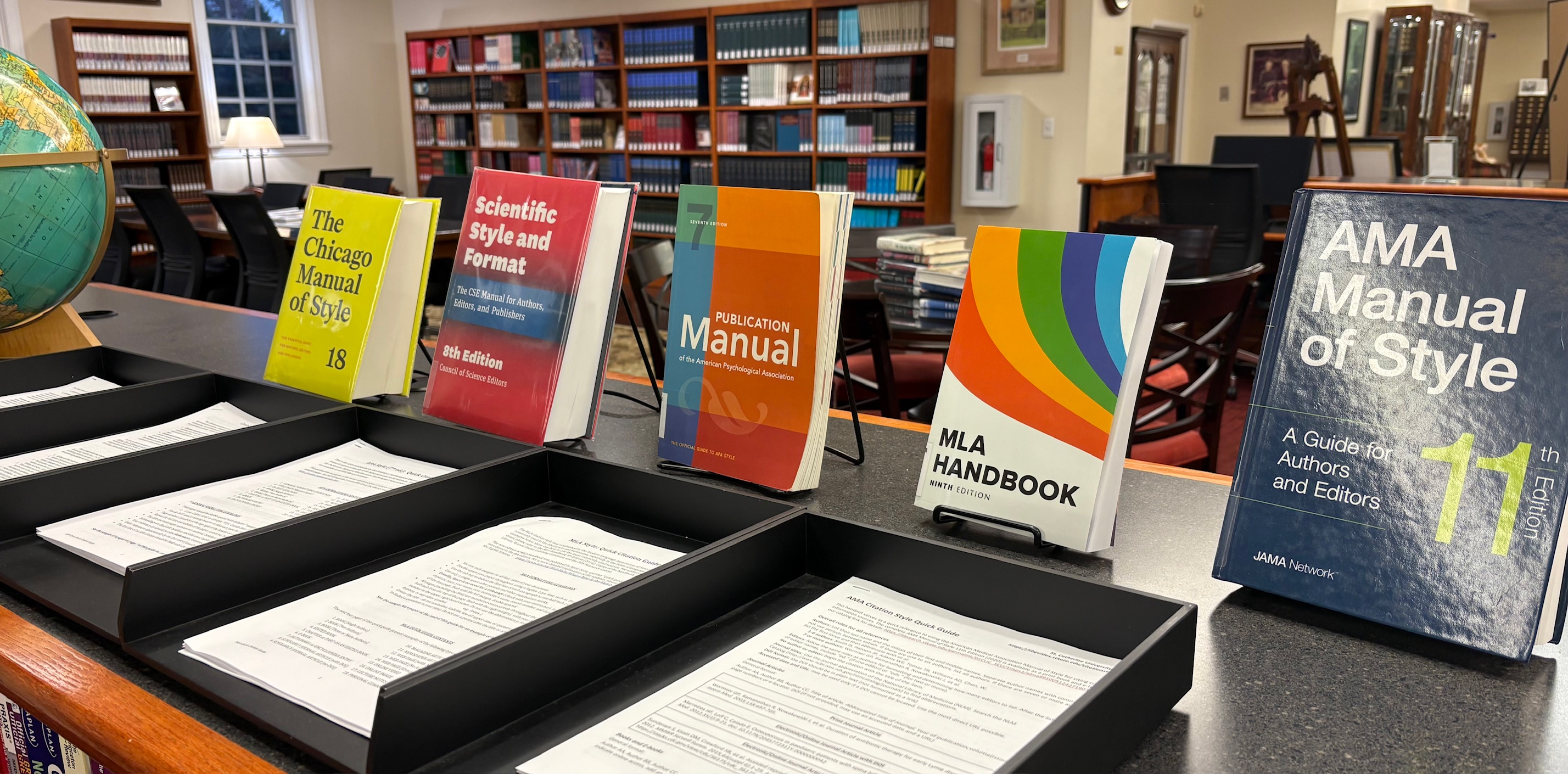
MLA (Modern Language Association) style, the standard format used for writing and documentation in the humanities, is the style that you will use for paper assignments in English 1103.
Formatting a paper in MLA style requires changing the font because Times New Roman, used in MLA papers, is not the default font in Microsoft Word. You will also need to create a running header that includes both your last name and the page number. If you do not know how to change a font or create a running header, this YouTube video on MLA page set-up will show you how.
For additional models of MLA style, see the sample essays posted on Blackboard and the MLA Style center’s sample essays, including this one by Holly Nelson, an undergraduate at Johns Hopkins University.
Bonus Assignment
As practice in both revision and MLA formatting, complete the assignment below. Students who do so will earn a bonus assignment credit in the short assignments and participation category.
Directions
Revise the introductory reflective writing that you began in class on January 5. If you were absent on the fifth or had not yet added the class, follow the assignment directions in the January 6 class notes. If your literacy narrative focuses on one of the classes that you wrote about in your reflection, do not include that class; the content of your bonus assignment should be markedly different from the content of your literacy narrative. You do not need to begin with a paragraph of summary followed by a paragraph of commentary. Those specifics were included in your reflective assignment so I could assess your understanding of the differences between the two and your ability to follow directions.
Compose a revision of at least two-hundred and fifty words, and type it into a Microsoft Word document that you have formatted to comply with MLA style. If you are unsure of how to change the formatting in a file, revisit the second paragraph of this blog post.
Print a copy of your file, and submit your paper copy at the beginning of class on Friday, January 23. You will not submit a copy online. Posting to Blackbaord and WordPress is a requirement for your three major writing assignments only. However, if you want to publish your bonus assignment on your blog as practice in using WordPress, you are welcome to do so.
Next Up
For Monday, in honor of Martin Luther King, Jr., you will read his ”Letter from Birmingham Jail.” You do not need to print a copy; I will distribute copies of an excerpt from the letter when class resumes on Wednesday, January 21, and we will examine it before you begin revising your literacy narratives in class.
This morning at the beginning of class, we will examine the literacy narrative that you read for today, “The Day Language Came into My Life,” which is the fourth chapter of Helen Keller’s autobiography, The Story of My Life.
Together, Sedaris‘s essay and Keller’s chapter demonstrate two vastly different ways to present a literacy narrative. “Me Talk Pretty One Day” offers a quirky look at the challenges of learning French from a sarcastic, soul-crushing instructor. Keller’s story poignantly recounts learning to make meaning of the world through sign language.
After we discuss Keller’s chapter, you will begin planning and drafting your first essay assignment, a literacy narrative: an account of a learning experience involving reading, writing, or learning to speak a language.
Directions
Begin by asking yourself this question: What were some of my most formative experiences as a reader, a writer, or a language learner? Freewrite on those, then choose one to bring to life. Your aim is to recreate your experience on the page and reflect on its significance. Your focus may be any one of the following:
A memory of a reading or writing assignment that you recall vividly
Someone who helped you learn to read or write
A writing-related school event that you found humorous or embarrassing
A particular type of writing that you found (or still find) challenging
A memento that represents an important moment in your development as a reader or writer
Learning a second language
Your literacy narrative should be a well-told story that includes these elements:
Vivid detail
Some indication of the narrative’s significance
A minimum of 600 words
A title that offers a window into your essay (It should not be titled “Literacy Narrative.”)
Detailed instructions are included in the assignment handout that you will receive in class today. An additional copy is posted on Blackboard in the Major Paper Assignments folder.
Yesterday in class, you wrote about David Sedaris‘s use of similes, metaphors, and hyperboles. The list that follows illustrates the wide variety of figurative language that you identified in “Me Talk Pretty One Day.”
David Sedaris employs a simile when he describes himself as “not unlike Pa Kettle trapped backstage at a fashion show” (167).
Sedaris fashions a metaphor with the words “everybody into the language pool, sink or swim” (167).
The essay “Me Talk Pretty One Day” features the metaphorical hyperbole “front teeth the size of tombstones” (Sedaris 168).
David Sedaris uses a simile when he writes that one classmate’s introduction sounds “like a translation of one of those Playmate of the Month data sheets” (168).
The author of “Me Talk Pretty One Day” turns to hyperbole when he writes, “The teacher killed some time accusing the Yugoslavian girl of masterminding a program of genocide” (Sedaris 169), and again when he notes that he and his classmates “learned to dodge chalk” (170).
Similarly, Sedaris uses hyperbole to emphasize his teacher’s reaction, which “led [him] to believe that these mistakes were capital crimes in the country of France” (170).
David Sedaris fashions a metaphor when he describes his dread, writing, “My fear and discomfort crept beyond the borders of the classroom and accompanied me out onto the wide Boulevard” (171).
Sedaris’ teacher insults him with a simile when she remarks, “‘Everyday spent with you is like having a cesarean section'” (172).
The bulleted sentences above follow the format that you should follow in your group exercises and other writing assignments that require quotations. These are the specific guidelines to remember:
The answer should be a minimum of one sentence. It need not be a long sentence, but it should include concrete detail.
The sentence should not begin with a quotation. Though journalists, fiction writers, and memoirists sometimes begin sentences with quotations, in academic writing, quotations are introduced with signal phrases.
Do not foreground the paragraph or page number in a sentence. The most important feature of the sentence is the writer’s particular use of words. The page or paragraph number follows in the parenthetical citation.
Dead Metaphors
Some of you identified “killed some time” (169) as a metaphor, but it’s actually a dead metaphor, one so familiar that it’s lost its meaning. Killing time and running for office have become synonymous with the actions they once compared. A dead metaphor is not the same as one that has become a cliché: a predictable or overly familiar expression. Avoid clichés like the plague, which I just failed to do for the sake of illustration. (Avoid . . . like the plague is textbook cliché.)
Memorable Words
One group cited the use of nonsense words, such as “meimslsxp” (167), as an effective way to convey Sedaris’s utter lack of understanding of his French teacher’s speech.
Another noted the fitting choice of “intoxicating” (173) to describe the feeling Sedaris experienced when he finally began to understand French.
Work Cited
Sedaris, David. “Me Talk Pretty One Day.” Me Talk Pretty One Day. Little Brown, 2000. pp. 166-73.
“What’s in a Name” Follow-Up
Friday’s blog entry offered a bonus assignment credit to any student who posted a response identifying the classmates whose names are also common nouns, which makes them playable Scrabble words.
The playable names of your classmates appear below in bold, followed by the definitions in parentheses.
Nick (to make a shallow cut) Beeker
Aidan Berlin (a type of carriage)
Jermaine Cain (a tax paid in produce or livestock, also kain)
Zach Dick (a detective)
Tommy (a loaf of bread) McHugh
Davis Smith (a worker in metals)
Dylan Virga (wisps of precipitation evaporating before reaching ground)
Sierra (a mountain range) Welch (to fail to pay a debt, also welsh)
Kudos to Nick Beeker, Aidan Berlin, Jermain Cain, Nicole Marin, Sophia Marin, and Sierra Welch for identifying your classmates’ names that are playable words. For their efforts, they will receive a bonus assignment credit in the short assignments and participation category
I will offer additional bonus assignments, so be on the lookout for those. Reading all the notes that I post for you here, on my blog, will ensure that you don’t miss those opportunities.
Congratulations to Aidan Berlin for winning a copy of The Santaland Diaries in yesterday’s raffle.
Next Up
In class tomorrow, you will begin drafting your first major writing assignment longhand. The assignment, a literacy narrative, is an account of a learning experience involving reading, writing, or learning to speak a language. As part of your prewriting process, look back at “Me Talk Pretty One Day” and consider how you might incorporate into your own essay some of the same elements that David Sedaris includes in his. Repeat the process with Helen Keller’s “The Day Language Came into My Life.”
This morning in class, after your Scrabble debriefing, we will examine David Sedaris‘s essay “Me Talk Pretty One Day,” and you and two or three of your classmates will collaborate on an exercise that asks you to examine–and subsequently address in writing–these elements of his literacy narrative:
Metaphors and similes
Hyperbole
Your group will also identify a word or phrase that appeals to you, or that seems particularly effective—one that is not an example of a metaphor, a simile, or a hyperbolic statement—and compose a sentence that includes the word or phrase and your observations about it.
Metaphors and similes make writing more vivid and can deepen a reader’s understanding of and connection to a piece of writing. In Imaginative Writing, novelist Janet Burroway observes, “Both metaphor and simile compare things that are both alike and different, and it is the tension between this likeness and difference that their literary power lies” (25).
Hyperbolic statements, along with metaphors and similes, are common in Sedaris’s humor, which has garnered him considerable commercial and critical success. Me Talk Pretty One Day (2000) was awarded the Thurber Prize for American Humor. In 2019, he was elected to the American Academy of Arts and Letters, and in 2021, the New York Public Library voted Me Talk Pretty One Day one of the 125 most important books of the last 125 years.
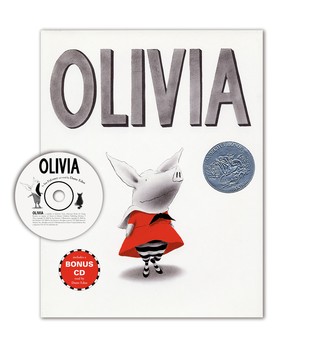
Sedaris rose to prominence in 1992 after National Public Radio broadcast his essay “Santaland Diaries,” which chronicles his stint as an elf at Macy’s flagship store in New York. That essay is included in his collection Holidays on Ice (1997). You will have the opportunity to win a copy of that book in today’s class raffle.
Work Cited
Burroway, Janet. Imaginative Writing: The Elements of Craft. Pearson, 2014.
Scrabble Debriefings
Starting today, at the beginning of class on Mondays, I will return your Scrabble score sheets from Friday, and you and your group members will participate in a Scrabble debriefing in which you will (1) review and discuss your game, and (2) individually compose journal entries on the game. Questions to address include, but are not limited to, the ones on the handout that I will distribute this morning in class. Those questions for consideration are also listed below.
Did you learn any new words from your teammate or from your opponents? If so, what were they? If you did not look up their meanings after class and record them in your journal, look them up and record their meanings now.
What plays involved analyzing multiple options? Did your team opt not to make the highest-scoring play possible in order to either (1) block your opponent, or (2) keep letters that might enable you to score more points later?
Where did creative problem-solving figure in the game? If your team had a rack of all consonants or vowels–or mostly consonants or vowels–how were you able to advance the game by playing only one or two letters?
What was the largest number of words formed in a single play and what were they?
Scrabble, like writing, is a process of composing, only the board game involves composing smaller units, words rather than sentences and paragraphs. What parallels, if any, can you draw between your Scrabble play and your writing process?
You will have the opportunity to draw on the journal entries that you write during debriefings when you compose your midterm and final reflections for the course. If you choose Scrabble as the focus of your final essay and annotated bibliography, you may incorporate portions of your Scrabble debriefings into that assignment as well.
Next Up
In class on Wednesday, you will begin drafting your first major writing assignment longhand. The assignment, a literacy narrative, is an account of a learning experience involving reading, writing, or learning to speak a language. As part of your prewriting process, look back at “Me Talk Pretty One Day” and consider how you might incorporate into your own essay some of the same elements that David Sedaris includes in his. Repeat the process with Helen Keller’s “The Day Language Came into My Life.”