This morning in class you will compose a short reflective essay that documents the processes of planning, drafting, and revising your analysis. In your reflection, you will include at least one relevant quotation from one of the sections of Writing Analytically listed below or from another section of the textbook.
Sample Works Cited Entries for Writing Analytically
Rosenwasser, David and Jill Stephen. “Late-Stage Editing and Revising: Some Tips.” Writing Analytically, 9th edition. Wadsworth/Cengage, 2024. pp. 151-52.
Rosenwasser, David and Jill Stephen. “On Keeping a Writer’s Notebook.” Writing Analytically, 9th edition. Wadsworth/Cengage, 2024. pp. 157-58.
Rosenwasser, David and Jill Stephen. “Putting X in Tension with Y.” Writing Analytically, 9th edition. Wadsworth/Cengage, 2024. pp. 248-49.
Rosenwasser, David and Jill Stephen. “The Thesis and the Writing Process.” Writing Analytically, 9th edition. Wadsworth/Cengage, 2024. pp. 237-38.
Questions to Consider in Your Reflection
What aspect of the writing seemed the most challenging? Choosing your topic? Deciding which text would serve as your subject? Determining your thesis? Identifying details to support your claims? Organizing the body of the essay? Composing the conclusion? Why did that aspect of the writing seem the most challenging?
Did the subject of your analysis change? If so, what was your original subject, and what did you change it to?
What do you consider the strongest element of your analysis?
At what point in the process did you decide on a title? Did you change the title during the writing process? If so, what was the original title?
What image that documents part of your writing process away from the screen did you include in your blog post? Why did you choose that particular image?
Next Up
Wordplay Day! To prepare for class, revisit the Dictionary and World Builder pages on the Scrabble website. Also review the blog posts devoted to Scrabble tips.
This morning in class you will read the sample student analysis “Wait Means Never” and collaboratively answer the questions that follow.
Does the writer present a summary of Martin Luther King, Jr.’s “Letter from Birmingham Jail” before he presents his thesis?
The authors of Writing Analytically note that “a productive thesis statement usually contains tension, the balance of this against that” (Rosenwasser and Stephen 248). Reread the thesis and note whether it includes any instances of “this against that.”
What specific example stands as the writer’s most effective support for his thesis
Effective strategies for concluding analyses include (1) offering an insight about the text or an additional quotation from it, (2) revisiting the thesis without stating it verbatim, and (3) pointing to the broader implications of the analysis. Does the writer employ any of those strategies? If so, which one or ones?
After you answer the questions above, review the grade criteria on your analysis assignment handout, and assign a grade. If you cannot reach a consensus, write each recommended grade.
Next Up
In class on Wednesday, you will compose a reflective essay on your analysis.
Last week I published a blog post that listed the first twenty-two playable four-letter words with three vowels. Knowing those words, and others with multiple vowels, proves useful when you’re faced with a rack of mostly, or all, vowels. Here’s a list of the remaining fourteen playable four-letter words with three vowels:
naoi: ancient temples (pl. of naos)
obia: form of sorcery practiced in the Caribbean (also obeah)
odea: concert halls (pl. of odeum)
ogee: an S-shaped molding
ohia: a Polynesian tree with bright flowers (also lehua)
olea: corrosive solutions (pl. of oleum)
olio: a miscellaneous collection
ouzo: a Turkish anise-flavored liquor
raia: a non-Muslim Turk (also rayah)
roue: a lecherous old man
toea: a currency in Papua, New Guinea
unai: a two-toed sloth (pl. unai; an ai is a three-toed sloth)
zoea: the larvae of some crustaceans
Next Up
Wordplay Day! To prepare for class, revisit the Dictionary and World Builder pages on the Scrabble website. Also review the blog posts devoted to Scrabble tips.
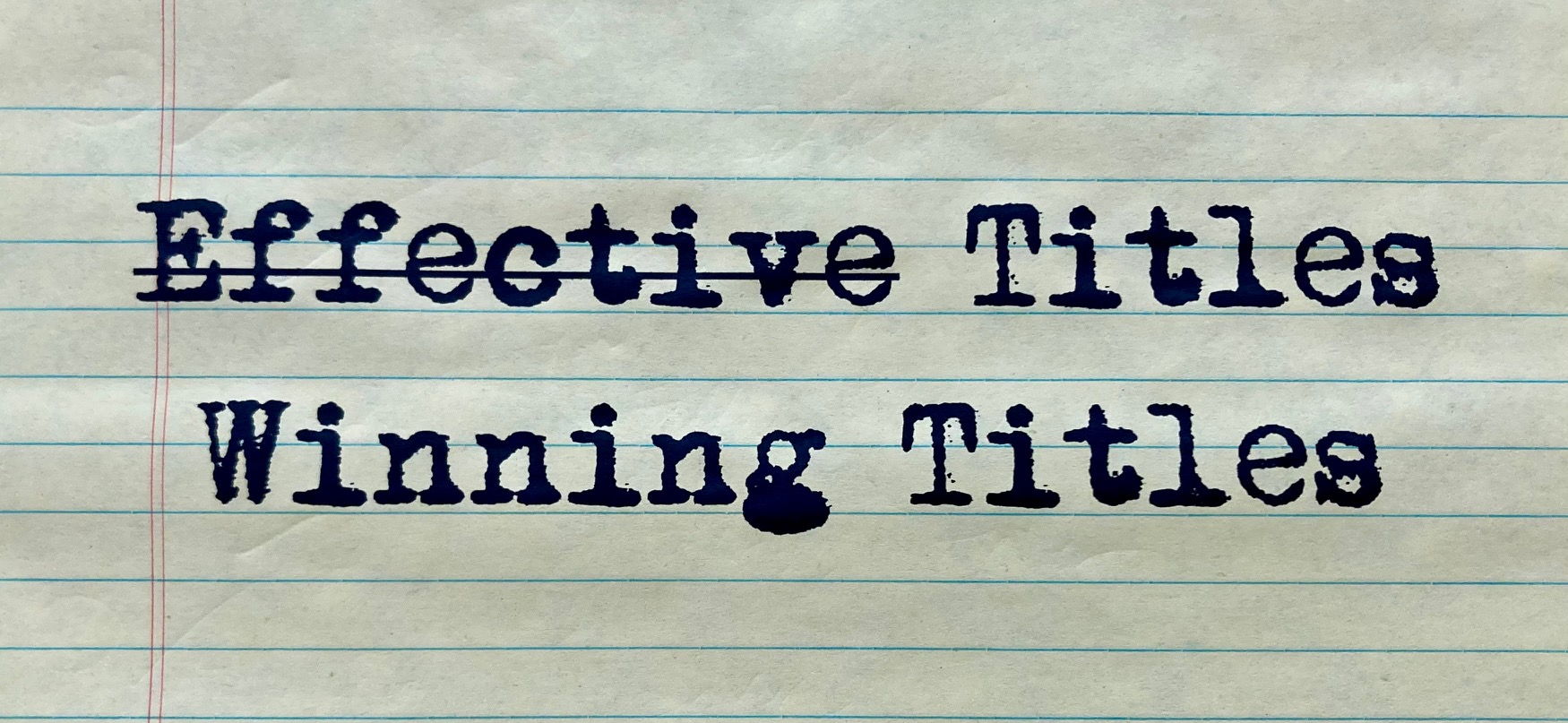
What makes for an effective title? That’s an important question to consider since the title contains the first words of yours that a reader will encounter. First, it should be descriptive; it should evoke an image in the reader’s mind. It should also be relevant to your subject; it should convey something about the writing to follow. Lastly, it should be intriguing; it should create in the reader a desire to keep reading. With those traits in mind, review the titles of your classmates’ midterm reflections listed below. Which of these is most effective and why?
“Aspects Leading to Success”
“The Awakening of My Inner Writer”
“Becoming a Better Writer
“Becoming a Stronger Writer”
“Controlled Writing”
“Developing as a Writer”
“Developing Skills”
“The First Half”
“Growth as a Writer”
“Growth in Analyzing”
“Growth-Mindedness”
“Highlights of Working with Others”
“How a Board Game Changed My Writing”
“How I have Grown”
“Impact of a Class”
“Impact of Collaboration”
“Improvements in My Writing”
“The Key to Writing”
“My Personal Development”
“My Road to Success”
“Professionalism”
“A Semester of Improvement”
“Seven Tiles but a Lifetime of Knowledge”
“The Start of a New Beginning”
“Think before You Write”
“Thinking beyond What I Knew”
“Transition to College”
“Unforeseen Clarity”
“Ways of Learning”
Bonus-Point Opportunity
Directions:
Determine which of your classmates’ titles you deem most effective.
Compose a comment that includes the title enclosed in quotation marks and a brief explanation of its effectiveness.
Post your comment as a reply to this blog entry no later than 4 p.m. today, Thursday, October 3. (To post your comment, click on the post’s title, and scroll down to the bottom of the page. You will then see the image of an airmail envelope with a leave comment option.)
I will approve your responses (make your comments visible) after the 4 p.m. deadline on October 3. Commenters will receive five bonus points for their October 4 Scrabble assignment.
Postscript
Congratulations to Ryan Kelley and Annalise Lindsay (section 19) whose titles were chosen as the most effective. Nicole Edelman (section 19) chose Ryan’s title “Impact of a Class,” and Cristique Duvall (section 20) chose Annalise’s title “Seven Tiles but a Lifetime of Knowledge.” Nicole and Cristique will each receive five bonus points for their October 4 Scrabble assignment/score sheet.
Next Up
Wordplay Day! To prepare for class, revisit the Dictionary and World Builder pages on the Scrabble website. Also review the blog posts devoted to Scrabble.
This morning, I will return your drafts with my notes, and you will have the remainder of the class period to begin revising your analyses on your laptops. Because next week is fall break, you will have two additional weeks to continue your revision work before you submit the assignment to Blackboard and publish it as a WordPress blog entry. The due date is Wednesday, October 16 (before class). The hard deadline is Friday, October 18 (before class). Directions for submitting your analysis are included on your assignment sheet and on the Blackboard submission site.
As you continue to revise your analysis, consider visiting The Writing Center. If you do so, you will earn five bonus points for the assignment.
To schedule an appointment, visit https://highpoint.mywconline.com, email the Writing Center’s director, Professor Justin Cook, at jcook3@highpoint.edu, or scan the QR code below. To earn bonus points for your analysis, consult with a Writing Center tutor no later than Thursday, October 17.
Nearly all of you in section nineteen consulted a Writing Center tutor as you worked on your literacy narrative, while less than half of you in section twenty did so:
Section 19: 18 of 20 students, 90%
Section 20: 7 of 19 students, 36.8%
Please encourage your classmates to take advantage of the opportunity to have an additional reader for your analysis-in-progress–and earn five bonus points to boot.
Next Up
Wordplay Day! To prepare for class, revisit the Dictionary and World Builder pages on the Scrabble website and review the blog posts devoted to Scrabble.
Rosenwaser, David and Jill Stephen. Chapter 7: “Finding an Evolving a Thesis.” Writing Analytically, 9th edition. Wadsworth/Cengage, 2024. pp. 234-78.
As you prepare to begin revising your analysis, read the section of Writing Analytically devoted to composing thesis statements (247-52). Also review the opening paragraph of my analysis of Art Spiegelman’sMaus and my sample opening for a possible analysis of Donald Bartheleme’s “The School,” both of which follow.
In Chapter 4 of Art Spiegelman’s graphic memoir Maus, he depicts his father Vladek’s account of the hangings of four Jewish merchants in Sosnowiec, Poland. Vladek and his wife, Anja, learn from Anja’s father, Mr. Zylberberg, that the Nazis have arrested his friend Nahum Cohn and his son. With his head bowed in sorrow, Mr. Zylberberg says to Anja and Vladek, “The Germans intend to make an example of them!” (83). That image of Mr. Zylberberg speaking with Vladek and Anja overlays the larger panel that dominates the page, one that depicts the horror that Mr. Zylberberg anticipates: the murder of his friend Nahum Cohn, Cohn’s son, and two other Jewish merchants. That haunting panel and the smaller ones that frame it illustrate the complexity of Spiegelman’s seemingly simple composition. His rendering of the panels of the living in conjunction with the fragmented panels of the hanged merchants simultaneously conveys connection and separation: both the grieving survivors’ ties to the dead and the hanged men’s objectification at the hands of the Nazis.
The authors of Writing Analytically note that “a productive thesis statement usually contains tension, the balance of this against that” (Rosenwasser and Stephen 248). Reread the thesis above (in bold) and consider the instances of “this against that”: larger panel and smaller one, complexity and simplicity, connection and separation.
Now consider the “this against that” in the sample opening for a possible analysis of Donald Bartheleme’s “The School,”
Donald Barthelme’s short story “The School” recounts a series of classroom lessons that end with the death of plants and animals–deaths that serve as a prelude to the death of a Korean orphan, followed by the deaths of classmates and family members. With conversational narration, accumulation of detail, and a shift in fictional mode, Barthelme deftly depicts the reality of the fleeting nature of life, even as the story itself veers from reality.
The sample opening paragraph above lacks the detail of the first paragraph of my Maus analysis because it’s the draft of an introduction for a paper I haven’t written. Completing a draft would enable me to develop the introduction and refine my thesis statement. That said, the introduction already has an instance of “this against that”: the reality of life depicted and the veering from reality with the shift in fictional mode.
Citing Others’ Ideas
If your analysis includes any ideas drawn from my remarks, which I subsequently posted as class notes on my blog, you should cite the blog post as you would any other online source.
Example: Dr. Lucas notes, “For Junod, choosing not to divide the first paragraph creates an unbroken movement that parallels the unbroken flight of his subject” (par. 3).
Tomorrow I will return your drafts with my notes, and you will have the class period to begin revising on your laptops. Because next week is fall break, you will have two additional weeks to continue your revision work. The due date is Wednesday, October 16 (before class). The hard deadline is Friday, October 18.
This morning in class you will plan and compose a midterm reflective essay that documents your work in the first half of the semester, focusing on two or three assignments or aspects of the course that have contributed to your development as a writer and a student. Since you have already written a reflection devoted solely to your literacy narrative, your midterm reflection should focus primarily on other assignments or aspects of the course, including the following:
Keeping a journal
Completing Check, Please! assignments
Studying one of the readings examined class, including “Letter from Birmingham Jail,” “Me Talk Pretty One Day,” “The Day that Language Came into My Life,” “The Power of the Pun,” “Back Story” (from The Blind Side), “The Falling Man,” “The School,” or the sample literacy narrative (“A Bridge to Words”)
Reading and editing samples of student writing
Writing for an online audience beyond the classroom/creating and maintaining a WordPress blog
Collaborating with your classmates on in-class writing assignments
Playing Scrabble/Collaborating with your teammates on Wordplay Day
Writing longhand
Limiting screen time
Include in your reflective essay the following elements:
A title that offers a window into your reflection
An opening paragraph that introduces your focus and presents your thesis
Body paragraphs that offer concrete details from your work to support your thesis.
A conclusion that revisits the thesis without restating it verbatim
Optional: A quotation from one the readings, introduced with a signal phrase and followed by a parenthetical citation. See the citation handout for models.
Sample MLA Works Cited Entries
Bartheleme, Donald. “The School.” The Best American Short Stories 1975, edited by Martha Foley, Houghton Mifflin, 1975. pp.8-11.
Sedaris, David. “Me Talk Pretty One Day.” Me Talk Pretty One Day. Little, Brown, 2000. 166-73.
Grade Criteria
GRADE CRITERIA
An A midterm reflection complies with all assignment guidelines, demonstrates a depth of understanding by using relevant and accurate detail, and is also well organized and relatively free of surface errors.
A B midterm reflection complies with all assignment guidelines and presents an adequate reflection that is well organized and relatively free of surface errors.
A C midterm reflection complies with most but not all assignment guidelines and may also be flawed by issues of organization and/or surface errors.
A D midterm reflection complies with only a few of the assignment guidelines and may also be flawed by issues of organization and/or surface errors.
An F midterm reflection fails to comply with most or all assignment guidelines and may also be flawed by substantial issues of organization and/or surface errors.
Next Up
On Wednesday, I will return the drafts of your analyses with my notes, and you will have the class period to devote to your revisions. The due date for your final revision is Wednesday, October 16 (before class). The hard deadline is Friday, October 18 (before class).
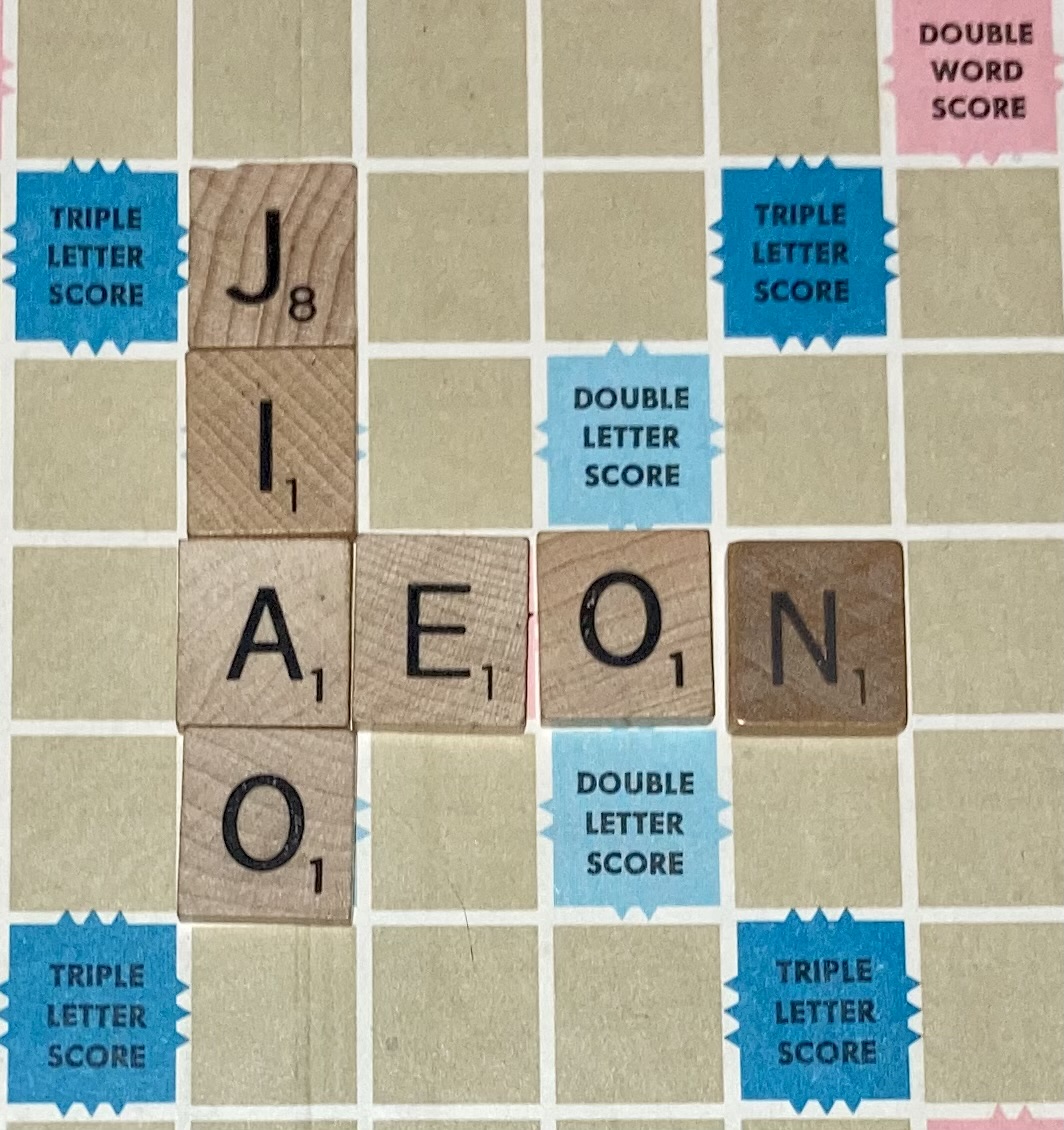
Knowing words with multiple vowels proves useful when you’re faced with a rack of mostly, or all, vowels. Here’s a list of the first twenty-two playable four-letter words with three vowels:
aeon: a long period of time (also eon)
agee: to one side (also ajee)
agio: a surcharge applied when exchanging currency
ague: a sickness associated with malaria
ajee: to one side (also agee)
akee: a tropical tree
alae: wings (pl. of ala)
alee: on the side shielded from wind
amia: a freshwater fish
amoa: a kind of small buffalo
awee: a little while
eaux: waters (pl. of eau)
eide: distinctive appearances of things (pl. of eidos)
emeu: an emu
etui: an ornamental case
euro: an Australian marsupial, also known as wallaroo, for being like the kangaroo and the wallaby; also a unified currency of much of Europe
ilea: the terminal portions of small intestines (pl. of ileum)
ilia: pelvic bones (pl. of ilium)
jiao: a Chinese currency (also chiao)
luau: a large Hawaiian feast
meou: to meow
moue: a pouting expression
Next Up
Wordplay Day! To prepare for class, revisit the Dictionary and World Builder pages on the Scrabble website. Also review this post.
Today’s blog post features my version of the fifth Check, Please! assignment, which you submitted at the beginning of yesterday’s class. Although you have now completed your final Check, Please! worksheet, this model assignment and the previous four will remain useful to you as you continue to hone your information literacy skills.
Next month, you will revisit the Check, Please! course when you and two or three of your classmates plan and deliver a five-minute presentation on one of the lessons.
Check, Please! Lesson Five
In the fifth lesson of the Check, Please!, Starter Course, Mike Caulfield, author of the course and ra esearch scientist at the University of Washington’s Center for an Informed Public, covers the final step in the five-step SIFT approach: “Trace Claims, Quotes, and Media to Their Original Context.” Caulfield outlines the process of locating the original context as an antidote to the issues of accuracy that occur when information passes through intermediaries.
One of the most instructive portions of lesson five features a passage in which Caulfield cites a study of how stories evolve as gossip through the processes of leveling (stripping details), sharpening (adding or emphasizing details), and assimilating, which combines the two. In the process of assimilation “the details that were omitted and the details that were added or emphasized are chosen because they either fit what the speaker thinks is the main theme of the story, or what the speaker thinks the listener will be most interested in.” Similarly, leveling, sharpening, and assimilating all figure in the altered photographs and memes in lesson four. The abbreviated speech of the NRA’s CEO, Wayne LaPierre, which omits commentary, inaccurately indicates a contradiction in his stance on the presence of guns in schools.
The image of photographer Kawika Singson with flames at his feet serves as an example of leveling. Although the flames are real, they were not caused by the heat of the lava flow where Singson stands with his tripod. Instead, to create the image, a friend of his poured accelerant on the lava before Singson stepped into the frame. The deception wasn’t intentional; Singson simply wanted the image for his Facebook cover photo.
Unlike Singson’s photograph, the altered photograph of the Notorious B.I.G. with Kurt Cobain was created with the intent to deceive. Cropping and merging the two photographs illustrates the assimilation process adopted by photoshop users to appeal to music fans eager to think that such fictional meetings of icons took place. Krist Novoselic, who founded Nirvana with Cobain, replied to the is-it-real question with his own fake photo, making the claim that the hand holding the cigarettes was Shakur’s, that he had been cropped from the right.
And thank you to the students who took the opportunity to earn bonus points on their final Check, Please! assignment by commenting on the merits of one of their classmates’ essays: JonCarlos Altamura, Nicole Edelman, Dalton Holbrook (section 19), and Aiden Bazzell (section 20)
Next Up
Wordplay Day! To prepare for class, revisit the Dictionary and World Builder pages on the Scrabble website, and review the blog posts devoted to Scrabble tips.
This morning in class, after I collect your fifth Check, Please! worksheets, you will begin planning and drafting your analysis. You will receive a hard copy of the assignment in class, and I am including an additional copy below.
Directions for Planning and Drafting
Review the texts that you have read for class, and determine which one appeals to you most as a subject of analysis.
Identify two or more elements that contribute to its effectiveness.
Develop your analysis through a close examination of those elements.
Write in dark ink, preferably black. You are welcome to use both sides of the page.
Before you leave class today, staple this handout on top of your draft and submit it to me. Next week I will return your draft with notes, and you will have the class period to begin revising and editing on your laptop or tablet.
Directions for Revising
The revision of your analysis should include the following:
A title that offers a window into your analysis
An introduction that includes a summary of the essay, essay excerpt, chapter, or story
A thesis statement, or main claim, that presents your take on the essay, essay excerpt, or chapter based on your close study of it
Textual evidence that supports your claims
A minimum of one relevant quotation from the text, introduced with a signal phrase and followed by a parenthetical citation
A conclusion that revisits the thesis without restating it verbatim
A work cited entry
A minimum of 600 words
Sample Works Cited Entries
Barthelme, Donald. “The School.” The Best American Short Stories 1975, edited by Martha Foley, Houghton Mifflin, 1975. pp.8-11.
Lewis, Michael. Chapter One: “Back Story.” The Blind Side. 2006. Norton, 2009, pp. 15-23.
Sedaris, David. “Me Talk Pretty One Day.” Me Talk Pretty One Day. Little Brown, 2000. pp. 166-73.
Think of your preliminary draft as your down draft; your aim in the early stage of the process is to get your ideas down on the page. You may need the process of drafting to discover what you think the essay, essay excerpt, or chapter means and how it makes its meaning.
Directions for Formatting and Posting Your Revision—See the Course Calendar for the Due Date and Hard Deadline
Save your revised essay as a Microsoft Word file or PDF and submit it to Blackboard in compliance with MLA manuscript guidelines.
Publish your revision as a blog post. In your post, omit the first-page information included in your file submitted to Blackboard (your name, course, section, instructor’s name, and date). Add to your blog post an image that documents some part of your writing process away from the screen, such as a photo of your reading notes or a page of your draft. Also add to your blog post an embedded link to a relevant website.
Grade Criteria
An A analysis complies with all assignment guidelines, demonstrates a depth of understanding by using relevant and accurate detail, and is also well organized and relatively free of surface errors.
A B analysis complies with all assignment guidelines and presents an adequate analysis but examines little more than what was addressed in class. A B analysis is also well organized and relatively free of surface errors.
A C analysis complies with most but not all assignment guidelines and may also be flawed by issues of organization and/or surface errors, or more consequential factual errors.
A D analysis complies with only a few of the assignment guidelines and may also be flawed by issues of organization and/or surface errors, or more consequential factual errors.
An F analysis fails to comply with most or all assignment guidelines and may also be flawed by substantial issues of organization and/or surface errors, or more consequential factual errors.
MLA Style
Look to my sample assignments on Blackboard as models of MLA style. For more information on MLA style, see the MLA Style Center and OWL sites linked to my blog.
Next Up
Wordplay Day! To prepare for class, revisit the Dictionary and World Builder pages on the Scrabble website, and review the blog posts devoted to Scrabble tips.





 Jane Lucas